
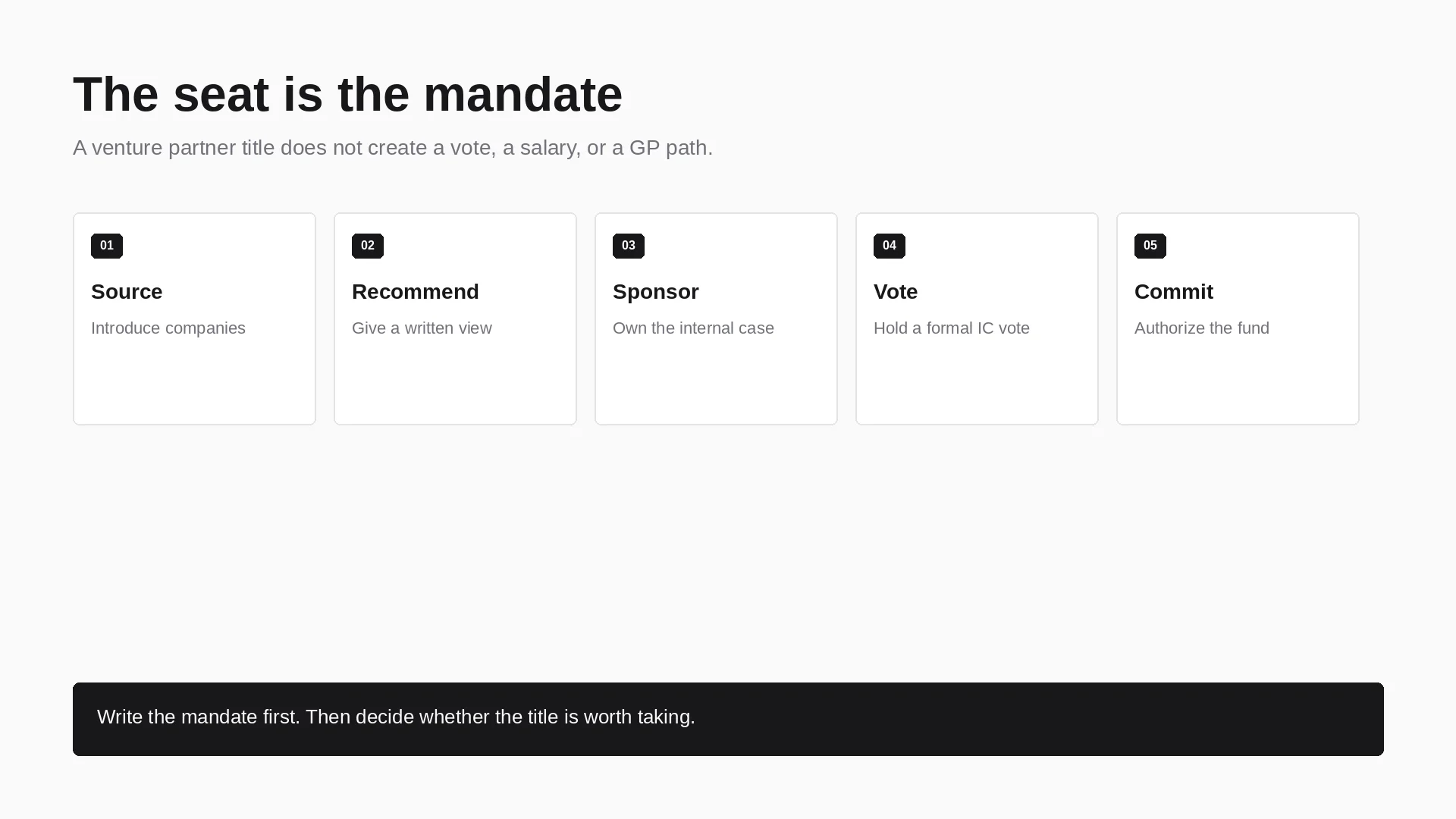
A venture partner is a senior affiliate of a venture capital firm, not a junior employee waiting to be promoted into the partnership. The firm borrows your founder access, sector judgment, or operating credibility for sourcing, diligence, boards, or portfolio work. You are usually paid with some mix of a retainer, deal-linked economics, and carry rather than a full general partner package. The title does not, by itself, give you a vote, a salary, or a path to owning the management company.
If you want a salaried investing seat, start with how to get a job in venture capital. If you already have dense access to founders or a track record operators trust, a venture partner arrangement can be a clean way to work with a fund without joining as a full-time GP.
What a venture partner actually does
The useful default is simple. A general partner is accountable for the fund. A venture partner is accountable for a defined slice of work.
That slice is usually one or more of:
- Bringing thesis-fit companies the core team would not otherwise see
- Diligence in a sector, geography, or technical domain the partnership cannot cover alone
- Opening founder or customer access that helps the firm win a competitive deal
- Sitting on a board or advising a portfolio company where you have relevant scars
- Making LP or co-investor introductions when the firm is raising or syndicating
What you usually do not do, unless the agreement says so in writing:
- Commit the fund
- Vote on every deal
- Own LP relationships for the whole partnership
- Run the firm
Titles are noisy. Some firms call almost everyone a partner on the website. Some use "venture partner" as a prestige label for a loosely defined advisor. The work test is better than the biography test: what do you source, decide, and support every month?
Five common venture partner seats
"Venture partner" is a family of arrangements, not one job description. Name the seat before you chase the title.
| Seat | Recurring output | Typical authority | Best when |
|---|---|---|---|
| Sourcing partner | Qualified companies from a community you already reach | Recommend, sometimes sponsor | You have dense founder access in a niche the fund cannot cover |
| Board partner | Governance and high-stakes advice on selected companies | Strong influence after investment; limited new-deal vote | You have board experience founders will actually use |
| Fundraising partner | LP or later-stage investor access for the fund or a portfolio company | Influence, not fund control | You have real allocator relationships, not a contact export |
| Business development partner | Customer, talent, or partnership intros that change a company's trajectory | Portfolio influence | You can open doors that a generalist partner cannot |
| Operating-labeled venture partner | Hands-on help with hiring, GTM, product, or finance | Support mandate; often little investment vote | Your edge is execution, and the firm is using the wrong title |
The last row is common and confusing. If the work is portfolio execution, you may actually be looking at an operating partner seat. If the work is sourcing with a small check, you may be looking at a scout arrangement. Do not let a senior-sounding title hide a different job.
Venture partner vs GP, operating partner, scout, and EIR
These roles sit next to each other on firm websites and get used as if they were interchangeable. They are not.
| Role | Primary job | Usual time | Usual economics pattern | Path signal |
|---|---|---|---|---|
| Venture partner | Expand investing reach or specialist coverage | Fractional, fund-specific, or full-time | Retainer plus deal or fund carry | Senior affiliation; GP path only if written |
| General partner | Fund performance, IC, LPs, firm building | Durable full-time | Broader carry, often GP commit, sometimes management-company ownership | Actual partnership |
| Operating partner | Repeatable portfolio execution | Employee or advisor | Salary or retainer plus carry | Operator mandate, not a sourcing title |
| Scout | External or part-time sourcing | Side arrangement | Deal-linked carry or fee | Proof of taste and access, not a partner seat |
| Entrepreneur in residence | Time-boxed embed, often while exploring a company | Months, not a career title | Stipend plus optionality | Temporary, not a substitute GP role |
For the title comparison in depth, use venture partner vs general partner. For the work-loop comparison, use venture partner vs operating partner. How people actually land a venture partner seat, and when they should walk, is a different question from how the titles compare.
How venture partners get paid
Do not reverse-engineer a salary from the word "partner."
Common pieces:
- Retainer or salary. More likely when the firm wants ongoing coverage, boards, or a minimum weekly commitment. Less likely when the relationship is purely deal-linked.
- Deal-linked carry. A slice of profits on companies you source, sponsor, or support. The percentage is meaningless without the base, vesting, forfeiture, and attribution rule.
- Fund carry. Broader than a single deal, still not the same as GP economics unless successor funds, vesting, and pool definition are written down.
- Company equity. Sometimes, when you take a board or operating role. It can conflict with fund incentives. Get the conflict policy in writing.
- GP commit. Often absent. If it is required, treat it as a cash and liquidity question, not a badge of honor.
Carry is a long-duration, contingent interest. Read the carried interest explainer for the vocabulary, then have qualified legal and tax advisers read the actual documents. A title that pays only if one attributed company exits in seven to twelve years is an upside bet, not a living.
The negotiation that matters is rarely the headline percentage. It is attribution, vesting, what happens when you leave, and whether the economics continue into the next fund.
Who actually gets hired
Funds do not hire venture partners the way they hire analysts. There is no campus process and no standard pipeline.
The backgrounds that show up repeatedly:
- Founders who have raised, built, and earned trust with other founders
- Operators with a functional edge in a sector the fund is trying to cover
- Angels or scouts with attributable intros, not a vague "I know a lot of people"
- Former investors who want a narrower mandate than a GP seat
- Specialists whose network is the product: a technical community, a geography, a buyer set
A startup operator path can lead here. So can a founder path. An analyst-to-associate ladder usually does not dump you into this title. If you are early-career and want investing reps, look at salaried roles, fellowships, or scouting first. For the broader ladder, use the venture capital career path.
The hiring filter is evidence of access plus judgment. A famous former title without a current network is a weak case. A quieter operator who can name ten founders who take their call, and two companies they would underwrite, is a stronger one.
How to get the seat
Most durable venture partner seats are not filled from a job board. They are created when a partner already trusts your judgment and wants a formal way to keep using it.
A sequence that works more often than a cold "can I be your venture partner?" email:
- Pick one community, sector, or geography you already reach better than a generalist partner can.
- Choose two or three funds whose actual portfolio matches that community. Use the companies directory, then test the website thesis against recent investments.
- Send a short, useful company note or a sector observation. Two tight paragraphs beat a biography.
- Repeat until a partner can describe your edge without looking at your LinkedIn.
- Only then ask whether a formal affiliation exists: scout, advisor, board help, or venture partner.
Warm introductions from portfolio founders still beat most cold outreach. If a posting exists, treat it as a filter. Show the mandate you can cover, not a generic desire to "be in VC."
When you do have the conversation, ask for the work, not the title:
- What problem was this seat created to solve?
- Who consumes my output each month?
- What can I decide without another partner?
- How is attribution recorded?
- What does the first year look like if no deal closes?
Employers writing a partner posting should use the venture capital partner job description. Candidates should not confuse that hiring template with this affiliation path.
Proof to ship before you ask for the title
Funds do not need another person who "loves startups." They need a repeatable engine they can explain to the rest of the partnership.
Build a proof packet before you ask for a title:
- Access map. Who you can actually reach, why those founders trust you, and what you will not pretend to cover
- Thesis page. The change you underwrite, the company profile that fits, and the profile you pass
- Two investment cases. One you would meet, one you would pass, both dated, both argued fairly
- Attribution log. Intros you have already made, what happened, and what you learned
- Time budget. Hours per week, exclusivity you can accept, and conflicts you already have
- Mandate memo. In your words: customer, outputs, authority, economics, review date
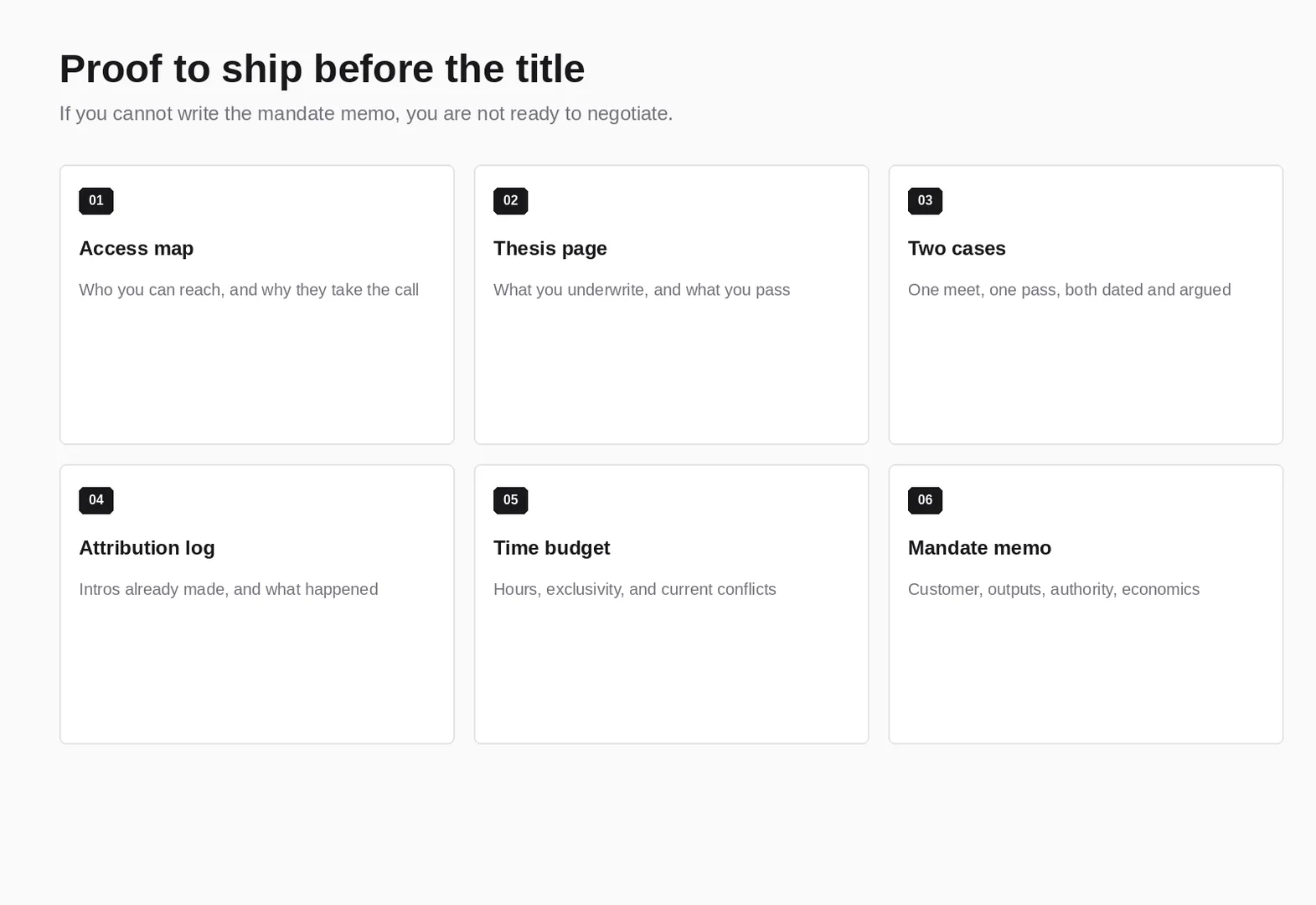
If you cannot write the mandate memo, you are not ready to negotiate. If the firm will not correct a material inaccuracy in that memo, the ambiguity is part of the offer.
When the title is a trap
A venture partner title can be an excellent senior role. It can also be unpaid sourcing with a nicer business card.
Walk, or renegotiate, when:
- "Path to GP" has no decision date, criteria, or precedent at the firm
- You are expected to produce GP-level work with advisor-level economics
- Attribution is informal and controlled by one person
- Exclusivity is full-time and pay is deal-linked only
- The firm cannot name the primary customer of the role
- Successor-fund economics reset at a GP's sole discretion
- You are asked to speak as if you can commit capital
Time served is rarely enough to become a GP. A credible case usually needs attributable judgment, founder trust, and evidence the partnership already treats you as a decision-maker. If that is the real goal, diligence the GP path using the comparison page, then decide whether this seat is a trial or a substitute.
If you want a salaried investing job instead, browse open VC roles and research firms in the companies directory. Use job alerts so you see new seats while you keep shipping proof.
Frequently asked questions
Is a venture partner the same as a general partner?
Usually not. A venture partner commonly has a narrower sourcing, specialist, deal, or portfolio mandate. A GP is usually accountable for the fund and the firm. A venture partner can still lead deals, vote, receive carry, or work full-time, so verify the actual structure.
Can a venture partner become a GP?
Yes, but the title does not create the path. Look for written milestones, a decision maker and date, precedent at the firm, expanding investment authority, and documented economics that continue into later funds.
Do I need to be a former founder?
No. Founders are common because they have founder trust and operating pattern recognition. Operators, angels, specialists, and former investors also get hired when they can show access plus judgment. A famous exit without a current network is a weak case.
Do venture partners get a salary?
Sometimes. Many arrangements are retainer plus carry, or carry only. Treat cash, carry base, vesting, and time expectation as one package. Do not assume GP-like W-2 pay because the word "partner" appears on a website.
Is this a good path if I am trying to break into VC from undergrad or as an analyst?
Usually no. This is a senior affiliation. Early-career candidates should look at internships, fellowships, scout programs, and salaried analyst or associate seats. Use how to become a venture capitalist for the broader entry map.
Can I be a venture partner at more than one firm?
Sometimes. Project-based seats can stack. Other firms want exclusivity, conflict clearance, and a cap on outside funds. Ask before you assume you can collect titles.
Where do I find venture partner jobs?
A few seats are posted. More are created after a partner already uses your judgment. Watch the job board, check firm sites, and keep sending useful work. Do not wait for a posting if you already have a relationship that is doing the job without a contract.
Related posts
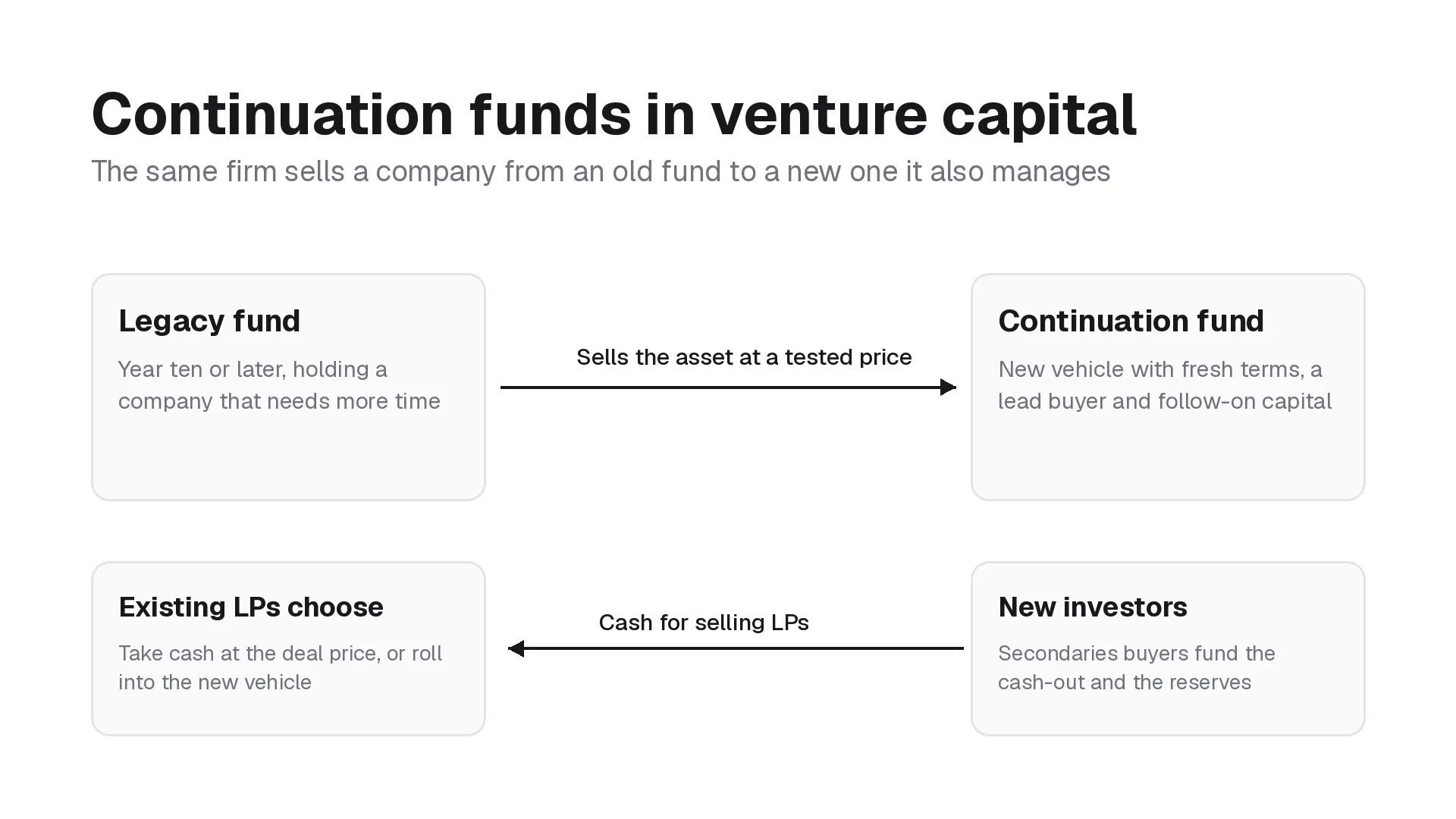
A continuation fund lets a VC firm sell a company from an old fund to a new vehicle it also manages, while LPs choose cash or a roll. Here is how the deal works, how price, fees and carry are set, and what it changes for people who work at the firm.
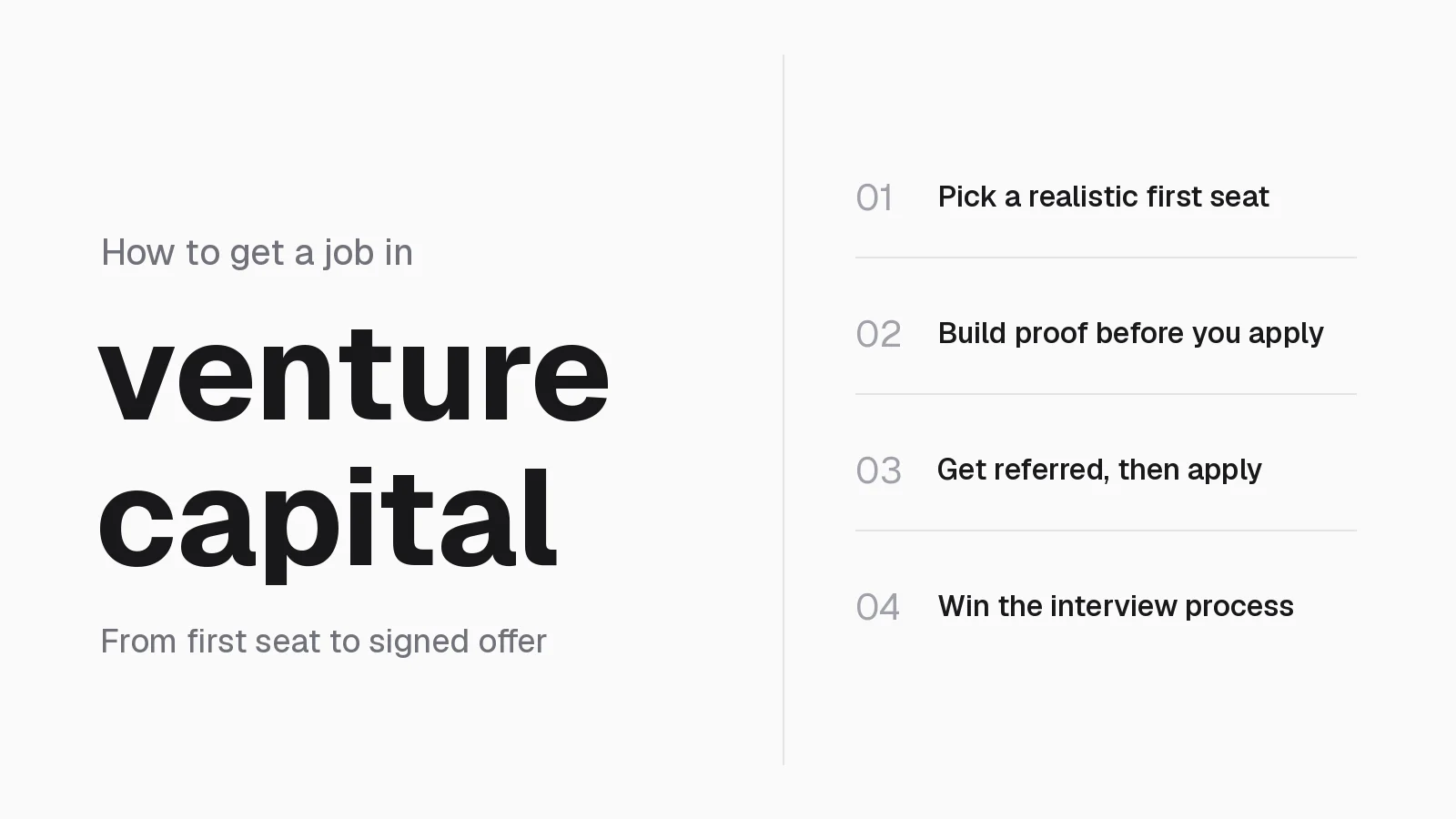
How to get a job in venture capital: which seats exist, the first seat that fits your background, proof to build, where VC jobs come from, how to screen a posting, the recruiting process from screen to offer, pay, and what to ask before accepting.
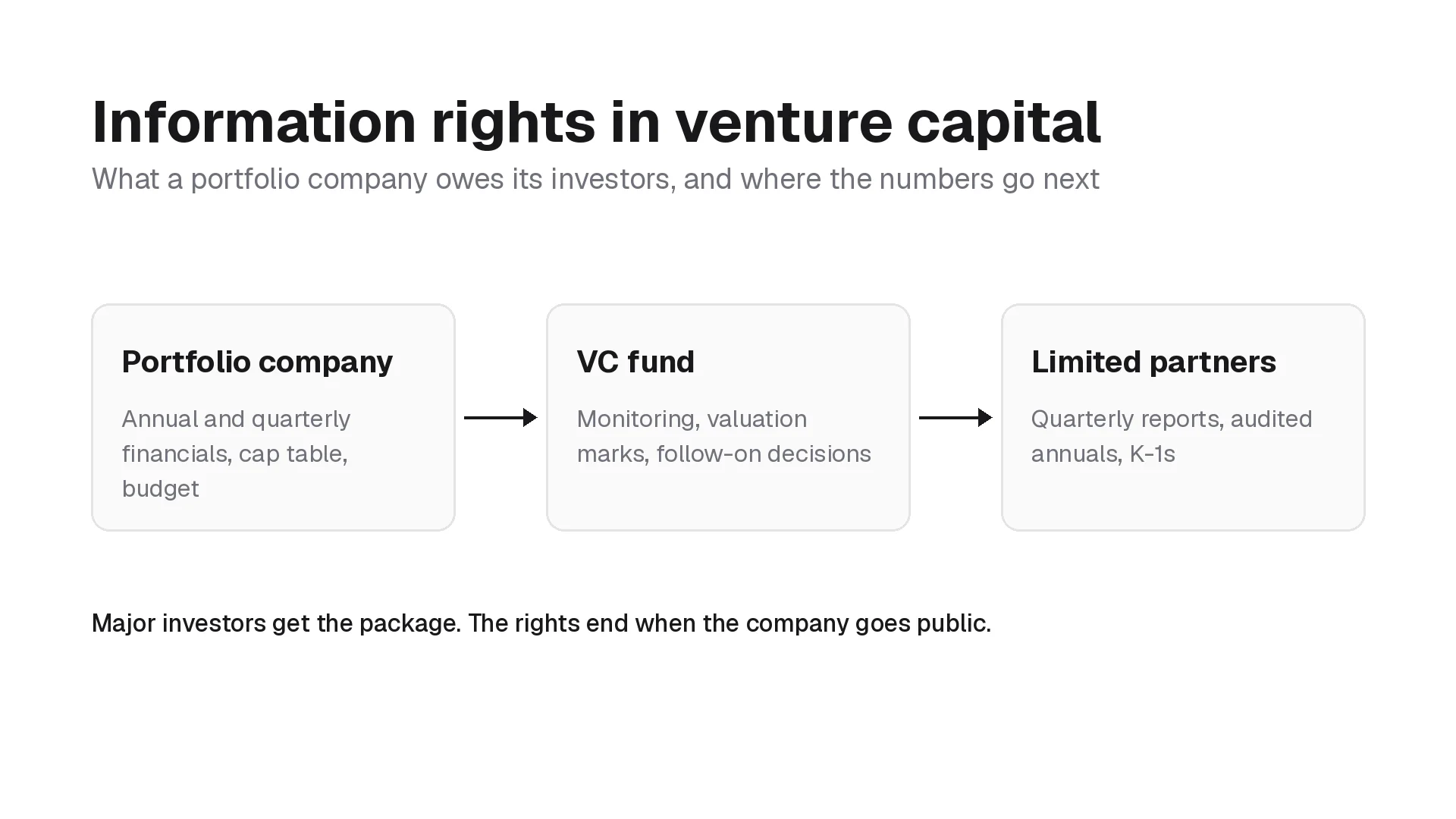
Information rights oblige a venture-backed company to send major investors annual and quarterly financials, a cap table and its budget. Here are the standard deadlines, who qualifies, how the rights end, and how analysts, fund finance and IR teams use the data.