
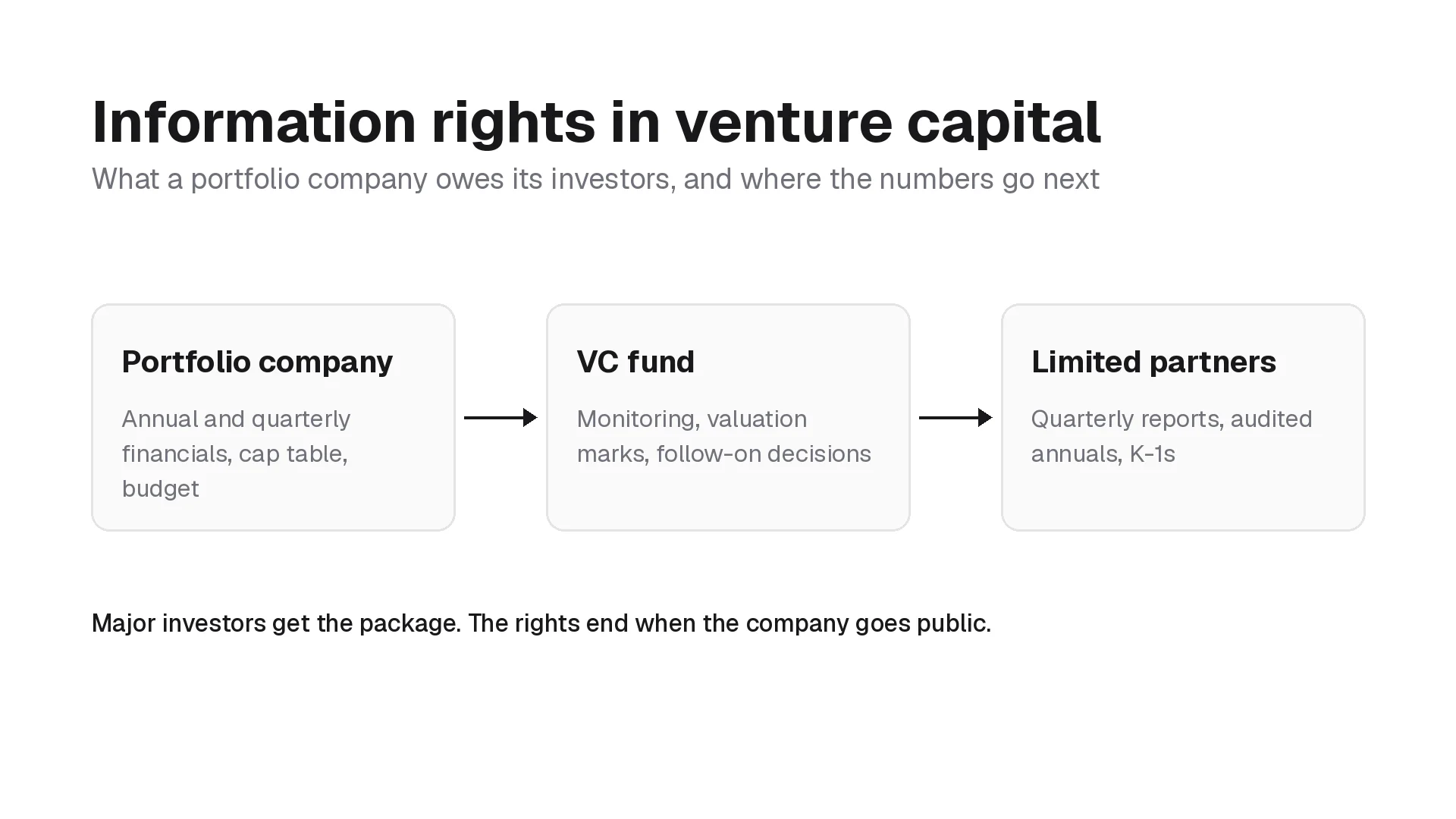
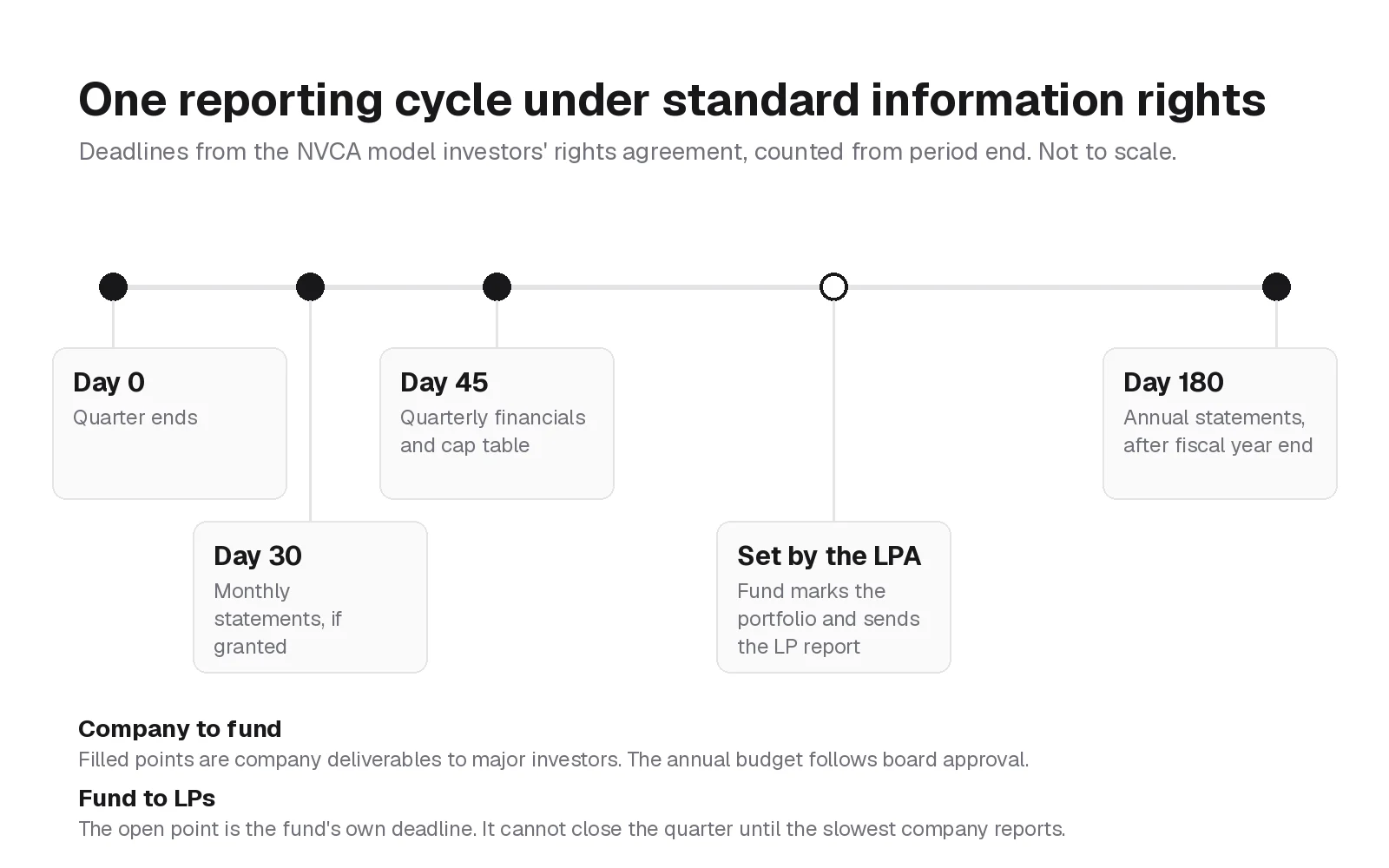
Information rights are the contract terms that oblige a venture-backed company to send its larger investors financial reports on a fixed schedule. In a US priced round they sit in the investors' rights agreement, and the National Venture Capital Association's model sets the usual baseline. Annual financial statements arrive within 180 days of year end. Quarterly statements and a cap table summary arrive within 45 days of each quarter. The board-approved budget follows each year, and monthly statements within 30 days are a common add. The rights usually go to "major investors" above a negotiated share count, and they end when the company goes public.
For people who work at a VC firm, those packages are raw material. Analysts and associates read them to track runway and spot problems. Fund finance teams use them to value the portfolio. Investor relations turns the results into the quarterly reports limited partners receive. When an interviewer asks about information rights, the question is usually about whether you know where portfolio data comes from and what a fund can do with it.
What information rights are in venture capital
An information right is a promise by the company, not a power the investor holds by default. It starts as a line in the term sheet, gets drafted in full in the investors' rights agreement, and binds the company for as long as the agreement says. The same agreement usually carries registration rights, the right of first offer on new shares, and post-closing covenants, which is why lawyers call it the IRA.
Three things make information rights different from other investor protections:
- They give an investor data, not a vote. Protective provisions let preferred holders block actions. Information rights only let them see what happened.
- They are tiered. Most packages go to major investors, so a small check can buy shares without buying visibility.
- They depend on the instrument. A SAFE or convertible note usually carries no information rights of its own, so seed investors who want reports ask for them in a side letter. Until the note or SAFE converts into preferred stock, that letter is the only contract right the investor has to see the numbers.
What investors receive under standard information rights
The NVCA model investors' rights agreement, updated in October 2025, is the closest thing to a US default. Most lawyers start from it and negotiate the bracketed options. Section 3.1 lists the deliverables.
| Deliverable | Deadline in the NVCA model | What it contains | Notes |
|---|---|---|---|
| Annual financial statements | Within 180 days of fiscal year end | Balance sheet, income and cash flow statements, statement of stockholders' equity, under GAAP | An audit by an independent accountant is a bracketed option, so early companies often deliver unaudited annuals |
| Quarterly financial statements | Within 45 days of quarter end | Unaudited income and cash flow statements and balance sheet | May omit footnotes and year-end audit adjustments |
| Capitalization statement | Within 45 days of quarter end | Shares of each class and series, convertibles, options issued and reserved | Must be detailed enough for each major investor to calculate its ownership percentage |
| Monthly financial statements | Within 30 days of month end | Unaudited income statement and balance sheet | Optional bracket. Common for lead investors in early rounds |
| Approved annual budget | As soon as practicable after board approval | Next year's monthly plan with balance sheets, income and cash flow statements | The model has the company prepare it at least 30 days before year end |
Two newer details are worth knowing. A major investor can ask the company to upload the package to a portfolio management platform instead of emailing PDFs, which matters for firms that run portfolio data through software. The company can also pause delivery 30 to 60 days before it expects to file a registration statement for an IPO, because SEC rules limit what it can share during that window.
Key performance metrics such as ARR, burn, churn or headcount are not part of the model deliverables. Investors who want them negotiate a KPI schedule or rely on board materials and monthly founder updates. In practice most of the operating data an associate reads comes through those informal channels, while the contract guarantees the audited and GAAP numbers.
Major investors and the threshold for information rights
The IRA defines a major investor as any investor that, together with its affiliates, holds at least a set number of registrable shares. The number is blank in the model and negotiated each round. It is a share count rather than a dollar amount, and it is adjusted for splits, so a threshold that sounded generous at the seed can look high later.
Aggregation with affiliates matters for VC firms. The model's affiliate definition includes any fund that shares the same general partner, management company or adviser, so a firm that invests through a main fund and an opportunity fund can combine both holdings to clear the threshold.
The threshold resets when a new round brings a new IRA. A small early investor can fall below it. Here is an illustrative case.
| Seed IRA | Series A IRA | |
|---|---|---|
| Major investor threshold | 250,000 shares | 1,000,000 shares |
| Seed fund holding | 400,000 shares | 400,000 shares plus 150,000 bought in the A |
| Major investor? | Yes | No, unless the Series A documents grandfather existing holders |
| What the seed fund still gets | Full package | Whatever the company chooses to send, plus any side letter rights |
That last row is where seed funds lose visibility. The fix is to negotiate it at the A, either with a carve-out that keeps prior major investors in the definition or with a side letter. Founders sometimes agree because it costs them little. Others refuse because each extra recipient adds to their reporting load.
The model also lets the company exclude any major investor that is a "competitor." The definition carves out financial investors that hold less than 20% of a competing company and have no right to name its directors. That carve-out exists so that a fund with a stake in a rival does not lose its rights.
Inspection, observer and management rights compared
Information rights are one of several access rights a VC can hold. They are easy to mix up in a term sheet, so it helps to see them side by side.
| Right | What it gives the investor | Where it usually lives | Typical holder |
|---|---|---|---|
| Information rights | Scheduled financial statements, cap table, budget | IRA Section 3.1 | Major investors |
| Inspection rights | Visits, a look at books and records, conversations with officers during business hours, at the investor's expense | IRA Section 3.2 | Major investors |
| Board observer rights | Attendance at board meetings without a vote, plus board materials | IRA optional section or a separate letter | Named investors without a board seat |
| Management rights | Consultation with management and access to records, mainly to support the fund's ERISA position | Management rights letter | VC funds that need venture capital operating company status |
| Board seat | A vote, all board materials, fiduciary duties | Voting agreement and charter | Lead investors |
Inspection rights have limits that founders rely on. Under the model, the company does not have to create new information for an inspecting investor, and it can withhold trade secrets or material that would waive attorney-client privilege. Board observers get the board deck itself, which usually contains far more operating detail than the quarterly financial package. Management rights letters are covered in our side letter guide.
Confidentiality, competitors and when the rights end
Every investor that signs the IRA agrees to keep company information confidential and use it only to monitor or make decisions about its investment. The model then lists who the investor may still share it with:
- Its lawyers, accountants and other advisers, where needed to monitor the investment.
- A prospective buyer of its shares, if the buyer agrees to the same confidentiality terms.
- Its affiliates, partners, members and stockholders in the ordinary course of business, as long as it tells them the information is confidential.
- Anyone a law, court order or subpoena requires, with prompt notice to the company.
The third item is what lets a VC fund report on a portfolio company to its own limited partners. Without that carve-out, the confidentiality clause would reach the fund's own LP letters. It is also why LP reports describe portfolio companies in summary rather than forwarding the packages.
The obligations to deliver financials and allow inspection end at the earliest of these events in the model:
- Just before an IPO or direct listing.
- When the company becomes subject to SEC periodic reporting under the Exchange Act.
- Optionally, at a sale of the company, if investors receive cash or public stock or get comparable reports from the buyer.
They are also suspended for any investor that becomes a sanctioned party. After an IPO, investors read the same public filings as everyone else.
Contractual information rights versus statutory rights
Contract rights are not the only route to company information. Under Section 220 of the Delaware General Corporation Law, any stockholder can make a written demand under oath, for a purpose reasonably related to its interest as a stockholder, to inspect a defined list of books and records. The list includes the charter and bylaws, board and committee minutes, materials given to the board for actions it took, and three years of annual financial statements.
| Contractual information rights | Section 220 inspection | |
|---|---|---|
| Who has it | Investors named in the IRA, usually major investors | Any stockholder, including common holders |
| How it works | Company delivers on a schedule | Stockholder sends a sworn demand and must show a proper purpose |
| What you get | Quarterly and annual financials, cap table, budget, optional monthlies | A defined list of records |
| Typical use | Routine monitoring | Disputes and investigations |
The NVCA model goes a step further. Each investor waives its Section 220 rights as a stockholder until the IPO, while keeping the contract rights in the IRA. Founders like this because it stops minority investors from using statutory demands as leverage. Investors accept it because the contract package is better for monitoring anyway.
Outside the US the baseline differs. UK companies follow the Companies Act and UK model documents, and some continental European regimes require equal treatment of shareholders, which can limit how much a company may give one investor that it does not give the rest.
How founders and investors negotiate information rights
Information rights are rarely the hardest term in a deal. Most of the negotiation is about who gets them, how often, and how much extra work the company signs up for.
| Founders usually ask for | Investors usually ask for |
|---|---|
| Rights limited to major investors | A threshold low enough to cover their position after later rounds |
| Quarterly and annual only | Monthly statements and a KPI schedule |
| Unaudited annuals until the company is larger | Audited annuals once revenue justifies the cost |
| A broad competitor exclusion | The financial investor carve-out from the competitor definition |
| One schedule and one package for every holder | Delivery through their portfolio platform |
The best founder move is simple. Put every investor who gets information rights on the same schedule. A company that promises monthly reports to its seed investors and quarterly reports to its Series A investors ends up running two reporting processes for years.
The best investor move is to think one round ahead. A fund that plans to keep its pro rata through the Series B should make sure the major investor definition and any grandfathering survive the next IRA. The model also has an optional clause that strips major investor status for pro rata purposes from any investor that fails to buy its full allocation, so passing on one round can cost more than the shares.
Information rights between a VC fund and its LPs
The same idea runs one level up. A VC fund's limited partnership agreement gives its LPs their own information rights. The usual package includes quarterly reports with capital account statements, contributions, distributions, unfunded commitments, fees and expenses, and a schedule of investments at cost and fair value. Annual audited financial statements follow, commonly due somewhere between 90 and 180 days after year end, along with Schedule K-1s for tax. Larger LPs add more through side letters, such as fee and expense templates or ESG data.
The two layers are linked. A fund cannot close its quarter until its portfolio companies send their numbers, so the fund's reporting runs on the slowest company. One late package can hold up the valuation file, the audit and the LP letter. If you want the vocabulary for the LP side, our guide to limited partners and general partners covers the roles, and fund performance metrics covers what LPs read in those reports.
How information rights shape work inside a VC firm
Most of the people who handle information rights day to day are not the partners who negotiated them. Here is where the data goes inside a typical firm.
| Role | What they do with information rights data | Skills it tests |
|---|---|---|
| Analyst or associate | Reads monthly and quarterly packages, updates portfolio tracking, flags runway and missed plan, drafts follow-on memos | Reading financial statements, spotting trends, writing short updates |
| Principal or partner with a board seat | Gets board materials through the seat and decides what to share across the firm | Judgment on confidentiality and what matters |
| Platform or portfolio operations | Collects KPI templates, chases late packages, runs the portfolio data platform | Process, follow-up, data hygiene |
| Fund finance, controller or CFO | Uses company financials to set fair value marks, supports the audit, updates capital accounts | Valuation, accounting, deadlines |
| Investor relations | Turns marks and company news into quarterly LP letters and answers LP data requests | Writing, precision, confidentiality |
| Legal or compliance | Applies confidentiality terms, competitor rules and material nonpublic information controls | Contract reading, risk calls |
If you are early in your career, the associate row is the one that will fill your quarter. Portfolio reviews, follow-on decisions and partner meeting prep all lean on these packages. Our associate job description and portfolio review guide show how that work fits the rest of the job, and fund accounting and fund operations cover the finance side.
Information rights also tell you something about a firm before you join. A fund that leads rounds and holds major investor rights across the portfolio has clean data and a steady reporting rhythm. A fund that writes small checks into many rounds may sit below the threshold in much of its portfolio, which means more chasing founders for updates and thinner data for marks. Questions worth asking in an interview:
- How does the firm collect portfolio company data, and who owns that process?
- In how many portfolio companies is the fund a major investor or on the board?
- How long after quarter end does the LP report go out, and what usually holds it up?
How to answer an information rights question in an interview
A strong answer is short and specific. For example:
"Information rights are the company's contractual obligation, usually in the investors' rights agreement, to send major investors annual and quarterly financials, a cap table and the budget. In the NVCA model that is 180 days for annuals and 45 days for quarterlies, and the rights end at the IPO. They matter to a fund beyond monitoring. The fund needs those numbers to mark the portfolio and report to its LPs, so if we write a small check below the major investor threshold I would want a side letter or a board observer seat to keep the data coming."
That answer shows you know the document, the deadlines and why a fund cares. It also ties the term to a decision you could make as a junior investor, which is what interviewers listen for.
Frequently asked questions
Are information rights in the term sheet or the IRA?
Both. The term sheet summarises who gets information rights and how often. The investors' rights agreement contains the binding language, deadlines, confidentiality terms and termination events.
Do SAFE investors get information rights?
Not by default. A standard SAFE does not include them, so seed investors who want reports negotiate a side letter. Once the SAFE converts into preferred stock, the holder may qualify under the new IRA if it clears the major investor threshold.
What is a major investor in venture capital?
It is the investor class that receives information rights, inspection rights and often the right of first offer. The IRA defines it as holders of at least a negotiated number of shares, counted together with affiliates.
Can a company stop sending information to investors?
Only on the terms in the IRA. The model allows a pause before an IPO filing and ends the obligations at the IPO, when the company becomes an SEC reporting company, or, if the parties choose, at a qualifying sale. It can also withhold material from an investor it treats as a competitor.
What happens if a company misses an information rights deadline?
Late delivery breaches the IRA, but investors seldom go to court over it. They raise it with the CEO or the board, and repeated misses become a governance concern when the next round or follow-on decision comes up.
Next steps
Information rights sit next to the other investor terms in term sheets, pro rata rights and protective provisions. If an interview is coming up, practise with our venture capital interview questions.
If you want to work on the investing, platform or fund finance side, browse venture capital firms, see open VC roles, or create a free account to get new jobs as they post.
Related posts
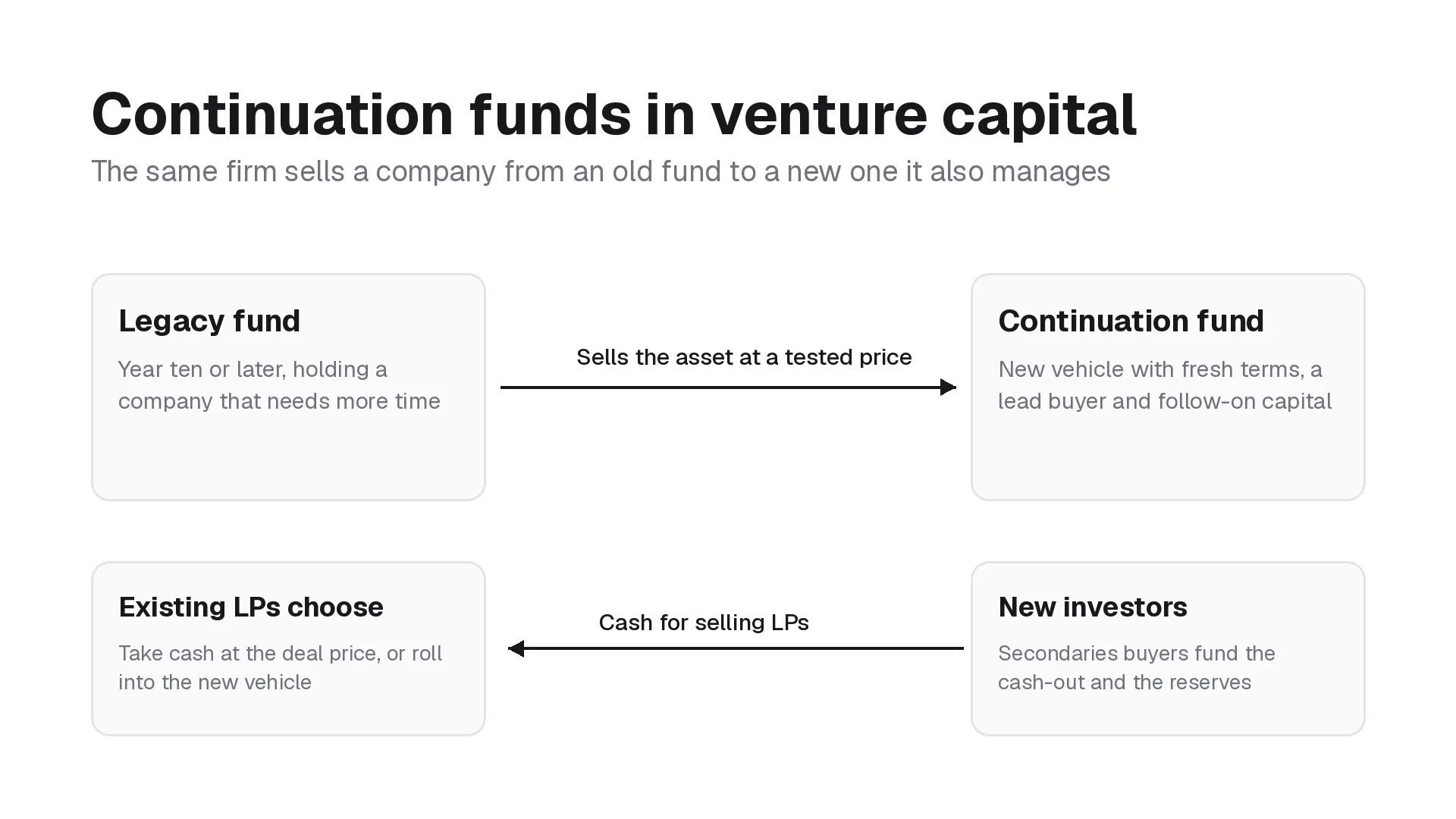
A continuation fund lets a VC firm sell a company from an old fund to a new vehicle it also manages, while LPs choose cash or a roll. Here is how the deal works, how price, fees and carry are set, and what it changes for people who work at the firm.
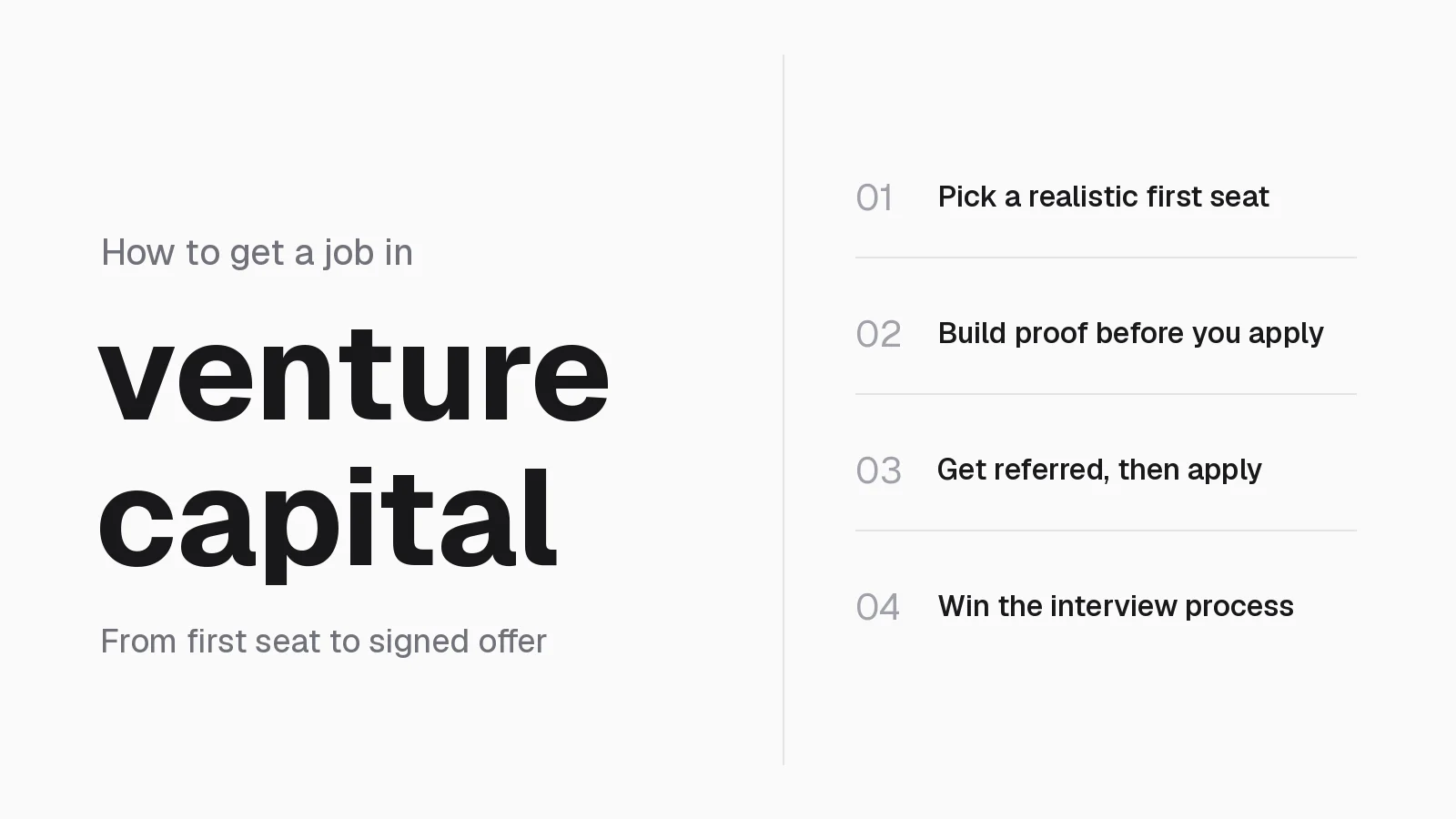
How to get a job in venture capital: which seats exist, the first seat that fits your background, proof to build, where VC jobs come from, how to screen a posting, the recruiting process from screen to offer, pay, and what to ask before accepting.
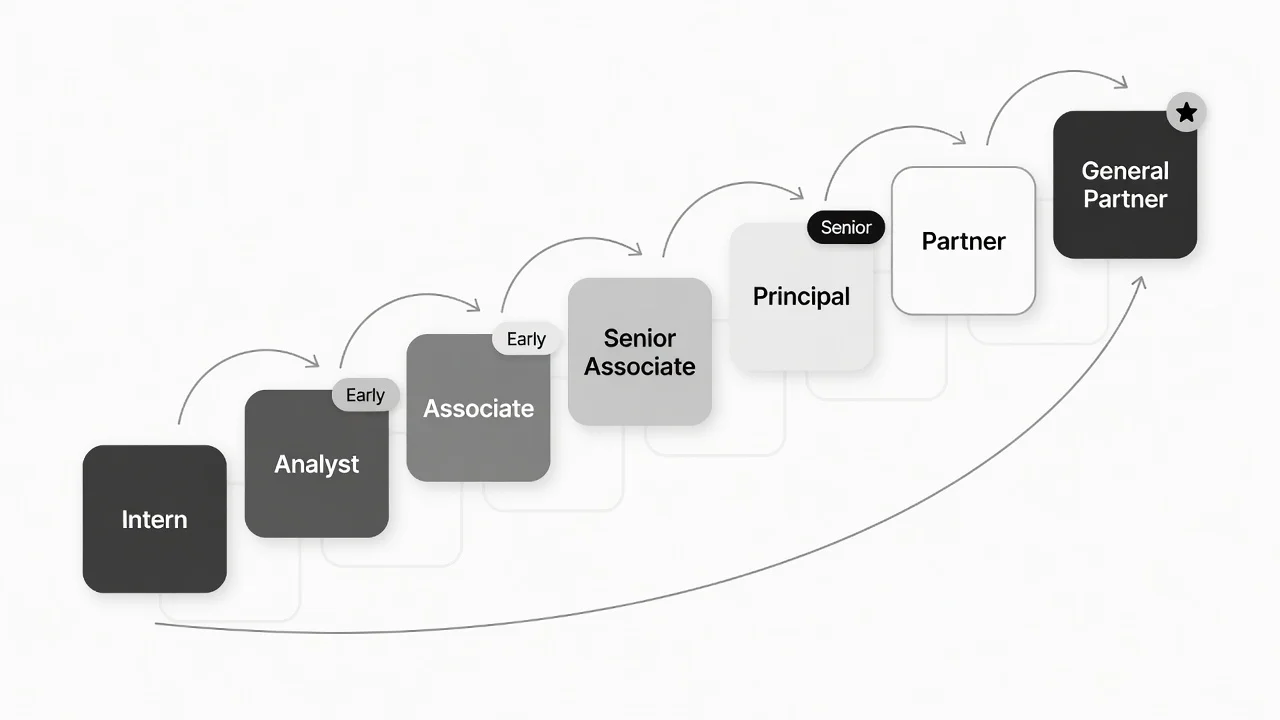
The VC career ladder from analyst to general partner, with typical years in each seat, the evidence that earns promotion, non-investing roles, decision points at years 2, 5, and 9, pay by level, and the own-fund path.