
A software engineer can move into venture capital. The move works when you turn product and systems judgment into evidence that you can source companies, form a market view, write a clear recommendation, and earn founder trust. Coding skill alone rarely closes the gap.
Funds hire engineers because some categories are hard to underwrite without technical depth. They still hire investors. Your search has to show that you can do investment work, not only that you can ship software.
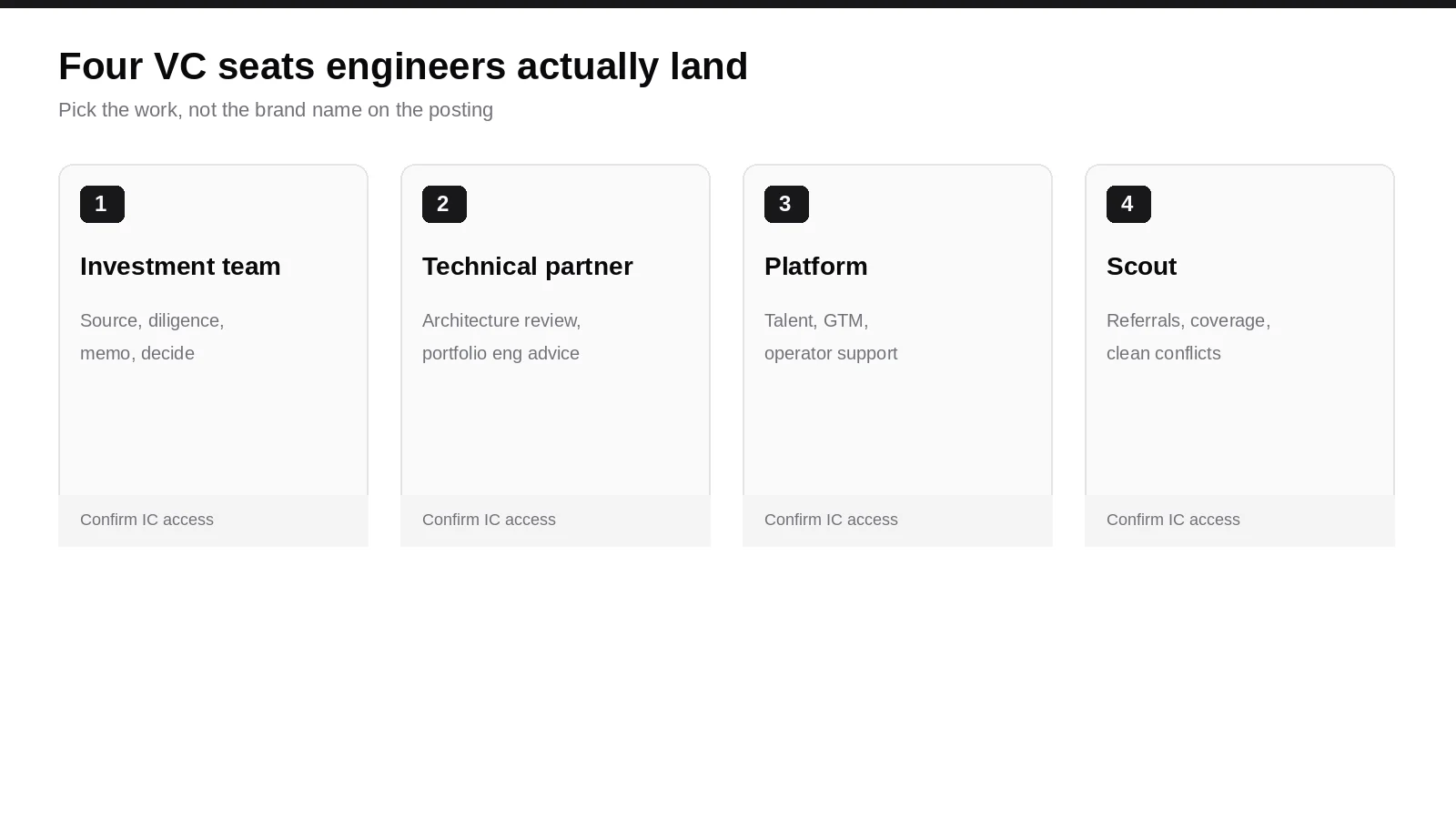
Decide which venture capital seat you want
"Working in venture" covers several jobs. Mixing them up produces a confused résumé and a worse interview story.
| Seat | Core work | Where engineering helps | What you must prove |
|---|---|---|---|
| Investment team | Sourcing, diligence, memos, investment decisions, light portfolio support | Technical diligence, product realism, founder empathy from building | Deal judgment, market reasoning, sourcing access, concise writing |
| Technical partner / venture engineer | Deep technical diligence, architecture review, portfolio eng advice, sometimes sourcing | Direct systems and codebase judgment | Clear recommendations under uncertainty; commercial restraint |
| Platform or talent / GTM support | Hiring help, community, go-to-market, operator support | Credibility with technical founders and teams | Repeatable support model; not automatic IC access |
| Scout | Referrals, thematic coverage, occasional checks | Domain network inside engineering communities | Consistent sourcing quality and clean conflict handling |
There is a fifth listing that hijacks this search: software engineer roles at portfolio companies, or "engineer at a VC-backed startup," that are not fund jobs. If the posting describes sprints, on-call, and a product roadmap with no mention of sourcing, memos, or investment committee work, it is an operating role. Treat it as a startup job, not a venture capital transition.
If you want to choose investments, say so and target investment seats. A technical partner or platform role can be excellent work. It is not automatically a bridge to the partnership. Ask how success is measured, whether the seat joins diligence and IC, and what happened to the last person in the role.
Early-stage funds that underwrite developer tools, infrastructure, security, AI systems, or deep tech are usually a cleaner fit than late-stage funds that live in growth metrics and financing process. Match your depth to the fund's actual portfolio, not to "tech VC" as a vibe.
Translate engineering skills into investment evidence
Engineering habits transfer when you rename them as investment work.
| Engineering experience | Investment application | Evidence to build |
|---|---|---|
| System design reviews | Spotting technical risk, scalability limits, and rewrite traps | Written technical diligence note with a clear invest / dig deeper / pass |
| Debugging and incident response | Separating fatal risks from noise | Diligence plan with decision thresholds |
| Shipping under constraints | Reading execution risk and team quality | Post-mortem that connects operating lessons to investment judgment |
| Open source or community work | Sourcing and founder access | Sourced company list with why each deserves a first meeting |
| Product sense from customer bugs | Testing whether a painful problem and buyer exist | Interview notes synthesised into a market view |
| Performance and cost intuition | Unit economics and infrastructure cost realism | Short teardown of what the metrics do and do not prove |
Name the gaps early. Most engineers have not built a repeatable sourcing network, modelled ownership and dilution, written an investment memo, or made decisions inside a fund's reserve and ownership model. Courses help with vocabulary. Work samples close the gap.
The behavioural shift matters as much as the skill map. In engineering, you optimise a system toward a known output. In early-stage investing, you make a few high-conviction bets with incomplete information and live with long feedback loops. If you need tickets closed every sprint to feel effective, you will hate junior investing even if you love startups.
Build an engineer-specific proof-of-work portfolio
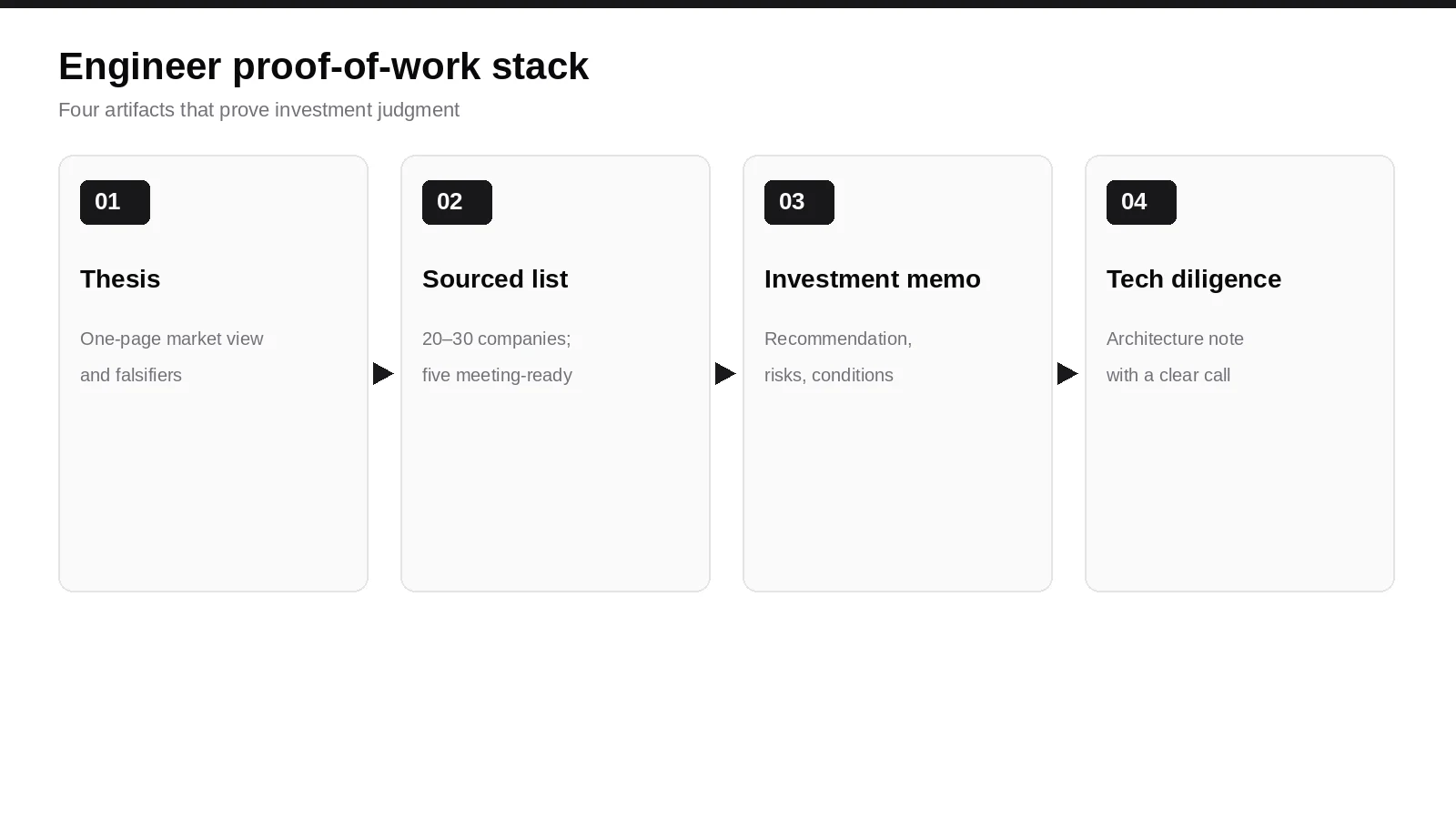
Four artifacts are enough if each is real.
- A one-page thesis. Define a narrow market, the change creating opportunity, what a winning company looks like, and what would disprove the thesis.
- A sourced company list. Identify 20–30 relevant startups and explain why five deserve a first meeting. Use public information. Do not invent proprietary access.
- One investment memo. Make a recommendation, not a company summary. Cover team, problem, product, market, traction signals, competition, risks, unresolved questions, and the conditions under which you would invest.
- One technical diligence note. Review architecture, data, security, or model risk for a company in your lane. End with a recommendation and the questions only a deeper dive would answer.
Quality beats volume. A vague twenty-page sector report is weaker than a one-page thesis with a non-consensus claim you can defend. A scraped spreadsheet of 200 companies is weaker than five well-researched targets with stage and ownership fit.
Use the venture capital investment memo guide to structure the recommendation. If angel checks or syndicate participation are available to you, small personal capital at risk is useful practice. Write the memo anyway. The writing is the evidence.
Target funds where technical depth is underwritten
Not every fund will pay for an engineering background. Prioritise funds that:
- Invest where product and systems risk are decisive, not decorative
- Already have technical partners, venture engineers, or operators on the team
- Lead or co-lead early rounds where first-meeting judgment matters
- Can explain how a junior or mid-level hire participates in diligence
Use the companies directory to shortlist by stage, sector, and geography. Read recent investments. If the portfolio is consumer marketplaces and your edge is distributed systems, keep moving.
Corporate venture and venture studios can be entry points, but read the mandate. Some seats are closer to partnership and BD than to independent investing. Compare them the same way you would compare startup operator paths or product-manager paths: by decision rights, sourcing expectations, and whether prior people converted into investor seats.
Run a thesis-led network and search
Venture hiring is relationship-heavy because teams are small and judgment is hard to score from a résumé. Lead with your edge, not with "I want to break into VC."
A useful sequence:
- Publish or privately share one sharp market observation in your lane.
- Ask investors and founders questions the website cannot answer.
- Send relevant companies or customer insights when you have permission and genuine fit.
- Request feedback on a memo or technical note.
- Ask about a role only after relevance is established.
Keep coffee chats short and specific. The venture capital coffee chat guide and networking email templates help you avoid spending someone else's reputation.
Browse the VC job board in parallel. Read role text carefully. Associate, principal, scout, platform, and "technical investor" titles are different jobs. Sign up through Venture Capital Careers if you want alerts while you keep building proof of work offline. Warm introductions still matter more than cold applications for most investment seats.
If you are still earlier in your path, the broader hubs on getting a job in venture capital and breaking in without an MBA cover search mechanics that this page does not repeat.
Tell a credible engineer-to-VC story in interviews
Your story needs four parts:
- Edge: the systems, markets, or founder problems you understand unusually well.
- Evidence: decisions you made in product or infrastructure and what changed.
- Investor work: the thesis, sourcing, memo, and technical diligence you already shipped.
- Choice: why investing is the work you want, not an escape from engineering politics or on-call.
A credible version sounds like this:
I spent five years building data infrastructure for B2B analytics products. That work gave me a close view of why teams rip out pipelines, where latency budgets break, and how buyers evaluate "AI" features. Over the last six months I mapped 30 companies in the category, wrote two investment memos, and produced technical diligence notes on storage and evaluation risk. I want an early-stage investment seat where that judgment improves sourcing and diligence. I still need deeper ownership and portfolio-construction reps, which is why I am focused on funds that lead seed and Series A rounds in developer infrastructure.
Expect follow-ups on a company you would back, a company you would pass on, and what evidence would change your mind. Prepare for a case study, market map, or memo review using the case study interview guide and interview question bank.
Watch for the product-takeover trap. The question is not "Would I build it this way?" It is whether the team understands the customer, learns quickly, and has a venture-scale path. Technical fascination without market discipline is a common miss for engineer candidates.
Follow a 90-day transition plan
| Phase | Primary objective | Deliverables |
|---|---|---|
| Days 1–30 | Choose a seat and a lane | Target-seat decision, narrow thesis, 30-fund research list, first market map |
| Days 31–60 | Produce evidence and test it | Company shortlist, memo, technical diligence note, five founder or expert conversations |
| Days 61–90 | Convert evidence into conversations | Revised portfolio, targeted outreach, interview practice, applications to high-fit roles |
By day 30 you should explain why a specific type of fund needs your perspective. By day 60 another investor should be able to critique your work. By day 90 your conversations should show whether the thesis creates access or only sounds interesting.
Do not measure progress only by applications. Track feedback quality, whether investors introduce you, whether founders engage, and whether your views get sharper. Those signals expose weak positioning earlier than a rejection email.
Know when not to make the move
Do not move into venture because you are tired of on-call, want a more prestigious title, or assume investors spend their days advising on architecture. Junior investors spend large blocks of time on sourcing, research, meeting prep, references, and internal writing. Attribution is murky. The feedback loop is long.
Stay in engineering, or take a product seat first, if you need direct ownership, frequent shipping, and short feedback cycles. A strong engineer can work with startups and funds without becoming an investor. Scouting or angel participation can scratch the curiosity itch without a full career change. If scouting is the real interest, use the dedicated how to become a venture capital scout guide rather than forcing an associate search.
The best reason to move is that you prefer forming views across many companies, building networks before you need them, making decisions with incomplete information, and living with a few high-conviction outcomes.
Frequently asked questions
Do software engineers need an MBA to enter venture capital?
No single credential guarantees entry. An MBA can add network and finance fluency, but engineers still need a differentiated edge and investor-quality evidence. For many mid-career engineers, focused proof of work is a sharper first test than another degree. See breaking into venture capital without an MBA for the broader non-MBA system.
Should I become a PM before trying for VC?
Sometimes. If you lack customer and market reps, a product seat can build them. If you already have deep domain access, founder trust, and written investment work, a detour through PM can be unnecessary delay. Choose based on missing evidence, not based on a default ladder.
Is a technical partner role the same as an investor role?
Not always. Some technical partners vote and own sourcing. Others advise on diligence without investment authority. Read the offer for decision rights, economics, and progression before treating the title as partner-track.
What should be in an engineer-to-VC investment memo?
State the recommendation first. Then cover team, customer problem, product advantage, market, traction evidence, competition, technical risk, unresolved questions, venture-return logic, and what would change your mind. Attach a short technical diligence note when systems risk is material.
How do I avoid applying to portfolio-company eng jobs by mistake?
Read the responsibilities. Fund roles mention sourcing, diligence, memos, portfolio support, or LP-facing work. Product eng roles mention roadmap delivery, code ownership, and team rituals. Brand names overlap. The work does not.
Related posts
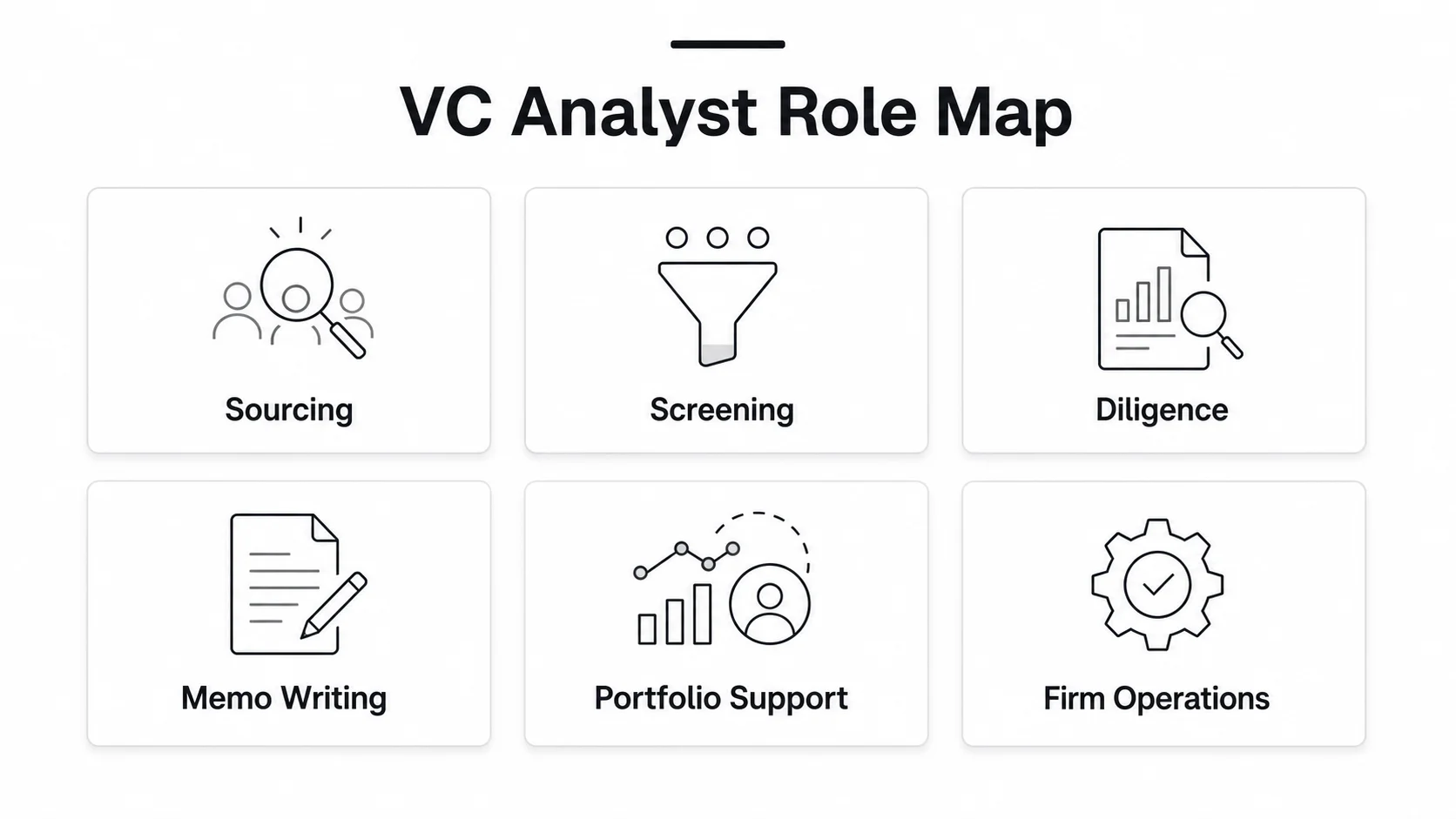
Copy-ready VC analyst job description template with responsibilities, skills, sourcing vs diligence seat signals, interview scorecard, and how candidates should read a posting.
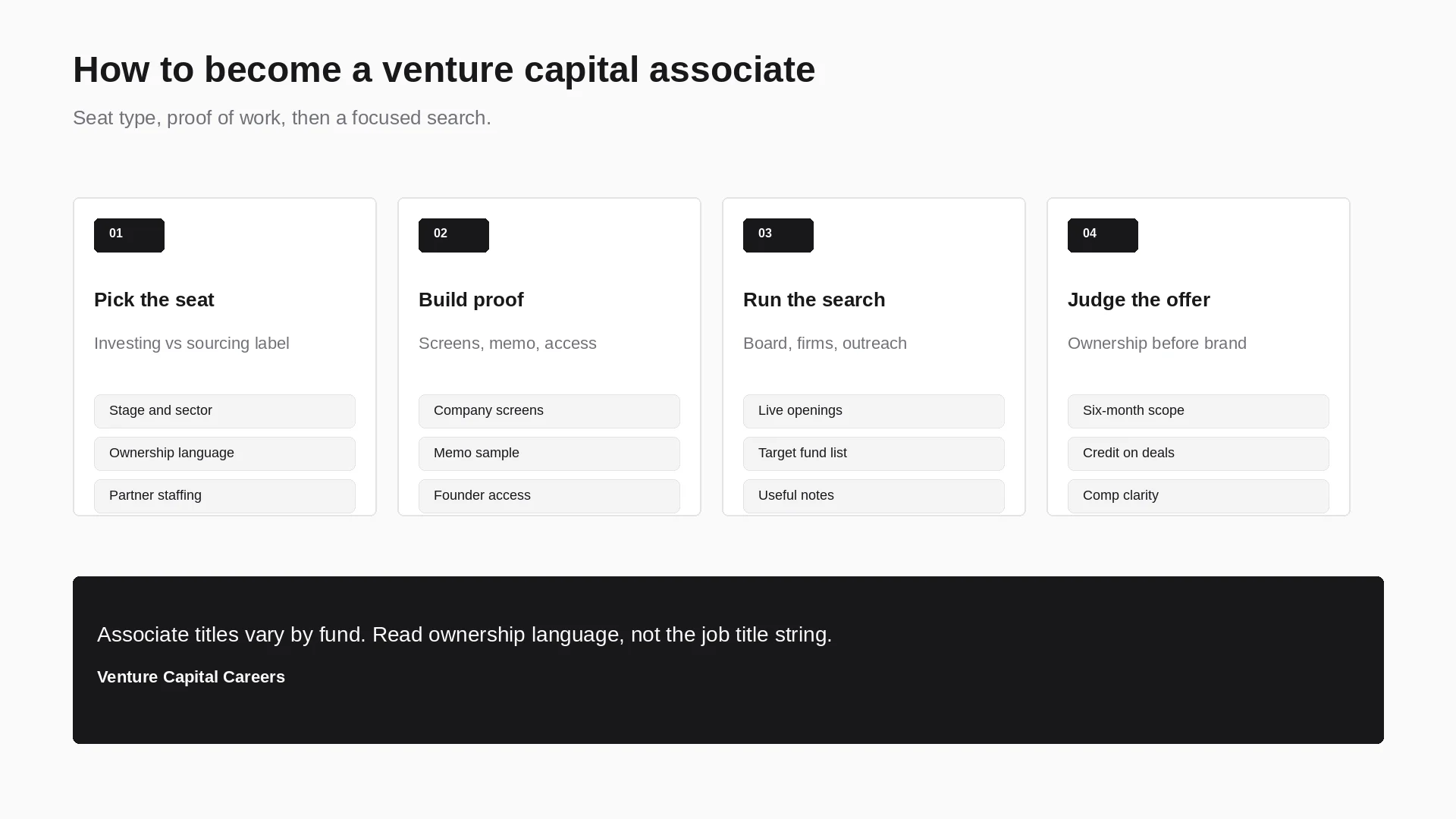
A practical guide to becoming a venture capital associate: what the seat is, which paths convert, how to prove you can do the work, and how to screen real associate openings.
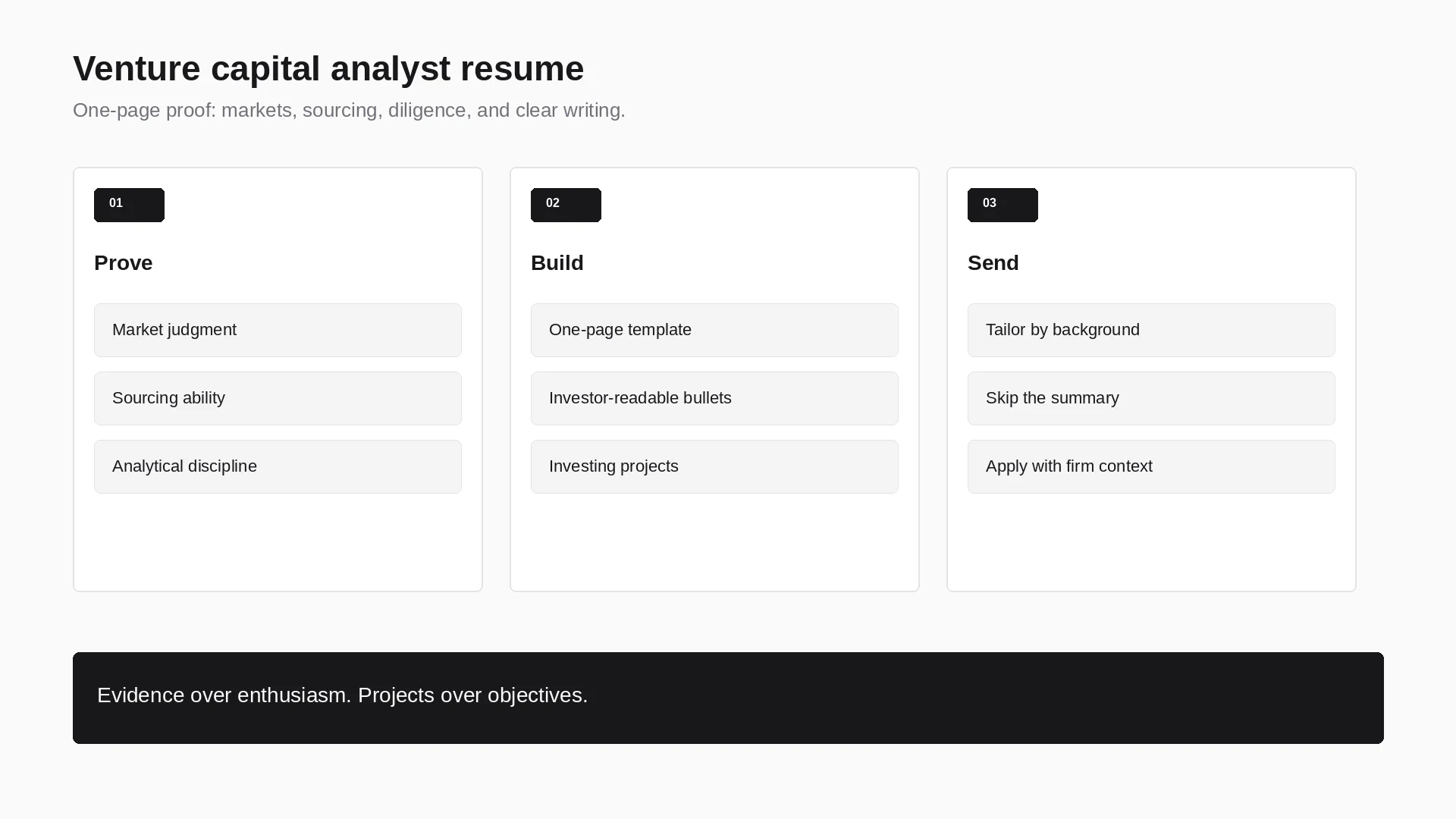
A VC analyst resume is a one-page proof document. Template, bullet formula, investing projects section, examples, and next steps for analyst applications.