
A venture capital scout finds startups that fit a fund's thesis and brings them to the investment team. Most scouts are not salaried junior investors. They are operators, founders, domain experts, or angels paid mainly through deal-linked carry, referral fees, or a small check-writing budget. The title is a sourcing arrangement, not a guaranteed seat on the partnership track.
If you want a full-time analyst or associate role, treat scouting as one proof path, not a substitute for how to get a job in venture capital. If you already have dense access to founders in a niche the fund cannot cover, scouting can be a clean way to practice investor judgment and get attributed deal flow without quitting your day job.
What a venture capital scout does
The core job is simple to say and hard to do well: surface companies that match a fund's real mandate early enough that the intro still matters.
Typical scout work includes:
- Staying inside a specific community, sector, or geography where founders trust you
- Spotting companies before a broad raise is obvious
- Writing a short context note, not a full diligence package
- Making a warm introduction with the founder's consent
- Tracking what happens after the handoff so attribution stays clean
- Disclosing conflicts, personal investments, and overlapping scout arrangements
What scouts usually do not do:
- Promise a term sheet or speak as if they can commit the fund
- Run open-ended diligence the agreement never covered
- Take board seats by default
- Replace the partner who owns the investment decision
Employers writing a posting should use the venture capital scout job description. This page is for candidates deciding whether and how to pursue the role.
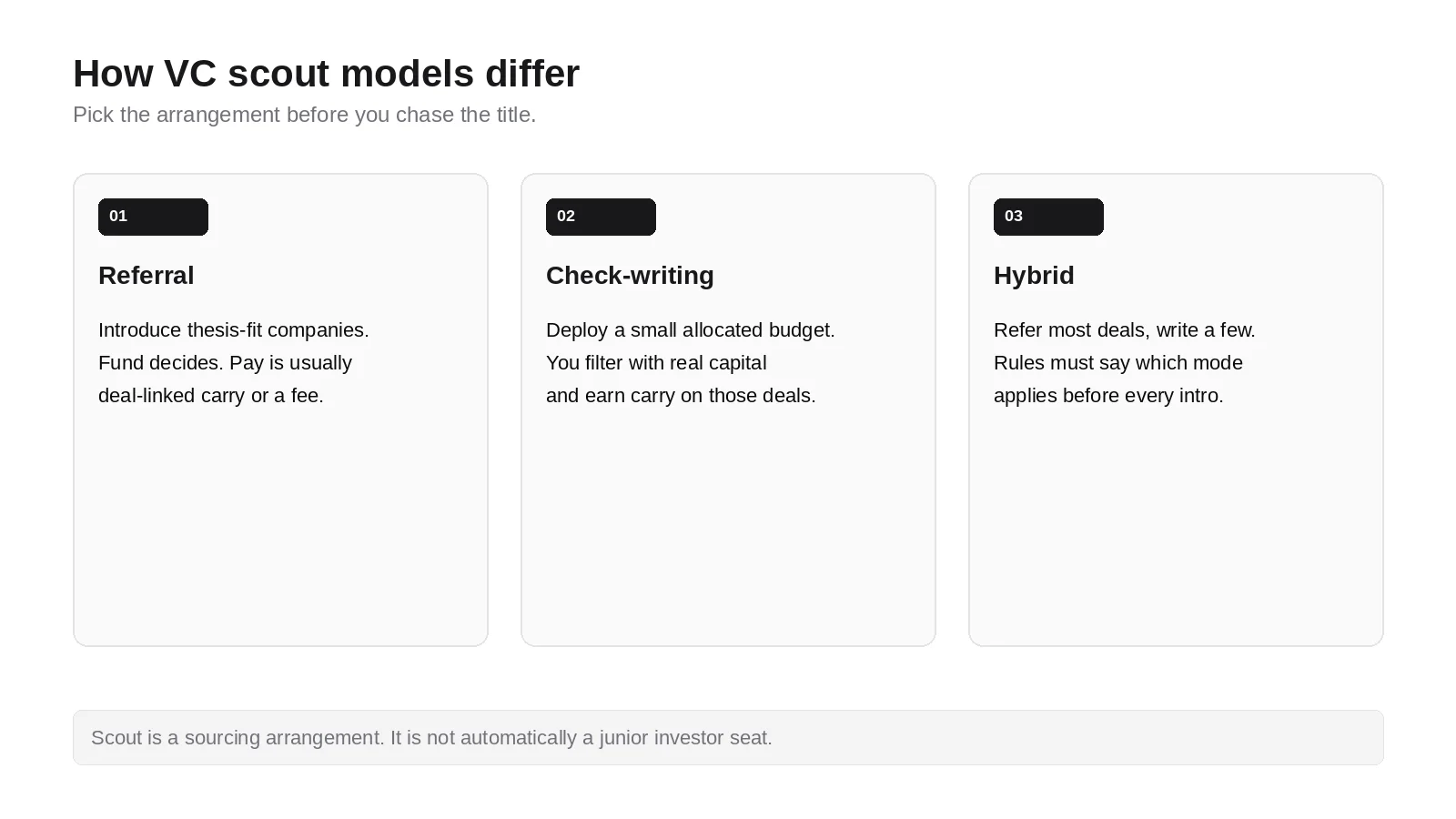
Scout models: referral, check-writing, and hybrid
"Scout" is not one employment type. Before you chase a program, name the model.
| Model | What you do | Typical economics | Best when |
|---|---|---|---|
| Referral scout | Introduce thesis-fit companies; fund decides | Deal-linked carry, cash bounty, or both | You have access but no desire to write checks |
| Check-writing scout | Deploy a small allocated budget at your discretion | Carry on those deals; sometimes stipend | The fund trusts your judgment enough to attach capital |
| Hybrid | Refer most deals; write small checks on a subset | Mixed carry and deployment rules | You want practice investing without raising your own vehicle |
| Internal sourcing employee | Full-time on the investment or platform team | Salary, bonus, sometimes carry | You want a real seat, not a side arrangement |
Many public "scout programs" are closer to referral networks than junior investor jobs. That is fine if your goal is deal flow and learning. It is a mismatch if you expected analyst-level training, IC exposure, and a promotion ladder.
How VC scouts get paid
Expect back-ended economics unless the agreement says otherwise.
Common structures:
- Deal-linked carry. You receive a slice of the fund's profit on investments attributed to you. Exact percentages vary by firm and are not standardized.
- Cash bounty or fee. A flat fee or a percentage of invested capital when a referred deal closes.
- Deployment budget. A small pool to invest directly, with carry on those positions.
- Stipend. Uncommon. Useful when the fund wants ongoing coverage, not one-off intros.
Carry that looks attractive on paper can still mean years before cash. Exits take time. Many referred companies never get funded. Treat scout pay as asymmetric upside attached to reputation work, not as a salary replacement.
Ask for the attribution rule in writing. "I introduced them once" is not a compensation policy. You need clarity on what counts as your deal, what happens if multiple scouts touch the same company, and whether follow-on rounds still credit you.
How to get selected (without treating it like a job portal)
Most durable scout seats are relationship-driven. Cold forms exist, especially at emerging managers and openly marketed programs, but the pattern that works across invite-heavy funds is the same: demonstrate judgment before you ask for a title.
A practical sequence:
- Pick one community you already reach better than a generalist partner can.
- Learn one or two funds' theses well enough to know what not to send. Use the companies directory and firm materials, then read recent portfolio announcements.
- Send a short, useful company note to a partner or associate you can reach cleanly. Two tight paragraphs beat a vague "thought this might be interesting."
- Repeat a few times with quality over volume. Track outcomes privately.
- Only then ask whether a formal scout, referral, or venture-partner-style arrangement exists.
Warm introductions from portfolio founders or current scouts still beat most cold applications. If a fund runs an open application, treat the form as a filter, not a lottery ticket. Show domain density, not a generic desire to "break into VC."
For outreach craft, borrow structure from the venture capital cold email template and networking guidance, then keep the ask small: feedback on a specific company note, not "can I be your scout?"
Build proof before you ask for a title
Funds recruit scouts for access and taste. Credentials help less than evidence.
Useful proof assets:
- A narrow network map: who you can actually reach, and why those founders trust you
- A short written screen you reuse: thesis fit, team, why now, risks, why this fund
- Two or three attributed intros that led to real partner conversations
- Optional: small angel checks or published notes that show how you think
Avoid spray-and-pray intros. Your filter is the product. A bad referral wastes partner time and burns the only asset that matters in this lane: trust.
If you need deeper sourcing craft, read venture capital deal sourcing and deal sourcing. Scouting is specialized sourcing with attribution rules attached.
Scout vs fellowship vs internship vs salaried sourcing seat
Candidates mix these labels. They are different products.
| Path | Time | Pay shape | What you practice | Converts to FT when |
|---|---|---|---|---|
| Scout | Part-time, often non-exclusive | Carry / fees / small checks | Sourcing, judgment, intros | You show repeated attributed quality and the firm has a seat |
| Fellowship | Structured weeks or months | Stipend, unpaid, or light pay | Fund process, research, sometimes IC exposure | Program is designed as a hiring pipeline and you outperform |
| Internship | Defined term, often campus-tied | Internship pay or unpaid | Junior investment work under supervision | Headcount exists after the program |
| Salaried sourcing / analyst / associate | Full-time employee | Salary, bonus, sometimes carry | Full workflow inside the firm | You are hired into the role |
For fellowship mechanics, see the venture capital fellowship guide. For the broad ladder, see the venture capital career path. An entrepreneur in residence seat is another adjacent path with different expectations and usually more formal time inside the firm.
Questions to settle in writing before you accept
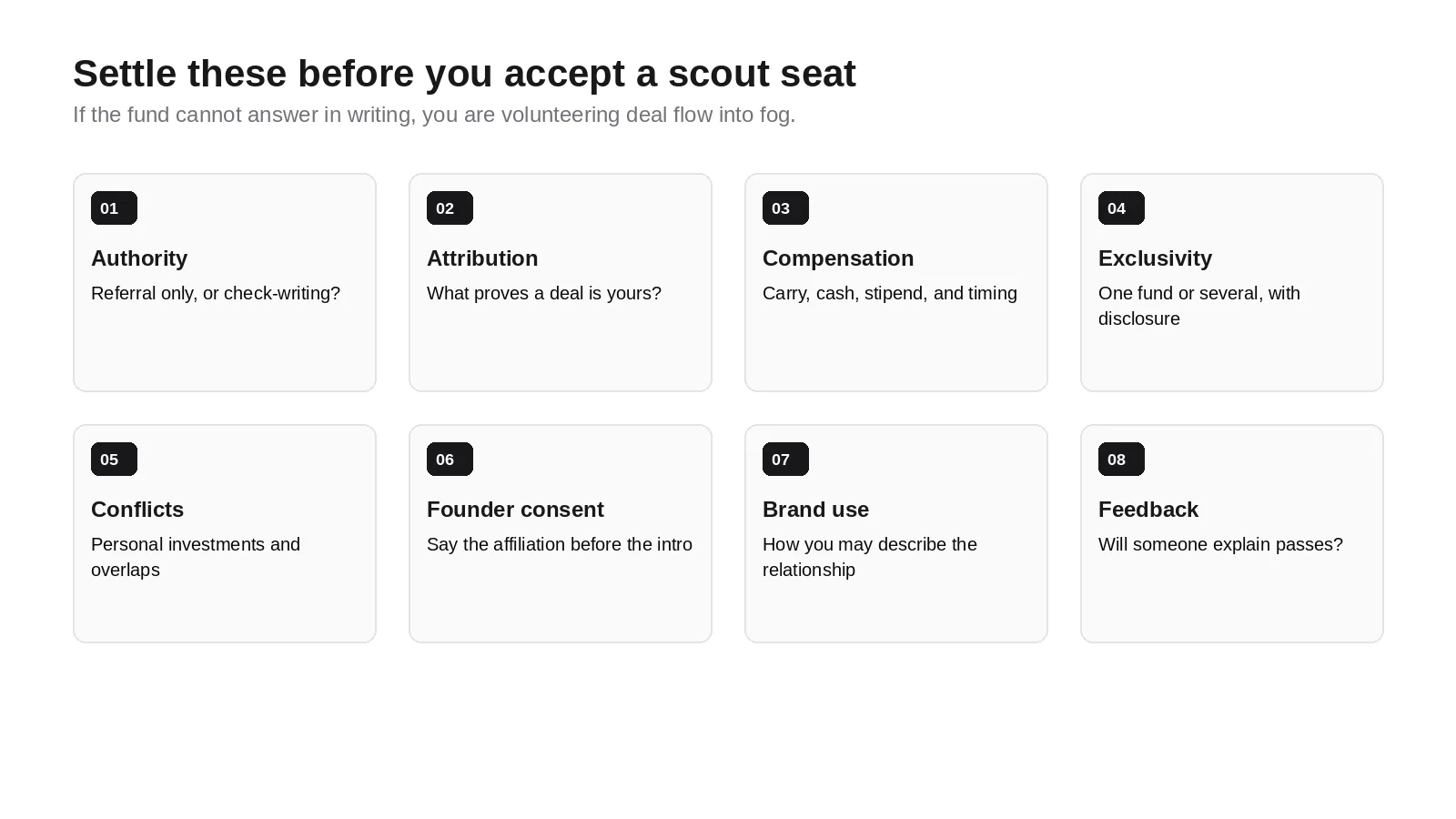
Do not join on vibes. Get the operating rules down before you use the fund's brand with founders.
Settle at least these:
- Authority. Can you write a check, or only refer?
- Attribution. What proves a deal is yours?
- Compensation. Carry percentage, cash fee, stipend, vesting, and timing.
- Exclusivity. Can you scout for more than one fund?
- Conflicts. How do personal investments and overlapping relationships get disclosed?
- Founder consent. Are you required to tell founders you are affiliated before the intro?
- Brand use. How may you describe the relationship publicly?
- Feedback loop. Will someone tell you why intros are passed so your filter improves?
- Expected volume. Is the fund optimizing for a few excellent intros or broad coverage?
- End conditions. How either side ends the arrangement.
If a program cannot answer those questions, you are volunteering deal flow into an undefined process. That can still be educational. It is a weak career contract.
When scouting is not a path into VC
Scouting helps when you already have unfair access and you want attributed practice. It fails as a break-in plan when:
- You have no niche and hope the title will create one
- You need near-term cash and the only pay is distant carry
- The firm has no history of converting scouts into employees
- You are using scouting to avoid building the artifacts full-time hiring actually screens for
- You cannot explain the fund's thesis well enough to know what not to send
In those cases, spend the same energy on a salaried search. Browse open roles on the Venture Capital Careers job board, research funds in the companies directory, and follow the break-in system in how to become a venture capitalist.
Turn scout work into a full-time seat
Scouting converts when the firm can point to repeated, attributed quality and has a real opening. Help that conversion on purpose:
- Keep a private log of intros, outcomes, and lessons
- Ask for feedback after passes
- Volunteer for scoped follow-up only when invited, then deliver clean notes
- Build the same proof full-time hiring wants: market maps, memos, references from founders and investors who saw your judgment
- Watch for analyst, associate, platform, and ops openings instead of waiting for a magical scout-to-partner jump
When you are ready to look at seats, set alerts via candidate sign-up and review live roles on the board. Scouting can strengthen the story. It rarely replaces the hiring process.
FAQ
Do I need to be an accredited investor to become a VC scout?
It depends on the model. Referral-only arrangements often do not require you to invest personal capital. Check-writing programs and any structure where you deploy fund or personal capital can trigger accreditation and legal requirements. Ask the fund's counsel or program lead for the rule that applies to that agreement.
Can scouting replace a venture capital internship or analyst role?
No. Internships and analyst seats are employment relationships with supervised workflow inside the firm. Scouting is usually external sourcing with lighter process access. Use it as proof and network density, not as a one-for-one substitute.
How many deals should I send before asking to be a scout?
There is no universal number. A small set of high-signal notes that match the thesis beats a long list of weak intros. Many people get formalized after several useful touches, not after a single cold ask.
Should I scout for multiple funds at once?
Only if every agreement allows it and you can manage conflicts cleanly. Disclose overlapping coverage. Never shop the same founder conversation carelessly across brands.
Is a public scout program better than an invite-only one?
Public programs are easier to enter and useful for practice. Invite-only networks at established funds can offer stronger brand signal and sometimes better economics, but they are harder to access without prior trust. Choose based on access you already have, not prestige alone.
What should I put on my resume if I scout?
State the fund relationship accurately, the model (referral or check-writing), and concrete outcomes you are allowed to share. Do not imply you were a full-time investor if you were not.
Related posts
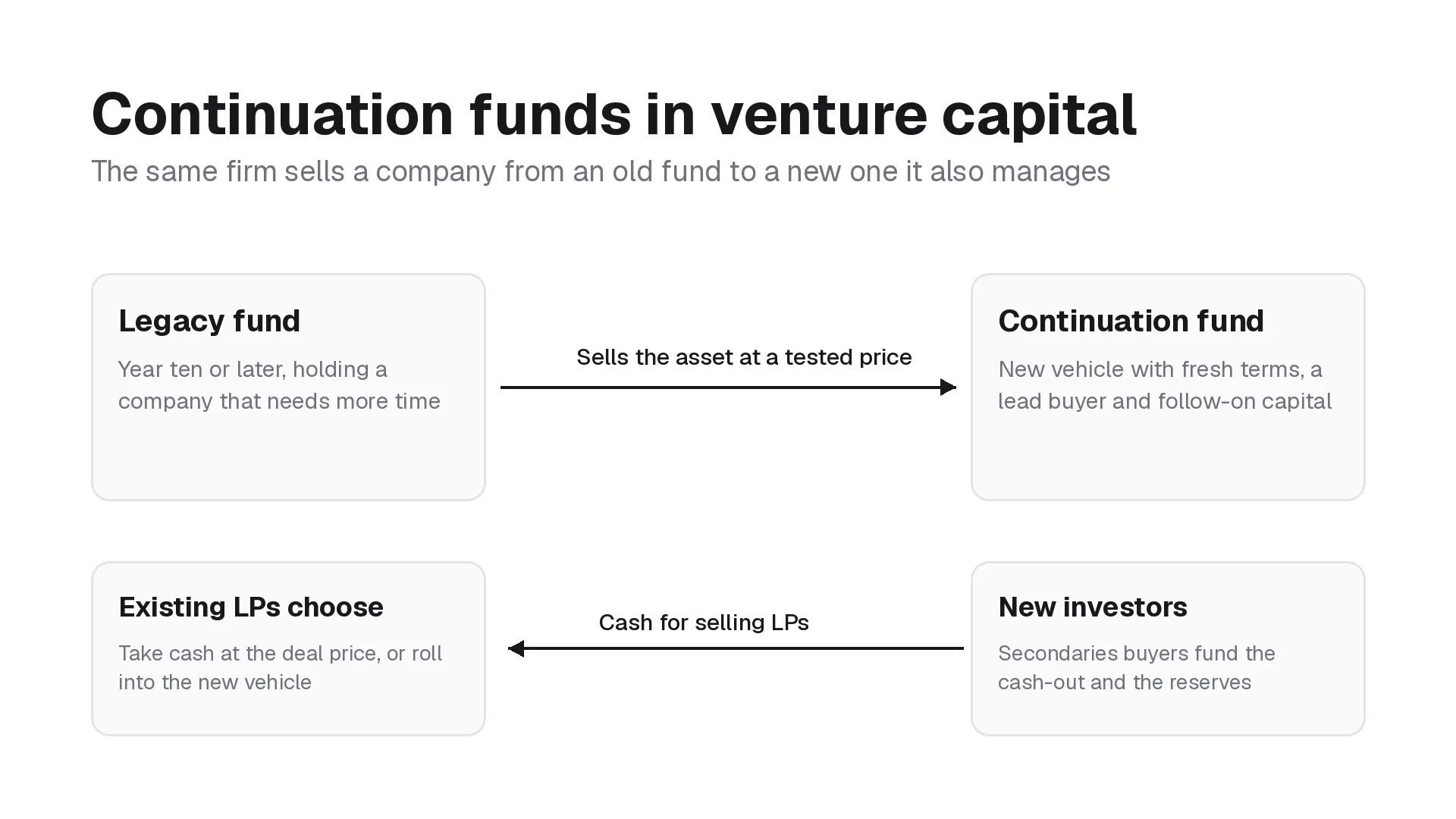
A continuation fund lets a VC firm sell a company from an old fund to a new vehicle it also manages, while LPs choose cash or a roll. Here is how the deal works, how price, fees and carry are set, and what it changes for people who work at the firm.
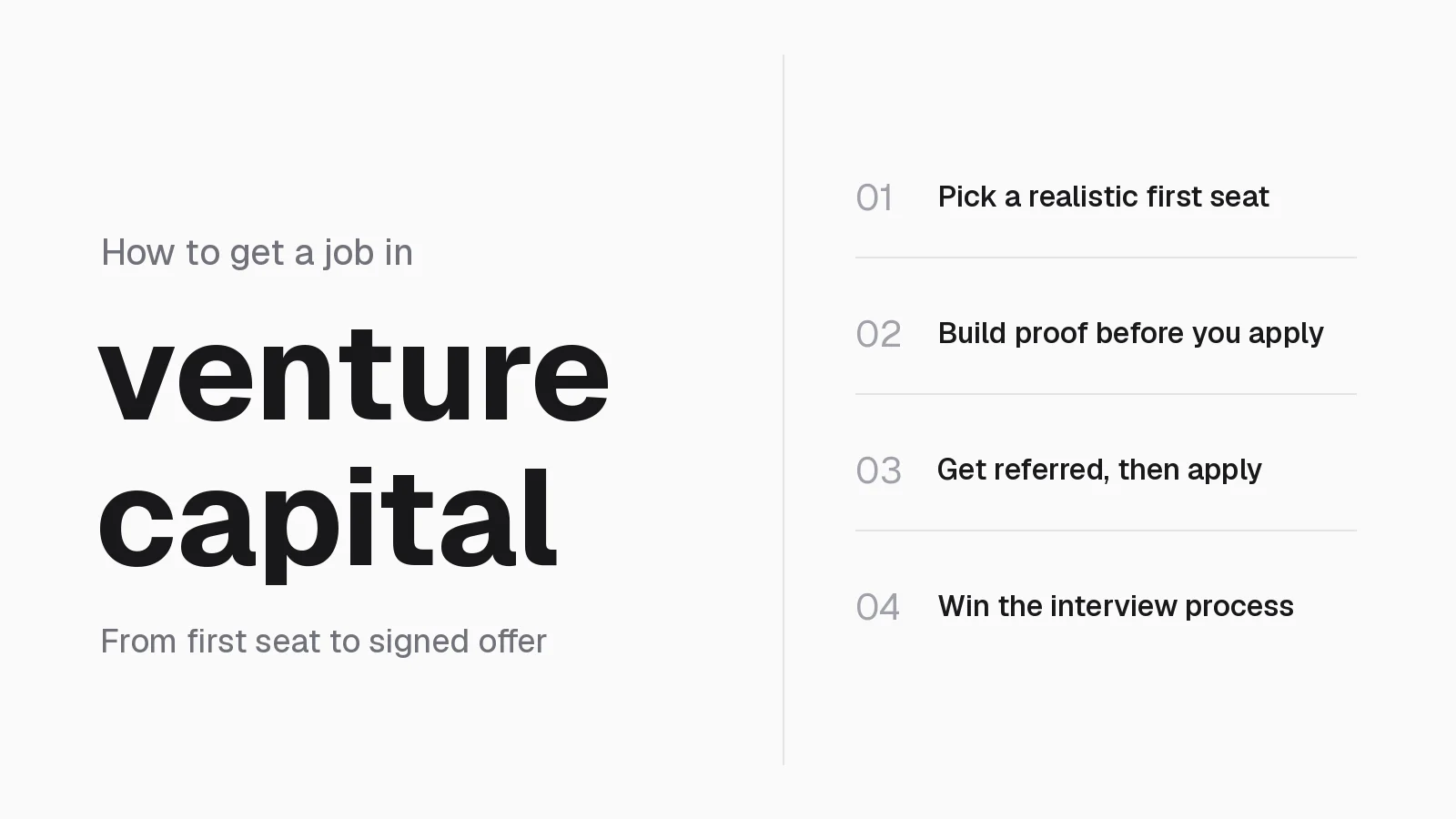
How to get a job in venture capital: which seats exist, the first seat that fits your background, proof to build, where VC jobs come from, how to screen a posting, the recruiting process from screen to offer, pay, and what to ask before accepting.
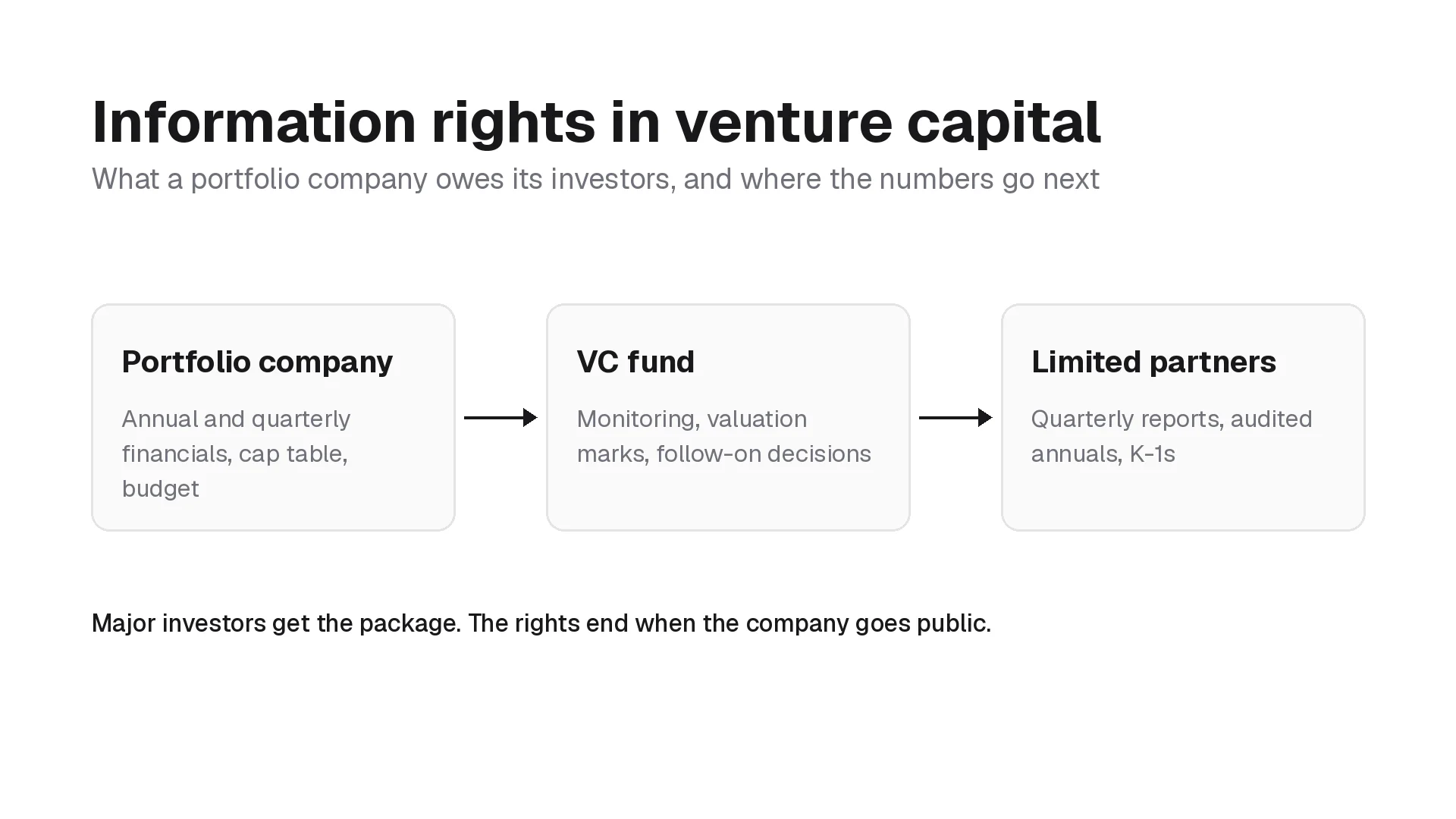
Information rights oblige a venture-backed company to send major investors annual and quarterly financials, a cap table and its budget. Here are the standard deadlines, who qualifies, how the rights end, and how analysts, fund finance and IR teams use the data.