
Deal sourcing is how private-market firms find and qualify investment opportunities. Private equity funds, venture capital firms, investment banks, and corporate development teams all use the phrase. Wikipedia treats deal sourcing and deal origination as the same label for that search.
The same two words also get used for buyouts, seed checks, advisory mandates, and UK house purchases. Those are different jobs. This page covers the finance meaning: the definition, how it differs from deal flow and origination, how PE, VC, and M&A use it, the process, the channels, the tools, and how teams measure the work.
For a deeper VC-only process, see venture capital deal sourcing. For the pipeline after opportunities exist, see deal flow.
What deal sourcing is
Deal sourcing is the systematic search for companies that fit an investment mandate. The work is identifying targets, checking them against written criteria, and deciding which ones deserve a conversation or diligence. It is the front of the investment process, not the close.
A sourced company is not an investment. Sourcing produces candidates. Diligence, negotiation, and a fund decision come later.
Finance teams also call the work deal origination or investment sourcing. The useful question is the same in each label: how does the firm find the right deals, and how does it stop spending time on the wrong ones?
Deal sourcing vs deal flow
Sourcing is the activity. Deal flow is the stream that results.
Deal sourcing is the strategy and the work used to find opportunities. Deal flow is the volume and rate of opportunities that reach the firm. Poor sourcing produces a thin or noisy pipeline. Strong sourcing produces fewer wasted first looks. A fund can have high deal flow and still source badly if the names are late, off-thesis, or already in a crowded process.
Deal sourcing vs deal origination
Some writers treat the two terms as synonyms. Others split them. Origination is the first identification of a target. Sourcing is the broader front-end discipline that includes screening, qualification, and relationship work after that first sighting.
M&A teams use origination for a third job: generating mandates to advise on a transaction. In conversation, people still use the words interchangeably. The useful distinction is first sighting versus the full front-end process.
Which market the term belongs to
Deal sourcing is not one market. Treating it as one playbook is how a PE CRM article or a UK house-flipping page gets read as the definition.
| Market | What a deal is | Who usually sources | What happens next |
|---|---|---|---|
| Private equity | A control or significant stake in a private company | Origination staff, associates, intermediaries | Management meeting, CIM, buyout diligence |
| Venture capital | Equity in an early or growth-stage startup | Analysts, associates, partners, scouts | Founder meeting, first screen, possible term sheet |
| M&A and investment banking | An advisory mandate or an acquisition target | Bankers, corporate development, brokers | Teaser, NDA, process letter |
| UK property | A residential or commercial asset to buy | Property sourcers and agents | Survey, financing, offer |
This page covers the first three. UK property deal sourcing is a different search with different economics, regulation, and buyers. It is not a private-fund definition.
Private equity and venture capital share a fund structure and a thesis. They do not share the same target, intermediary mix, or diligence clock. M&A origination can feed a PE process when a banker runs an auction. It is still a sell-side or advisory motion, not the same job as a fund associate mapping a sector.
Why deal sourcing matters
A fund that does not source only sees marketed processes: banker books, auctions, and inbound that every peer also receives. Those processes are real work. They are not a strategy. Teams spend time on networks, research, and brand so they can see companies earlier, or off-market, and spend scarce partner time on thesis-fit targets.
The practical payoff is simple. Better sourcing improves the quality of deal flow, strengthens founder and intermediary relationships, and keeps calendars on companies the mandate actually wants. Poor sourcing shows up as a stale pipeline, late entry into crowded rounds, and weeks spent on companies the thesis should have rejected on day one.
Great companies do not appear because a fund exists. They appear because someone is looking with criteria.
How private equity and venture capital source differently
The same phrase hides two operating models.
| Dimension | Private equity | Venture capital |
|---|---|---|
| Target | Mature, cash-generating, or turnaround companies | Early or high-growth startups |
| Typical check | Control or large minority in one company | Minority equity across many companies |
| Intermediaries | Investment banks, advisors, and CIM processes are common | Seed and Series A are rarely banker-led. Angels, scouts, and other VCs matter more |
| Proprietary access | An off-market conversation with management before an auction | A relationship or research path to a founder before a crowded round |
| Diligence clock | Longer. Financial, operational, and legal work is the product | Faster at early stage. Team, market, and product come first |
| Brand job | Reputation with intermediaries and management teams | Reputation with founders and operators |
PE teams mix proprietary outreach, sector research, and intermediary processes. Many PE deals still arrive as banker-led auctions. Proprietary in that world means reaching management before the auction starts.
VC teams mix founder and portfolio referrals, angels and scouts, accelerators, outbound market maps, and company data. Proprietary in that world means a path to the founder before the round is widely shopped. For the VC process in more depth, use the venture capital deal sourcing page. That page is a deeper VC process, not a replacement for this definition.
M&A deal origination sits next to both. It is about originating advisory mandates, buyer lists, and process materials. That is buy-side or sell-side process work, not the same as a seed fund writing a first check.
The deal sourcing process
Published guides describe the same sequence with different step counts. Some use four steps: team, method, target list, information. Some use seven: thesis, team, generate deal flow, qualify, diligence, relationships, then track. The useful union is five.
Define the investment thesis
A thesis that cannot reject companies is a slogan. Write stage, sector, geography, business model, check size, and hard passes before expanding coverage. An unclear mandate produces scattered inbound and wasted outbound.
When a founder or intermediary asks what the fund invests in, the answer should match that written filter.
Choose the team and the method
Someone has to own research, outreach, and records. That can be in-house analysts and associates, a dedicated origination hire, or contracted coverage. Method is the second choice: relationship-led, data-led, or both. Traditional networks and online platforms are methods, not competing religions.
Build a target list
Criteria become a named list of companies, not a vague sector interest. Filter by sector, stage, location, and readiness for funding or sale. Selectivity matters. A list without next actions is a bookmark folder.
Qualify, then decide what deserves diligence
Not every name on the list earns a deep dive. Qualification checks thesis fit, market, competition, team, and whether the timing is real. Diligence is the next stage, not a synonym for a first screen. Qualification answers whether scarce time is justified. Diligence answers whether the firm should invest.
Track the record and reuse it
If the record does not exist, the firm did not source the company. Capture source, date first seen, thesis tags, outcome, and next action. The point is institutional memory, not a software brand. Volume, conversion, and source quality only become visible when the record is honest.
Inbound, outbound, traditional, and online channels
Channels sit on two axes. Inbound versus outbound is about who made the first useful touch. Traditional versus online is about how coverage is built.
Inbound is deal flow that arrives without a cold first touch: founder emails, portfolio referrals, intermediary teases, website submissions, and inbound from content or reputation. Outbound is the firm going to the company: market maps, direct outreach, event coverage, and data screens.
Traditional sourcing is reputation, referrals, and industry knowledge. Online sourcing is databases, marketplaces, alerts, and shared records that reach past a personal network. Most serious teams run both. A relationship without coverage misses companies. A database without a path to the founder is a list.
| Channel | Typical use | Common failure |
|---|---|---|
| Portfolio and founder referrals | Highest-trust inbound in VC | Transactional asks that burn goodwill |
| Angels, scouts, and other funds | Early sightings and round context | Shopped deals with no criteria |
| Accelerators and demo days | Dense early-stage coverage | The same companies every fund sees |
| Universities and labs | Technical founders | Commercial unreadiness ignored |
| Conferences and banker processes | PE and M&A visibility | Paying auction prices for public processes |
| Outbound market maps | Thesis-led discovery | Cold spray with no reason to talk |
| Content and community | Inbound from aligned founders | Generic posting with no point of view |
| Databases and alerts | Coverage and refresh | Treating enrichment as access |
Deal sourcing tools and platforms
Tools sit after the thesis and the channel mix. They help a team find companies, remember relationships, and keep a pipeline honest. They do not invent criteria.
| Category | Job |
|---|---|
| Market and company data | Find and filter companies by sector, stage, geography, and financing history |
| Relationship and CRM systems | Record who knows whom, what was said, and what happens next |
| Pipeline and workflow | Move a company from first sighting to pass, track, meet, or diligence |
| Deal marketplaces and networks | See marketed or matched opportunities beyond a personal book |
| Capture and alerts | Notice new financings, hires, or product launches that refresh a list |
Research products that investors actually open include company databases and private-market data terminals. CRM and relationship intelligence products sit next to those. Deal marketplaces exist for marketed PE and M&A processes. Choose software when volume makes a spreadsheet the bottleneck, or when the firm needs shared memory across partners.
How teams measure deal sourcing
Measure what progresses, not only what arrives.
Useful measures:
Companies added that match the thesis
Share of new names that are on-thesis
First conversations booked
Meetings that earn diligence
Investments, or near-misses worth a written postmortem
Source of each company that progressed
Time from first sighting to first meeting
Written pass reasons, reused as training data
Volume without conversion is noise. Conversion without source attribution teaches the team nothing about which channel to keep. Measurement is how a PE origination desk and a VC platform team decide whether outbound maps, banker coverage, or founder inbound deserve more time.
FAQ
What is deal sourcing?
Deal sourcing is the process finance teams use to find and qualify investment or acquisition opportunities that fit a mandate. It is also called deal origination.
What is the difference between deal sourcing and deal flow?
Deal sourcing is the work of finding and qualifying opportunities. Deal flow is the resulting stream. Strong sourcing improves deal-flow quality.
How do venture capital firms source deals?
Through founder and portfolio referrals, angels and scouts, accelerators, outbound market maps, community presence, and company data. VCs usually take minority equity in earlier companies than PE firms.
How does private equity deal sourcing work?
PE teams mix proprietary outreach, sector research, and intermediary processes. Many deals still arrive as banker-led auctions. Proprietary sourcing means reaching management before that process starts.
How do you start deal sourcing?
Write the thesis. Choose inbound and outbound methods. Build a short target list. Capture every name with a source and a next action.
Is UK property deal sourcing the same thing?
No. Property deal sourcing is finding residential or commercial assets to buy. It is a different market, even when the same two words appear.
What tools do deal sourcing teams use?
Company databases, CRMs, pipeline tools, and sometimes deal marketplaces. Tools support a written mandate. They do not replace one.
Related reading
To see how specific VC firms describe stage, sector, and geography, use the companies directory. Open venture roles when the next step is a seat on a deal team. For the VC process in more depth, continue with venture capital deal sourcing. For pipeline language, see deal flow.
Related posts
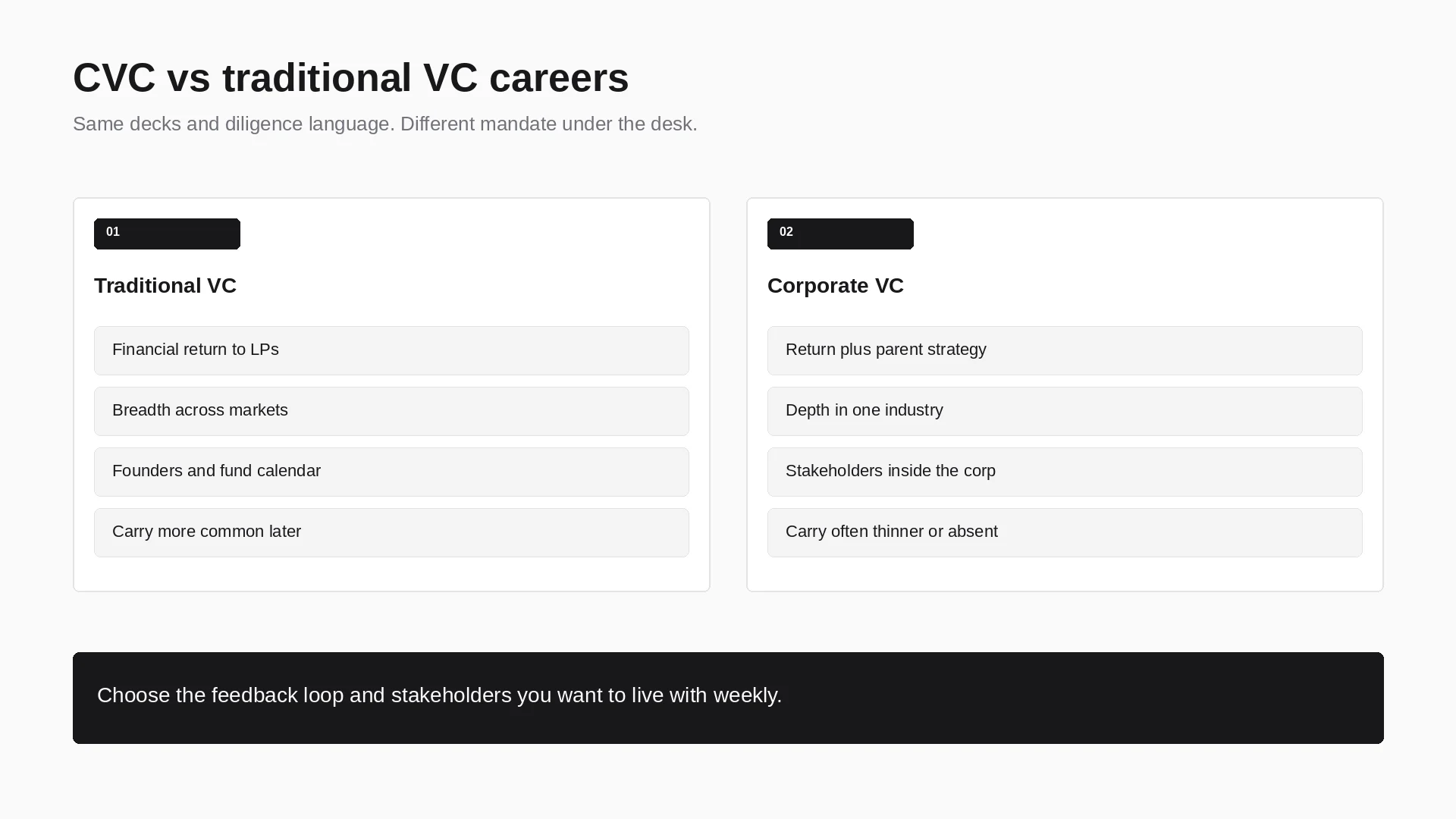
Traditional VC and corporate venture capital share decks and diligence language. The mandate underneath the desk decides what you learn, how you get paid, and where you can go next.
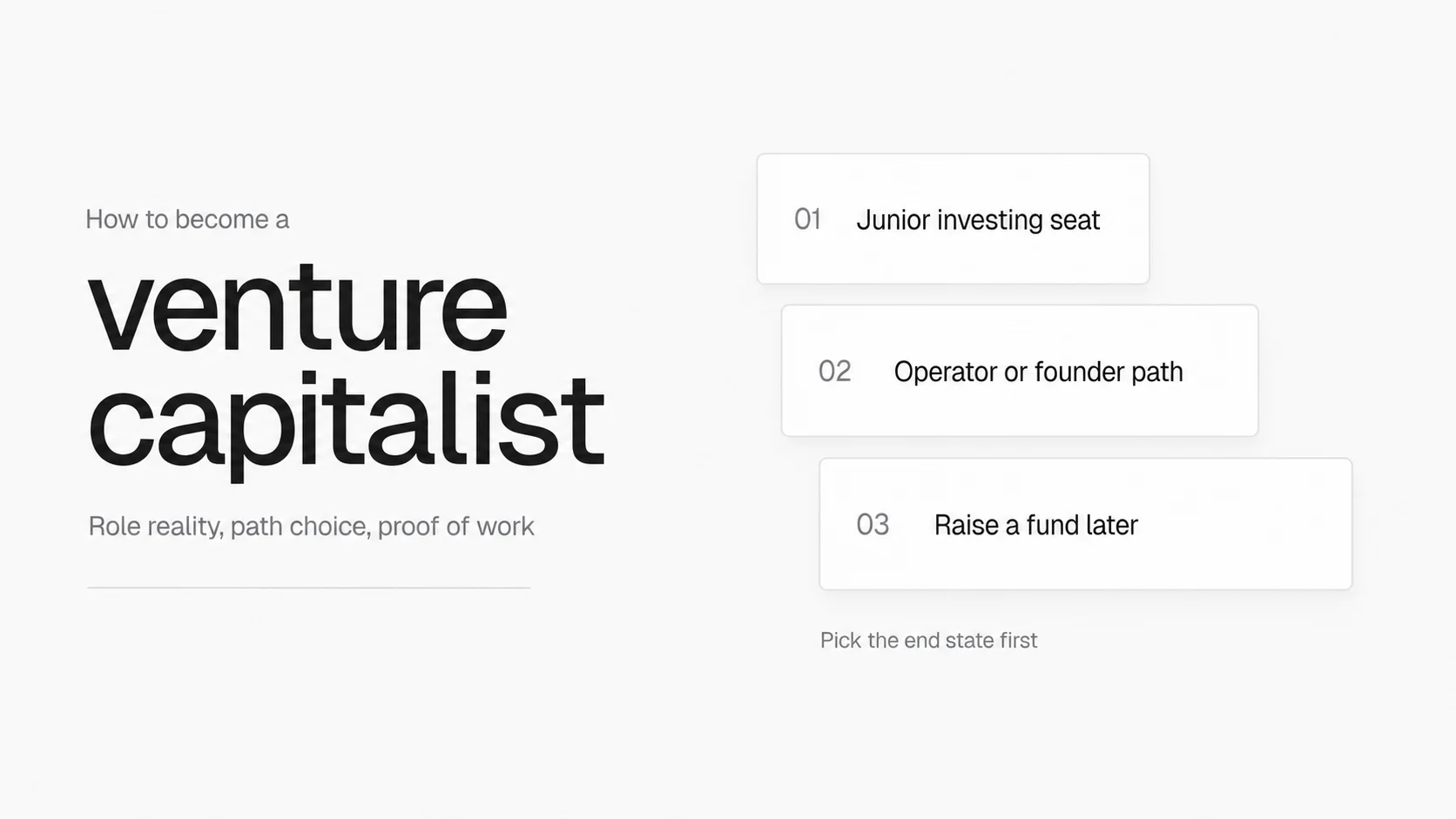
What venture capitalists actually do, realistic paths by background, which seat type to target first, and when raising your own fund is premature.
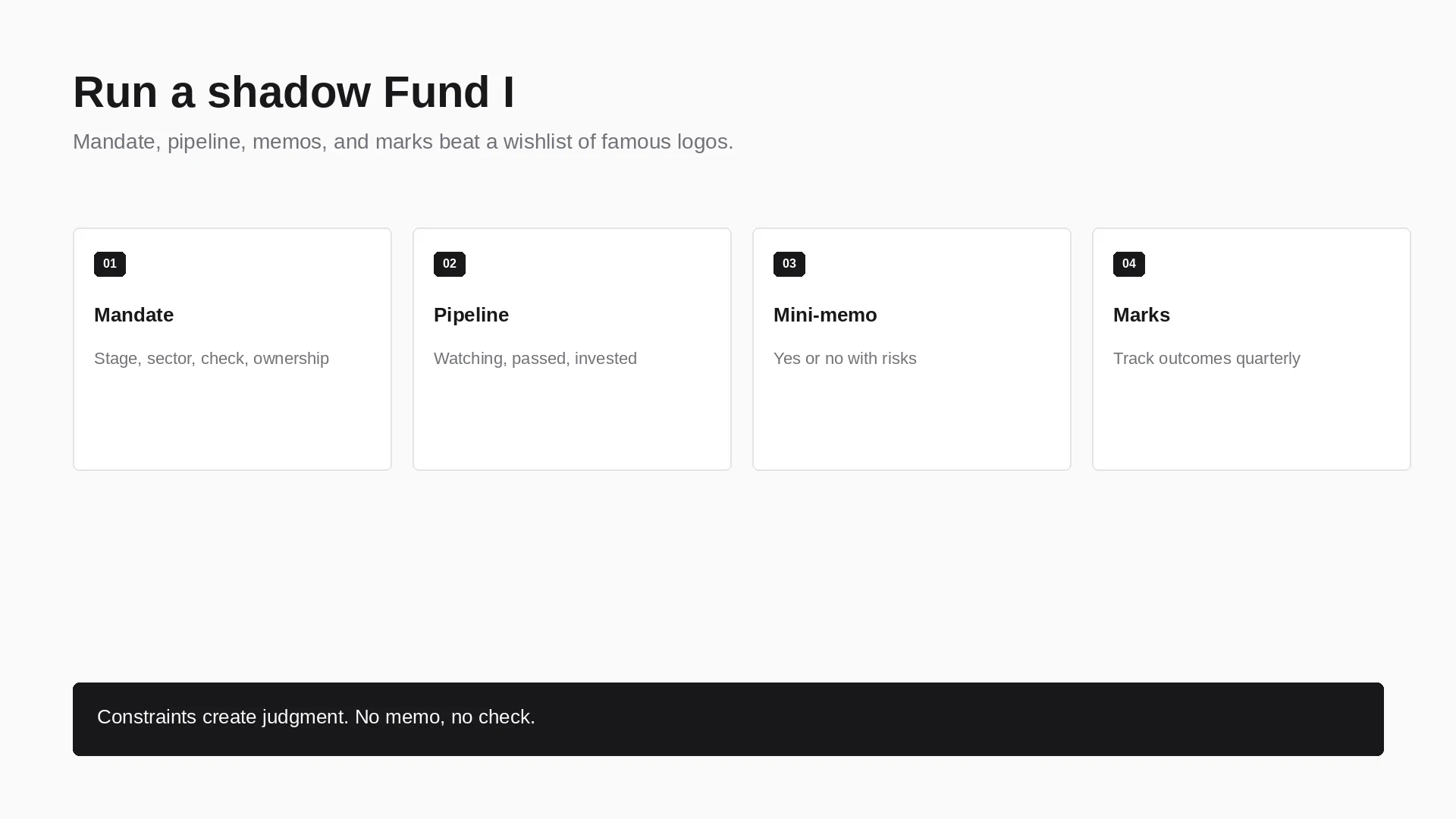
A hiring-grade system for a fantasy VC portfolio: mandate, pipeline, memos, marks, quarterly reflection, and how to use it in interviews.