
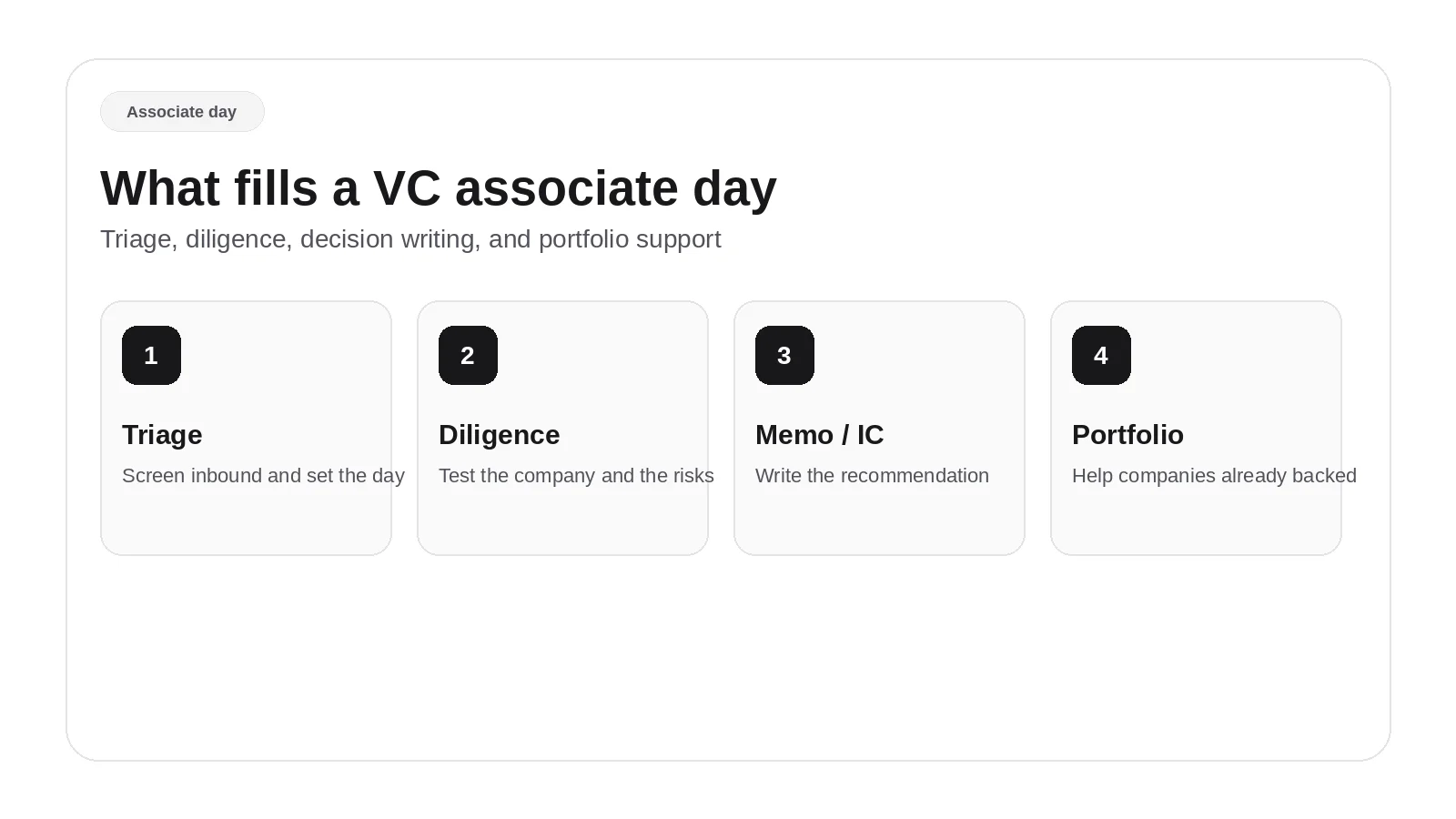
A venture capital associate day is mostly triage, judgment, and coordination. The calendar rarely looks like a fixed factory shift. Morning pipeline review can turn into a founder call, a diligence scramble, a memo rewrite, or a portfolio request before lunch.
The useful picture is not one glamorous schedule. It is a repeating loop: find and qualify opportunities, pressure-test them, write the case, help the team decide, and support companies already in the portfolio. Finsimco's associate day-in-the-life piece describes that loop well. Vault's hour-by-hour analyst diary shows why a timestamped day helps candidates. This guide updates the format for associate work, shows how the day changes by firm type, and connects the schedule to recruiting decisions.
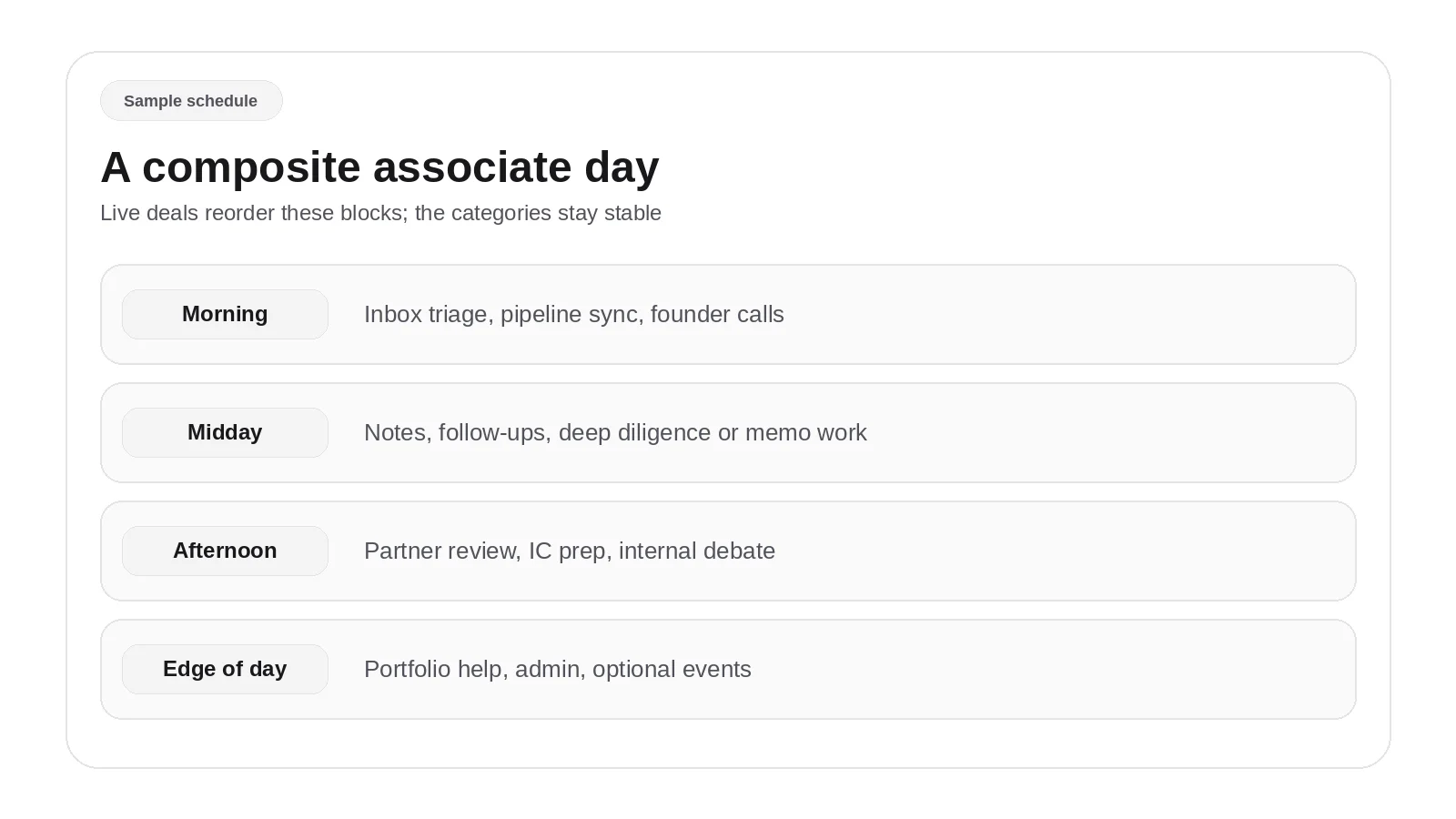
Treat the sample day below as a composite. Live deals, fund stage, team size, and partner style can reorder every block.
A timestamped day in the life of a VC associate
| Time | What often happens | Why it matters |
|---|---|---|
| 8:00-9:00 | Inbox and CRM triage: inbound decks, warm intros, news alerts, overnight founder notes | Associates protect partner attention by deciding what deserves a reply, a pass, or a deeper look |
| 9:00-10:00 | Pipeline stand-up or informal priority sync | The day fails when every request feels urgent and nothing is ranked |
| 10:00-12:00 | Founder calls, first meetings, or diligence interviews | Associates test whether the company matches the fund thesis and whether the conversation reveals judgment |
| 12:00-13:00 | Working lunch: notes, follow-ups, or a light research block | Clean notes are an associate product. Vague memory is not |
| 13:00-15:30 | Deep work: market map, customer references, model checks, or memo drafting | This is where the recommendation gets built |
| 15:30-17:00 | Internal debate, principal or partner review, IC prep | Associates turn analysis into a decision narrative and open questions |
| 17:00-18:30 | Portfolio support, recruiting intros, event prep, or leftover admin | Portfolio and firm work often fills the edges of the day |
| Evening | Variable: one event, reading, or a live-deal catch-up | Ecosystem work is real, but strong teams distinguish useful relationship time from performative attendance |
A live deal day looks different. Customer references move across time zones. A partner challenges the market section. A term-sheet clock starts. Recurring work gets postponed rather than deleted. For workload ranges and spike patterns, use VCC's venture capital hours guide instead of treating any one calendar as a promise.
The day also has judgment checkpoints that candidates should listen for in interviews:
- What gets a pass without a meeting?
- What gets escalated to a partner quickly?
- What evidence would change the recommendation?
- What work is owned end-to-end versus staffed as support?
If a team cannot answer those questions, the associate seat may be activity-heavy and decision-light.
The five workstreams that fill the day
Associates rarely do one job all day. The same person usually moves across five workstreams. The mix changes by fund, but the categories stay stable.
| Workstream | Typical associate work | What good looks like |
|---|---|---|
| Sourcing | Thesis lists, warm outreach, event follow-ups, inbound screening, CRM hygiene | A clear reason each company is on the list, and a clean pass or advance decision |
| Diligence | Founder calls, customer references, market work, competitive context, expert calls | Risks ranked by decision impact, not by how easy they were to research |
| Memos and IC | Drafting, rewriting, exhibit cleanup, pre-wires, Q&A preparation | A recommendation the team can defend, with explicit open questions |
| Portfolio | Hiring intros, research requests, follow-on prep, issue tracking | Useful help delivered without turning the associate into unpaid consulting bandwidth |
| Admin and firm ops | Pipeline updates, calendar coordination, process notes, interview support | Low-friction systems that keep the team honest about status |
Mergers & Inquisitions groups VC work into similar areas and reminds readers that networking and relationship maintenance sit underneath the formal tasks. The associate version of that point is sharper: relationship work only counts when it creates qualified deal flow, better diligence access, or portfolio outcomes.
Two failure modes show up often.
Inbox theater. The associate stays busy answering everything and never builds a recommendation. Memo theater. The associate writes long documents that never force a decision.
A healthy day balances both. Screening protects time. Deep work converts time into judgment.
How the day changes by firm type
Firm type changes the texture of the day more than the job title does.
Seed and early-stage
Seed-associate days often lean toward sourcing, first meetings, pattern recognition, and lighter financial modeling. Diligence still matters, but the evidence set may be founder quality, early customer pull, product insight, and market timing rather than long operating histories. Small teams can also mean more admin and more direct partner access in the same afternoon.
Growth and later-stage
Growth-associate days usually include denser data rooms, deeper financial and commercial diligence, more process coordination, and longer memo cycles. The calendar can look more like a transaction team week when a live process is underway. Relationship work still matters, but a larger share of the day may sit inside structured workstreams.
Small fund versus platform fund
| Dimension | Smaller fund pattern | Platform fund pattern |
|---|---|---|
| Breadth | One person may touch sourcing, diligence, memo, and portfolio on the same day | Work may be narrower, with clearer handoffs and more specialist support |
| Access | Faster proximity to partners and founders | More process, more stakeholders, sometimes less direct ownership early |
| Spikes | Absences and live deals hit harder because leverage is thin | Spikes still happen, but coverage and specialization can absorb some load |
| Career signal | Breadth and ownership stories | Process excellence, communication across a larger team, and sharp judgment inside a lane |
Forum threads, including practitioner day discussions on Reddit, often emphasize how much fund size changes start times, evening load, and whether the seat feels like generalist immersion or specialized support. Treat those comments as texture, not audited benchmarks.
In interviews, ask for the last week of the person who held the seat. A week description beats a brand description.
Analyst vs associate vs principal day
Titles vary by firm. The day still reveals the real level. VCC's analyst vs associate guide covers the mandate shift in depth. The table below focuses on how the day feels.
| Dimension | Analyst day | Associate day | Principal day |
|---|---|---|---|
| Primary job | Produce reliable evidence | Turn evidence into a recommendation and keep work moving | Own a workstream end-to-end and drive internal conviction |
| Morning focus | Research, screening notes, data cleanup | Triage plus priority calls | Priority setting across deals, people, and partner alignment |
| External time | Joins calls, captures notes, runs assigned follow-ups | May lead early founder or diligence conversations | Leads key conversations and manages escalation |
| Writing | Sections, exhibits, source packs | Full narrative, risks, recommendation | Decision package and advocacy path into IC |
| Portfolio | Metrics pulls, lists, research support | Scoped projects with delivery ownership | Higher-stakes company issues and follow-on judgment |
| Success signal | Accuracy, speed, clarity | Judgment, prioritization, trusted ownership | Conviction building and outcome accountability |
If the posted title says associate but the day is only list-building with no decision access, believe the day. If the title says analyst but the person leads calls and owns memos, believe the day. For ladder context beyond the daily view, see the venture capital career path guide.
Tools, hybrid work, and 2026 operating notes
Associates still live in spreadsheets, decks, notes docs, CRM records, and email or chat threads. Many teams also use research databases, recording or transcription tools, and shared diligence rooms. The exact stack varies by firm budget and stage. Do not treat any vendor list as a hiring requirement unless the job description says so.
Hybrid patterns are likewise firm-specific. Some teams want office density for debate and mentoring. Others run distributed calendars with heavy video diligence. The candidate question is not whether hybrid exists. Ask how decisions get made when people are apart, how juniors get feedback, and whether relationship work is expected on site.
Two cautious notes for 2026 candidates:
- Tooling can speed note capture and research, but it does not replace judgment. Interviewers still listen for how you prioritize and what you would believe or distrust.
- Hybrid flexibility can improve commute load while leaving evenings open to founder messages and event expectations. VCC's hours guide is the better place for workload testing questions.
Avoid any claim that a particular percentage of associate time is now automated, remote, or AI-assisted. Opened SERP sources do not support a precise industry figure, and inventing one would mislead candidates.
Skills the day trains and how interviews test them
A realistic associate day trains a short list of skills that interview processes repeatedly probe.
| Skill trained by the day | How it shows up at work | How interviews often test it |
|---|---|---|
| Prioritization | Choosing what to pass, chase, or escalate | "Walk me through your pipeline triage" or a case with too much information |
| Structured curiosity | Asking questions that change the recommendation | Founder-call role plays and diligence plans |
| Written judgment | Turning messy evidence into a memo someone can decide from | Take-home memos and writing samples |
| Stakeholder management | Updating partners without dumping raw notes | "How would you pre-wire this concern?" |
| Relationship discipline | Following up, tracking intros, and closing loops | Networking stories with concrete outcomes, not just meetings attended |
| Composure under spike | Reordering the day when a deal becomes live | Behavioral stories about deadlines and conflicting asks |
Playfair's associate reflections emphasize learning posture and founder empathy over performative certainty. Candidates can use that lesson without inventing personal war stories. Prepare one example each for a pass decision, a diligence risk that changed your view, a memo rewrite after pushback, and a portfolio or process follow-through.
For role expectations beyond the day narrative, read the venture capital associate job description. For timing the search, use the venture capital recruiting timeline.
Use the day to evaluate roles and firms
Candidates should reverse the day-in-the-life question. Once you know what the work looks like, ask whether a specific seat produces that work in a healthy way.
Use this checklist when comparing associate roles:
- What share of the week is sourcing versus diligence versus portfolio versus admin?
- Who sets priorities when two partners want work for the same IC?
- How often does the associate lead an external conversation alone?
- What does a good memo look like at this firm, and who edits it?
- What happened in the last live-deal crunch, and what got deprioritized?
- How does a junior investor get feedback after a weak call or weak draft?
- Is the seat broad because the fund is small, or narrow because the process is mature?
Then do concrete research:
- Browse open VC roles and compare the stated responsibilities with the day mapped here.
- Research firms in the companies directory for stage, portfolio shape, and team signals.
- Cross-check workload claims with the hours guide and scope claims with the associate job description.
The point of a day-in-the-life article is not romance. It is fit. If the day energizes you because you like judgment under ambiguity, associate work can be a strong seat. If you want long stretches of deep specialist craft with fewer context switches, scrutinize fund type and team design before accepting the title.
FAQ
What does a venture capital associate do day to day?
Most associate days mix pipeline triage, founder or diligence conversations, research and memo work, internal decision prep, and some portfolio or firm support. The exact mix depends on fund stage, team size, and whether a deal is live.
What does a typical day look like for a VC associate?
A useful composite day starts with triage and priorities, moves into calls and deep diligence or memo work, then ends with internal review, portfolio tasks, and variable evening relationship work. No single timestamped schedule is universal.
How does a VC associate day differ at a seed fund vs a growth fund?
Seed days often emphasize sourcing, early meetings, and lighter evidence sets. Growth days often include denser data, longer diligence processes, and more coordination around a formal decision package.
How is an associate day different from an analyst or principal day?
Analyst days usually center on producing reliable evidence. Associate days add ownership of recommendations and coordination. Principal days add stronger end-to-end ownership and internal conviction-building. Titles vary, so ask for real examples from the seat.
Are VC associate days nine-to-five?
Often no. Many teams have flexible core hours with uneven evenings around calls, events, or live deals. Ask separately about office expectations, event load, and weekend norms rather than accepting a single lifestyle claim.
How should candidates prepare for interviews using this day view?
Prepare stories that show triage judgment, diligence prioritization, clear writing, and follow-through. Tie each story to a decision or outcome, not only to activity.
Related posts
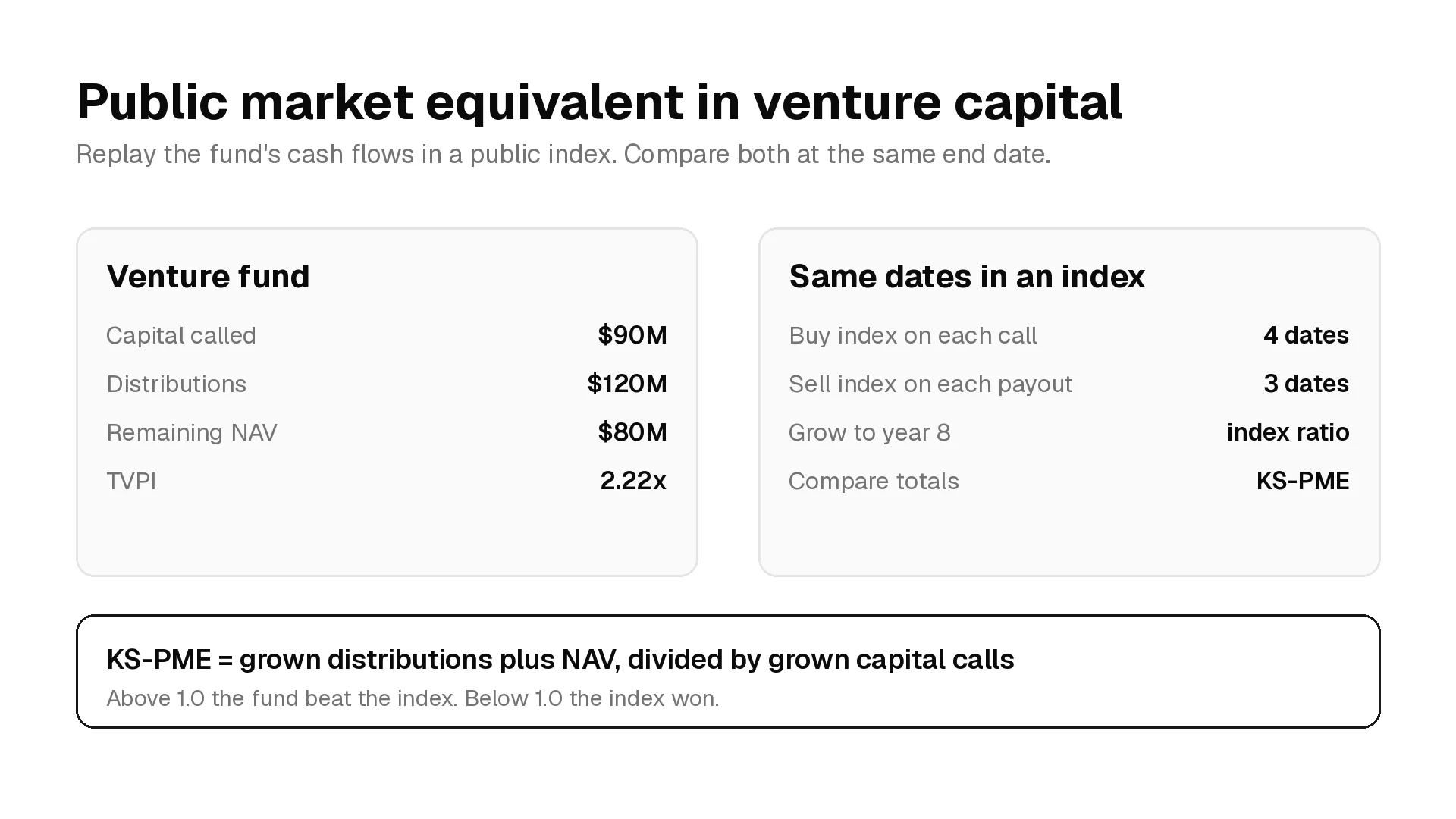
PME asks whether a venture fund beat a public index on the same cash-flow dates. A worked KS-PME and direct alpha example, five methods compared, current Cambridge Associates data, and what it means if you work at a VC firm.
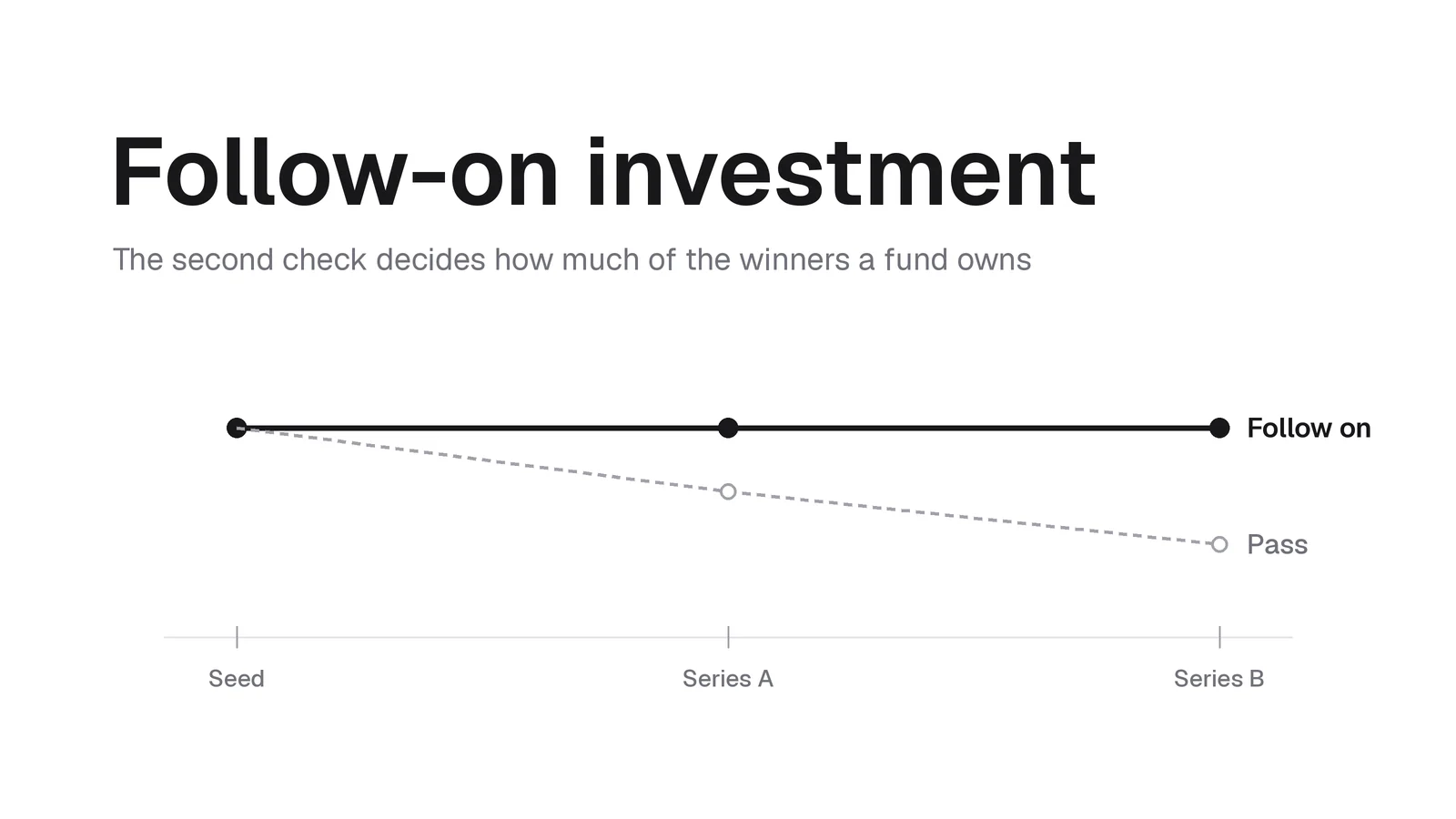
A follow-on investment is more capital from an existing investor in a company's later round. How pro rata, reserves, signaling, and the follow-on decision work, with two-round ownership math.
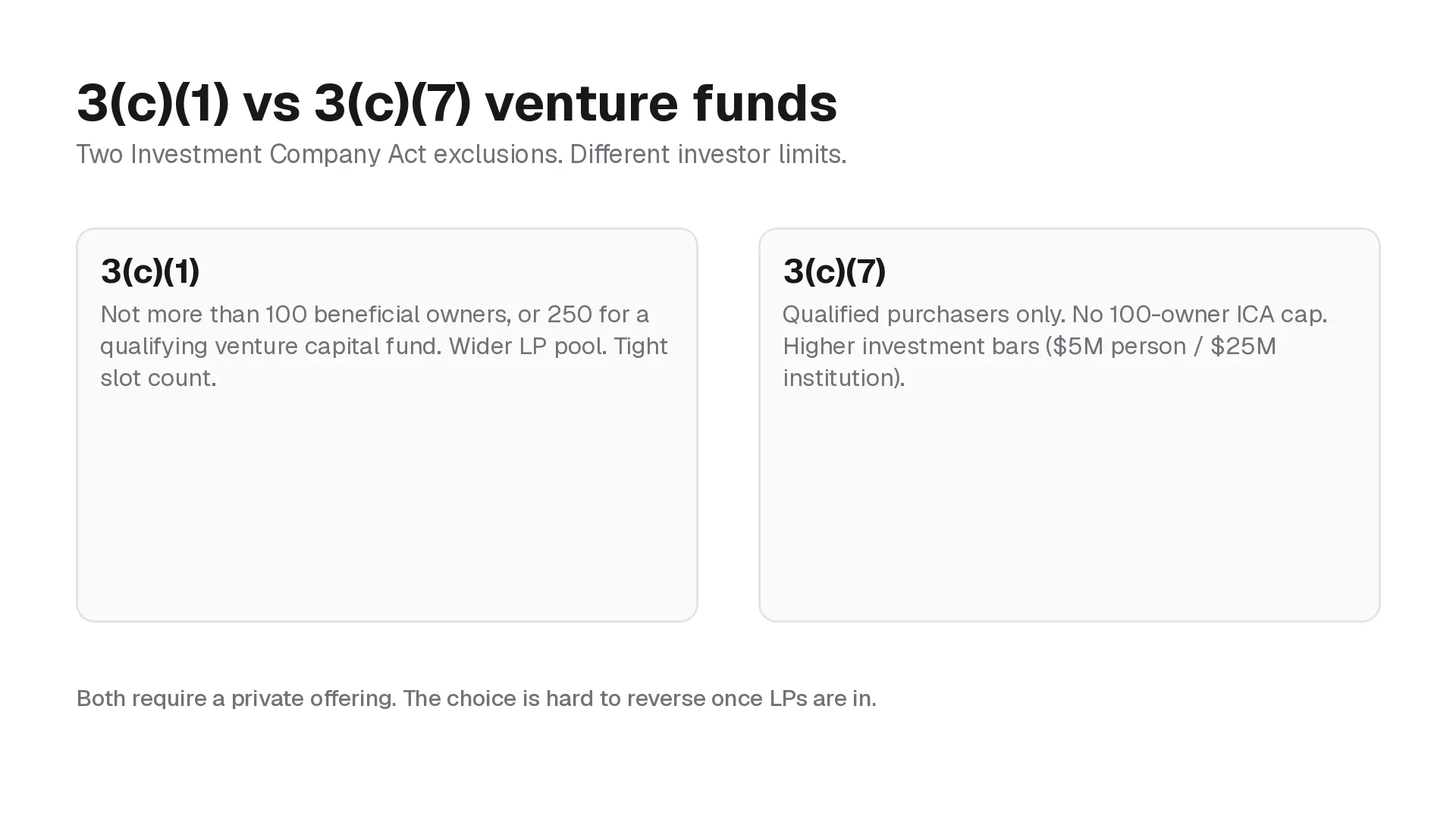
U.S. venture funds usually avoid Investment Company Act registration through 3(c)(1) or 3(c)(7). One caps how many people can own the fund. The other admits only qualified purchasers. Here is the difference, a worked slot example, and what it means for people who work at VC firms.