
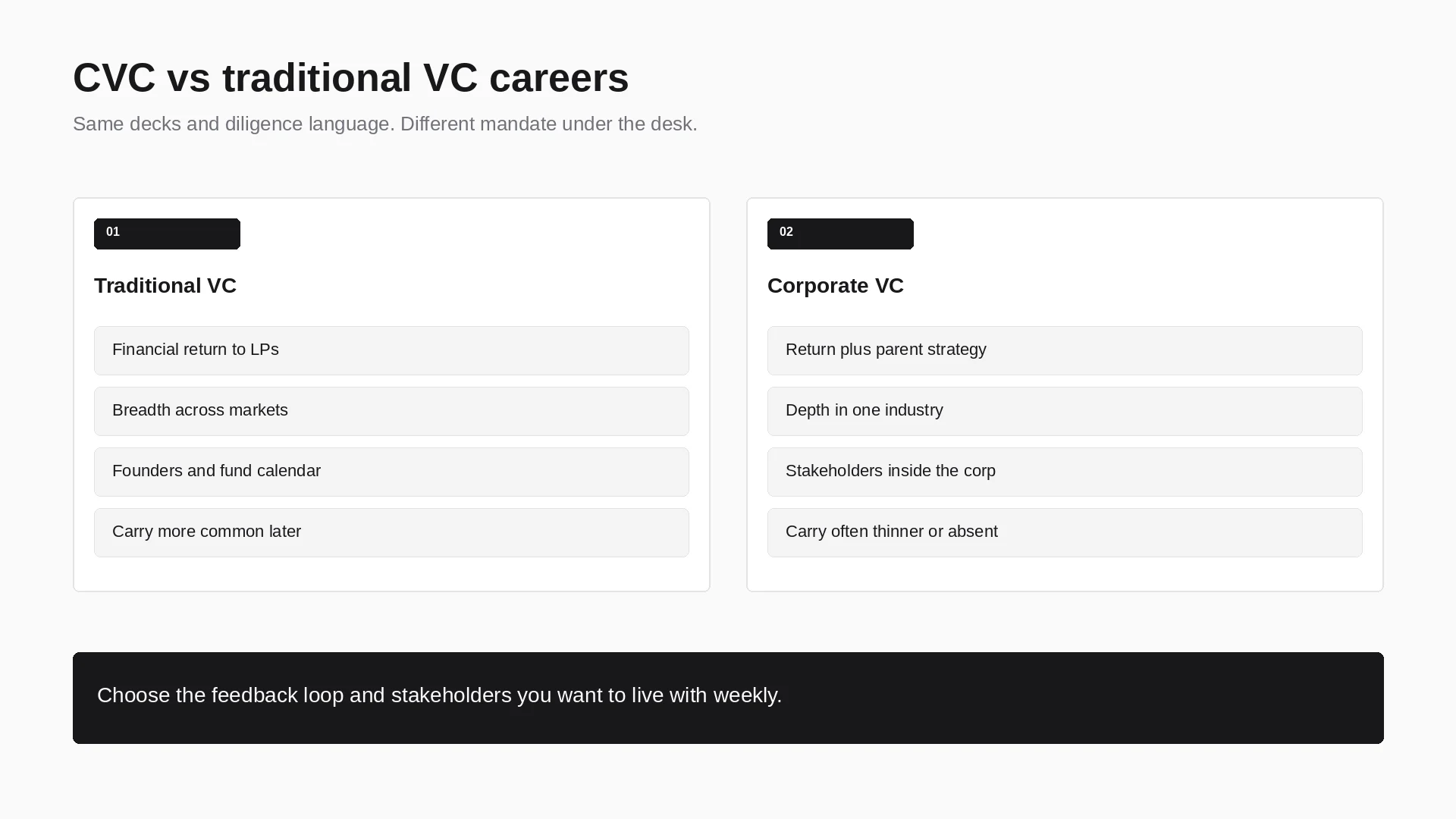
Traditional venture capital and corporate venture capital share the same vocabulary: decks, diligence, memos, founders, committees, and portfolios. The jobs diverge underneath that language. A traditional VC seat is built around financial returns for limited partners. A corporate venture capital seat still cares about return, but it also answers to a parent company with products, customers, distribution, and internal politics.
That mandate difference decides what you learn, who you work with, how long decisions take, whether carry is real, and which exit doors open later. Choose the seat for the work and feedback loop you want, not for the logo that looks best on a résumé.
If you need the financing definition first, read the sibling guide to corporate venture capital. This page is for candidates comparing careers.
Corporate venture capital vs venture capital at a glance
| Dimension | Traditional VC | Corporate venture capital (CVC) |
|---|---|---|
| Primary mandate | Financial return to fund LPs | Financial return plus strategic value for a parent company |
| Capital source | Fund raised from institutions, family offices, and other LPs | Parent balance sheet, dedicated CVC vehicle, or a fund with the parent as main LP |
| Core weekly craft | Source, screen, diligence, memo, invest, support portfolio companies | Same investing craft, plus internal stakeholders, commercial validation, and strategy alignment |
| Typical follow-up questions | Can this become a large outcome? What ownership and price make sense? | Those questions, plus: Can we become a customer, partner, channel, or acquirer? |
| Breadth vs depth | Often broader across sectors and business models | Often deeper inside the parent's industry and adjacency map |
| Fundraising exposure | Common as you get senior | Often limited if the parent is the only capital source |
| Carry | More common at senior levels, still highly variable | Often thinner, delayed, or absent outside more independent CVC funds |
| Best fit | You want an investing career centered on markets, founders, and portfolio construction | You want investing plus corporate strategy, industry depth, and platform access |
These are tendencies. A highly independent CVC fund can feel closer to traditional VC than a tightly controlled corporate "innovation investing" team. Compare the actual mandate, not the job title.
The mandate is the career
A traditional VC fund raises capital from limited partners and deploys it to produce fund-level returns. The investment conversation stays close to market size, team quality, product, distribution, competitive dynamics, ownership, dilution, reserves, and exits.
A CVC team can ask every one of those questions and then add another layer. Will this company teach the parent something about where the industry is going? Could the parent become a customer or distribution partner? Does the technology strengthen an existing product line? Would a future commercial relationship or acquisition create strategic value that a pure financial investor cannot offer?
That second layer is not decoration. It changes who needs to say yes, how long a process runs, what "value-add" means after the investment, and whether a deal dies because finance liked it but a business unit did not.
Candidates feel the mandate in two places: the investment memo and the calendar. In traditional VC, more of your week lives with founders, other investors, and portfolio companies. In CVC, more of your week may also live with product, strategy, corporate development, procurement, legal, and executives who do not think like fund managers.
Independent CVC funds vs business-unit teams
Not all CVC seats are the same. Before you optimize for "CVC versus VC," diagnose which CVC you are looking at.
More independent CVC funds often invest through a dedicated vehicle, lead or co-lead rounds, take board seats or observer rights, follow on with real reserves, and evaluate deals with a venture-like process. Compensation and culture can look closer to traditional VC, including some form of carry.
More integrated business-unit teams sit closer to corporate strategy or corporate development. Investments may need an internal sponsor. Themes track the parent's roadmap. Decision rights can sit with executives outside the investing team. The work still includes sourcing and diligence, but stakeholder management and commercial validation take more weight.
Neither model is automatically better. Independent funds usually teach cleaner investing craft and keep more optionality toward other VC seats. Business-unit teams can teach industry depth, corporate navigation, and partnership work that later helps in strategy, corpdev, or operator roles. The failure mode is accepting a title that says "venture" while the week is mostly internal slideware with no real deal ownership.
Day-to-day: same craft, different questions
An associate on either side can spend a morning reviewing a deck, mapping a market, speaking with a founder, building a memo, and preparing a committee discussion.
The fork appears in the questions that follow.
Traditional VC follow-ups usually stay inside the investment case:
- Why now for this market?
- What is the unfair distribution or product wedge?
- What ownership and price still leave room for a power-law outcome?
- What would make us pass even if we like the team?
CVC follow-ups often add:
- Which business unit cares, and who will sponsor the relationship?
- Can we pilot, distribute, or integrate without trapping the startup?
- Does this create competitive conflict with partners or customers?
- If the strategic story fades, is the financial case still good enough?
That difference rewards different instincts. Traditional VC rewards breadth, pattern recognition across markets, and comfort with long feedback loops. CVC rewards the ability to translate startup evidence into corporate language without watering down the investment judgment.
For a map of traditional investment-team roles, use the venture capital career path. For the skills firms test on either path, use the venture capital skills guide.
Who gets hired where
Traditional VC hiring still pulls heavily from banking, consulting, growth equity, startups, product, research, and founder networks. Direct undergrad and MBA hiring exists, but many seats want evidence you can source, judge, or help founders before the firm pays you to learn the job.
CVC hiring can look broader because the strategic layer values industry and operating context. Corporate strategy, corporate development, product, business development, engineering, and sector operators can all be relevant, especially for business-unit teams. Highly independent CVC funds often recruit more like traditional VC shops.
If you are coming from a corporate seat, CVC can be a bridge into investing without pretending you already have a decade of fund experience. If you are coming from banking or consulting and want the purest investing apprenticeship, a traditional fund or a clearly independent CVC is usually the cleaner bet.
Compensation, hours, and carry
Do not choose between the seats from a single salary screenshot. Cash pay varies by geography, seniority, fund size, and whether the CVC behaves like a fund or a corporate department.
The structural difference that matters most is upside. Traditional VC may offer carried interest at more senior levels, with all the usual caveats around vesting, fund performance, team allocation, and departure terms. Many CVC groups pay little or no carry, or award it under corporate rules that feel different from fund economics. Some independent CVC funds are exceptions. Ask for documents, not slogans.
Hours are often slightly more contained in corporate-attached teams because there is less evening founder networking and less travel tied to a personal brand. That is a tendency, not a promise. A lean independent CVC covering a hot sector can still run long weeks.
For directional cash and package structure on the traditional side, use the venture capital salary guide. For how carry actually works when it exists, use the carried interest guide.
Exit opportunities
Traditional VC exits include other funds, operating roles at startups, later-stage investing, platform leadership, and, for a minority, partner tracks or fund formation. Brand, network, and investment attribution matter a lot.
CVC adds corporate doors: strategy, corporate development, innovation, partnerships, and sometimes product-adjacent roles inside the parent. Moving from a little-known CVC team into a top traditional fund is harder than moving from a recognized independent CVC brand. Treat the logo, deal ownership, and references as part of the offer, not as afterthoughts.
If your long-term goal is to become a partner at a traditional firm, bias toward seats where you lead work on real investments, build founder relationships, and can explain your judgment in public. If your long-term goal is industry leadership inside a corporation or a corpdev path, a strong CVC seat can be the more direct apprenticeship.
How to screen a CVC or VC job posting
Use this checklist before you fall in love with a title.
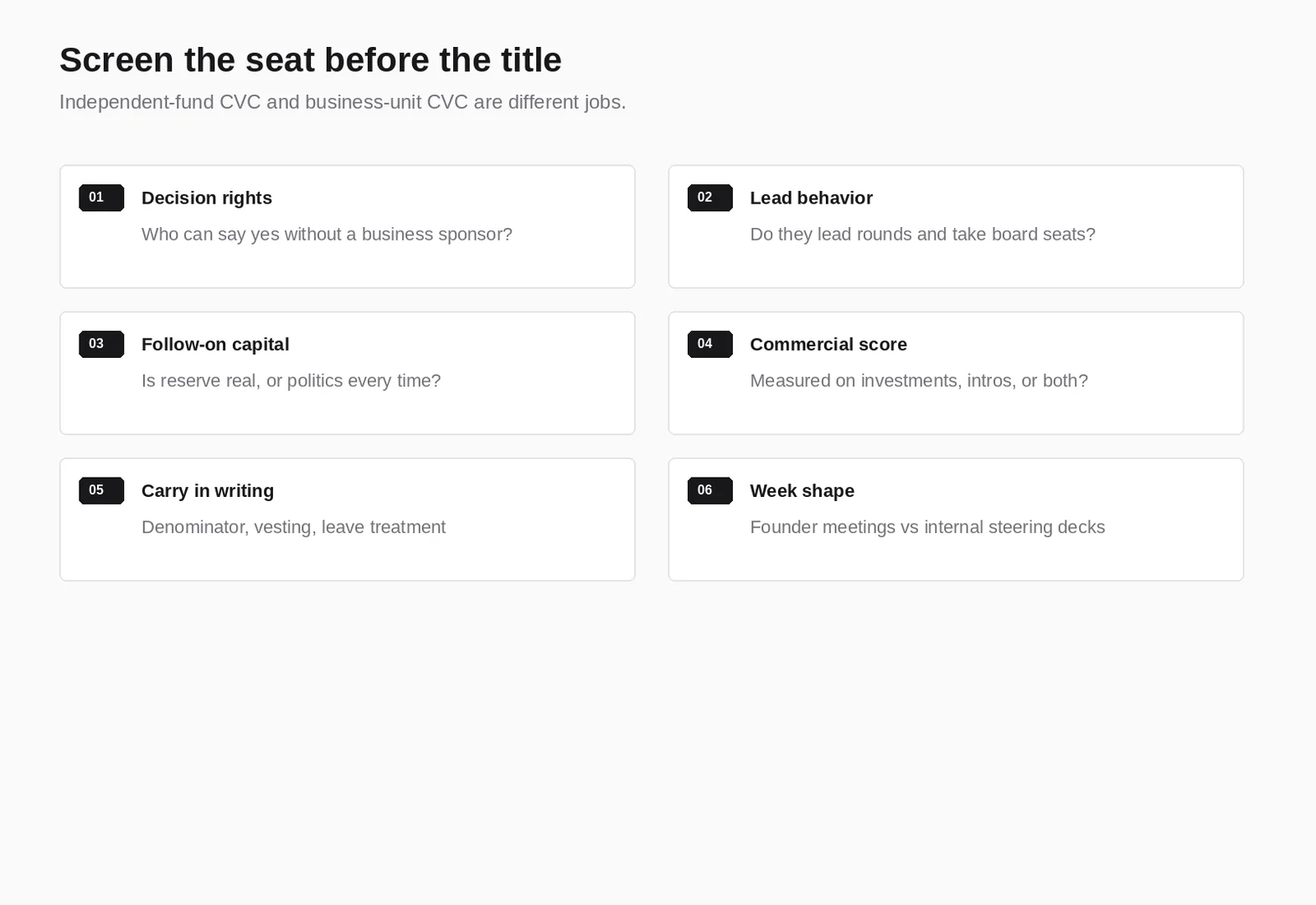
- Capital and decision rights. Is there a fund, a balance-sheet budget, or both? Who can say yes without a business-unit sponsor?
- Lead vs follow. Does the team lead rounds, write meaningful checks, and take board or observer seats?
- Theme flexibility. Are themes fixed to the parent's roadmap, or can conviction pull the team into adjacent markets?
- Follow-on capacity. Is there reserved capital, or does every follow-on restart internal politics?
- Commercial expectations. Are you measured on investments, on introductions into the parent, or on both?
- Carry and vesting. Is carry in writing? What is the denominator, vesting, and treatment if you leave?
- Week shape. Ask for a real calendar sample: founder meetings versus internal steering decks.
- Attribution. Who gets credit on memos, board seats, and sourcing? Ambiguity here predicts politics later.
Traditional VC postings deserve the same skepticism on stage, check size, partner access, and whether "associate" means investing seat or glorified sourcing contractor. Browse live roles on the Venture Capital Careers job board and research firms in the companies directory before you optimize for a label.
Decision scorecard
Choose traditional VC if most of these are true:
- You want breadth across markets more than depth inside one corporate roadmap.
- You are optimizing for an investing career and eventual fund economics.
- You want your calendar weighted toward founders, other investors, and portfolio work.
- You can tolerate slow feedback and ambiguous attribution.
Choose CVC if most of these are true:
- You want industry depth and proximity to an operating company.
- Your background already sits near strategy, product, corpdev, or a sector the parent cares about.
- You value platform access for diligence and portfolio support.
- You understand the strategic layer and still want real investment ownership.
A third answer is sequencing. Some people use a strong CVC seat to enter investing, then move to a traditional fund. Others use traditional VC to build judgment, then join a CVC with clearer strategic influence. The sequence only works if the first seat teaches transferable craft: sourcing, memos, decision quality, and founder trust.
Frequently asked questions
Is corporate venture capital the same as traditional venture capital?
No. Both can buy startup equity, but CVC also answers to a parent company's strategic goals. That changes stakeholders, process speed, and often compensation. The corporate venture capital guide covers the investor definition in more detail.
Is CVC a good career path?
It can be, when the team has a clear mandate, real decision authority, meaningful deal flow, and a parent that helps portfolio companies without distorting judgment. It is weaker when the title says venture but the week is mostly internal alignment with no ownership of investments.
Can I move from CVC to a traditional VC firm?
Yes, especially from independent CVC brands where you owned diligence, memos, and founder relationships. Bring proof of judgment, not only proof that you survived corporate process.
Can I move from traditional VC to CVC?
Yes. Funds sometimes hire investors who want industry depth, more stable capital, or closer operating exposure. Be ready to explain why the strategic layer appeals to you rather than sounding like you are escaping fundraising pressure.
Which pays more, CVC or traditional VC?
Junior cash can favor either side depending on the parent and the fund. Senior upside usually favors traditional VC when carry is real. Verify documents for the specific seat.
Next step
If you are still deciding, pick five traditional funds and five CVC teams in your target sector. For each, write five lines: mandate, check size, lead behavior, decision rights, and what a strong associate would own in year one. Then browse open roles and apply only where the calendar and economics match the seat you actually want. For a week-by-week search system, use how to get a job in venture capital.
Related posts

Deal flow is the stream of investment opportunities a venture firm receives and the funnel that sorts them. For every deal closed, firms consider about 101 companies.
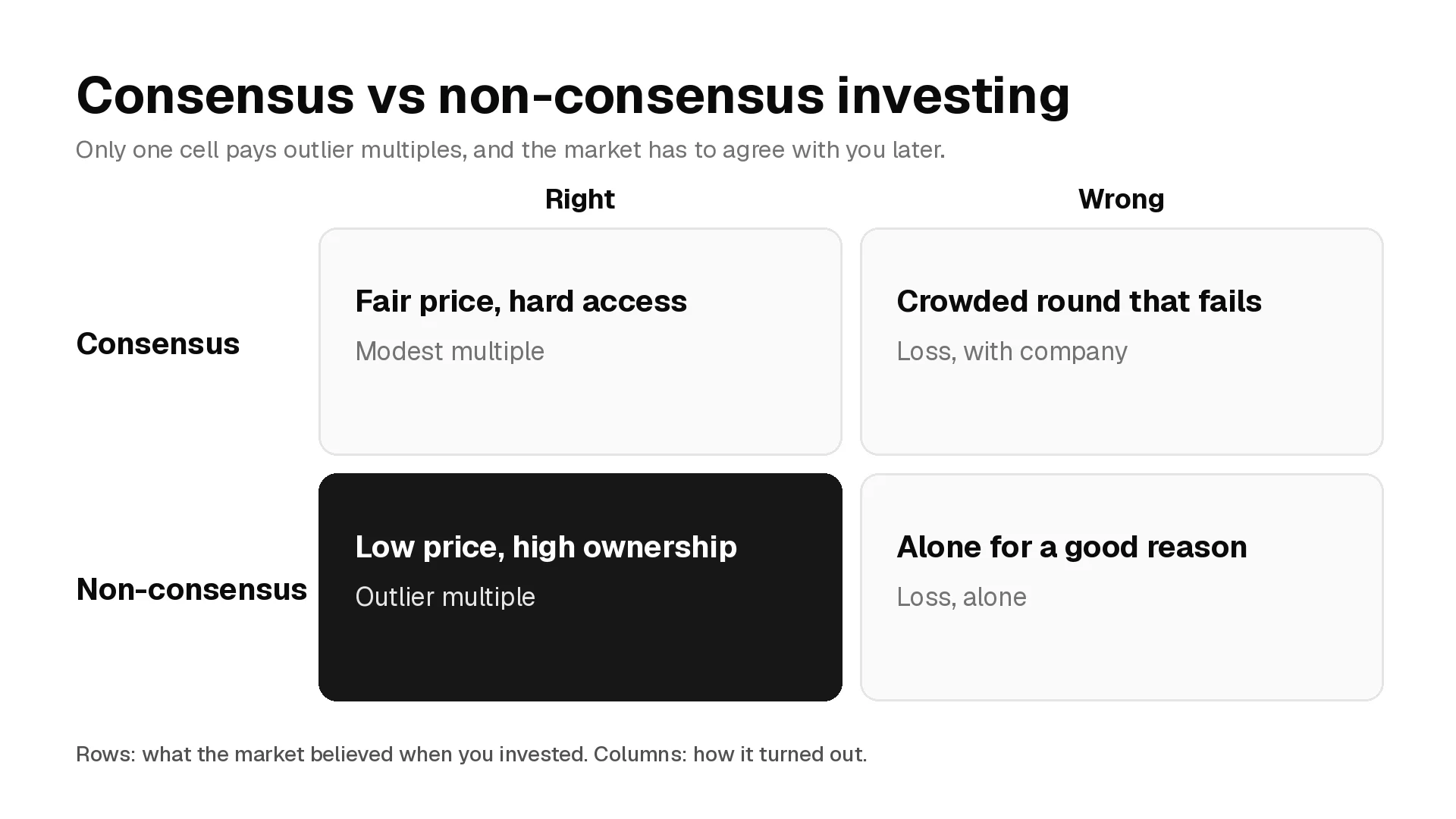
Non-consensus investing means backing a company most investors have passed on or not yet seen, for a reason you can state and test. How the 2x2 works, why firms drift toward consensus, how investment committees vote, and how analysts and associates bring a non-consensus deal.
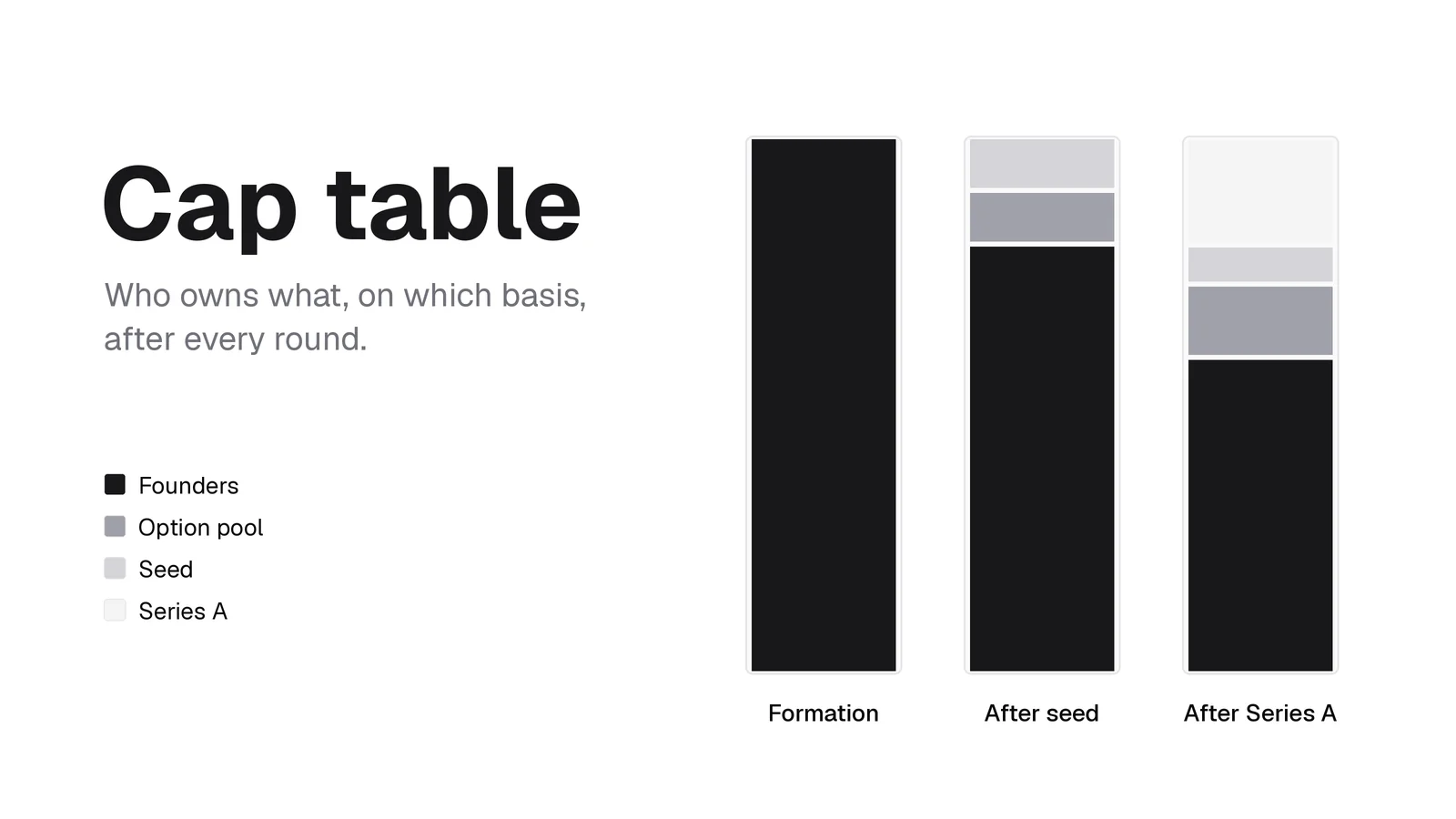
A cap table records who owns a company's shares, options, warrants, and convertible securities, and what percentage each holder owns on a stated basis.