Entrepreneur in Residence: Role, Salary, and Career Path in Venture Capital
Learn what an entrepreneur in residence does at a venture capital firm, how EIR roles work, what compensation can look like, and how to find EIR jobs.
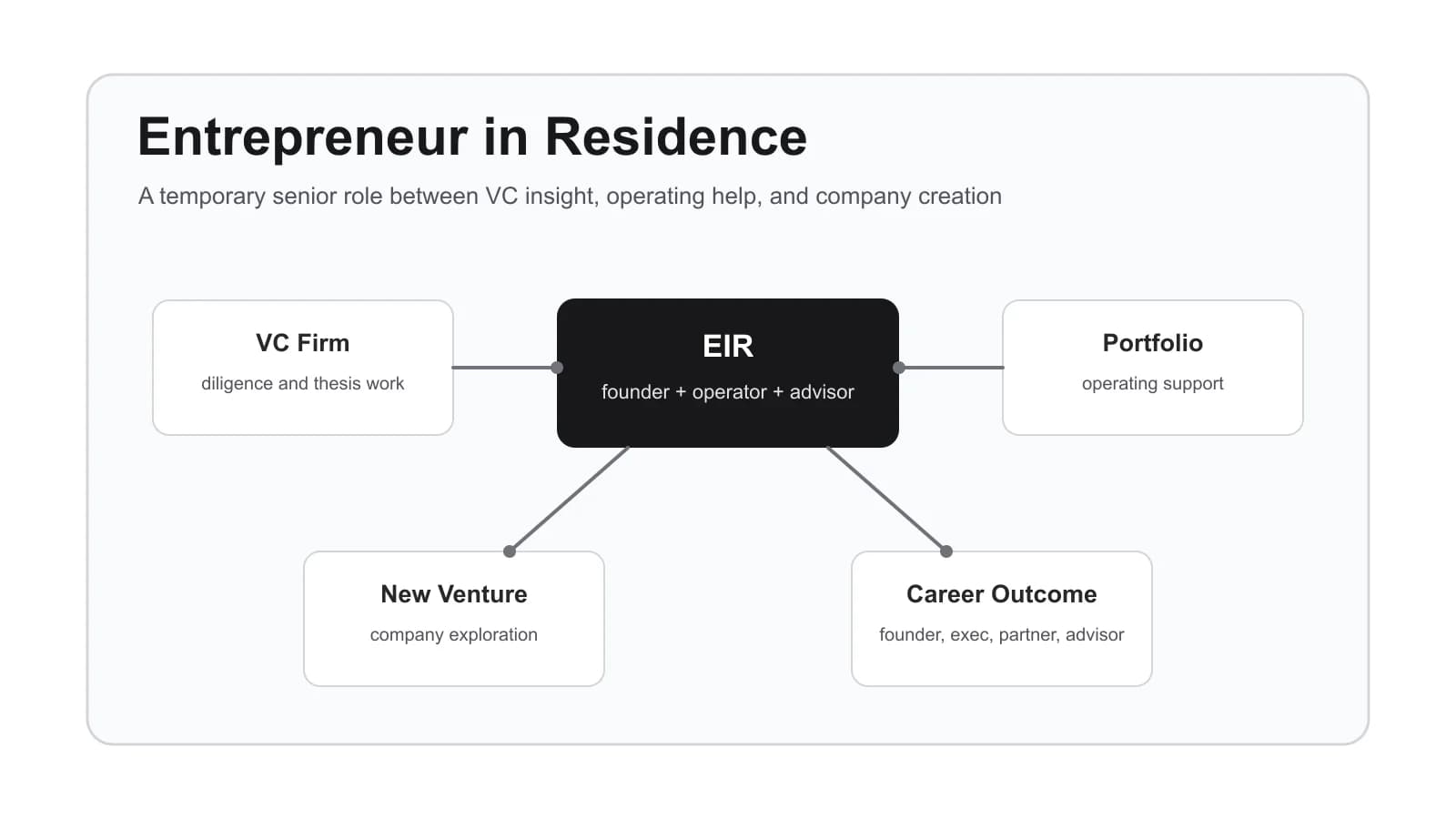
An entrepreneur in residence, often shortened to EIR, is an experienced founder, operator, or executive who works with a venture capital firm, accelerator, university, venture studio, or company for a limited period. In venture capital, the role usually sits between investing, portfolio support, company creation, and the entrepreneur's own next move.
The title sounds simple, but it is used in several different ways. One EIR may spend six months developing a new startup idea with a VC firm's support. Another may help portfolio companies with go-to-market, hiring, product strategy, or fundraising. A third may be a senior operator who is available for interim leadership roles. That ambiguity is why candidates should read the mandate carefully before treating any EIR role as a standard job.
For Venture Capital Careers readers, the practical question is not only "what is an entrepreneur in residence?" It is whether the role fits your background, how firms evaluate EIR candidates, and where to find roles that are often filled through relationships before they ever reach a public job board.
What is an entrepreneur in residence?
An entrepreneur in residence is a temporary role for an experienced builder who brings operating judgment, founder credibility, and network access to an institution. At a VC firm, an EIR may evaluate markets, advise portfolio companies, help diligence investments, explore a new company, or prepare to join a portfolio company as an executive.
Most EIR roles have three traits:
- They are senior. Firms usually expect founder, executive, product, go-to-market, or sector expertise.
- They are temporary or transitional. The role often lasts months, not years.
- They are flexible. The exact work depends on the fund, the entrepreneur, and the opportunity being explored.
That flexibility is useful, but it also makes the title easy to misuse. A true VC EIR role should have a clear reason to exist: new company formation, portfolio company support, investment diligence, executive placement, or a defined strategic project.
What does an EIR do at a VC firm?
At a venture capital firm, an EIR is usually not a junior investing role. The firm is paying for judgment, credibility, and operating pattern recognition that the existing team does not fully have.
Common EIR work includes:
- Developing a new startup idea in a thesis area the fund cares about.
- Meeting founders and helping the investment team understand a market.
- Advising portfolio companies on hiring, product, sales, partnerships, fundraising, or strategy.
- Helping diligence potential investments in the EIR's area of expertise.
- Taking interim or permanent leadership roles in portfolio companies.
- Building relationships with founders, executives, customers, and future co-founders.
The best EIR arrangement is specific. "Help with startups" is vague. "Explore vertical AI opportunities in healthcare operations, support two portfolio companies on enterprise sales, and evaluate whether to start a company in the fund's thesis area" is much clearer.
Types of entrepreneur-in-residence roles
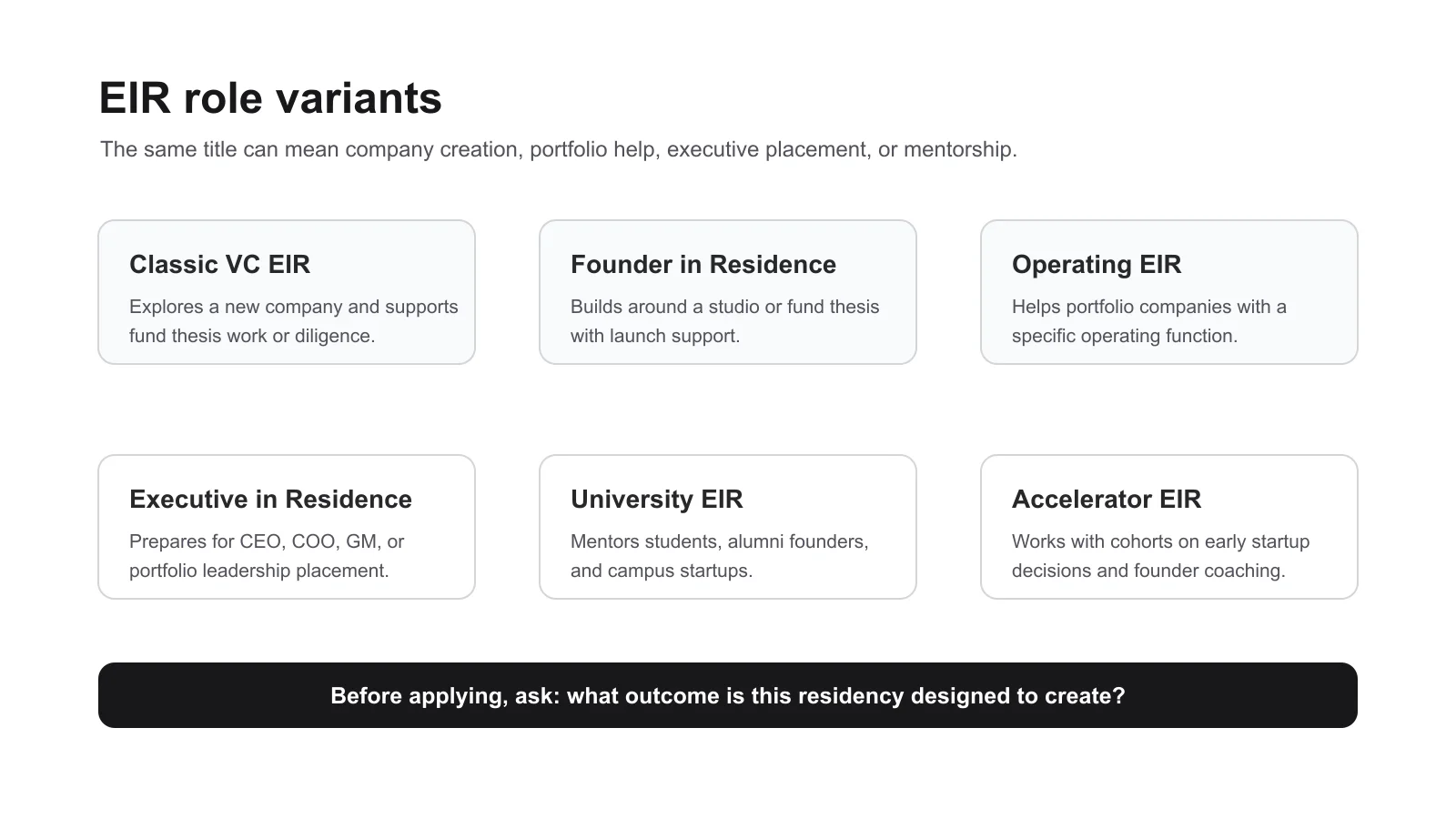
Search results mix several EIR meanings together. Before applying, identify which version the role actually is.
| EIR type | Typical home | Core work | Best fit |
|---|---|---|---|
| Classic VC EIR | Venture capital fund | Explore a new company, support diligence, advise portfolio companies | Former founder or senior operator considering a next venture |
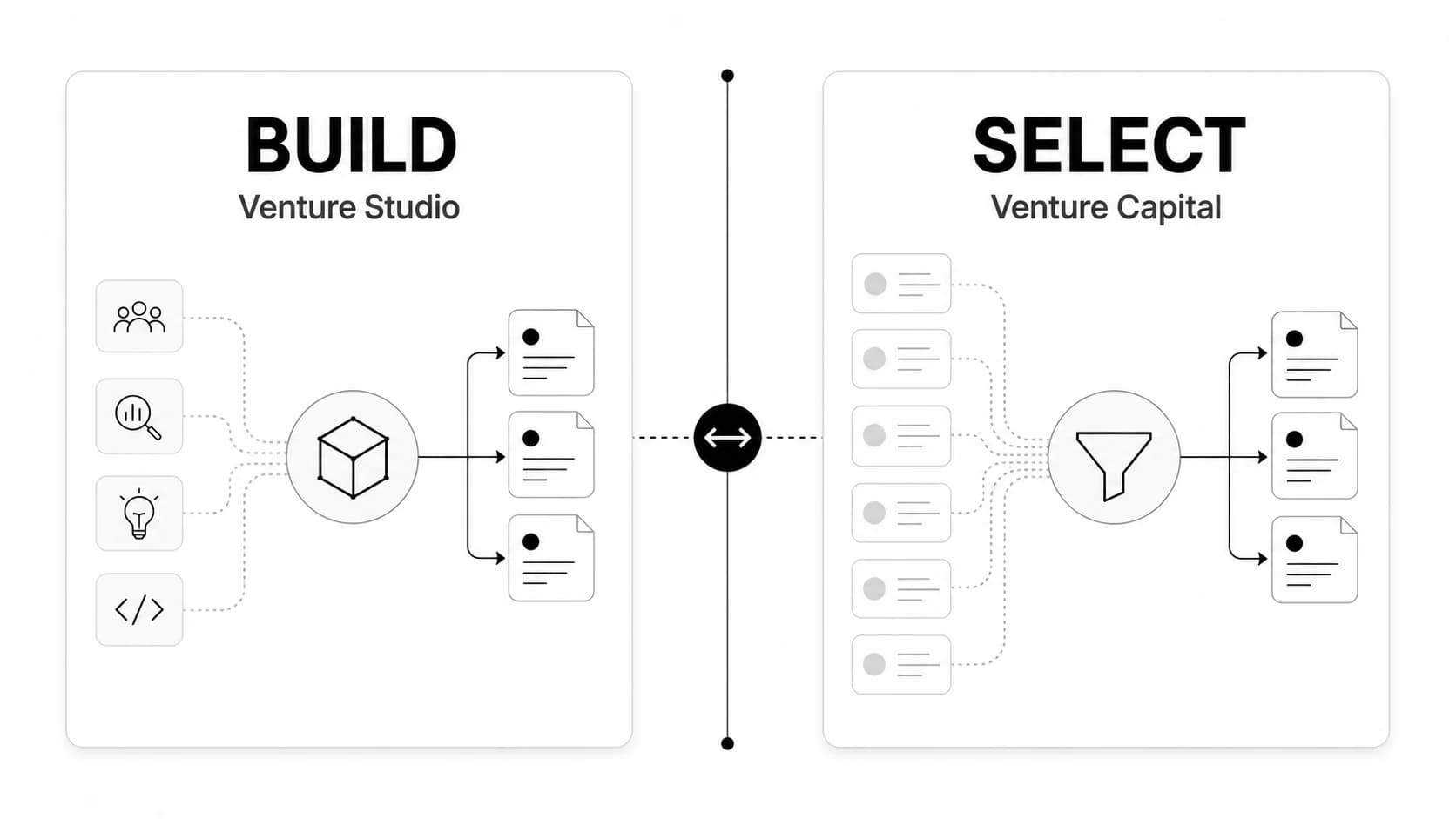
| Founder-in-residence | Venture studio or company builder | Build a company around a predefined thesis | Founder-ready operator who wants structured ideation and launch support |
| Operating EIR | VC fund or portfolio platform | Help portfolio companies solve a specific operating problem | Functional leader in sales, product, talent, finance, or go-to-market |
| Executive-in-residence | VC fund, PE firm, or portfolio company | Prepare for CEO, COO, GM, or board-adjacent placement | Senior executive with company-scaling experience |
| University EIR | University entrepreneurship center | Mentor students, founders, and alumni | Founder/operator who wants teaching and advising work |
| Accelerator EIR | Accelerator or startup ecosystem program | Mentor early founders and support program cohorts | Broad startup mentor with early-stage pattern recognition |
These roles can overlap. The important question is where the role creates value. A VC-fund EIR usually creates value through company creation, portfolio support, or investment insight. A university EIR often creates value through mentorship. A venture studio founder-in-residence may be expected to become the founding CEO of a company that the studio helps launch.
EIR vs venture partner, operating partner, platform, and advisor
EIR is often confused with nearby VC titles. The differences matter because the work, authority, economics, and hiring criteria can be very different.
| Role | Main purpose | Usually permanent? | Typical authority |
|---|---|---|---|
| Entrepreneur in residence | Explore, build, advise, or transition into a company | Usually no | Project, advisory, or company-building authority |
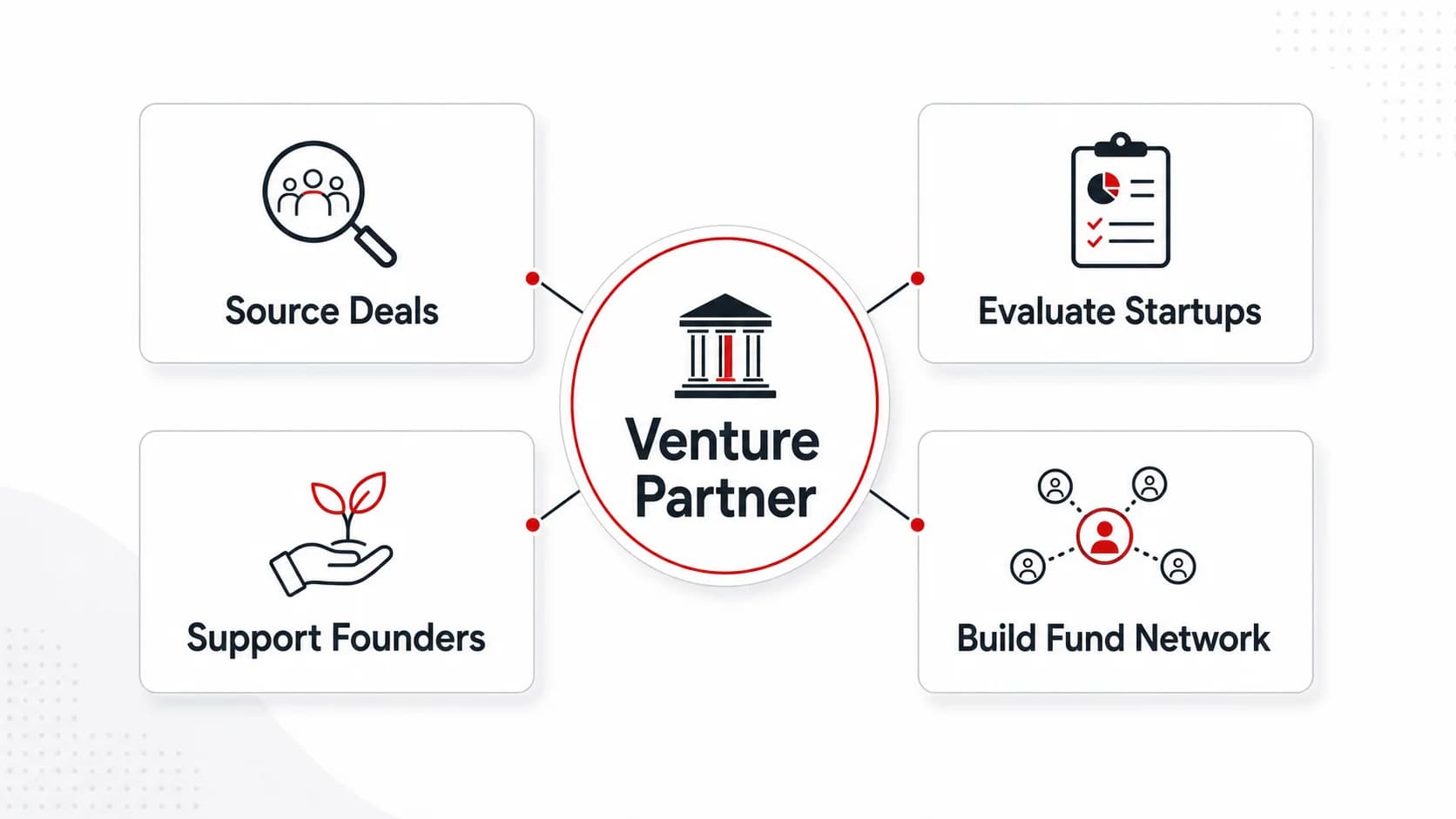
| Venture partner | Source deals, advise the fund, and sometimes represent the firm externally | Sometimes | Deal sourcing and network influence; voting varies |
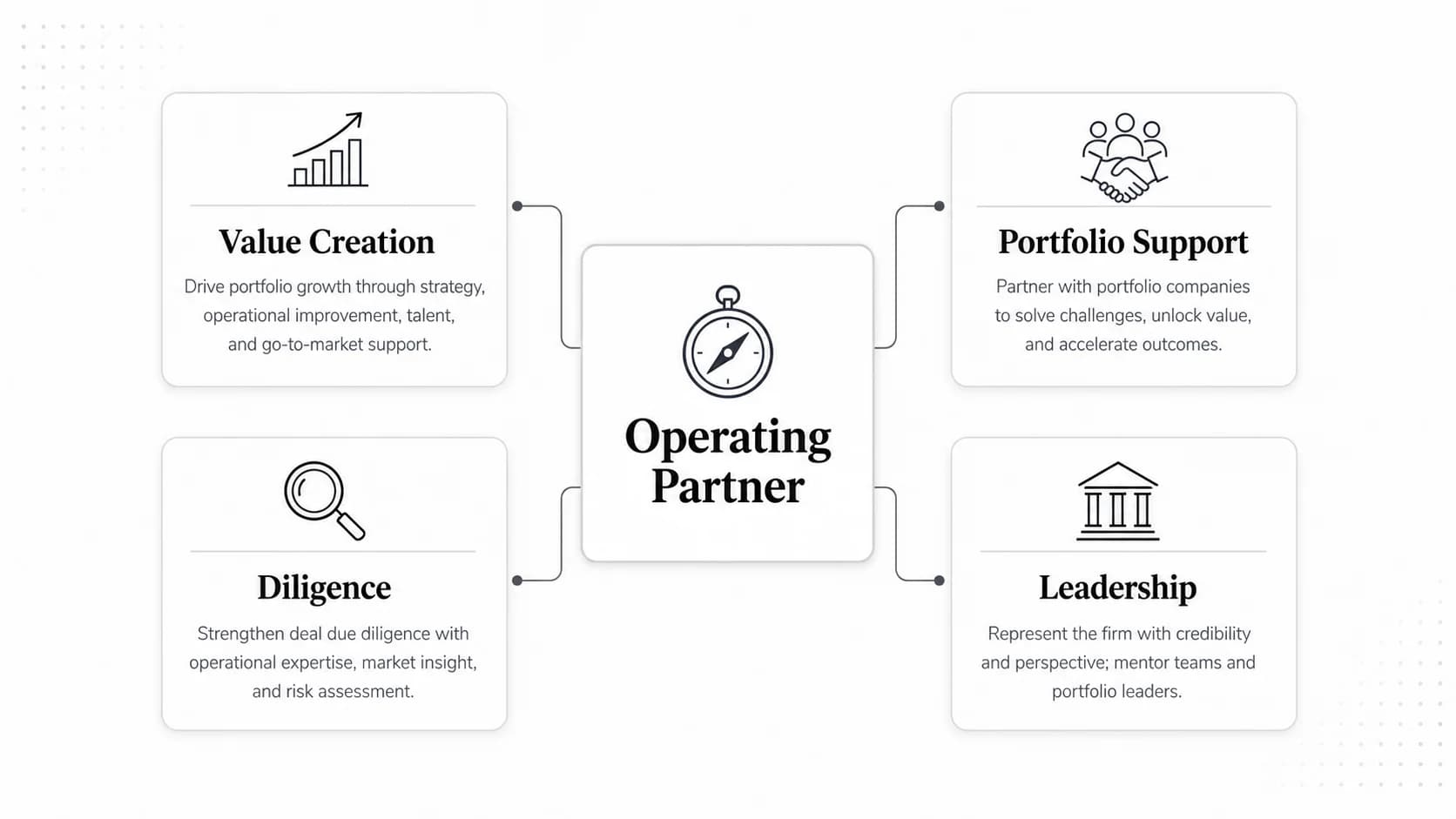
| Operating partner | Improve portfolio company operations or support diligence | Often more durable | Functional operating authority, usually advisory to portfolio companies |
| Platform role | Build services, community, talent, marketing, or portfolio programs | Yes | Program ownership and portfolio support |
| Advisor | Provide narrow expertise or network access | Usually flexible | Limited advisory scope |
If the role is mostly deal sourcing, it may be closer to a venture partner role. If it is mostly portfolio support, compare it with a VC operating partner job description or venture capital platform role. If it is a senior investing seat with partnership responsibilities, compare it with the venture capital partner job description.
Do entrepreneurs in residence get paid?
Many EIR roles are paid, but compensation varies widely because the role is not standardized. A VC EIR may receive a salary, stipend, consulting fee, office resources, health benefits, expense support, or none of those if the arrangement is informal. Some roles include equity in a new company if one is formed. Carry or fund economics are less common and should not be assumed.
The practical compensation question is: what is the EIR being paid to do?
- If the firm expects a regular weekly commitment, portfolio work, diligence support, or operating projects, compensation should be explicit.
- If the role is mainly a soft landing while the entrepreneur explores a new company, the economics may focus on support, access, and potential seed investment.
- If the role is tied to a venture studio, equity in the eventual company may matter more than salary.
- If the role is mostly mentorship at a university or accelerator, compensation may be modest or event-based.
Candidates should clarify time commitment, exclusivity, IP ownership, outside consulting rules, investment rights, and what happens if a company is formed. Those terms matter more than the title.
Who is a good fit for an EIR role?
EIR roles are usually not entry-level VC jobs. They fit people who can bring an institution something it cannot get from a generalist investor or junior operator.
Strong candidates often have:
- Founder experience, even if the prior company was not a massive exit.
- Senior operating experience in a sector the fund cares about.
- Clear functional expertise, such as enterprise sales, product-led growth, fintech compliance, healthcare operations, AI infrastructure, talent, or marketplaces.
- A credible network of founders, executives, customers, and future hires.
- Enough ambiguity tolerance to work without a clean job description.
- A real thesis or exploration area, not just a desire to "break into VC."
The role is usually weaker for candidates who want a predictable analyst-to-associate path, formal training, or a clear promotion ladder. If your target is a traditional investing role, start with the venture capital career path, build a focused VC resume, and evaluate open roles on the Venture Capital Careers job board.
How to become an entrepreneur in residence
Most people become EIRs because a fund, studio, or ecosystem already trusts their judgment. The path is usually relationship-driven.
A practical path looks like this:
1. Build a clear wedge. Know the market, function, or company type where your operating experience is strongest. 2. Package your thesis. Write a short memo on what you believe, where the opportunities are, and what you can help a fund or portfolio company see earlier than others. 3. Map relevant firms. Use the VC companies directory to identify funds that match your sector, stage, geography, and operating background. 4. Start with value, not a job ask. Offer market notes, founder referrals, customer insight, or portfolio help before asking whether the firm has an EIR seat. 5. Target title variants. Search for EIR, entrepreneur in residence, founder in residence, executive in residence, venture builder, operating partner, venture partner, and portfolio operator. 6. Validate the mandate. Before accepting, confirm the role's goals, duration, compensation, IP terms, investment rights, and success criteria.
Because many EIR roles are custom, the best opening may be a conversation rather than a posted job. Public listings still matter, but they are only one channel.
How to find EIR jobs
Start with targeted search, then use relationship-led outreach.
Use the Venture Capital Careers job board for open venture roles, and broaden your search to adjacent titles. A firm may not call the role "EIR" even when the work is similar. Also search firm career pages, venture studios, accelerators, university entrepreneurship centers, and portfolio job boards.
When reviewing a listing, look for concrete signals:
- Does the role mention company creation, thesis exploration, or a portfolio-company placement path?
- Is the sector or function defined?
- Does the firm describe duration, compensation, and reporting line?
- Is the expected outcome a new company, portfolio support, investment diligence, or executive placement?
- Does the role require founder experience, operating depth, or a specific network?
If those details are missing, ask. A vague EIR listing can hide a strong custom role, but it can also hide an unpaid advisory arrangement with unclear expectations.
Guidance for employers writing an EIR job post
If you are hiring an EIR, be precise about why the title is the right one. Candidates will evaluate whether the role is real, paid, and senior enough for their background.
Include:
- The role type: classic EIR, founder-in-residence, operating EIR, venture studio founder, executive-in-residence, or mentor EIR.
- The expected duration and weekly time commitment.
- The operating domain or thesis area.
- Whether the EIR will work with the investment team, portfolio companies, new company creation, or all three.
- Compensation structure and any equity, investment, or IP terms that can be disclosed.
- The likely next step after the residency.
If the role is actually a full-time portfolio operator, use that title. If the role is deal sourcing and external representation, consider venture partner. If the role is programmatic portfolio support, use platform. Clear titles attract better candidates.
Employers can post a venture capital job and describe the mandate directly.
FAQ
Is entrepreneur in residence a real job?
Yes, but it is not always a standardized job. Some EIR roles are paid, structured positions. Others are flexible advisory or exploration arrangements. The mandate, compensation, time commitment, and next step matter more than the title.
What does EIR mean in venture capital?
In venture capital, EIR usually means a founder, operator, or executive temporarily affiliated with a fund. The EIR may help evaluate markets, advise portfolio companies, support diligence, build a new company, or prepare for a leadership role.
How long does an EIR role last?
Many EIR roles last around six to twelve months, but there is no universal rule. Some are shorter project-based arrangements, and some evolve into founder, executive, partner, advisor, or portfolio company roles.
Is an EIR an investor?
Sometimes, but not necessarily. An EIR may help the investment team, but the role usually does not carry the same authority as a partner unless the agreement says so. Some EIRs are closer to operators, company builders, or advisors.
Do EIRs get equity?
Sometimes. Equity is most relevant when the EIR helps create or joins a new company. It is less automatic in fund advisory or university mentor roles. Candidates should clarify equity, IP, and investment rights before accepting.
Can an EIR role help you get into venture capital?
It can, especially for senior operators and founders who want exposure to fund work. It is usually not the best entry-level path for analysts or recent graduates. For traditional investing roles, focus on VC analyst, associate, platform, or portfolio roles first.