
A venture capital coffee chat is a 20-to-30-minute conversation where you show that you can talk about a firm, a market, and a role with the same specificity an investor uses at work. It is not a first-round interview, a founder pitch, or a request for a job. The useful ones are prepared, short, and specific. You bring one point of view, ask questions the firm's website cannot answer, and leave with a next step that does not spend the other person's reputation.
If you still need the meeting, use the venture capital networking system and the networking email templates. The conversation itself starts after the calendar invite exists.
What a VC coffee chat actually is
Most people treat "coffee chat" as one thing. In venture it is at least four different meetings that share a name.
| Meeting | Who it is for | What success looks like | What it is not |
|---|---|---|---|
| Candidate coffee chat | You, trying to understand a firm or role | You leave with a clearer map of the work, one useful contact, and a reason to follow up | A scored interview |
| Informational interview | Same, usually more structured | You test whether the role matches your background | A backdoor application |
| First-round screen | The firm, evaluating you | They decide whether to spend more partner time | Casual networking |
| Founder coffee | An investor screening a company | The investor learns whether the team is worth a second meeting | Your career conversation |
If someone from a fellowship, student fund, or recruiting process booked "coffee," assume it is closer to a screen until they prove otherwise. Prepare as if judgment is being tested. Stay human. Do not pull out a deck.
The candidate version has a simple job: become a specific, useful person in a small market. Volume of chats does not do that. One conversation where you understood the firm's actual mandate beats five generic "how did you break in" calls.
Prepare in 30 minutes
You do not need a research binder. You need enough context to stop asking questions Google already answered.
In 30 minutes, write this down:
- Fund stage and typical check size.
- Two recent investments and why they might fit.
- The person: current title, last role before this one, anything they have written or said in public.
- One question only they can answer.
- One point of view you can defend in two minutes: a company, a market pattern, or a product change you have actually seen.
Use the companies directory to confirm stage, geography, and team. Then read the firm's own site and one recent portfolio announcement. If you cannot explain why this person is the right 20 minutes, you are not ready.
Leave the resume at home unless they asked for it. A printed CV turns a research conversation into an audition. Bring a notebook. Bring the one POV. That is enough.
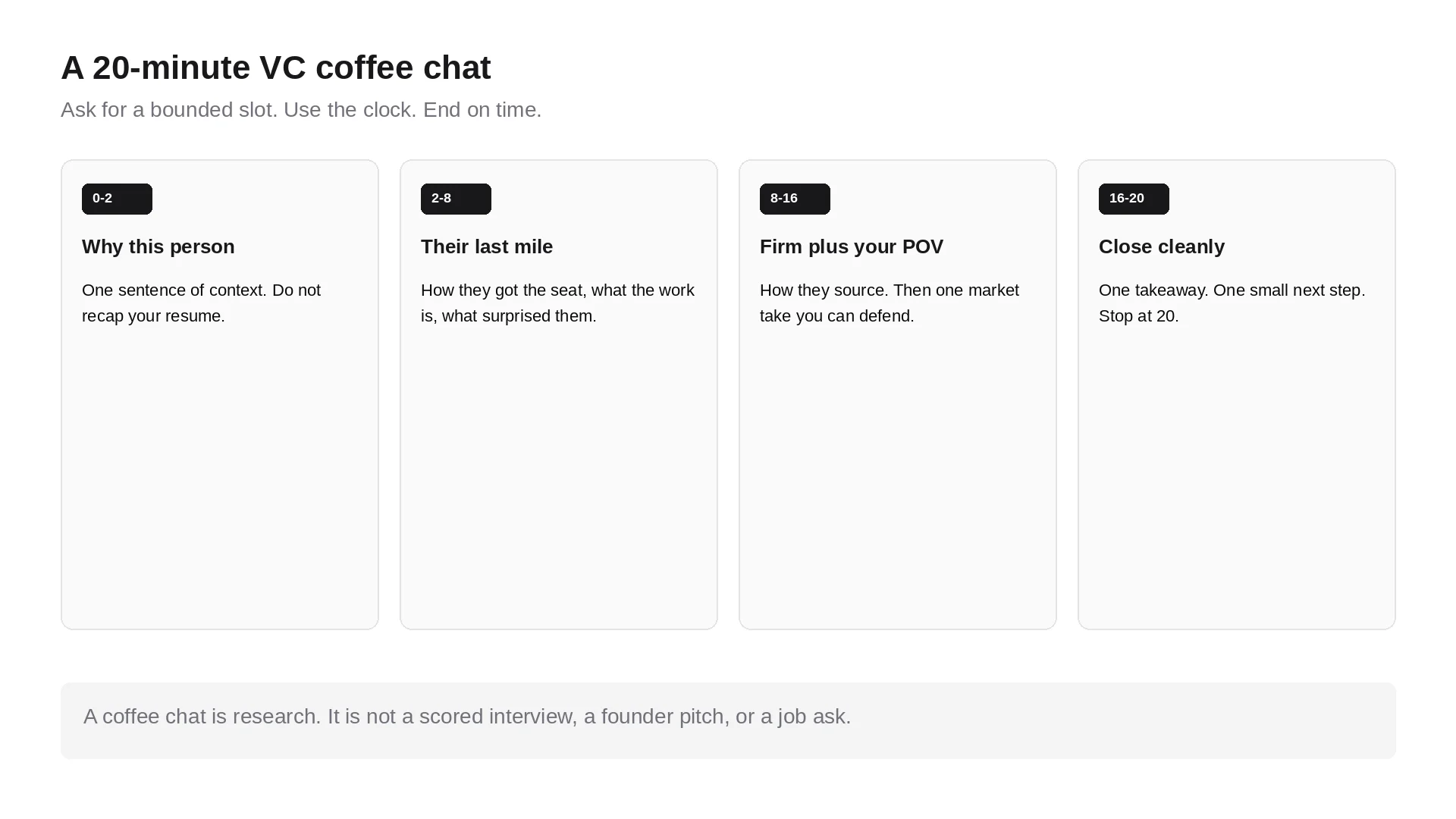
A 20-minute agenda
Ask for 20 minutes, not 45. Busy investors say yes to a bounded slot. They resent an unbounded "pick your brain."
Use the clock on purpose.
| Minutes | What happens | Your job |
|---|---|---|
| 0-2 | Why this person, why now | One sentence of context. Do not recap your entire resume. |
| 2-8 | Their last mile into this seat | How they got the role, what the work actually is, what surprised them. |
| 8-16 | Their firm plus your point of view | How they source, what they underwrite, then your one market observation. |
| 16-20 | Close | Thank them, name one takeaway, ask for one small next step. End on time. |
If they want to drive, let them. The agenda is a backup, not a script you force through.
On video, test audio first and keep the camera on. In person, arrive five minutes early and sit where you can hear. Neither format needs a costume. Look like someone who could walk into the office afterward.
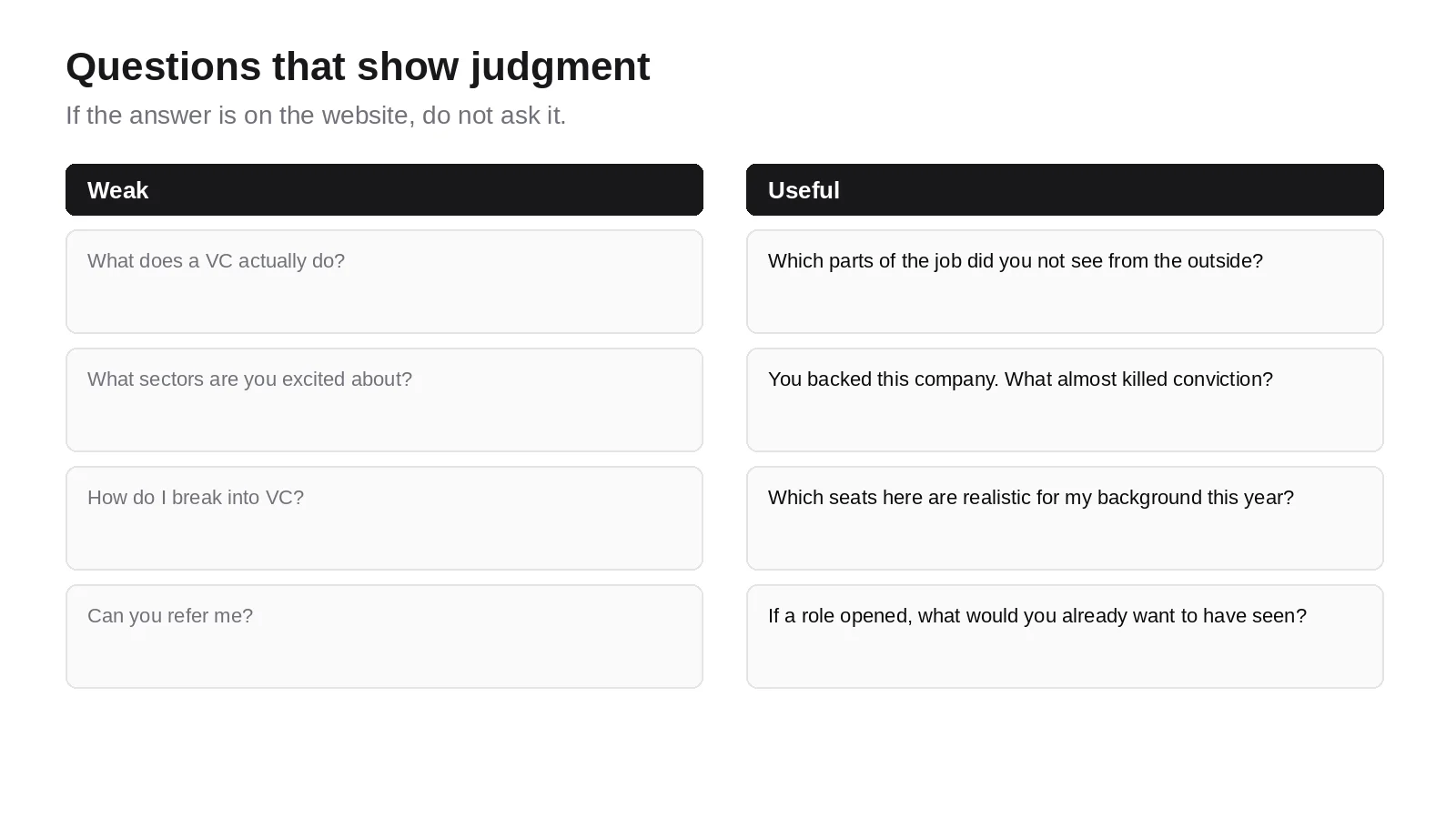
Questions that show judgment
Do not arrive with 25 questions. Arrive with six you might use, then follow the interesting answer.
Weak questions are Wikipedia. Useful questions force a tradeoff, a miss, or a firm-specific mechanic.
| Weak | Useful |
|---|---|
| What does a VC actually do? | Which parts of the job did you not see from the outside? |
| What sectors are you excited about? | You led or backed [recent company]. What almost killed your conviction? |
| How do I break into VC? | For someone with my background, which seats at this firm are realistic in the next year, and which are not? |
| What is your investment thesis? | Do you source against themes, or do you wait for inbound and pattern-match later? |
| Can you refer me? | If a role opened on your team tomorrow, what would you want to have already seen from a candidate? |
| What books should I read? | Which work product actually gets attention here: market maps, founder notes, or something else? |
The test is simple. If the answer is on the website, the blog, or LinkedIn, do not ask it.
When they mention a company, stay there. Ask how they found it, who else was in the round, and what would have made them pass. Deals are how VCs think. Career autobiography is how candidates think. Meet them on their side of that line.
How to answer "what can I do for you"
They will ask this, often in the first minute. "Give me a job" is the wrong answer. So is pretending you have no agenda.
State the real reason in one breath, then name a small, easy next step.
If you want to learn the role:
"I am trying to understand how junior investing actually works at a seed firm that leads, not one that only sprinkles. Your path from [last role] is the closest match I have found. I have two specific questions, and I would like to leave knowing whether an associate seat here is even the right target."
If you want a second introduction later:
"I have been mapping vertical SaaS tools that sell into clinics, and I keep seeing the same wedge fail. I wanted your read, and if it is useful I would like to know who else on your team lives in that category."
If a role is already open:
"I applied to the associate seat. I am not asking you to lobby. I want to know what 'good' looks like in the first six months so I do not waste the process."
Notice what those answers do not do. They do not ask the person to spend reputation on a stranger. They do not hide the fact that you are job-searching. They make the 20 minutes useful even if no role appears.
Associate chats vs partner chats
The right conversation depends on who is sitting across from you.
| Contact | Best use of 20 minutes | Skip |
|---|---|---|
| Analyst or associate | Day-to-day work, sourcing load, interview process, what the partnership actually rewards | Asking them to hire you |
| Principal or senior associate | How conviction gets built, what promotion requires, which skills are missing on the team | A generic break-in story they have told 40 times |
| Partner | A specific thesis, a company, or a founder you both know | Entry-level career coaching with no context |
| Platform or talent | How hiring actually happens, which roles are real | Treating platform as a backdoor into investing |
Junior investors are usually the higher-yield first call. They remember the process. They know which skills matter this year. A partner can be the right first call when you have a real overlap: a sector they own, a company they backed, or a warm introduction that already explains why you are in the room.
If you are switching careers, pick the person who can see the bridge. An operator should talk to the investor who already lives in that sector. A banker should talk to later-stage or growth investors who still care about process. Do not make a pre-seed generalist decode your coverage group.
For the broader ladder, use the venture capital career path. For what the formal process will ask later, use venture capital interview questions.
Follow up that compounds
Send a same-day note. Four sentences is plenty: thanks, one specific takeaway, anything you promised, one optional next step.
Do not attach a resume unless they asked. Do not write a recap of the entire call. Do not ask for a referral in the thank-you unless they offered one.
The second touch should have a reason. A company that matches something they said. A short note on a market they care about. A role that just opened, with a sentence that ties it to the conversation. Empty monthly check-ins train people to ignore you.
If they offered an introduction, make it easy. Send a forwardable blurb: who you are, why this person, what you want from 20 minutes. Then stop chasing. One reminder after a week is enough.
When a real seat appears, use the relationship as context, not as pressure. "We spoke in March about clinic SaaS wedges. The associate role is live. Here is the one-page note I mentioned." That is the whole message.
Common mistakes
The first is treating the chat as an interview you must win. You start performing. They start evaluating. Nobody learns anything.
The second is asking Google questions. It signals you wanted a meeting more than you wanted this meeting.
The third is bringing no point of view. "I am passionate about startups" is not a POV. A two-minute take on why a specific product is winning a specific buyer is.
The fourth is asking for a job, a referral, and a mentor in one sitting. Pick one small ask. Earn the rest.
The fifth is running long. Ending at 19 minutes is a professional move. It is also rare, which is why it gets remembered.
The sixth is disappearing, then returning only when a posting goes live. If the conversation mattered, you would have had a reason to write sooner.
FAQ
How long should a VC coffee chat last?
Ask for 20 minutes. Many will run to 30 if the conversation is specific. Do not ask for an hour from someone you have never met.
Should I bring a resume or a deck?
No, unless they asked. Bring one point of view you can discuss without slides. If the meeting is actually a screen, they will tell you what to send.
Is a coffee chat the same as an informational interview?
Close. An informational interview is usually a structured research call. A coffee chat is the same intent with a looser label. Prepare the same way. If the firm booked it as part of recruiting, treat it as a screen.
Who should I take coffee chats with first?
Start with people close to the work you want: current analysts and associates, or principals who still source. Save partners for when you have a reason that matches their calendar.
How many coffee chats do I need to break in?
There is no number that converts. One or two good conversations a week, held for months, beats a burst of 20 shallow calls. Pair the conversations with the actual search in how to get a job in venture capital.
What if they ask me to walk through my background?
Give a 60-second version that ends on why you wanted this conversation. Then ask your first real question. Do not spend ten minutes on school.
Turn the conversation into a real search
A coffee chat is research. It is not the job. After the call, write down the firm, the person, what you learned, and the next step. Then look at whether that firm, or firms like it, are actually hiring.
Browse open roles on the Venture Capital Careers job board. Research more firms in the companies directory. If you want alerts, use candidate sign-up. For the wider break-in path, read how to become a venture capitalist.
The conversation worked if you now know something you could not have known from the website, and if the other person would take a second 15 minutes without dreading it. That is the whole standard.
Related posts
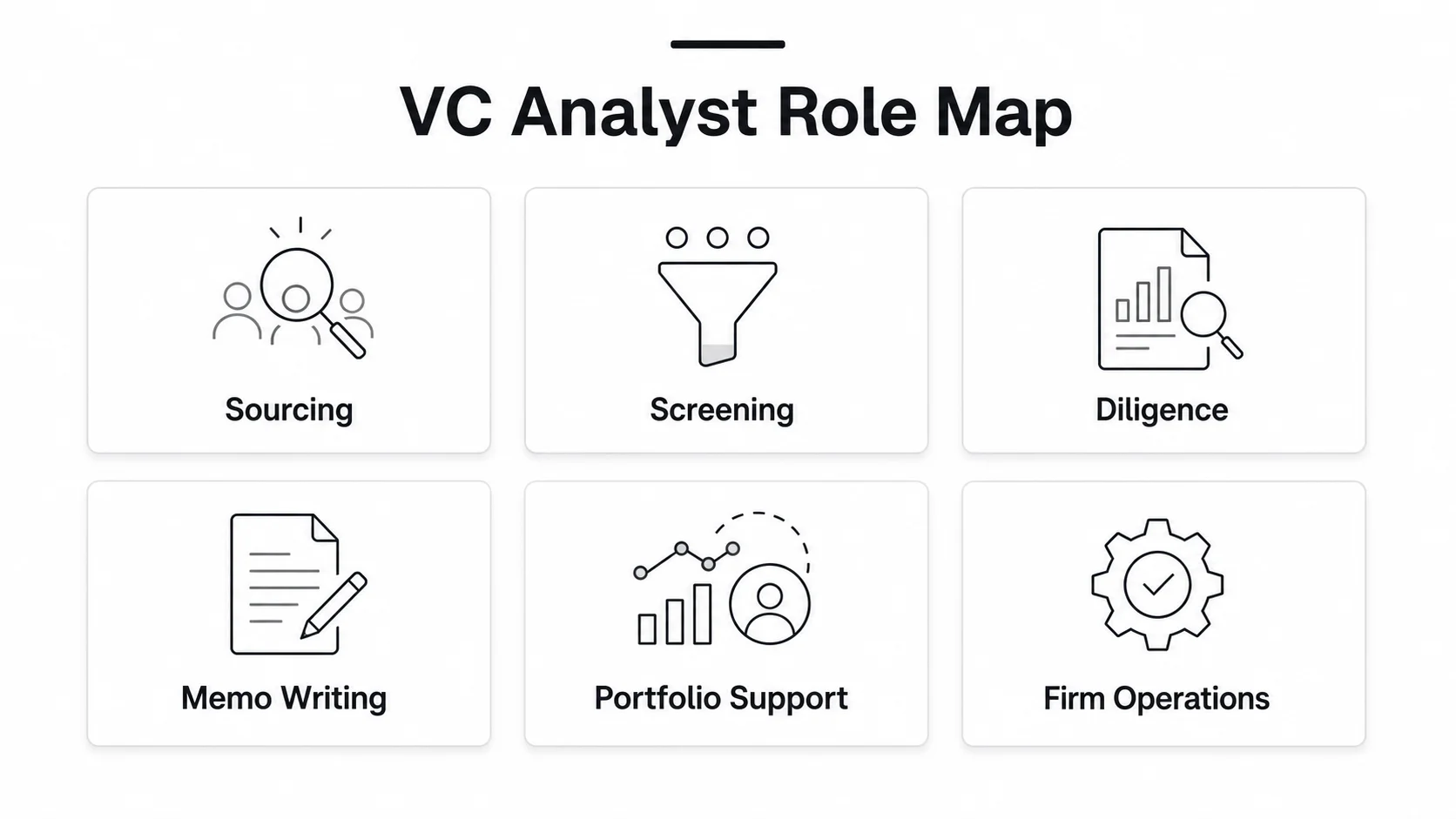
Copy-ready VC analyst job description template with responsibilities, skills, sourcing vs diligence seat signals, interview scorecard, and how candidates should read a posting.
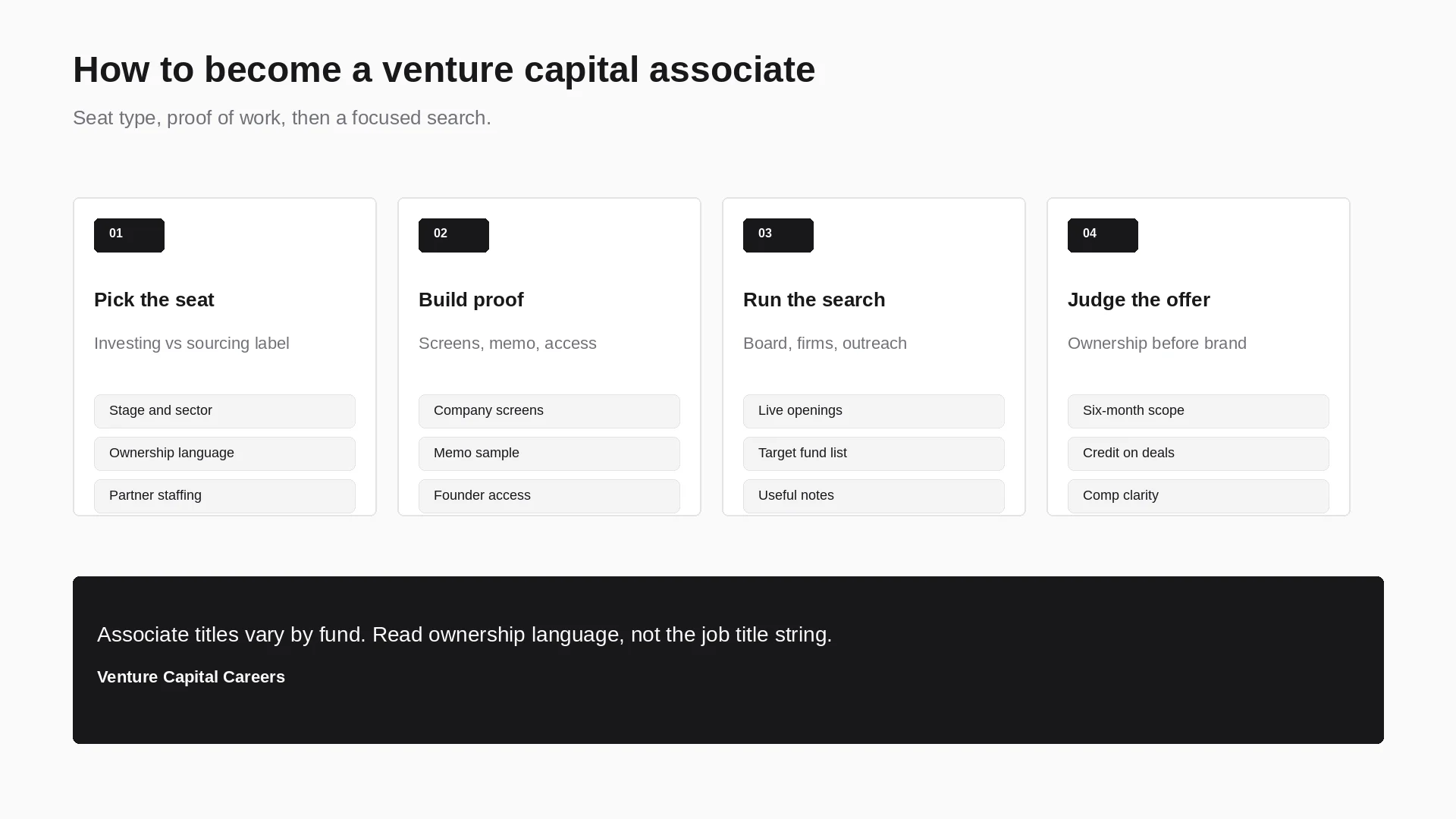
A practical guide to becoming a venture capital associate: what the seat is, which paths convert, how to prove you can do the work, and how to screen real associate openings.
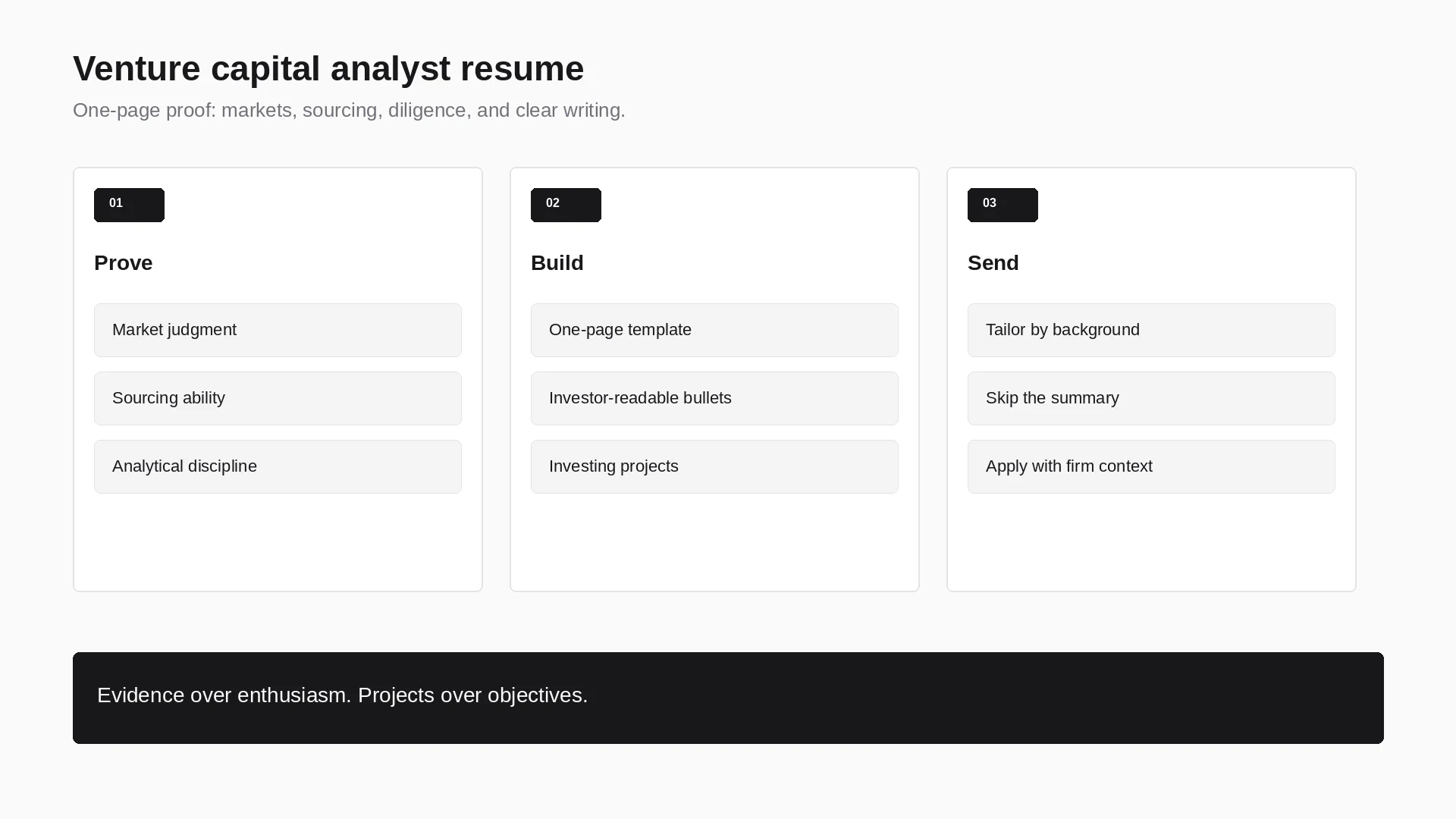
A VC analyst resume is a one-page proof document. Template, bullet formula, investing projects section, examples, and next steps for analyst applications.