
Yes, a product manager can move into venture capital. The strongest candidates do not pitch product management as a substitute for investing experience. They translate customer judgment, market analysis, prioritization, and cross-functional leadership into evidence that they can source opportunities, form an investment view, write clearly, and earn founder trust.
That distinction matters. A PM résumé may get an investor curious. A focused thesis, credible network, and sharp investment work are what make the transition believable.
Decide which venture capital seat you actually want
“Working in venture” can mean three very different jobs. Choosing the wrong one produces a confused search and an equally confused interview story.
| Seat | Core work | Where PM experience helps | What you must prove |
|---|---|---|---|
| Investment team | Sourcing, diligence, memos, investment decisions, portfolio support | Market insight, product judgment, founder empathy | Deal judgment, sourcing access, commercial reasoning, concise writing |
| Platform or portfolio operations | Recruiting, go-to-market, community, product or operating support | Hands-on operating depth and functional credibility | Repeatable support model and restraint around founder ownership |
| Internal product or systems | Building fund software, data, workflows, or research tools | Direct product craft | Ability to serve an investment organisation; usually not an investor track |
If you want to choose investments, target investment roles explicitly. A platform or internal product role can be valuable work, but it is not automatically a bridge to the investment committee. Ask how success is measured, whether the role sources or diligences deals, and how previous people in the seat progressed.
Your best investment fit is usually close to your operating edge. An early-stage B2B product manager may have a credible angle on developer tools or vertical SaaS. A growth PM may be useful to consumer or product-led growth investors. Domain depth is more convincing than claiming to be a generalist on day one.
Translate product skills into investment evidence
Stanford's PM-to-VC discussion highlights product vision, customer communication, and the ability to hear signal through noise. Those skills matter, but a hiring partner will still ask what they look like in investment work.
| Product-management experience | Investment application | Evidence to build |
|---|---|---|
| Customer discovery | Testing whether a painful problem and credible buyer exist | Interview notes synthesised into a market view |
| Roadmap prioritisation | Ranking risks and identifying the decisive unknown | Diligence plan that separates fatal risks from nice-to-know questions |
| Product analytics | Reading retention, activation, and behaviour with context | Short KPI teardown explaining what the numbers do and do not prove |
| Market and competitor research | Mapping category structure and differentiation | Market map with a written investment thesis |
| Cross-functional leadership | Aligning people without formal authority | Examples of earning trust across founders, experts, and partners |
| Product launches | Understanding execution risk and go-to-market dependencies | Post-mortem that connects operating lessons to investment judgment |
The gaps are just as important. Most PMs have not built a repeatable sourcing network, modelled ownership and dilution, written an investment memo, or made decisions under a fund's portfolio constraints. Name those gaps early. Then close them with work, not a list of courses.
ProductPlan's analysis makes another useful warning: investing requires a wider lens and slower feedback loop than product. You will evaluate team quality, market structure, financing, competition, and return potential—not just whether a product can delight users.
Build a proof-of-work portfolio before you apply
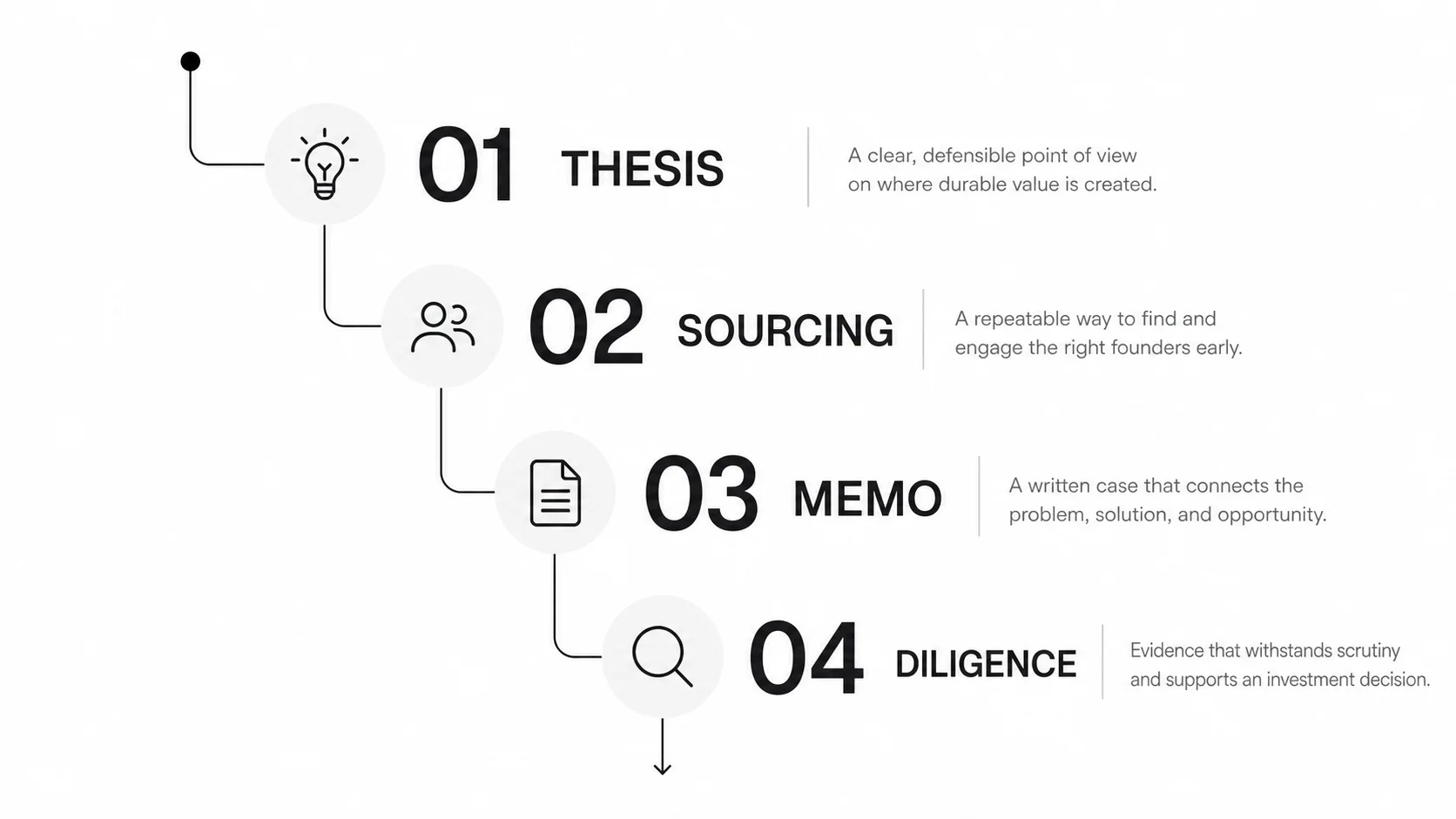
A compact investment portfolio gives a fund something concrete to evaluate. Four artifacts are enough if each is genuinely strong:
- A one-page thesis. Define a narrow market, the change creating opportunity, what a winning company looks like, and what would disprove the thesis.
- A sourced company list. Identify 20–30 relevant startups and explain why five deserve a first meeting. Use public information; do not pretend you have proprietary access.
- One investment memo. Make a recommendation, not a company summary. Cover team, problem, product, market, traction signals, competition, risks, deal questions, and the conditions under which you would invest.
- A diligence workplan. List the critical questions, evidence needed, expert calls, customer checks, and decision thresholds for one company.
Quality beats volume. A vague ten-page sector report is less useful than a one-page thesis with a clear non-consensus claim. A 50-company spreadsheet is less persuasive than five well-researched companies and a reason each fits a fund's stage, geography, and ownership model.
Use the venture capital investment memo guide to structure the recommendation. Then ask an investor, founder, or experienced operator to challenge the assumptions. Your revision trail is evidence too: good investors update without becoming directionless.
Learn to diligence without taking over the product
Product managers are trained to find problems and drive a roadmap. Investors must resist turning every diligence conversation into a product review.
The question is not “Would I build it this way?” It is “Does this team understand the customer, learn quickly, and have a credible path to an outcome that matters?” That shift protects founder agency and improves judgment.
Use four lenses:
- Market: Is the problem urgent, frequent, and attached to budget? What change makes the timing plausible?
- Product: Does the product create a meaningful behavioural or economic improvement? What evidence suggests users return?
- Team: Has the team earned a differentiated insight or distribution advantage? How does it respond when evidence contradicts the plan?
- Venture case: Can the company become large enough, fast enough, for this fund's model? What ownership, follow-on, and exit assumptions matter?
The last lens is where many operator candidates are weakest. A good product can still be a poor venture investment because the market is too small, the economics require too much capital, the entry price leaves little upside, or the likely outcome does not move the fund.
Venture in Security's practitioner analysis also names the behavioural traps: wanting immediate results, failing to zoom out, and refusing to give up product ownership. Treat those as interview questions you must answer with evidence, not abstract self-awareness.
Run a thesis-led networking and job search
Venture hiring is relationship-heavy because funds are small and investment judgment is hard to assess from a résumé. A useful networking process creates signal before it asks for a job.
Start with a narrow thesis and a list of funds that genuinely invest in it. Use the Venture Capital Careers companies directory to research stage, sector, geography, and team. For each fund, know why your product background is relevant to its actual portfolio—not to venture capital in general.
Then run a simple sequence:
- Publish or privately share one useful market observation.
- Ask investors and founders precise questions that improve the thesis.
- Send relevant companies or customer insights when you have permission and genuine fit.
- Request feedback on a memo or market map.
- Ask about a role only after the conversation has established relevance.
Avoid the generic “I want to break into VC” message. Lead with your edge: the market you understand, the customer pattern you have seen, or the company you believe others are missing. The VC networking email templates can help you keep the message concise.
Browse the VC job board in parallel, but do not limit the search to advertised openings. Use role descriptions to learn how funds divide sourcing, diligence, portfolio work, and internal operations. Sign up through Venture Capital Careers to keep your search organised around new opportunities.
Tell a credible PM-to-VC story in interviews
Your story needs four parts:
- Edge: the markets, customers, or products you understand unusually well.
- Evidence: the decisions you made and what changed because of them.
- Investor work: the thesis, sourcing, memo, and diligence work you have already done.
- Choice: why investing is the work you want, not an escape from product management.
A credible version sounds like this:
I spent four years building workflow software for logistics teams. The work gave me a close view of how fragmented operators buy, integrate, and abandon tools. Over the last six months I mapped 28 startups in the category, interviewed operators, and wrote two investment memos. I want an early-stage investment role where that customer access and product judgment can improve sourcing and diligence. I know I still need to deepen my ownership and portfolio-construction skills, which is why I have focused my work on funds that lead seed rounds in vertical software.
That answer is specific enough to test. Expect follow-ups on the thesis, a company you would back, a company you would pass on, and what evidence would change your mind.
Prepare for a case study, market-sizing question, sourcing exercise, or memo review. The VC case study interview guide explains how to structure the work without turning it into a pitch deck.
Follow a 90-day transition plan
| Phase | Primary objective | Deliverables |
|---|---|---|
| Days 1–30 | Choose a lane and establish a point of view | Target-seat decision, narrow thesis, 30-fund research list, first market map |
| Days 31–60 | Produce evidence and test it | Company shortlist, memo, diligence plan, five expert or founder conversations |
| Days 61–90 | Convert evidence into conversations | Revised portfolio, targeted outreach, interview practice, applications to high-fit roles |
By day 30, you should be able to explain why a specific type of fund needs your perspective. By day 60, another investor should be able to critique your work. By day 90, your conversations should reveal whether the thesis creates genuine access or merely sounds interesting.
Do not measure progress only by applications. Track the quality of feedback, whether investors introduce you to others, whether founders engage with your questions, and whether your investment views become sharper. Those signals expose weak positioning earlier than a rejection email.
Know when not to make the move
Do not move into venture because you are tired of execution, want a more prestigious title, or assume investors spend their days giving product advice. Junior investors often do large amounts of sourcing, research, meeting preparation, reference work, and internal writing. The feedback loop is long, and individual attribution is murky.
Stay in product—or target a venture platform role—if you need direct ownership, frequent shipping, a stable operating cadence, or measurable short-term outcomes to feel effective. A strong product leader can work closely with startups and investors without becoming an investor.
The best reason to move is that you prefer forming views across many companies, building networks before you need them, making decisions with incomplete information, and living with the consequences of a few high-conviction choices.
Frequently asked questions
Do product managers need an MBA to enter venture capital?
No single credential guarantees entry. An MBA can provide a network, finance training, and structured recruiting, but a PM still needs a differentiated edge and investor-quality evidence. For many experienced product managers, focused proof of work is a more direct first test than committing to another degree.
Should a PM target associate or partner roles?
Seniority in product does not map neatly to fund titles. A product leader with deep domain access may join as a principal, venture partner, operating partner, or specialist investor; another may need an associate seat to learn the craft. Evaluate decision authority, sourcing expectations, economics, and progression—not title alone.
Is a platform role a good route into investing?
It can create proximity and firm knowledge, but it is not a guaranteed conversion path. Ask whether platform team members participate in sourcing, diligence, and investment meetings, and whether the fund has promoted anyone from platform to investing.
What should be in a PM-to-VC investment memo?
State the recommendation first. Then cover the team, customer problem, product advantage, market, traction evidence, competition, risks, unresolved questions, venture-return logic, and what would make you change the decision.
Related posts
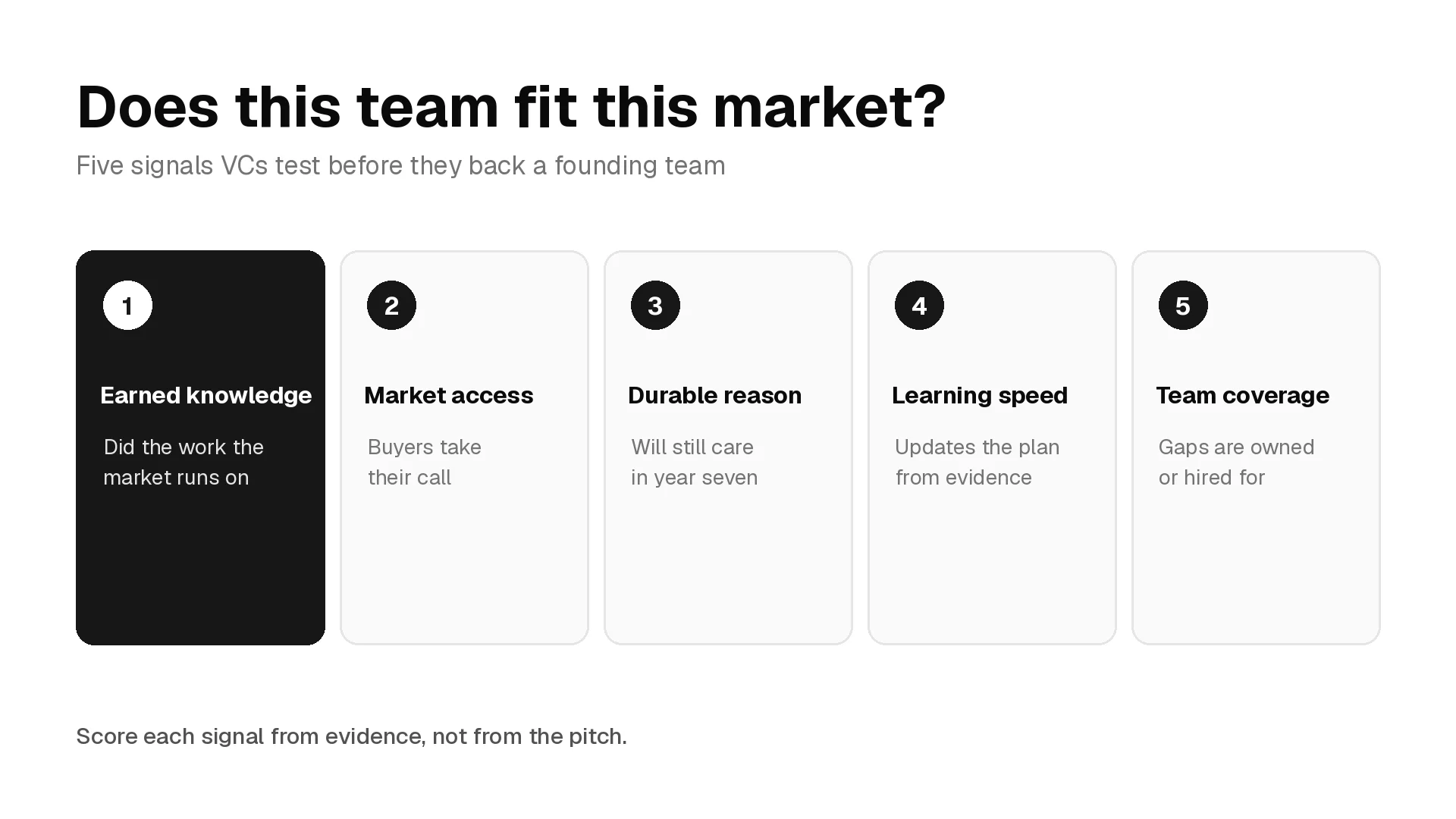
Founder-market fit is the match between what a founding team knows, can access and cares about, and what its market demands. How VCs weigh it, test it with evidence, score it, and write it into a memo or interview answer.
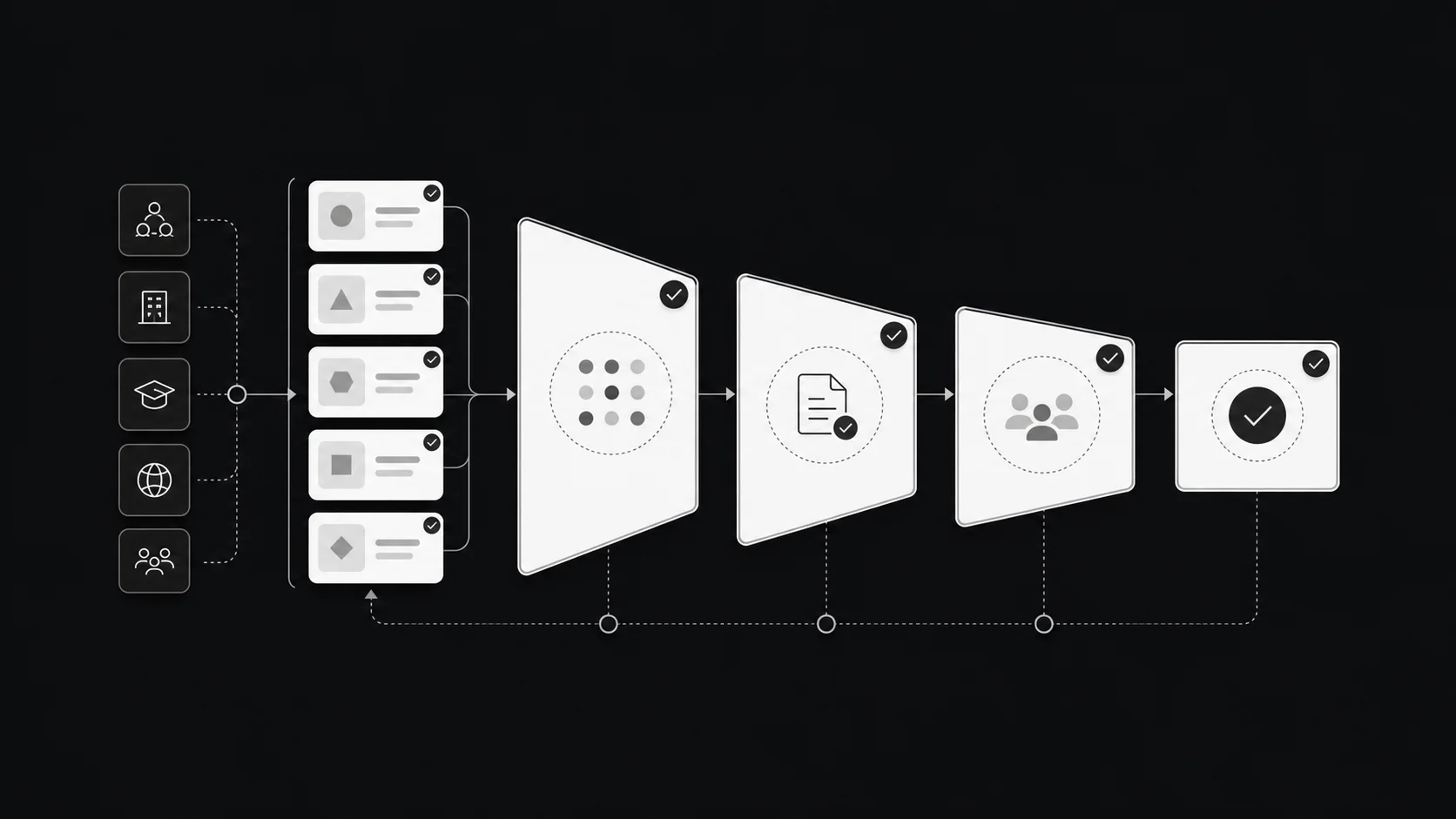
Deal flow is the stream of investment opportunities a venture firm receives and the funnel that sorts them. For every deal closed, firms consider about 101 companies.
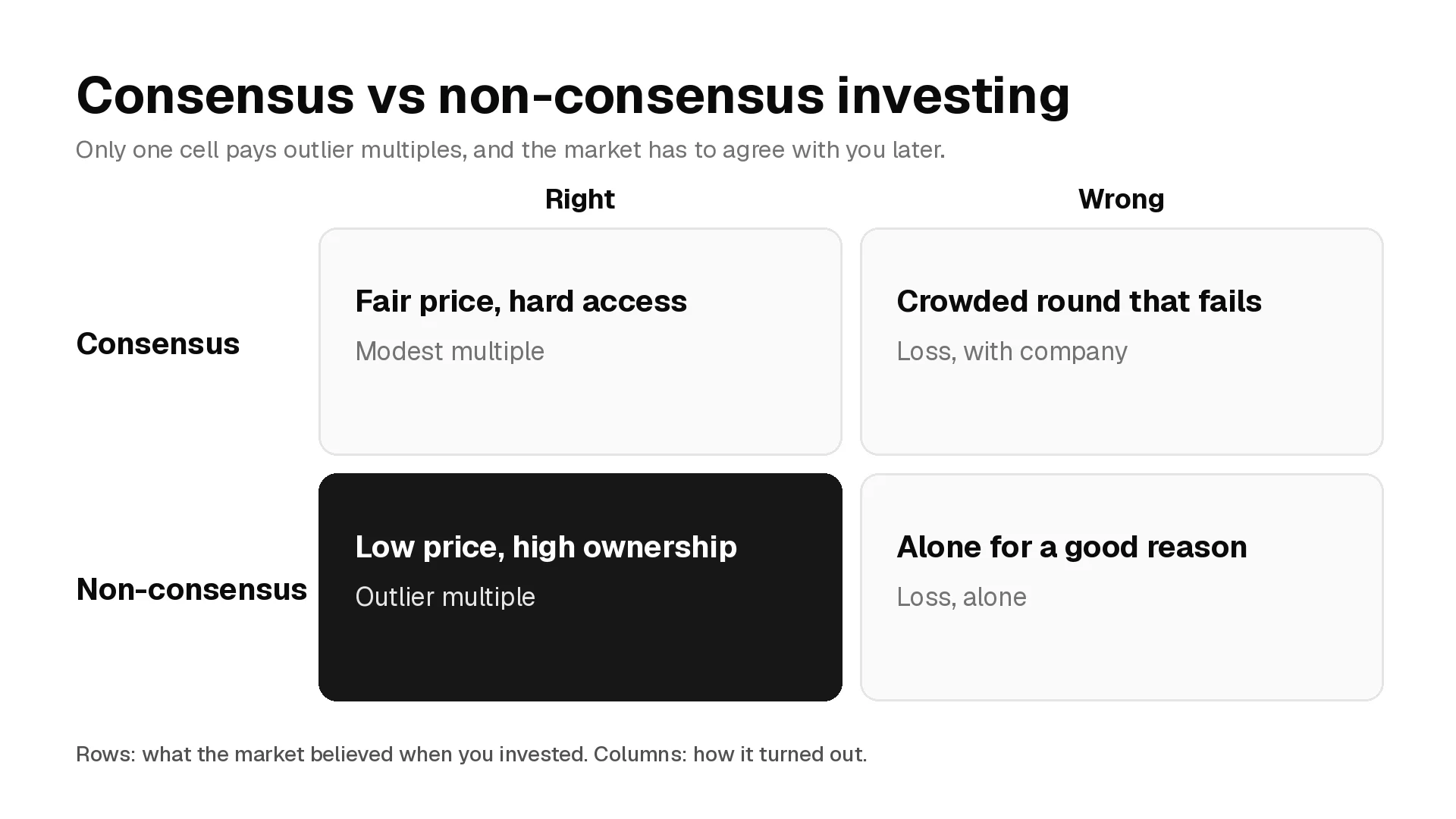
Non-consensus investing means backing a company most investors have passed on or not yet seen, for a reason you can state and test. How the 2x2 works, why firms drift toward consensus, how investment committees vote, and how analysts and associates bring a non-consensus deal.