
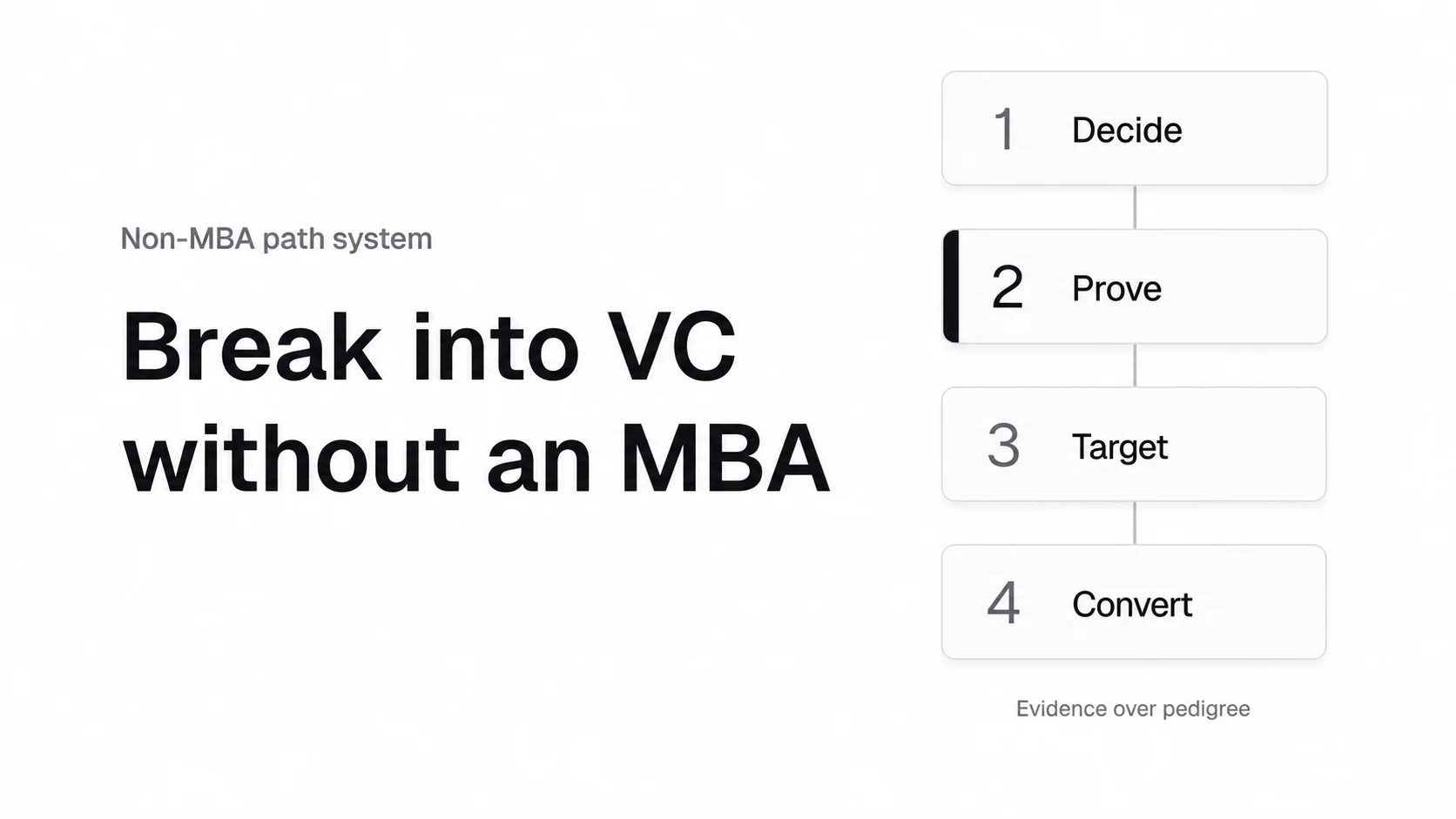
You can break into venture capital without an MBA. Funds hire people who can source interesting companies, form a coherent view of a market, earn founder trust, and help partners make better investment decisions. An MBA can help with access and signaling, but it is not a license and it is not the only wedge.
If you are deciding whether to skip business school—or you already have—the job is the same: build evidence a fund can underwrite, target firms where that evidence maps to how they invest, and run a disciplined search. Use this guide as the without-MBA system. For the broad break-in playbook, see how to get a job in venture capital. If you are already in (or committed to) business school, use the MBA to venture capital recruiting plan instead.
Do you need an MBA for venture capital?
No. You do not need an MBA to work in venture capital.
Many partners hold graduate degrees, and some junior seats still skew toward post-MBA associates—especially at larger multi-stage platforms with structured MBA hiring. That is a hiring pattern, not a professional requirement. Pre-MBA associates, domain specialists, operators, scouts, and fellowship alumni enter funds every year without a business school credential.
What funds actually need from junior and mid-level investing hires:
- Deal access or sourcing capacity — can you find or open companies others miss?
- Judgment under uncertainty — can you write a clear yes/no with risks, not a book report?
- Domain fluency — do founders respect your questions in a specific sector or function?
- Work rate and communication — can you turn meetings into memos, and memos into partnership-ready notes?
- Trust — will a partner put you in front of a founder without babysitting?
An MBA can accelerate network density and give you a calendar of on-campus conversations. It does not replace those five.
For what the job feels like day to day and how titles progress, read the venture capital career path and what venture capitalists do.
When skipping the MBA is rational (and when it is not)
Use a four-part decision rule before you treat “no MBA” as a strategy.
| Test | Skip the MBA if… | Reconsider an MBA (or another access path) if… |
|---|---|---|
| Access gap | You already meet partners, founders, or scouts in your sector weekly | Your network has zero VC density and no realistic path to build one in 12 months |
| Evidence opportunity | You can produce public or shareable proof (maps, memos, scouting, operator results) in your current role | Your current job gives you no founder contact, no sector depth, and no time for proof-of-work |
| Role target | You are aiming at early-stage investing, scout/fellowship paths, domain principal seats, or operator-heavy funds | You only want brand multi-stage post-MBA associate classes and refuse adjacent seats |
| Cost and optionality | Tuition + opportunity cost would force a weak ROI solely “to get into VC” | You want the MBA for broader optionality (PE, growth, GM roles) and VC is one of several outcomes |
Practical rule: If your primary reason for an MBA is “open VC doors,” price cheaper experiments first—six months of thesis work, scouting, fellowship applications, and targeted outreach. If those experiments produce zero conversations with investing professionals, the bottleneck may be positioning or network design, not the missing degree. If they produce conversations but no conversion, fix the evidence package before spending two years and six figures.
Non-MBA paths that actually convert
There is no single non-MBA path. There are repeating patterns. Pick the one that matches the strongest asset you can prove in the next two quarters.
| Path | What you bring | Where it converts best | Main risk |
|---|---|---|---|
| Startup / scale-up operator | Execution scars, hiring taste, GTM reality | Seed–Series B funds that care about founder support | “I worked at a startup” without thesis or sourcing |
| Investment banking | Deal craft, speed, analytical rigor | Later seed through growth; multi-stage platforms | Pure banking persona; weak founder fluency |
| Consulting | Structured problem solving, industry projects | Sector funds, growth, platform-adjacent diligence | Generic strategy language; no company-picking reps |
| Technical or domain specialist | Deep product/science credibility | Thematic funds (infra, bio, climate, fintech, etc.) | Cannot translate depth into investment memos |
| Founder / early employee (exit or not) | Pattern recognition, empathy, network | Early-stage generalists and operator-partners | Assuming founder status alone is a hire signal |
| Scout, fellowship, or angel track | Live deal flow and written IC practice | Funds that already know your judgment | Volunteer theater without serious volume or quality |
| Structured undergrad / analyst programs | Training seat inside a large platform | Insight-style and similar programs where they exist | Extremely competitive; not available in most cities |
Deep dives by background:
- Startup operator to venture capital
- Investment banking to venture capital
- Consulting to venture capital
- Venture capital fellowship
If your story is “I will get an MBA and then recruit,” switch lanes to the MBA recruiting guide. This article assumes the degree is not your plan.
Match your background to stage and role type
Non-MBA candidates often fail by applying one story to every fund.
Stage fit
- Pre-seed / seed: domain access, founder trust, product taste, creative sourcing. Modeling is lighter; narrative and network are heavier.
- Series A / B: clearer metrics, competitive dynamics, first diligence systems. Operators with analytical range do well.
- Growth / late: finance comfort, unit economics, customer diligence, process. Banking and consulting transfer more cleanly.
Role type fit
| Role type | Non-MBA angle |
|---|---|
| Investing associate / senior associate | Need proof you can source and diligence, not only “learn finance later” |
| Principal / domain hire | Strongest when you already own a category; MBA rarely required |
| Platform / talent / community | Operator and network stories can win—but do not pretend it is an investing seat if it is not |
| Scout / venture partner (part-time) | Best apprenticeship when full-time seats are scarce |
| Fund ops / IR / finance | Real firm jobs; different skill proof than investing |
Be explicit in outreach: the seat you want, the stage you understand, and the work sample that matches that seat.
Build proof of work funds can underwrite
Pedigree substitutes for evidence until it does not. Without an MBA, evidence is the product.
Five-evidence scorecard
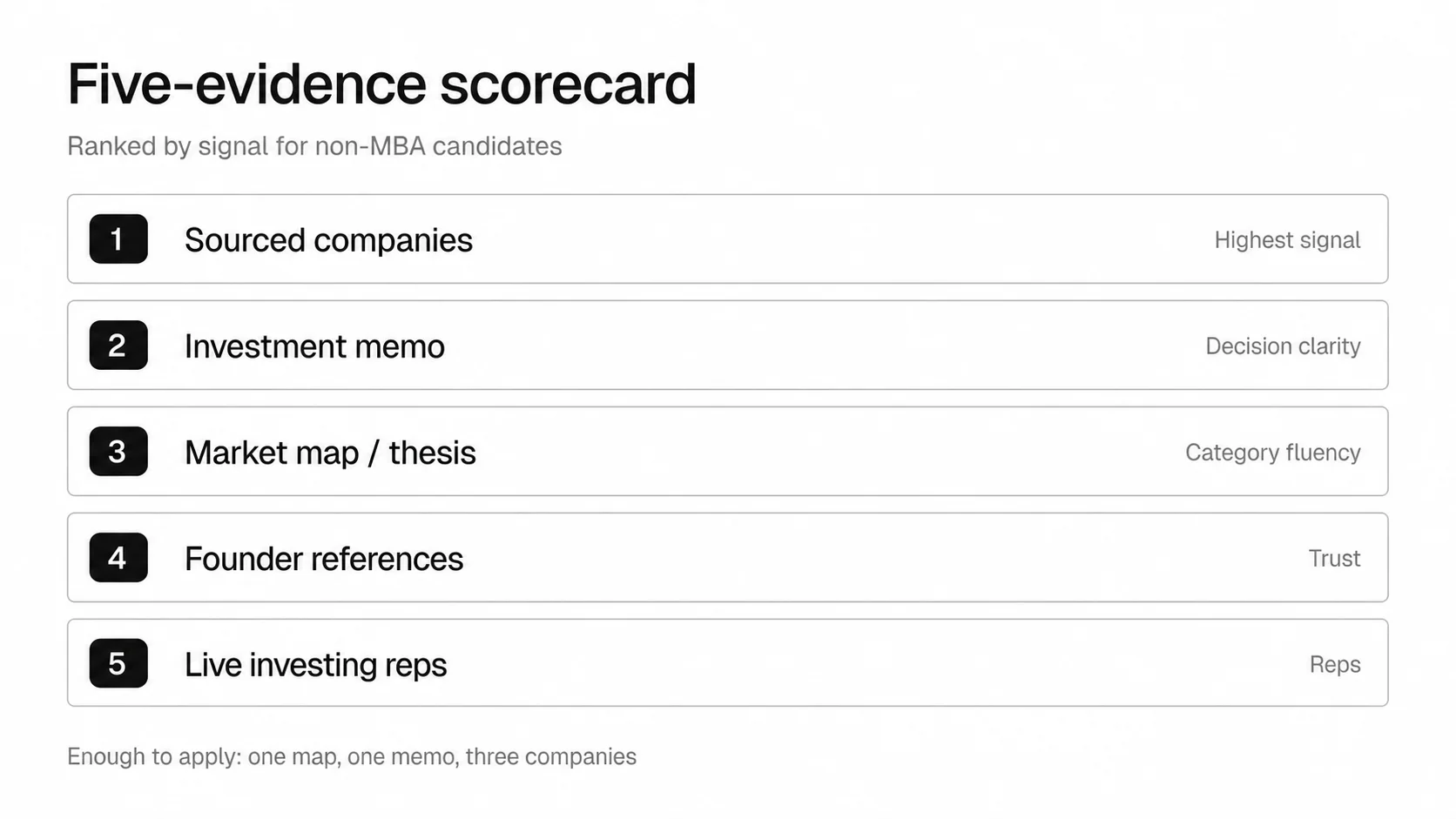
Rank these by signal for most early- and mid-stage funds:
| Rank | Evidence | What “good” looks like | Weak version |
|---|---|---|---|
| 1 | Sourced companies | A short list of real companies you found early, with why they matter and what happened next | Random AngelList scrolling notes |
| 2 | Investment memo | One tight memo: problem, product, market, team, risks, decision | 20-page dump with no recommendation |
| 3 | Market map / thesis | A named category, structure, white space, and who you would meet first | Generic “AI is big” essay |
| 4 | Founder or operator references | People who will say you help, not that you are “interested in VC” | Cold LinkedIn count |
| 5 | Live investing reps | Scout checks, angel checks, fellowship diligence, IC notes | Certificate courses with no output |
Enough-to-apply bar: before you ask a partner for a job conversation, you should be able to send one map or thesis, one memo, and three companies that fit their stage and sector—without asking them to imagine your potential.
How to build the artifacts:
- Market maps: venture capital market map
- Memos: venture capital investment memo
- Case practice: venture capital case study interview
Do the job in public enough that a stranger can audit your judgment. Private interest is not a candidacy.
Build a target-fund list before you network
Networking without a list becomes coffee spam. Build the list first.
Suggested columns:
| Column | Why it matters |
|---|---|
| Fund name | Focus |
| Stage | Matches your evidence |
| Sector / thesis | Matches your domain |
| Geography | Meeting reality |
| Check size / ownership style | Filters fantasy targets |
| Recent portfolio examples | Conversation fuel |
| Role types they hire | Investing vs platform honesty |
| Warm path | Who can intro you |
| Evidence to send | Map, memo, or company list |
| Hiring signal | Open role, recent junior leave, partner tweet, etc. |
| Next action + date | Operating cadence |
Use the Venture Capital Careers companies directory to research firms and thesis fit, then cross-check open seats on the VC job board. Save funds in three tiers:
- Core (10–15): true fit; weekly progress
- Stretch (10): brand or competitive; high bar of evidence
- Bridge (5–10): scouts, fellowships, platform, CVC, accelerators
If you cannot explain why a fund is on the list in one sentence tied to your proof, delete it.
Run a 90-day without-MBA operating plan
Treat the search like a project, not a mood.
Days 1–30 — Foundations
- Write a one-page personal thesis: sectors, stage, and the non-MBA asset you are selling.
- Draft one market map and one shadow memo on a company in-market now.
- Build the tiered fund list (start with 25 names).
- Identify five people who can give hard feedback (operators, angels, junior VCs)—not twenty polite chats.
- Set alerts and a weekly board review on Venture Capital Careers so you see real seats, not only mythology.
Days 31–60 — Evidence and access
- Ship v2 of the map and memo after feedback.
- Source ten companies that fit three core funds; write three-sentence notes on each.
- Start useful outreach: share a relevant company or map slice, ask for thesis pressure-testing, not a job.
- Apply to open roles that match stage and background; track responses.
- Add one live rep if possible: scout program, fellowship application cycle, angel syndicate diligence, or campus/community deal flow. See VC fellowships and networking.
Days 61–90 — Conversion
- Turn conversations into second meetings with a clear ask: feedback on a specific company, intro to the associate who owns sourcing, or consideration for an upcoming seat.
- Run mock case / memo drills weekly.
- Refresh the fund list based on what you learned (kill bad-fit prestige).
- Decide: continue the direct investing search, take a bridge role that increases evidence, or revisit whether an access program (including, rarely, an MBA) is still the bottleneck.
Weekly cadence (keep this boring):
| Day | Block |
|---|---|
| Mon | Board + portfolio news scan; update list |
| Tue | Deep work on map/memo/sourcing |
| Wed | Two quality outreach or follow-ups |
| Thu | One founder or operator conversation |
| Fri | Write one page: what I learned; next week’s three priorities |
For calendar context by background, use the venture capital recruiting timeline. Most non-MBA seats are off-cycle; waiting for a mythical “VC recruiting season” is how people lose a year.
Network and interview without pedigree theater
Networking
Lead with utility:
- “I mapped X; curious if this white space matches how you think about the category.”
- “I wrote a short memo on Company Y—where am I wrong?”
- “I keep seeing founders with Z problem; is that noise or a real pattern in your pipeline?”
Avoid:
- “Can I pick your brain about breaking into VC?”
- Long autobiographies
- Asking for a job in message one
Follow-up is where non-MBA candidates win: send the improved artifact, the company update, or the intro you promised. For message craft, see venture capital networking and networking email templates.
Interviews
Expect variations on:
- Why venture, why this fund, why now
- A market you know cold
- A company you would source or pass on
- A case or take-home memo
- References who can speak to judgment and hustle
Your without-MBA story should sound like this: asset → evidence → fit → seat. Not: “I could not get into a top MBA, so I am trying VC.”
Prepare with venture capital interview questions and case study prep.
Bridge roles when associate seats stay closed
Direct associate seats are scarce. A bridge is rational when it increases at least one of: domain depth, founder trust, deal reps, or network density.
Strong bridges:
- Operating role at a high-signal startup in your target sector
- Corporate venture or strategic investing with real diligence ownership
- Accelerator, studio, or platform role with founder contact
- Scout or part-time venture partner with written IC discipline
- Research / community roles that produce public work funds already read
Weak bridges:
- Prestige jobs with no founder or investing adjacency
- Unpaid “VC experience” that is mostly admin
- Endless courses without artifacts
Decision rule: take the bridge if twelve months later you will have better proof on the five-evidence scorecard. Otherwise keep building proof in place or widen the fund list.
Common mistakes on the non-MBA path
- Treating “no MBA” as a personality — Funds do not hire underdogs; they hire useful people.
- Copying MBA recruiting timelines — Your calendar is off-cycle and relationship-driven.
- Sending interest instead of artifacts — Curiosity is table stakes.
- One prestige-fund obsession — Diversify tiers; emerging and specialist funds often underwrite non-pedigree stories faster.
- Confusing platform seats with investing seats — Both can be great; lying about the mandate destroys trust.
- Operator vague-speak — “I scaled things” without metrics, decisions, or scars.
- Banker/consultant spreadsheet cosplay at seed — Stage mismatch.
- Angel checks as résumé stickers — Capital without judgment notes is a weak signal.
- Ignoring live roles — If you never look at a board, you are networking into a fantasy market. Start on the VC job board and set job alerts.
- Never reading the inverse path — If you later choose school, do it with eyes open via MBA to VC.
Frequently asked questions
Can you break into venture capital without an MBA?
Yes. Operators, bankers, consultants, domain experts, founders, scouts, and fellowship alumni enter funds without business school. You still need evidence of sourcing, judgment, and fit.
Do most VCs have MBAs?
Many senior investors have graduate degrees, and some firms run MBA-oriented associate hiring. Plenty of investing professionals do not. Treat survey stats as background, not a gate.
Is it easier to get into VC with an MBA?
An MBA can improve access density and create a recruiting calendar. It does not guarantee seats, and it is expensive if VC is the only goal. Cheaper proof-of-work experiments should come first for most people.
What is the best non-MBA background for VC?
The best background is the one you can turn into stage-relevant evidence. Early-stage funds overweight domain and founder trust; later-stage funds overweight analytical diligence. There is no universal winner.
How long does a non-MBA VC search take?
Often multiple quarters. Relationship lag is real. A focused 90-day sprint should produce artifacts, a fund list, and first conversations—not necessarily an offer.
Should I do a VC fellowship instead of an MBA?
Fellowships can create reps and network at far lower cost. They are not interchangeable with a full-time seat. Compare programs on work product, mentorship, and conversion rates—see venture capital fellowships.
Can I go straight from undergrad into VC without planning an MBA later?
Possible at a small set of firms and programs, still uncommon. Most candidates are stronger after a few years of operating or finance reps. Internships can help; full-time junior seats remain scarce.
Next steps
- Run the four-part decision rule and write your one-sentence non-MBA asset.
- Ship one map, one memo, and three sourced companies.
- Build a tiered fund list in the companies directory.
- Review live roles on the venture capital job board and create an account for alerts.
- Run the 90-day cadence; adjust with bridge roles only when they improve the scorecard.
Breaking in without an MBA is not a loophole. It is the standard path for people who already have something a fund can use—and who are willing to prove it on paper before anyone opens a seat.
Related posts
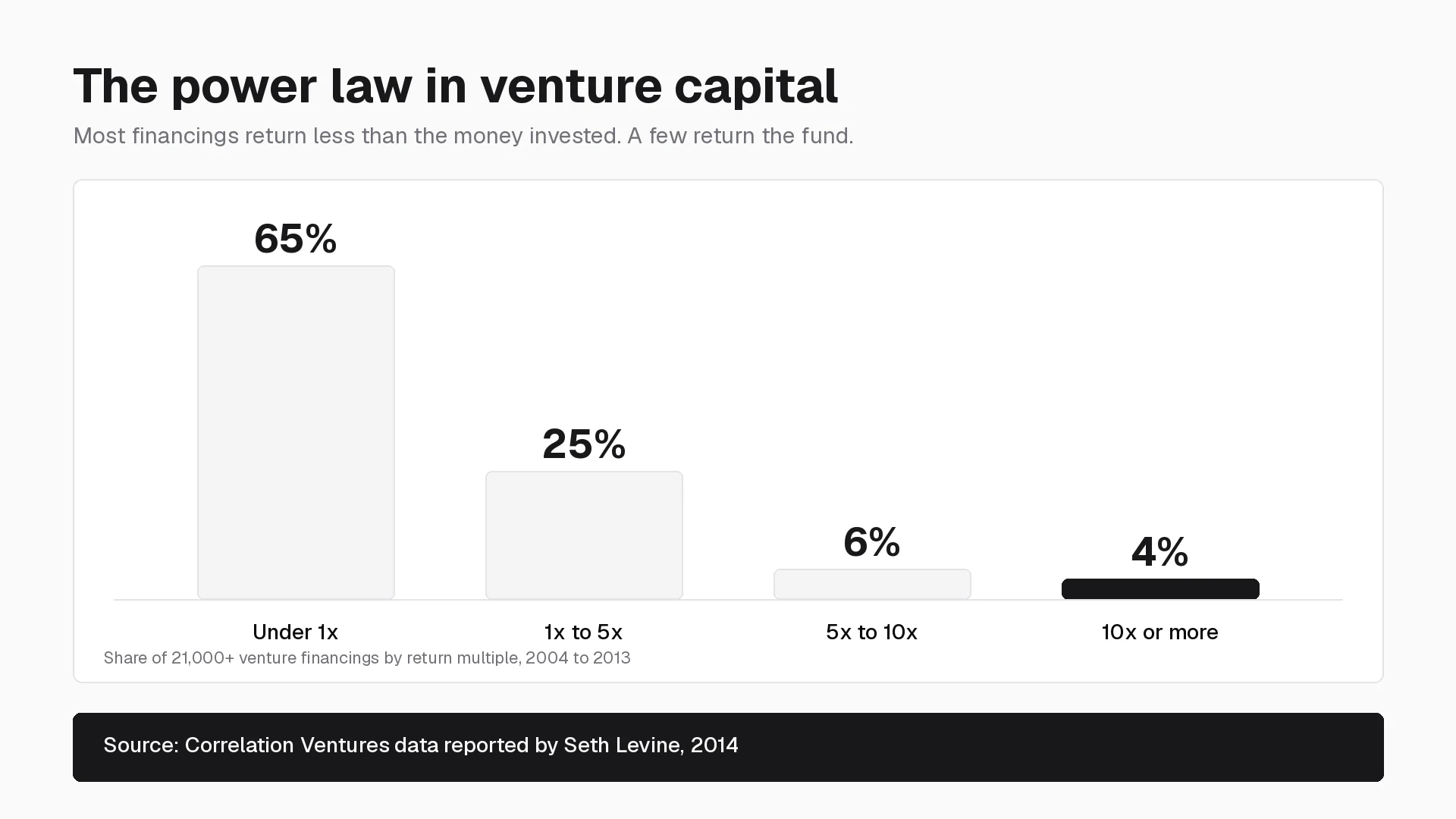
The power law in venture capital explained with primary data, a fund-returner grid by fund size and ownership, and what it changes in VC sourcing, screening, carry, and interviews.
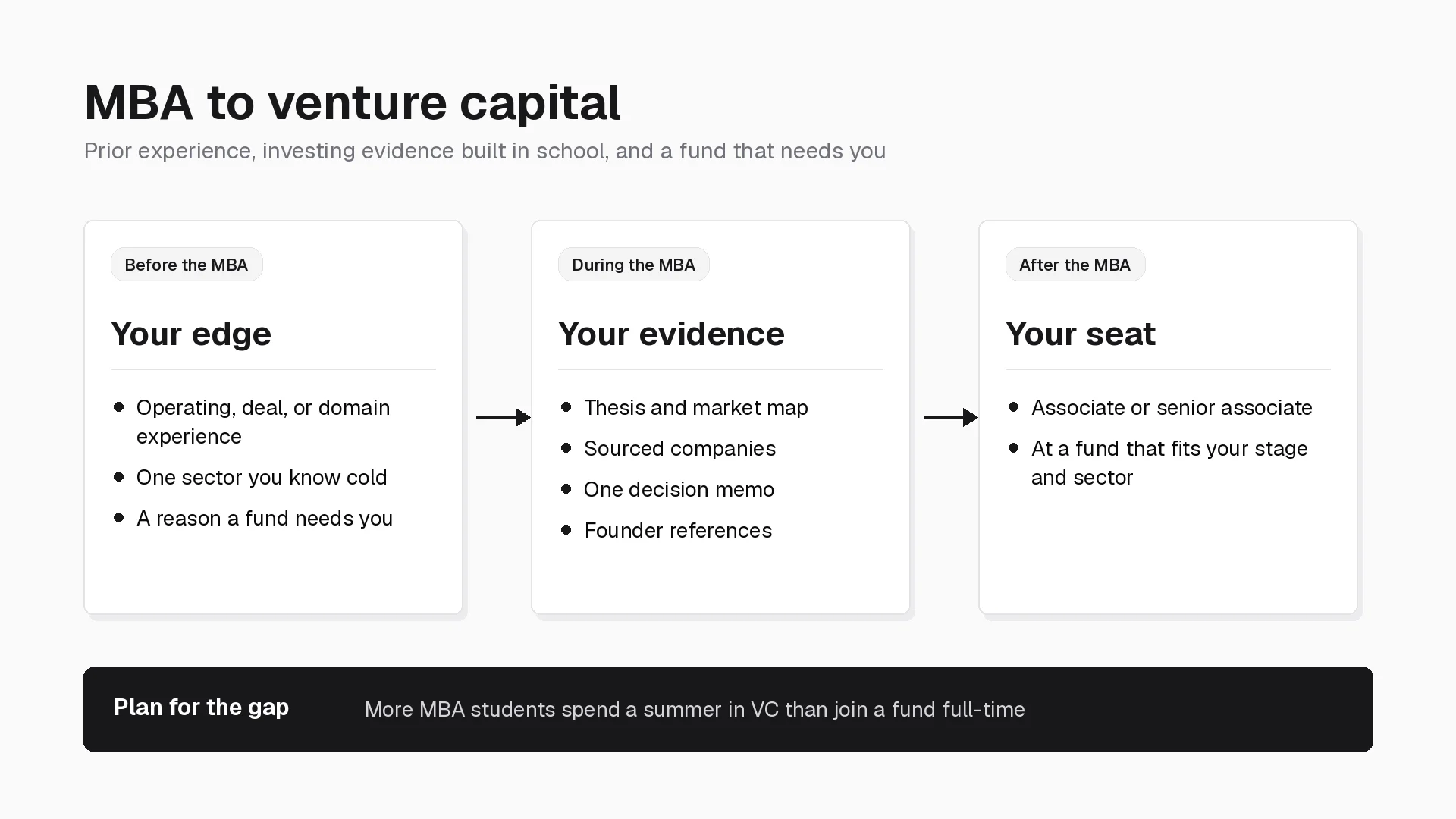
How to move from an MBA to venture capital: what employment reports show about VC placement, how to judge a program, why summer VC internships outnumber full-time offers, and a two-year recruiting plan.
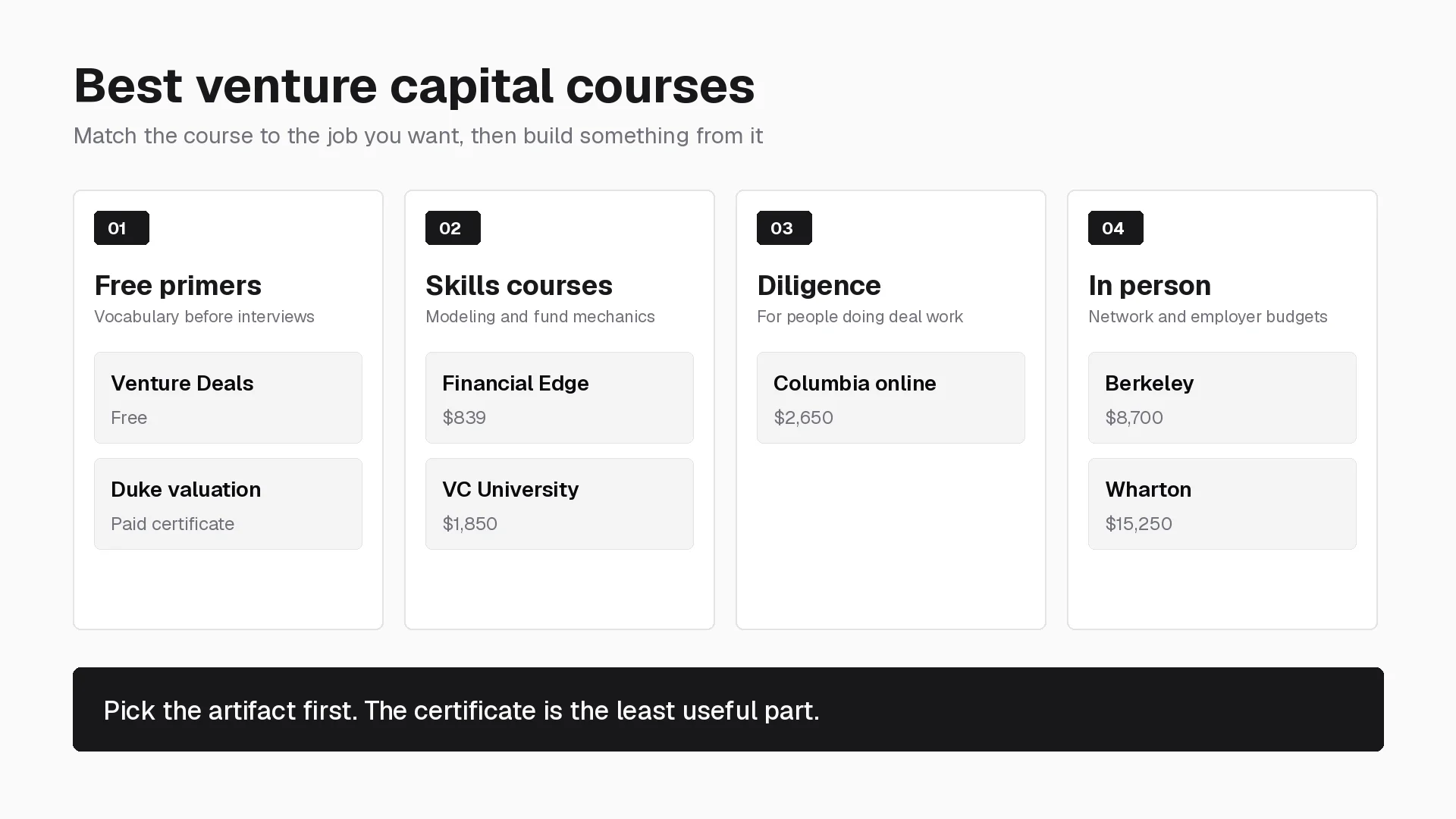
Seven venture capital courses compared on price, length, and format, with the role each fits and the artifact to build so the course helps in VC interviews.