
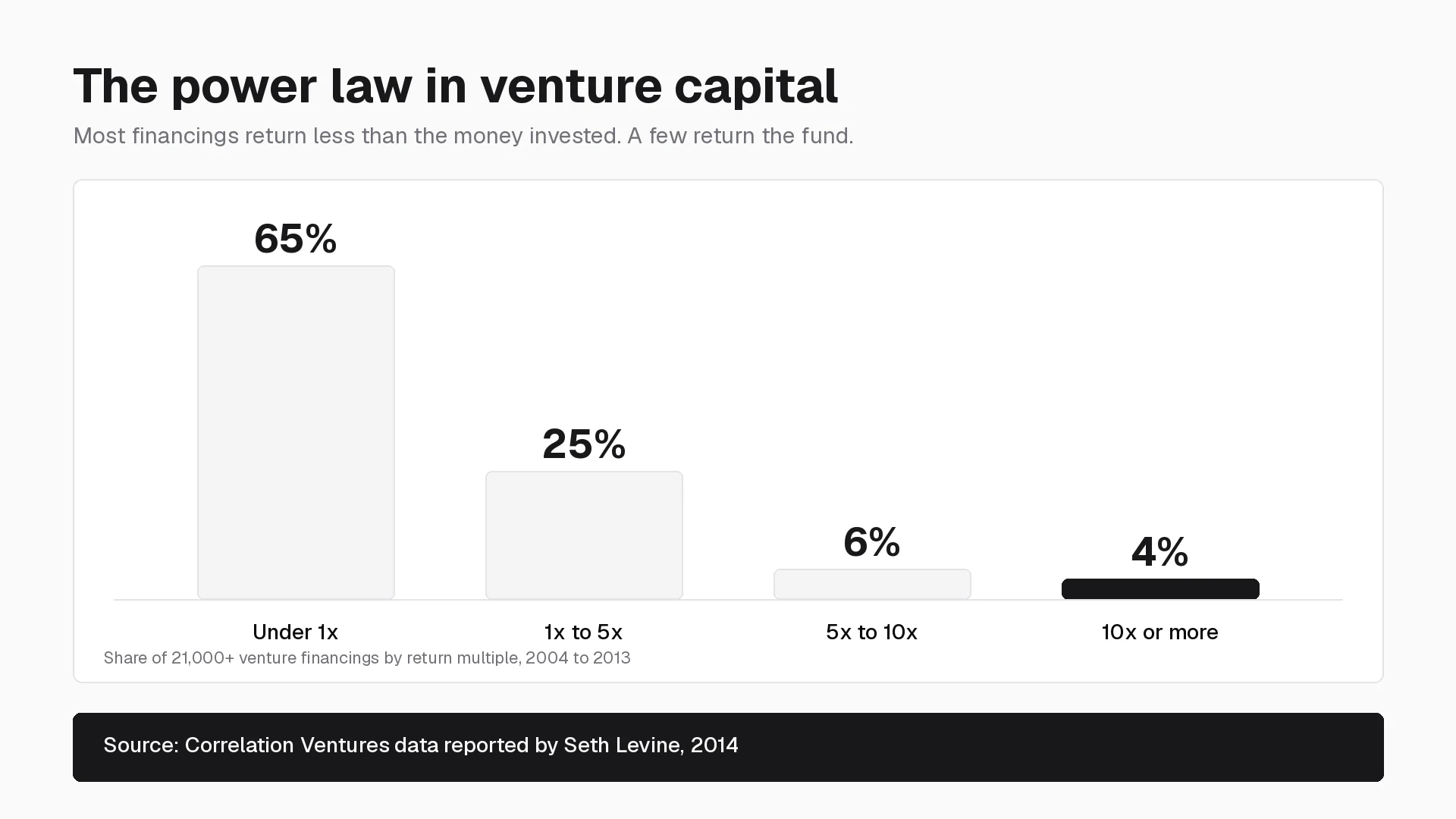
The power law in venture capital is the pattern where a small number of investments produce most of a fund's returns and most of the rest return little or nothing. In data that Horsley Bridge, an LP in hundreds of venture funds, shared with Andreessen Horowitz, about 6% of investments, using 4.5% of the dollars, generated roughly 60% of total returns.
That skew is the reason VCs pass on good businesses, chase companies that look slightly crazy, and keep money in reserve for the few that work. It also decides how people at VC firms spend their weeks, how junior investors get judged, and what their carry is worth. If you want a job in venture, you need to understand it well enough to do the math out loud.
What the power law means in venture capital
A power law is a distribution where outcomes do not cluster around an average. Most results are small and a few are enormous. In a VC fund, that means the best company is often worth more than every other investment combined. Peter Thiel's version, quoted in the same a16z post, is that actual returns are "incredibly skewed," and that bad VCs assume "all companies are created equal."
Venture investors used to describe a good portfolio with a rule of thirds: lose money on a third, get your money back on a third, and make the fund on the last third. The data says reality is harsher. Correlation Ventures looked at more than 21,000 financings from 2004 to 2013 and found that 65% returned less than 1x, only 10% returned 5x or more, and only 4% returned 10x or more, as Seth Levine reported.
The statistics matter for one reason. AngelList's analysis of thousands of seed deals found that, after about five years, winning seed investments draw their multiples from a power law steep enough that the average has no ceiling in theory. In plain terms, the cost of missing the single best deal is, in theory, unlimited. That is why a VC worries more about the company they passed on than the one that went to zero.
What the data shows
Four datasets sit behind most of the numbers people quote about the power law. Here is what each one measured.
| Source | What was measured | Finding |
|---|---|---|
| Horsley Bridge, shared with a16z in 2015 | Investments across hundreds of VC funds since 1985 | About 6% of investments, using 4.5% of dollars, produced about 60% of returns. Home runs above 10x averaged about 20x at good funds and almost 70x at great funds. Great funds lost money on a larger share of deals than good funds did. |
| Correlation Ventures, reported by Seth Levine in 2014 | 21,000+ financings, 2004 to 2013 | 65% returned under 1x. 10% returned 5x or more. 4% returned 10x or more. |
| AngelList, 2019 | Thousands of seed deals syndicated on AngelList over seven years | Winning seed investments follow an extreme power law after about five years. In 10-year simulations, fewer than 10% of investors beat a broad seed index, even with some picking skill. |
| AngelList, September 2026 | 2025 seed vehicles on AngelList | Truly indexing seed does not work in practice because new money changes which companies get funded. Access to good deals may be the skewed skill, while pure picking ability looks closer to normal. |
Read together, the numbers say three things.
Losing is normal. The best funds in the Horsley Bridge data lost money on more deals than merely good funds. Swinging hard means more strikeouts.
The size of the winner beats the hit rate. Great funds had more home runs, and their home runs averaged almost 70x against about 20x at good funds.
Average is a bad outcome. Levine built a $100M fund with 20 companies using Correlation's average outcomes and got about $206M back before fees, roughly a 10% IRR. Almost $100M of that came from 0.8 of one company that returned 5x or better. Miss that one, and the fund fails to return capital after fees.
How big an exit has to be to return the fund
"Can this return the fund?" is the question VCs ask most about a new company. It has a simple formula:
Exit value needed to return the fund = fund size ÷ your ownership at exit.
Ownership at exit is usually lower than ownership at entry because later rounds dilute you unless the fund buys its pro rata in them. Returning the fund once is the floor, not the goal. Management fees and years of waiting come out of it.
| Fund size | 5% at exit | 10% at exit | 15% at exit | 20% at exit |
|---|---|---|---|---|
| $25M | $500M | $250M | $167M | $125M |
| $50M | $1B | $500M | $333M | $250M |
| $100M | $2B | $1B | $667M | $500M |
| $250M | $5B | $2.5B | $1.67B | $1.25B |
| $500M | $10B | $5B | $3.33B | $2.5B |
| $1B | $20B | $10B | $6.67B | $5B |
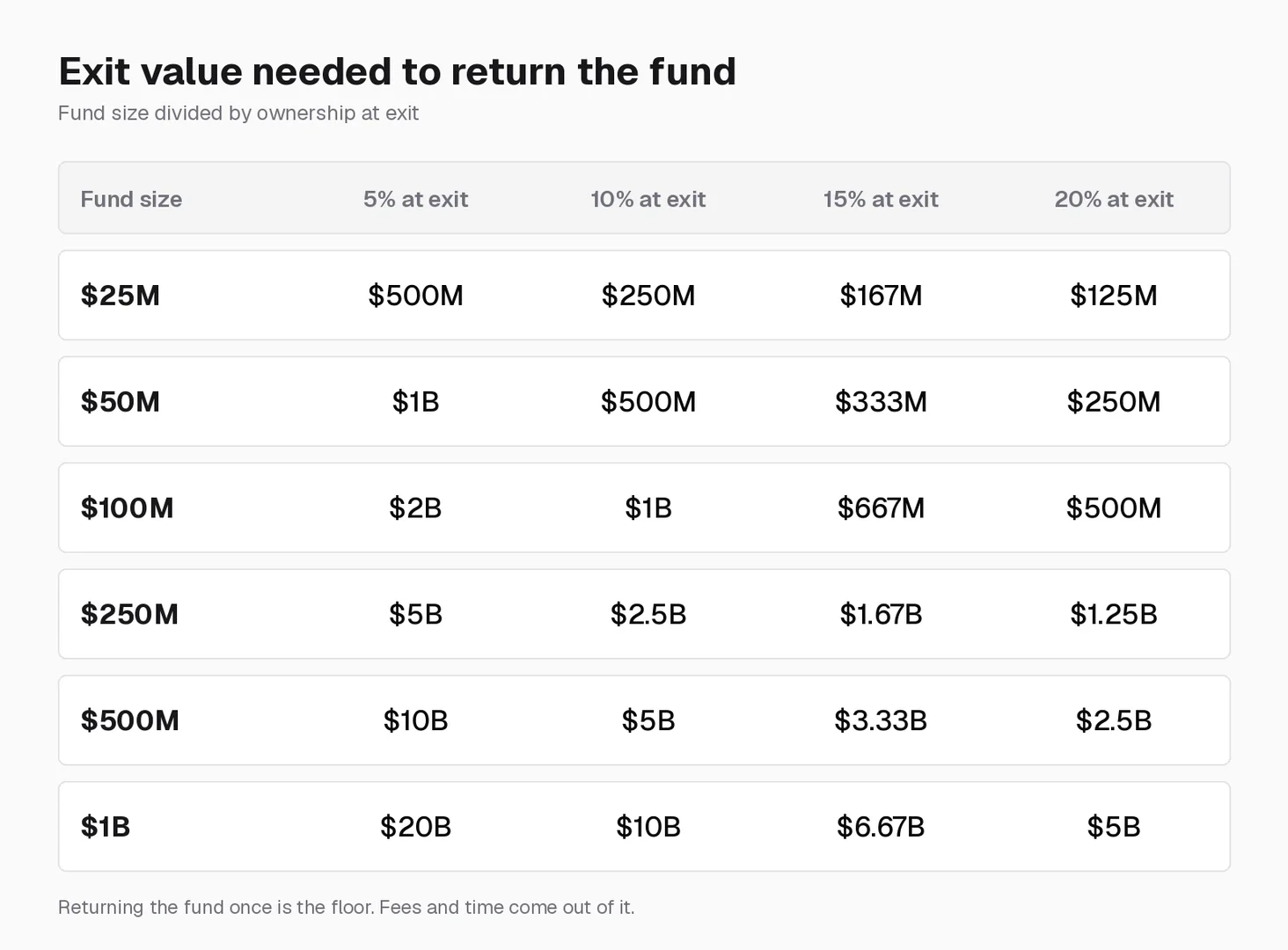
The grid explains a lot of VC behavior that looks strange from the outside. A $400M acquisition returns a $25M seed fund that owns 15% more than twice over. The same exit returns 2% of a $1B fund that owns 5%. So the large fund passes on a company the small fund is excited about, and both are being rational. When you pitch a company to a partner, run this math for that firm's fund size before anyone asks.
How the power law shapes portfolio strategy
Every fund has to answer the same question: how do we make sure we own enough of the one company that matters? Funds tend to pick one of three answers.
| Approach | The bet | The risk |
|---|---|---|
| Broad portfolio, small checks | More shots means a better chance the winner is in the portfolio | Ownership in the winner is too small to move the fund |
| Concentrated portfolio, high ownership | Fewer, bigger positions make each winner count | Miss the winner and nothing saves the fund |
| Moderate first checks, large reserves | Pay up later in the companies that are working | Reserves get spent defending companies that are not breaking out |
AngelList's 2019 work argued for the first approach at seed. Its 2026 follow-up adds a catch: in its check-sizing research, a GP's small seed checks outperformed their typical or large ones, consistent with the best rounds rationing allocation. The deals everyone wants are the ones where you get the least.
Allocation, reserve ratios, and how many companies to hold are their own topic. The venture capital portfolio strategy guide covers them with a worked example. What the power law adds is the test every one of those choices has to pass: if our best company works, do we own enough of it to matter?
How the power law changes the work at a VC firm
The power law is not only a return pattern. It sets the priorities for each part of the job, from the first founder call to the way partners decide who gets promoted.
Sourcing: coverage beats cleverness
You cannot back the outlier if you never meet it. That puts a premium on seeing a large share of the credible companies in your area before they raise, and on founders knowing you exist. A narrow pipeline of polished deals is worse than a wide one with a few strange ones in it. For the mechanics, see venture capital deal sourcing.
Screening: the first question is size, not quality
A screen for a power-law fund asks whether the company could plausibly be worth the fund-returner number for your fund. A profitable company that tops out at $100M of value is a fine business and a pass for most funds. Write that reasoning down when you pass. It is the same logic VCs apply in the investment decision process, stated as a number.
Conviction over consensus
The Horsley Bridge data shows the best funds lose money more often than good ones. A deal that every partner likes on day one is usually a deal every other firm likes too, at a price that leaves little upside. Junior investors who only bring consensus deals add little. The ones who get noticed bring a company with a clear reason it could be huge and a clear list of what has to be true.
Passes cost more than losses
A bad investment can lose 1x. A missed winner can cost 100x. Some firms keep an anti-portfolio, the companies they passed on that later broke out, and review why. Do the same with your own passes. A short note on each pass, with the reason and the evidence that would change your mind, becomes the best record of your judgment you have.
Time goes where the value is
Winners show up over years, not quarters. Reserves, board time, recruiting help, and follow-on diligence tend to flow toward the companies that are working, so expect your portfolio work to be uneven. The follow-on investment guide explains how those decisions get made.
How junior investors get judged
A fund's results usually take the better part of a decade to show, which is often longer than an analyst or associate stays in one seat. So firms judge junior investors on things they can see sooner:
- The quality and breadth of your pipeline in your sector
- Whether companies you flagged early went on to raise from strong firms
- The clarity of your investment memos, especially the upside case
- Whether your pass notes hold up a year later
Build those signals on purpose. They are what gets discussed when the partners decide who moves up the venture capital career path.
What it means for your carry and your choice of firm
Carry is a share of a fund's profits. Under a power law, those profits usually come from one or two companies, so the value of your carry depends on which fund it comes from and whether that fund already holds a breakout. The carried interest guide covers the mechanics. The power-law questions to ask before you accept an offer are these:
- Which fund or funds does my carry come from, and what is its vintage?
- Is that fund early in investing, or mostly deployed?
- Does any company in it already account for most of its value on paper?
- How does my carry vest, and what happens to unvested carry if I leave?
- How concentrated were the returns of the firm's prior funds? Results that rest on one company tell you less about whether the firm can repeat them.
There is a tradeoff. Carry in a mostly deployed fund with a breakout already in it may be worth more, sooner. Carry in a new fund is a bet on the team finding its outlier while you are there. Neither is wrong, but you should know which one you are being offered. The associate offer negotiation guide covers how to raise these questions, and the salary guide covers base and bonus.
How to answer power law questions in a VC interview
The power law comes up in fit questions, technical questions, and the case study. Common versions:
- "What is the power law, and how should it affect how we invest?"
- "This company could be a $300M business. Would you invest?"
- "How would you build a portfolio for a $50M seed fund?"
- "Tell me about a company you would pass on that might be a mistake."
A strong answer has three parts. Define it in one sentence. Do the fund-returner math for this firm. Apply it to a real company and say what would have to be true.
Here is an example for a firm with a $150M Series A fund that targets about 15% at entry:
"The power law means a few companies drive most of a fund's returns, so the real question for any deal is whether it could return the fund. For a $150M fund, if dilution takes 15% down to around 10% by exit, a company needs to be worth about $1.5B to return the fund once. For the company I would pitch, that means taking a large share of a market I can size, and here is the evidence I would test first."
Two traps to avoid. Do not say losses do not matter. Price, ownership, and reserves still decide whether a winner moves the fund. And do not claim you can spot unicorns. Interviewers want to hear how you would find, test, and size a possible outlier. Practice the math with the venture capital interview questions and the modeling test guide.
Where the power law gets misused
The idea is right. The way people use it is often wrong.
As an excuse for weak underwriting. "Any deal could be the outlier" is not a thesis. A power law makes the upside case more important to underwrite, not less.
As a reason to ignore price. Paying any valuation for a hot company cuts your ownership and your multiple. The grid above shows how fast a lower ownership raises the exit you need.
As if every fund needs a $10B outcome. Fund size sets the bar. A $500M exit can make a small seed fund and do little for a large one. A small fund that copies a mega-fund's screen will pass on the companies that could make it.
As if every stage works the same way. AngelList found seed returns are more extreme than later rounds because startups grow fastest early and seed money has longest to compound. Growth investors face a less extreme distribution, so price and downside carry more weight. See growth equity vs venture capital.
As if the rule of thirds were the data. The Correlation numbers are far harsher than one third, one third, one third. Planning for the friendly version leads to funds that look fine on paper and return little.
As if picking were the whole game. AngelList's 2026 analysis suggests access to the best rounds may be the more skewed skill. For a junior investor, that makes reputation with founders and other investors part of the job, not a side project.
Frequently asked questions
What is the power law in venture capital?
It is the pattern where a few investments produce most of a fund's returns. In Horsley Bridge's data, about 6% of investments produced about 60% of returns. The best company in a fund is often worth more than all the others combined.
What does "return the fund" mean?
A company returns the fund when the fund's proceeds from that one company equal the fund's total size. For a $100M fund owning 10% at exit, that takes a $1B exit. It is a screening bar, not a target return.
Is the VC power law the same as the 80/20 rule?
The 80/20 rule, or Pareto principle, is a milder version of the same idea. Venture is more extreme. Correlation's data shows 4% of financings returning 10x or more, and Horsley Bridge's shows about 6% of investments producing about 60% of returns.
Why do VCs pass on good, profitable businesses?
Because a business that tops out below the fund-returner number cannot move the fund, even if it is a great company. Many such companies are better suited to other kinds of capital.
Does the power law apply to growth-stage funds?
Less strongly. AngelList found the most extreme distribution at seed and said it does not appear to hold for later-stage investments. Later-stage funds buy into companies that are already working, so more of their work goes into price and downside protection.
What should I read to go deeper?
Sebastian Mallaby's The Power Law is a history of venture told through this idea. It is on our list of the best venture capital books. For the fund side, read venture capital fund performance metrics and management fees.
How can I practice power-law thinking before I work at a fund?
Build a fantasy VC portfolio with a set fund size and ownership target, then write the fund-returner math and an upside case for every company you add. It gives you real examples for interviews.
Next steps
The fastest way to see the power law at work is to look at real funds and the people they hire. Research VC firms by stage and focus, then run the fund-returner math on their fund sizes before you reach out. When you are ready to apply, browse open venture capital jobs, or create a free account to get new roles by email.
Related posts
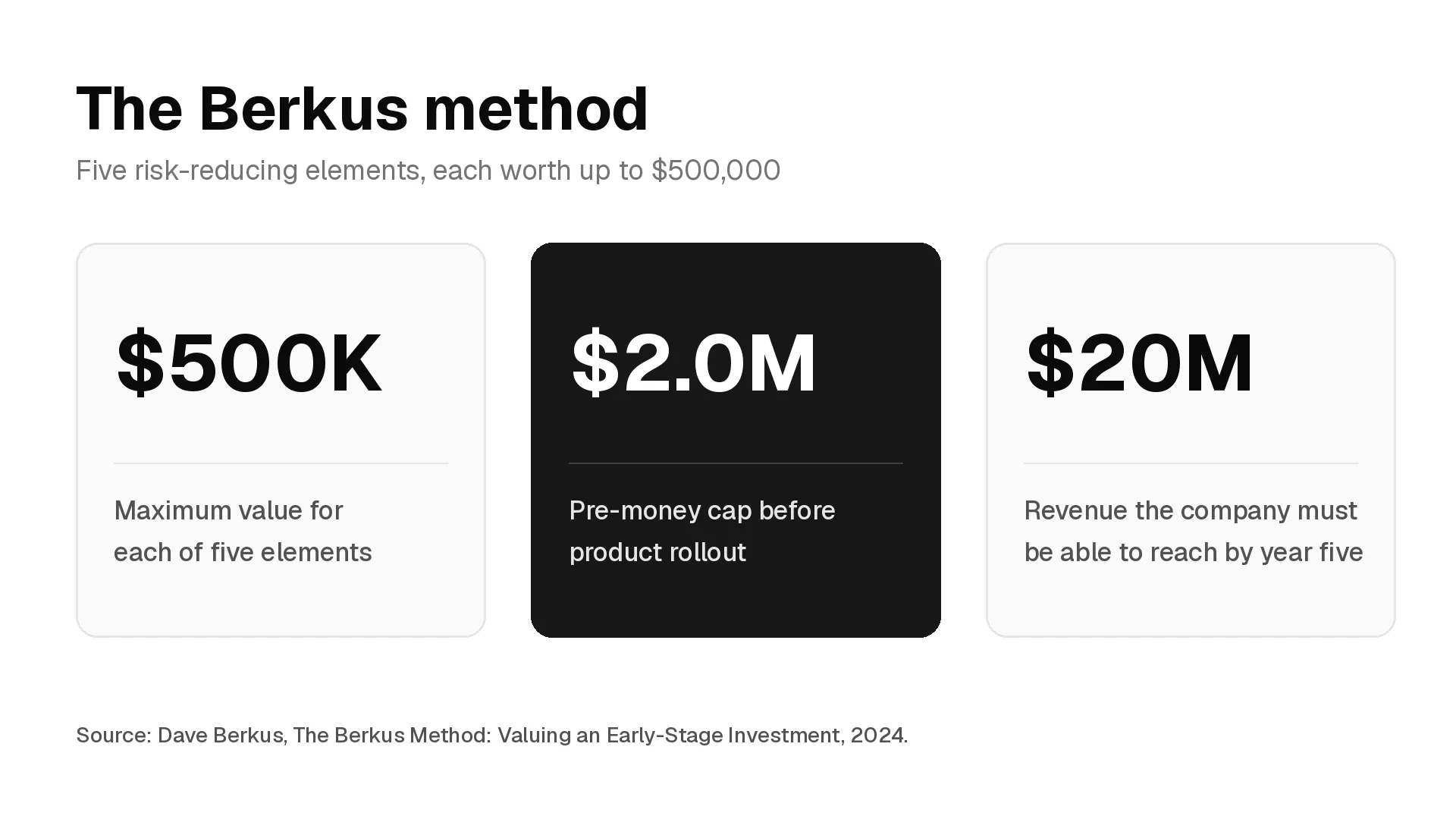
How the Berkus method values a pre-revenue startup, how to score each of the five elements, a worked example with ownership and 10x checks, how the $500,000 caps compare with current seed prices, and how VC analysts use it in memos and interviews.
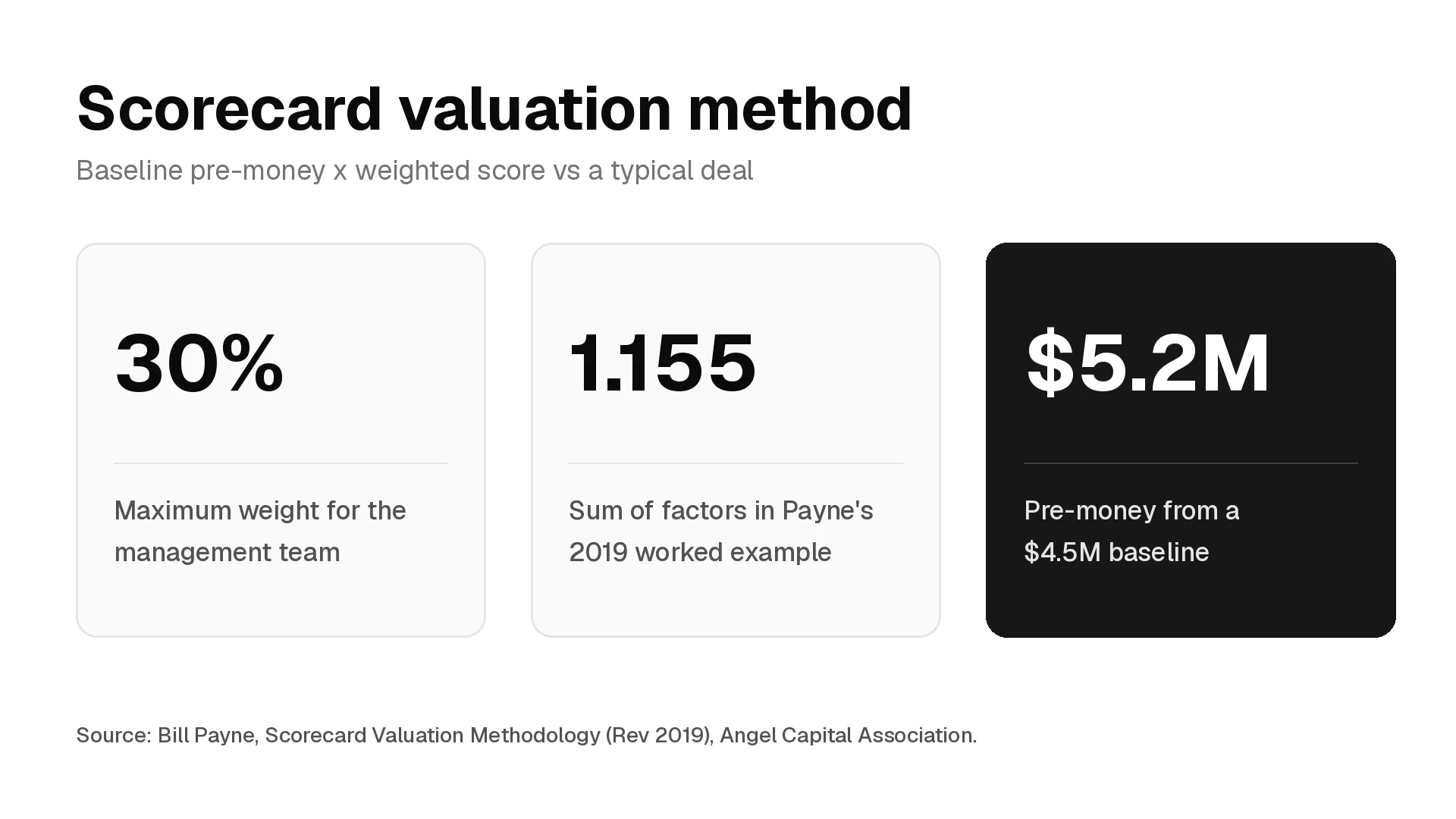
How the scorecard valuation method works, Bill Payne's seven factor weights, his worked example with the arithmetic checked, how to choose the baseline with current seed data, how sensitive the answer is, and how VC analysts use it in memos and interviews.
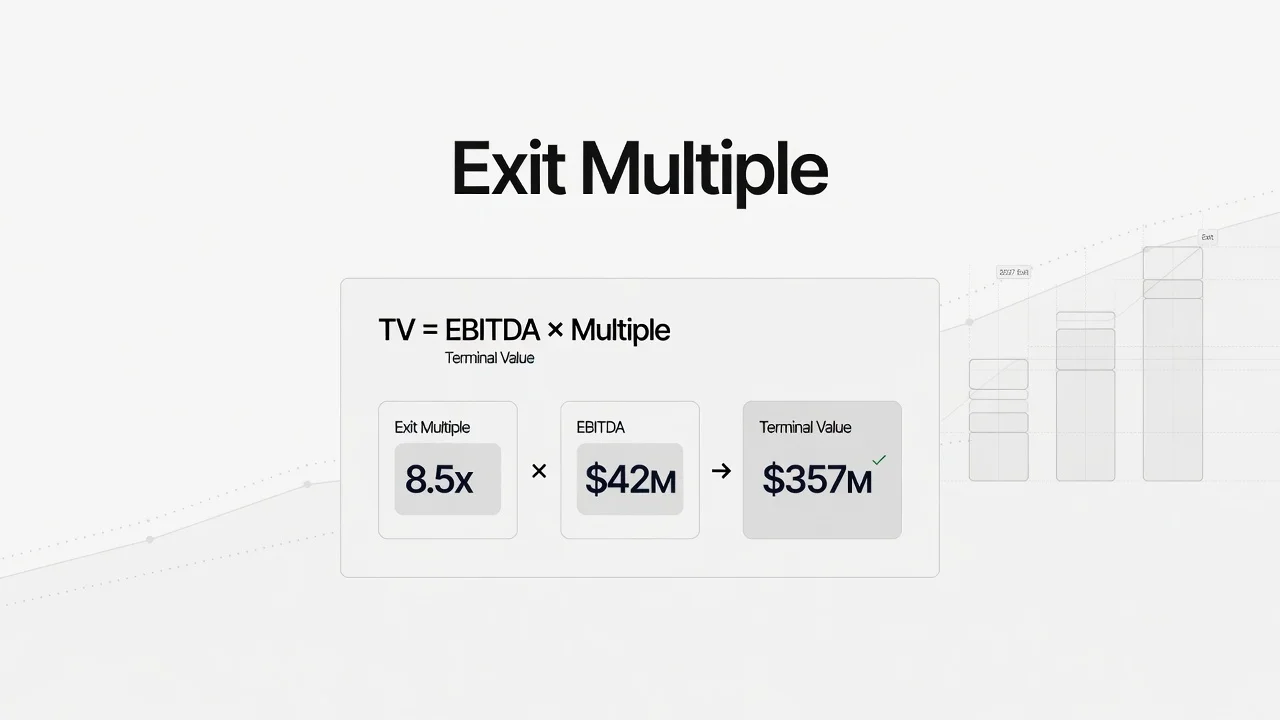
Exit multiple formula, a worked DCF terminal value example with a sensitivity grid, the implied growth cross-check, January 2026 industry multiples, and how VC investors use exit multiples.