
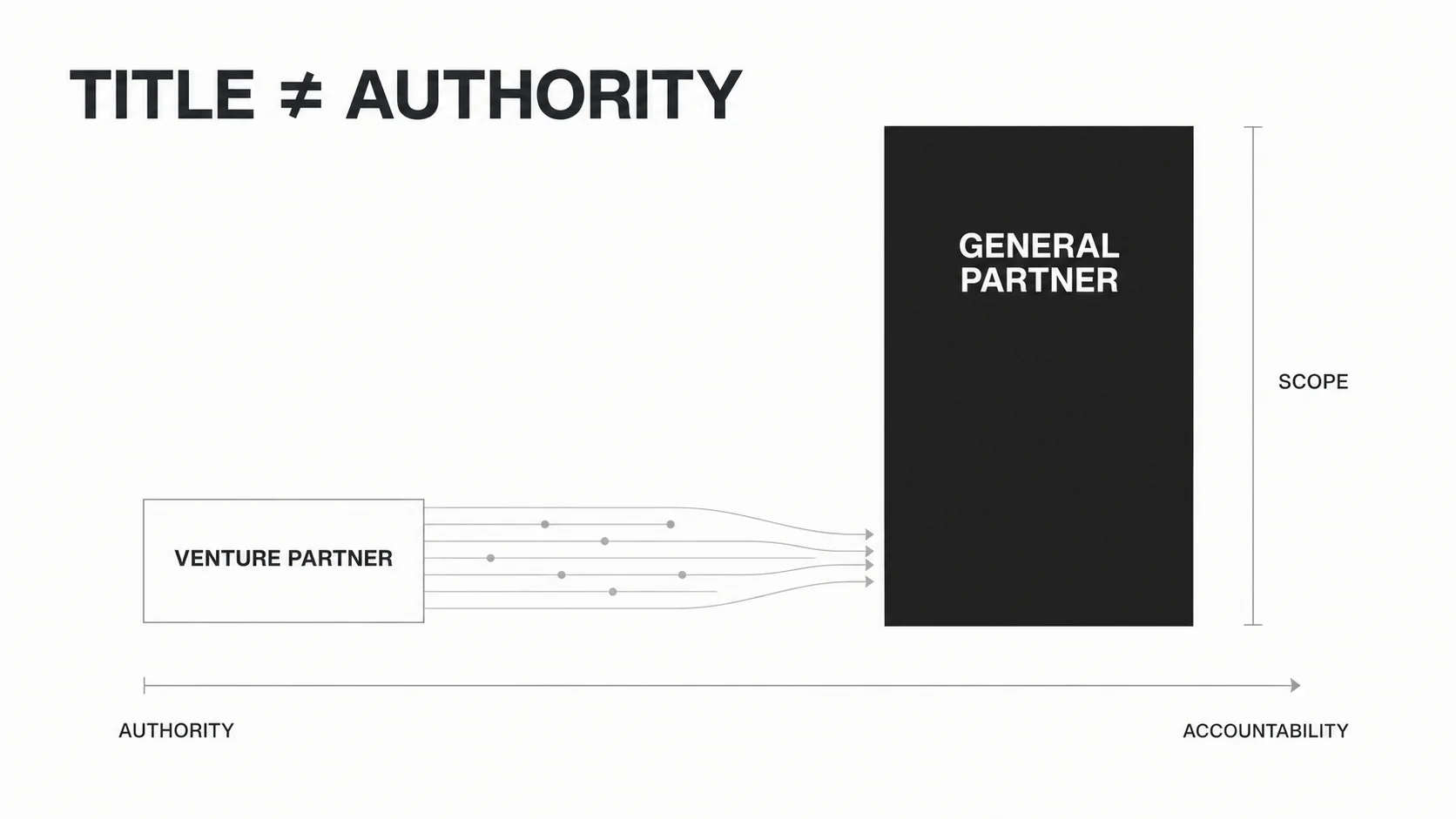
A general partner (GP) is typically accountable for the fund as a whole: raising capital, setting strategy, approving investments, managing the portfolio, reporting to limited partners, and building the firm. A venture partner usually has a narrower mandate built around sourcing, sector expertise, selected deals, or portfolio support. The role may be full-time, fractional, or tied to a particular fund.
That is the useful default—not a universal hierarchy. Venture firms use titles differently, and a senior-sounding title does not prove who can vote, sign for the fund, own management-company equity, or participate in carry.
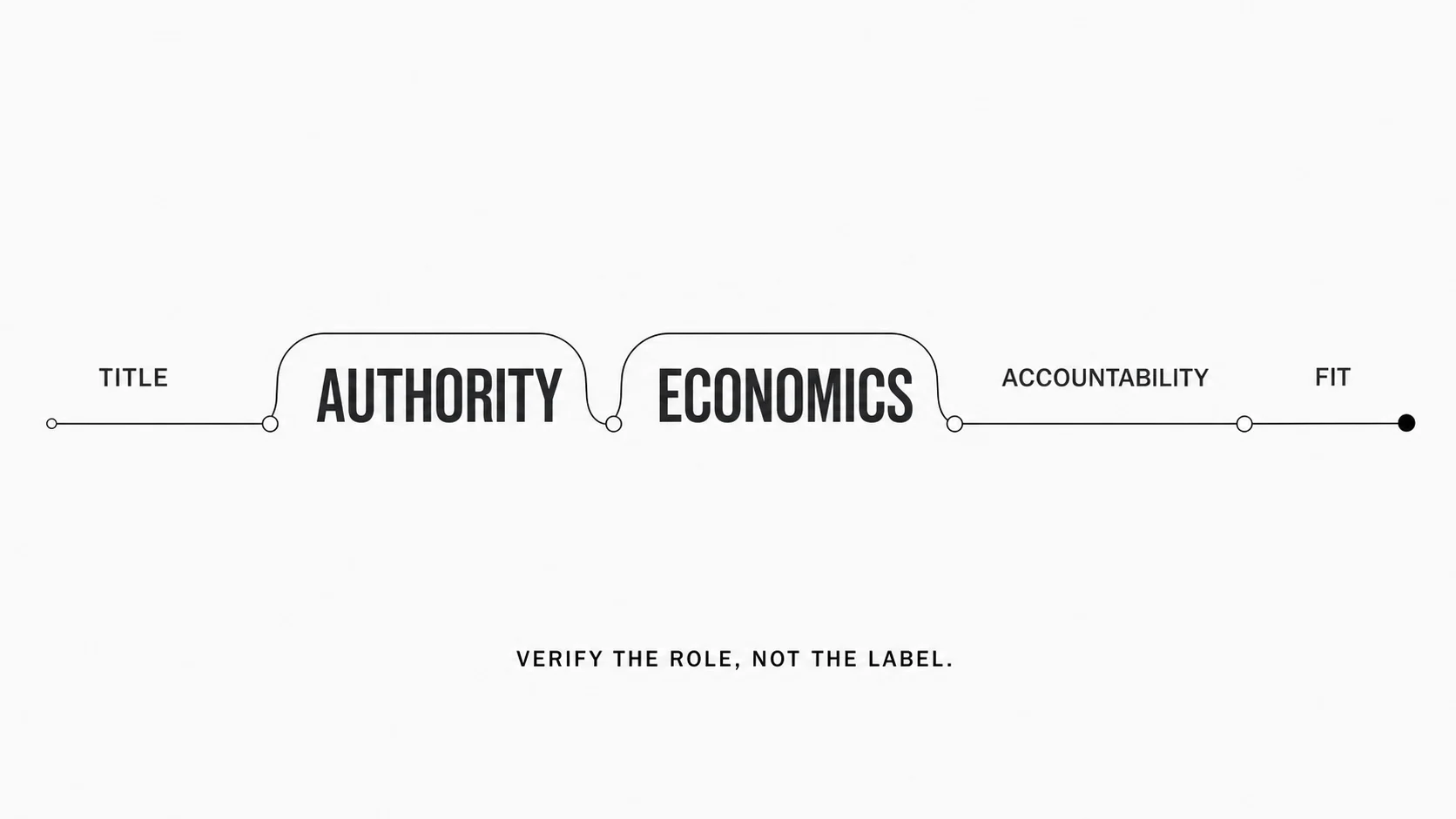
Evaluate the role across five dimensions: entity position, decision authority, economics, time commitment, and accountability. Those facts matter more than the title on a biography.
Venture partner vs general partner at a glance
| Dimension | Venture partner | General partner |
|---|---|---|
| Typical mandate | Defined sector, geography, sourcing channel, deal set, or portfolio function | Performance and governance of the full fund and firm |
| Time commitment | Can be fractional, project-based, fund-specific, or full-time | Usually a durable, full-time leadership role |
| Investment authority | May recommend, sponsor, or vote; scope varies | Usually leads deals and has formal investment authority |
| Fundraising | May make introductions or support a raise | Owns LP relationships and fundraising outcomes |
| Portfolio work | Selected companies where expertise or relationships matter | Portfolio-wide decisions, reserves, follow-ons, boards, and outcomes |
| Economics | May combine retainer or salary with deal or fund carry | Typically participates more broadly in fund economics and may own part of the management company |
| Capital commitment | May have none or a negotiated commitment | Often expected to invest personally in the fund or GP commitment |
| Accountability | Defined outputs under a narrower mandate | Fund returns, LP trust, compliance, operations, team, and firm continuity |
| Common career use | Specialist affiliation, flexible senior role, mutual trial, or path toward GP | Long-term fund leadership and firm ownership |
| Best diligence question | What can I decide, and what economics attach to that authority? | Which entities, funds, and obligations am I joining? |
Treat every row as a hypothesis to verify. Some venture partners sit on the investment committee and lead deals. Some people called “partner” do not. A small firm may use “GP,” “partner,” and “managing partner” almost interchangeably, while a larger platform may separate legal ownership, investment authority, and operating leadership.
The structural difference: title, GP entity, and management company
“General partner” can describe both a senior investing role and the entity that manages a limited partnership. Those meanings overlap, but they are not identical.
A typical venture structure includes the fund, its limited partners, a GP entity with management authority, and a management company that employs the team and receives management fees. Sydecar’s fund-structure overview explains why these pieces are separate. An employment title alone does not tell you who owns any entity or who is legally authorized to act for it.
Practitioner Chris Neumann makes the title problem concrete: a GP may be an owner and LPA signatory, while a person called “Partner” may lead deals and hold an investment-committee vote without the same entity ownership or signature authority. He also notes that official voting weight and informal influence can diverge. His partner-title breakdown is a useful reminder that title, formal power, and soft power are separate variables.
A venture partner might be:
- an employee of the management company;
- a contractor or adviser with a defined mandate;
- a member of an investment committee for one fund;
- a participant in deal-specific or fund-level carry;
- a board member or portfolio specialist; or
- a senior investor being tested for a broader GP role.
These arrangements can be combined. The written agreement, fund documents, committee charter, and actual operating practice determine the role.
What each role actually owns
General partner responsibilities
A GP’s job extends well beyond finding promising startups. AngelList’s GP overview describes a broad mandate: raising the fund, deploying capital, supporting portfolio companies, deciding on follow-ons, communicating with LPs, overseeing fund operations, and building the team.
In practice, a GP is expected to own several loops at once:
- Capital: raise commitments, maintain LP trust, and help finance the management company.
- Investments: shape thesis, source and win deals, make decisions, and allocate reserves.
- Portfolio: support companies, serve on boards, manage concentration, and decide when to follow on.
- Institution: hire and develop the team, protect the firm’s reputation, and prepare the next fund.
- Governance: ensure decisions and reporting follow fund documents, policies, and applicable obligations.
The role is attractive because the authority and upside can be durable. It is demanding for the same reason: poor fund outcomes, weak fundraising, team problems, and broken LP confidence all land at GP level.
Venture partner responsibilities
A venture partner usually owns a narrower but still senior brief. Visible’s role overview emphasizes sourcing, sector expertise, portfolio guidance, firm representation, and network access. The exact mix depends on why the firm created the role.
Common outputs include:
- bringing credible opportunities into the pipeline;
- evaluating companies in a defined sector or geography;
- sponsoring selected opportunities through diligence;
- helping a partner win access to a competitive deal;
- advising founders or serving on boards;
- connecting portfolio companies with customers, executives, or later investors; and
- representing the firm in a specialist ecosystem.
The crucial distinction is between influence and authority. A venture partner may persuade the investment committee without having a vote. They may hold a vote without being able to sign documents. They may lead a deal but need a GP to approve reserves or a follow-on. None of those structures is inherently bad; ambiguity is the problem.
Four common venture partner configurations
“Venture partner” is best understood as a family of arrangements.
| Configuration | Main output | Typical authority | Economics pattern to verify | Best fit | Main risk |
|---|---|---|---|---|---|
| Network and sourcing partner | Qualified introductions and access to a community | Recommends opportunities; rarely owns the full decision | Retainer, deal-linked economics, or limited carry | Well-connected founder, executive, or ecosystem leader | Prestige title with vague attribution and no repeatable mandate |
| Sector or geography specialist | Thesis development, diligence, and deal support in a domain | May sponsor deals and join relevant IC discussions | Fund or deal carry tied to a defined scope | Deep operator or investor with differentiated expertise | Used as a signal while core partners retain all meaningful authority |
| Portfolio or operating specialist | Hands-on help to selected companies | Strong influence over portfolio work; limited new-investment authority | Salary or retainer plus carry or portfolio incentives | Experienced operator who wants portfolio exposure | Venture-partner title obscures what is really an operating partner role |
| GP-track investment partner | Sourcing, leading deals, boards, portfolio decisions, and fundraising exposure | Can progress from sponsor to IC member and broader fund authority | Fund carry, vesting, and possible ownership path | Proven investor joining a new platform or succession plan | “Path to GP” has no timeline, criteria, precedent, or allocated economics |
A firm may move someone between configurations as trust develops. That can be healthy when the milestones are explicit. It can also become an indefinite trial in which the venture partner produces GP-level work without gaining GP-level authority or economics.
Authority: who can source, sponsor, vote, and commit?
Investment authority is not binary. Map it as a ladder:
- Source: introduce an opportunity.
- Recommend: provide a view or diligence input.
- Sponsor: own the internal case and move the deal through the process.
- Vote: hold a formal investment-committee vote.
- Commit: sign or authorize the fund’s legal commitment.
A venture partner could operate at any point on that ladder. A GP usually operates near the top, but even a GP may be constrained by the investment committee, fund documents, concentration limits, or consensus norms.
Ask for examples, not adjectives. “You will have significant influence” is not an answer. Better evidence includes:
- the committee charter or a written description of membership;
- which decisions require a vote and whose votes count;
- a recent deal where someone in the same role acted as sponsor;
- whether the role can approve reserves, bridges, or follow-ons;
- who signs term sheets and final investment documents; and
- how disagreements between the venture partner and a GP are resolved.
Formal authority still does not capture soft power. A founding or managing partner may carry more influence than an equal vote suggests. A specialist venture partner may be decisive inside their domain without holding the same authority across the portfolio. Interview people who have seen the process work under disagreement, not only when everyone agreed.
Economics: salary, carry, ownership, and commitment
Compensation varies too much for a single venture-partner or GP formula. Compare the complete package.
| Component | What to verify | Why the headline can mislead |
|---|---|---|
| Salary or retainer | Amount, time expectation, expenses, benefits, and review cycle | A part-time retainer and full-time salary are not comparable |
| Carry base | Deal, sleeve, fund, or management-company carry pool | The same percentage can apply to very different economic bases |
| Vesting | Start date, schedule, cliff, fund-by-fund treatment, and acceleration | Carry that never vests has little practical value |
| Forfeiture | Good-leaver/bad-leaver rules and treatment after departure | Leaving before distributions may change the outcome materially |
| Attribution | How sourced, led, and supported deals are credited | Subjective attribution can weaken both promotion and economics |
| GP commitment | Whether personal capital is required and on what terms | A commitment can create alignment and meaningful liquidity pressure |
| Management-company ownership | Voting, distributions, dilution, transfer restrictions, and buyback terms | Fund carry does not automatically mean firm ownership |
| New funds | Whether economics automatically extend to successor vehicles | A good arrangement in one fund may disappear in the next |
Venture capital carry is a long-duration, contingent interest—not an annual cash bonus. Review the structure alongside the VCC carried-interest explainer, then have qualified legal and tax advisers assess the actual documents.
The most important negotiation is often not the nominal carry percentage. It is the combination of base, vesting, forfeiture, attribution, fund scope, and the right to participate in future funds.
Eight questions before accepting a venture partner title
Use the following scorecard before treating a title as a promotion.
| Question | Evidence to request | Strong signal | Red flag |
|---|---|---|---|
| Which entity engages me? | Offer, consulting agreement, entity chart | Employer/contracting party and obligations are explicit | Brand name is clear; legal counterparty is not |
| What can I decide? | IC charter, role description, recent example | Source, sponsor, vote, and follow-on rights are distinguished | “Partner-level influence” with no examples |
| What economics are mine? | Carry documents, vesting schedule, pool definition | Base, fund, vesting, forfeiture, and successor-fund treatment are written | Economics depend on later discretion |
| What time does the role require? | Calendar expectations, exclusivity, conflict policy | Time, travel, boards, response times, and outside activity are defined | Fractional pay with full-time availability expectations |
| How is attribution recorded? | Review template or portfolio attribution process | Sourcing, decision, board, and portfolio contributions are tracked | Credit is informal and controlled by one senior person |
| What is the GP path? | Criteria, timeline, prior examples, decision maker | Milestones and a real precedent exist | Promotion is described only as “possible” |
| What happens in the next fund? | Successor-fund language or written policy | Role and economics have a defined review or continuation mechanism | Every fund resets at a GP’s sole discretion |
| What happens when we disagree? | Governance process and reference conversations | Escalation and decision rules are clear | Authority changes depending on the outcome desired |
Two reference calls are especially valuable: one with someone who progressed from a similar role and one with someone who left. Ask what authority they actually exercised, which economics vested, how attribution worked, and whether the role expanded when promised.
The output should be a one-page role memo in your own words:
- legal counterparty and fund scope;
- expected weekly and annual commitment;
- authority ladder position;
- compensation and carry mechanics;
- success measures for the next 12–24 months;
- GP milestones and decision date; and
- failure, departure, and successor-fund treatment.
If the firm will not correct inaccuracies in that memo, the ambiguity is part of the offer.
When venture partner is the better role—and when GP is
A venture partner role can be the stronger choice when you have differentiated expertise, want a clearly bounded mandate, need flexibility, or want both sides to test a long-term fit. The structure works best when authority matches responsibility and the economics reward the outputs the firm actually needs.
A GP role is the stronger choice when you want full-fund accountability: fundraising, LP relationships, investment governance, portfolio construction, team leadership, and firm building. The upside is broader authority and potentially more durable economics. The cost is a longer obligation and less room to treat investing as one commitment among several.
Be cautious about accepting GP accountability without GP authority. Be equally cautious about rejecting an excellent venture partner role merely because the title sounds less senior. The correct comparison is mandate, evidence, economics, and fit.
Moving from venture partner to general partner
Time served is rarely enough. A credible GP case usually combines several forms of proof:
- Attributable investments: deals you sourced or led and the judgment behind them.
- Investment discipline: decisions you declined, reserves you protected, and mistakes you corrected.
- Founder trust: references from leaders you supported through difficult periods.
- Portfolio outcomes: value creation that is specific enough to attribute, even before exits.
- Fundraising credibility: a thesis and track record that LPs understand and trust.
- Firm building: recruiting, mentoring, process design, reputation, and productive partnership behavior.
- Institutional judgment: ability to choose for the portfolio and partnership, not only for one deal.
Ask whether anyone at the firm has made the same transition, what changed in their authority and economics, and who approved it. A pathway without precedent can still be real, but it needs a decision date and measurable criteria.
For a wider view of seniority and progression, use the VC career path and the broader venture capital partner role.
How to research the firm before interviews
Start with the firm rather than the title.
- Use the Venture Capital Careers companies directory to identify the firm’s stage, geography, focus, and team.
- Read partner biographies for evidence of deals, boards, operating work, and fundraising—not title inflation.
- Compare role language across current and past funds. A person may be a GP in one vehicle and a venture partner in another.
- Ask how the investment committee works and who owns follow-on decisions.
- Compare the mandate with current open VC roles and adjacent senior-role descriptions.
Job descriptions rarely contain the full entity and economics picture. Use them to form questions; use documents and references to reach conclusions.
Frequently asked questions
Is a venture partner the same as a general partner?
Usually not. A venture partner commonly has a narrower sourcing, specialist, deal, or portfolio mandate. A GP is usually accountable for the fund and firm more broadly. A venture partner can still lead deals, vote, receive carry, or work full-time, so verify the actual structure.
Is venture partner higher than partner?
There is no reliable universal ranking. At one firm, venture partner is a senior fractional affiliation; at another, it is a step toward GP; elsewhere, “Partner” may have more formal investment authority. Compare decision rights and economics.
Do venture partners vote on investments?
Some do and some do not. Ask whether the person is an investment-committee member, which decisions require their vote, whether votes are equal, and how the firm handles follow-ons and conflicts.
Do venture partners get carry?
They can receive deal-specific, sleeve-level, or fund-level carry, but arrangements vary. The base, vesting, forfeiture, attribution, and successor-fund treatment matter as much as the percentage.
Are venture partners full-time?
The role can be full-time, fractional, project-based, or fund-specific. Confirm time, exclusivity, board, travel, and response-time expectations in writing.
Can a venture partner become a GP?
Yes, but a title alone does not create a promotion path. Look for explicit milestones, a decision maker and date, precedent at the firm, expanding investment authority, fundraising exposure, and documented economics.
The decision rule
A venture partner title can be a valuable senior role or an elegant label for undefined work. A GP title can carry real ownership or simply reflect a small firm’s naming convention.
Write the role down in operational terms: who employs you, what you can decide, how you are paid, whom you answer to, and what changes in the next fund. If those facts support the title, the role is worth evaluating. If they do not, the title is the least important part of the offer.
Research firms in the VCC companies directory, then compare current opportunities on the VC job board.
Related posts
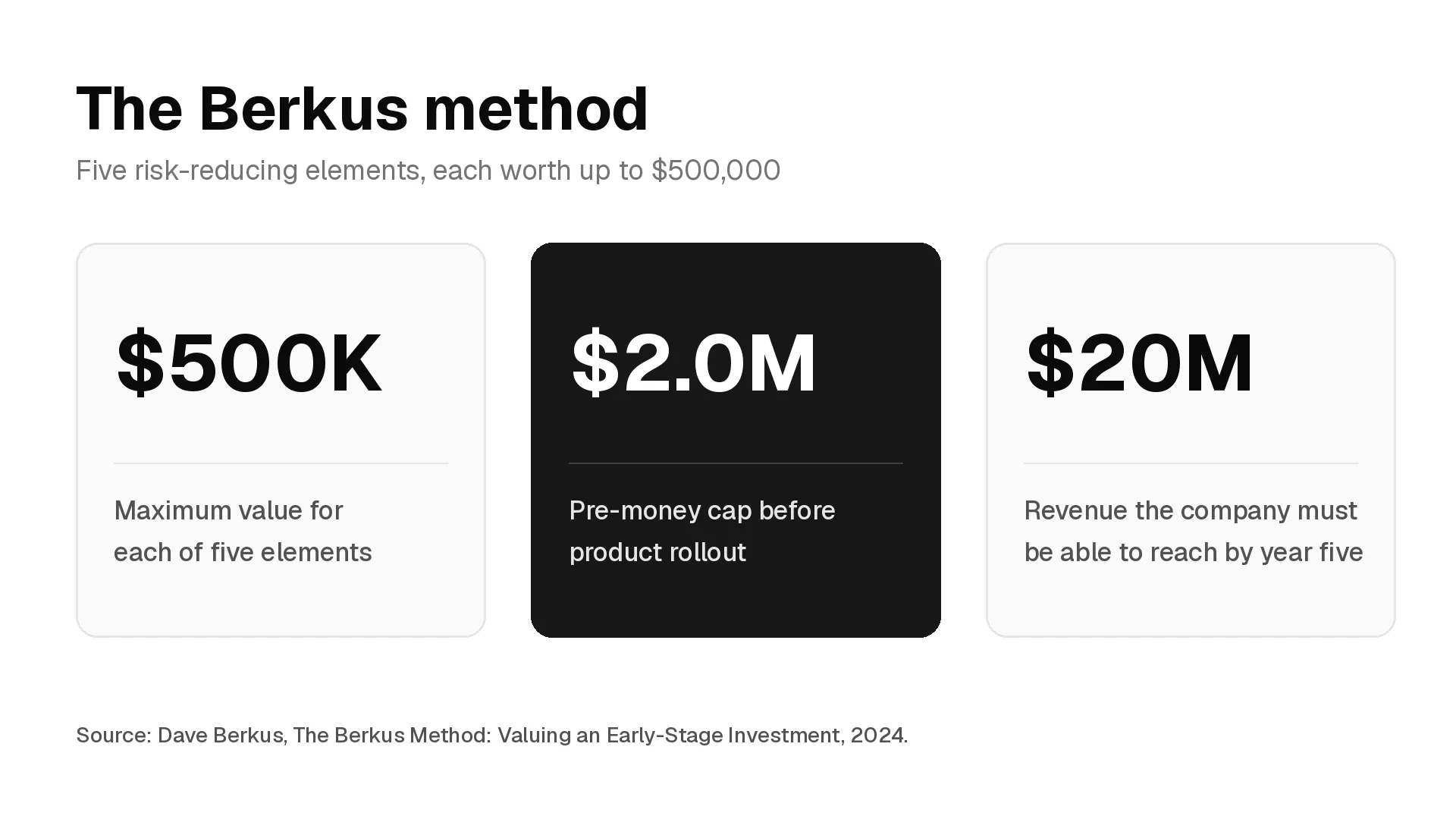
How the Berkus method values a pre-revenue startup, how to score each of the five elements, a worked example with ownership and 10x checks, how the $500,000 caps compare with current seed prices, and how VC analysts use it in memos and interviews.
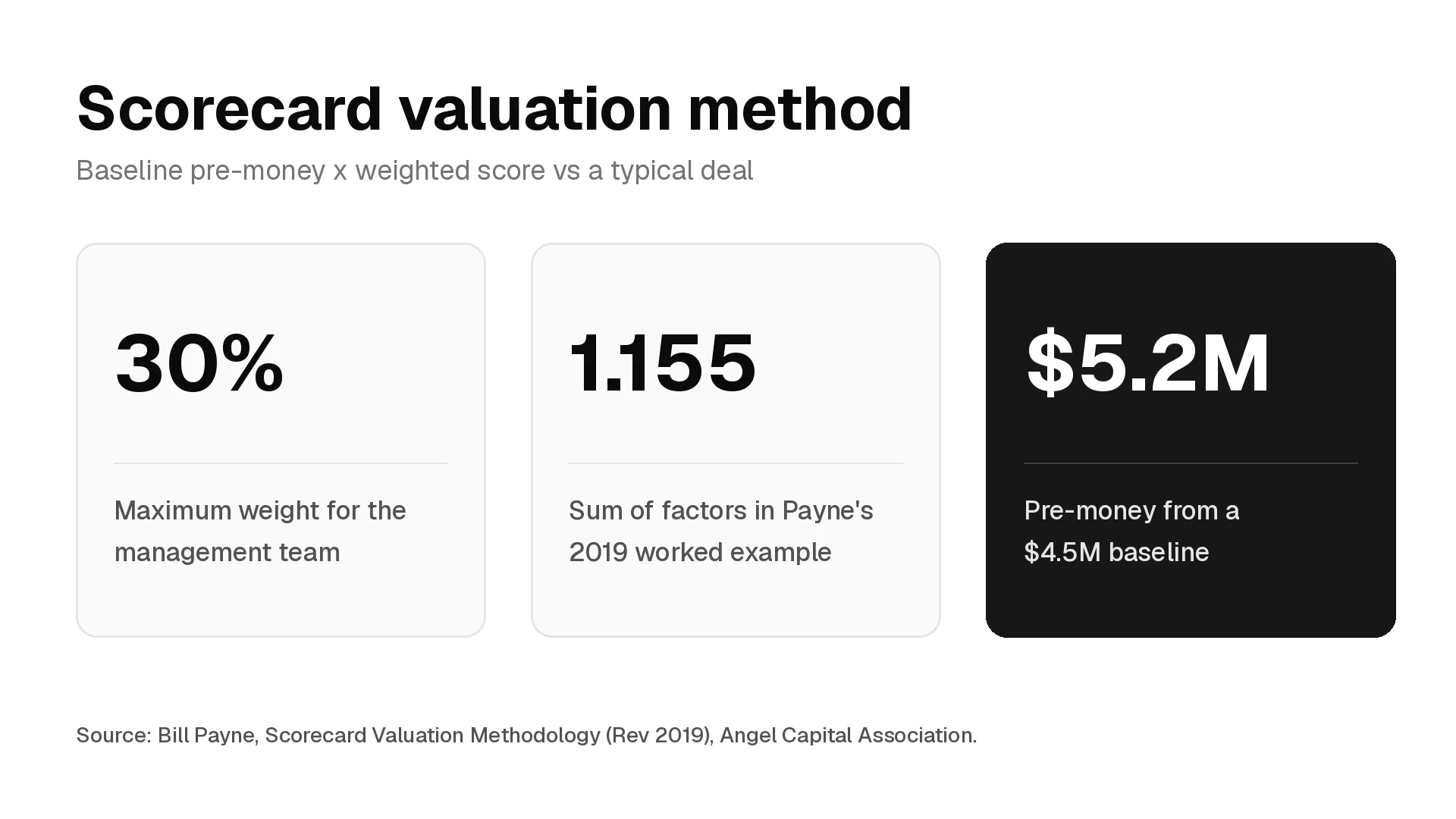
How the scorecard valuation method works, Bill Payne's seven factor weights, his worked example with the arithmetic checked, how to choose the baseline with current seed data, how sensitive the answer is, and how VC analysts use it in memos and interviews.
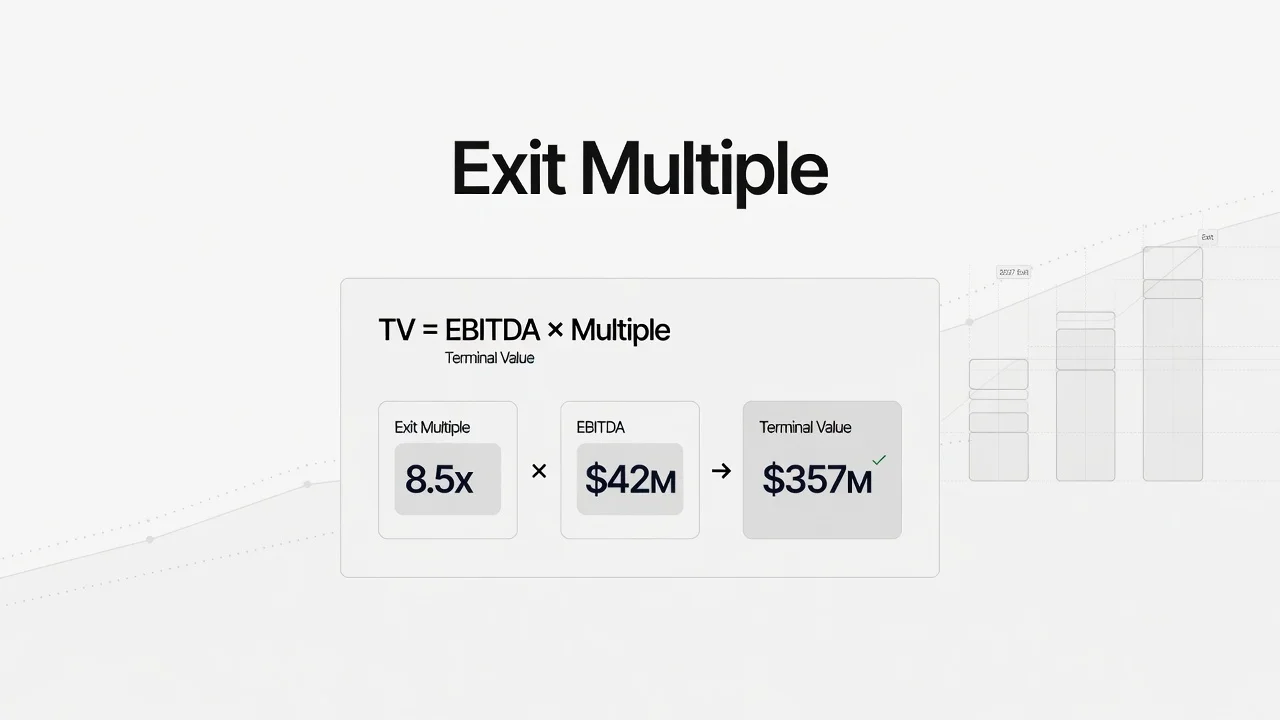
Exit multiple formula, a worked DCF terminal value example with a sensitivity grid, the implied growth cross-check, January 2026 industry multiples, and how VC investors use exit multiples.