
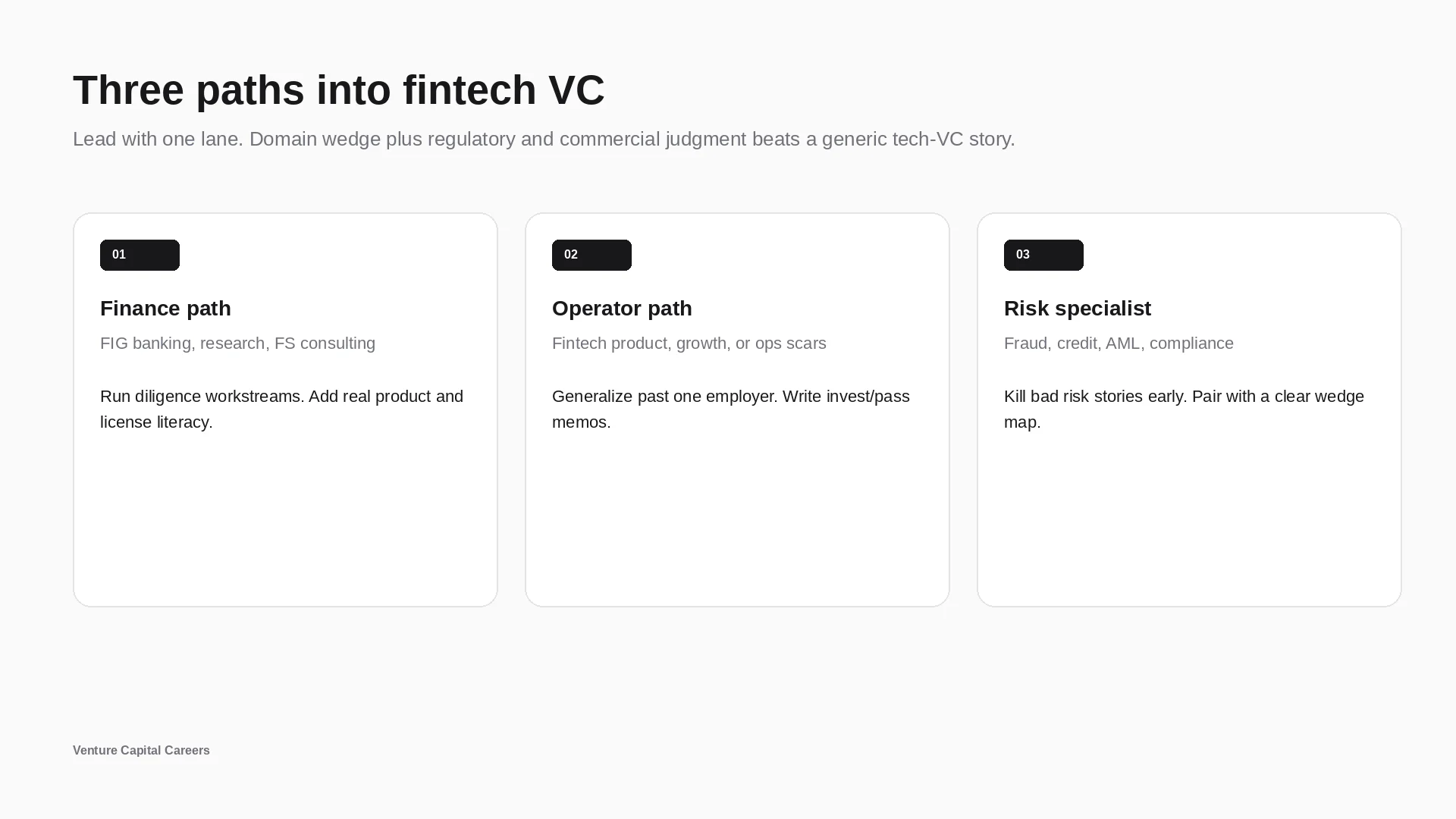
Fintech venture capital hires for domain wedge plus regulatory and commercial judgment. The funds that matter most still underwrite payments, lending, banking infrastructure, wealth and brokerage, insurance, and fraud or risk products where licensing, unit economics, and distribution risk can wipe out a clever product story. That is why a generic tech-VC resume alone rarely transfers cleanly, and why candidates who only talk about "disrupting banks" usually stall.
If you want a general break-in map first, start with how to become a venture capitalist or how to get a job in venture capital. For another sector specialist pattern, see how to get into biotech venture capital. This page is the fintech version: which seats exist, which wedges you can defend, what proof to build, and when fintech VC is the wrong escape from banking or a fintech operating job.
Fintech VC is not generic tech VC
Tech venture capital can hire pattern recognition from operators, bankers, product leaders, and scouts across many consumer and SaaS categories. Fintech funds still ask a harder first question: can you tell whether the company can legally distribute the product, earn sustainable unit economics, and survive the next compliance or partner-bank shock before the growth narrative collapses?
That changes the job and the hiring bar.
| Dimension | Typical tech VC junior seat | Typical fintech VC seat |
|---|---|---|
| Core risk | Market, product, distribution | Regulation, partner banks, unit economics, fraud, distribution |
| Diligence language | Users, retention, GTM, ARR | Licenses, KYC/AML, take rates, loss rates, credit box, interchange |
| Common feeder | Banking, consulting, product, founder ops | FIG banking, fintech operator/product, risk/fraud/compliance, founder |
| Junior headcount | Thin, but more generalist associate seats | Often thin and thesis-specific |
| Modeling intensity | Varies by stage | Higher when credit, insurance, or late-stage growth is in scope |
Multi-stage generalist funds with a few fintech logos on the website are not the same as a specialist fintech desk. Mixing those stories is how candidates sound senior and still miss.
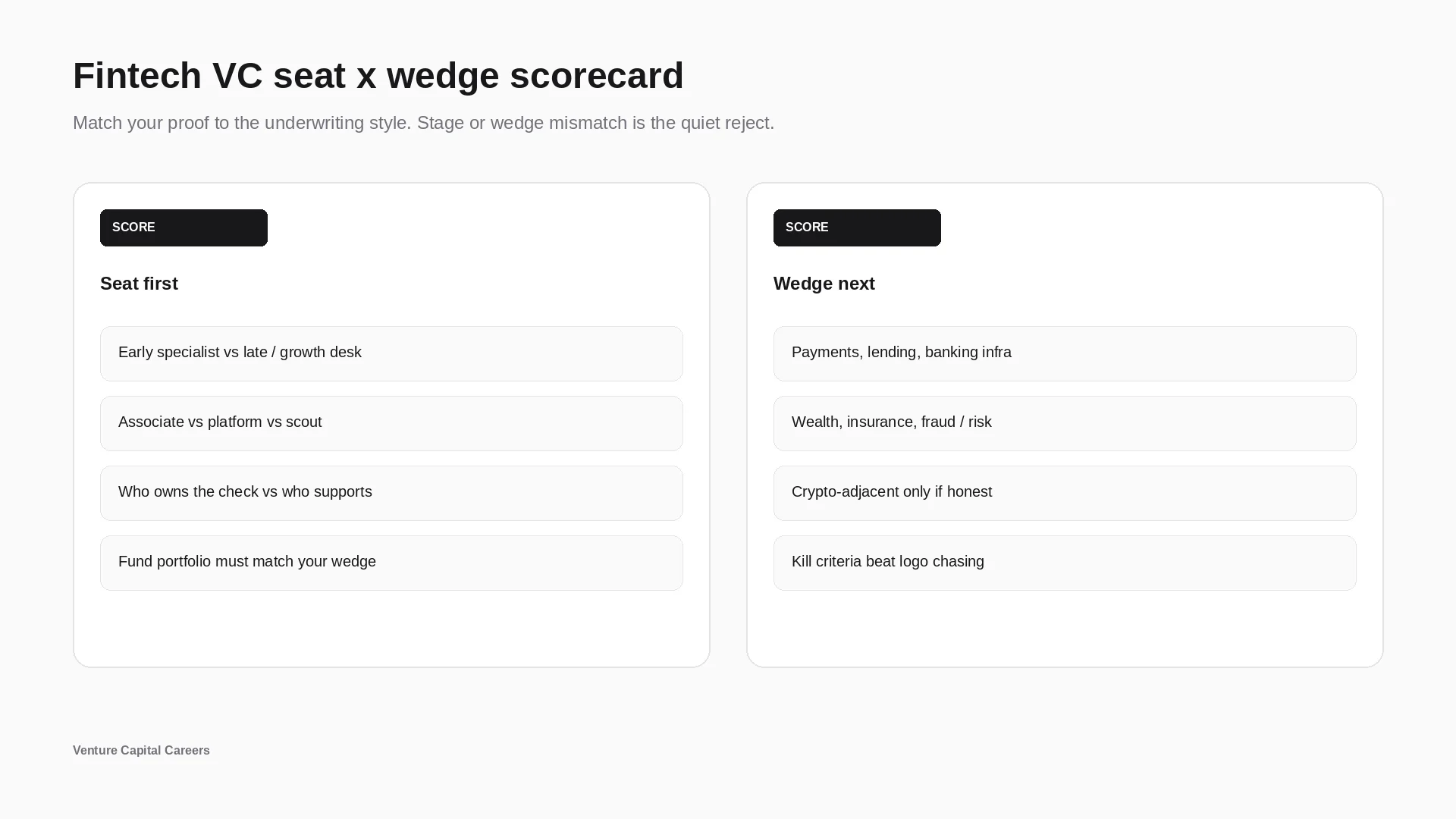
Pick the seat and the wedge first
"Fintech VC" is not one job. Name the seat and the wedge before you chase logos.
| Seat | What you actually do | Who underwrites you | Weak fit when |
|---|---|---|---|
| Early-stage specialist investor | Source companies in a wedge, diligence founders and regulatory path, help shape go-to-market | Domain credibility in one or two wedges | Your proof is only late-stage modeling |
| Associate / principal on a fintech or multi-stage fund | Screen deals, build memos, run customer and partner calls, support IC | Commercial judgment plus enough regulatory literacy | You pitch a generic consumer SaaS story |
| Late-stage / growth-oriented fintech desk | Diligence scale metrics, credit or insurance quality, path to profitability | Finance chops and sector fluency | Your only edge is a thesis without numbers |
| Platform / talent / BD at a fintech-heavy fund | Help portfolio companies hire, partner, or raise | Operator proof in fintech companies | You pitch yourself as an investor on day one |
| Scout / part-time coverage | Surface deals in a niche network | Access plus judgment in a named wedge | You expect a full-time associate ladder immediately |
Wedge matters as much as seat. Pick one you can defend:
| Wedge | What "good" looks like in diligence | Honest warning |
|---|---|---|
| Payments / money movement | Take rates, volume quality, partner dependencies, settlement risk | Crowded; differentiation is hard |
| Lending / credit | Credit box, loss curves, funding model, collections reality | Models break when cycles turn |
| Banking infrastructure / BaaS | Bank-partner risk, compliance load, gross margin after partners | Partner-bank concentration can be fatal |
| Wealth / brokerage | AUM economics, advice vs product, distribution channel | Slow sales cycles; regulatory overlays |
| Insurance / insurtech | Loss ratios, distribution, capital intensity | Underwriting depth is non-negotiable |
| Fraud / risk / identity | Detection lift, false positive cost, buyer budget | Easy to overclaim "AI" without ops proof |
| Crypto-adjacent | Only when the fund truly invests there and you can defend custody, compliance, and cycle risk | Do not invent a crypto story for a payments desk |
Use the companies directory to see whether a fund's recent investments match the stage and wedge you can defend. Brand alone is a weak filter.
Paths that work
Most durable entries still fall into four buckets. You can combine them, but you should lead with one.
1. Finance / FIG banking path
Common profiles: financial institutions group investment banking, fintech coverage, payments or specialty finance banking, equity research covering banks or fintechs, and life-adjacent consulting that actually touches financial services strategy.
What funds buy: process, diligence stamina, competitive maps, and the ability to run a workstream without getting lost in product theater.
What funds still need from you: enough product and regulatory literacy to ask real questions, not just restate a banker book. Late-stage and growth-oriented seats are the natural landing zone. Pure early-stage desks will still overweight operators and specialists.
If this is your lane, the investment banking to venture capital and consulting to venture capital guides still apply. Add fintech deal samples and a wedge thesis on top.
2. Fintech operator / product path
Common profiles: product managers, growth or ops leaders, and early employees at payments, lending, banking, wealth, or insurance companies who shipped at the stage the fund invests in.
What funds buy: scars from regulated distribution, pricing fights, partner integrations, and customer trust problems.
What funds still need from you: evidence you can generalize beyond one employer and write an invest or pass memo, not only a product roadmap. The product manager to venture capital, software engineer to venture capital, and startup operator to venture capital paths are the closest siblings.
3. Risk, fraud, and compliance specialists
Common profiles: fraud leaders, credit risk managers, AML/KYC operators, and compliance leads who have lived through audits, partner-bank reviews, or chargeback crises.
What funds buy: the ability to kill bad risk stories early and pressure-test founder claims about "AI fraud models" or "lightweight compliance."
What funds still need from you: commercial instincts and communication that is not an internal risk committee transcript. Pair the specialist spike with one wedge map and two written diligence notes.
4. Founder path
Common profiles: founders who built or wound down a fintech, and operators who raised institutional capital and can explain what investors got wrong about them.
What funds buy: founder empathy, pattern recognition on teams, and credibility in a specific wedge.
What funds still need from you: evidence you can underwrite other people's companies, not only relive your own. A clean exit helps. A failed company with specific lessons and strong references can still work.
Proof of work by background
Generic enthusiasm for "democratizing finance" does not move a hiring partner. Ship artifacts that match the seat.
Finance-path packet
- One wedge thesis (8-12 pages or a tight memo): what changed, who wins, what fails, what you would not fund
- Annotated map of 15-25 companies in that wedge, with kill criteria tied to regulation or unit economics
- Two written diligence notes on public or hypothetical companies, including partner-bank or licensing risk
- Proof you can source: a warm pipeline of founders, bankers, or operators who already send you deals
- Resume that leads with fintech outcomes, not generic banking language (VC resume guide)
Operator-path packet
- Three operating problems you fixed at the stage the fund holds (pricing, conversion, partner integration, fraud loss, collections), with metrics and references
- One "would I have invested?" memo on a company you know from the inside, written as an outsider
- Evidence of cross-company pattern recognition, not only loyalty to one employer brand
- Optional: a scout or fellowship project with dated deliverables
Risk / compliance packet
- One memo that kills a popular narrative in your specialty (for example, a fraud model that only works in lab conditions)
- A simple framework for diligence questions you would ask every founder in that wedge
- References who can confirm you improved loss rates, audit outcomes, or partner-bank confidence
Keep the packet short. Partners do not want a second product review deck. They want signal that you can help them say no faster.
How recruiting actually works
Fintech VC recruiting is relationship-heavy and seat-scarce. Many specialist desks are thin: more partners than true associates. Junior openings often appear after a fundraise, a partner departure, or when a multi-stage firm staffs a dedicated fintech coverage seat.
Practical implications:
- Cold applications without a warm context underperform even more than in general tech VC
- Timing follows fund cycles and partner bandwidth, not a campus calendar
- Headhunters matter more at larger multi-stage firms; specialist desks still hire through networks
- Geographic clusters still matter: New York, San Francisco Bay Area, London, and a handful of other hubs concentrate both companies and investors
Build the list of target funds from recent investments and partner backgrounds, then use the Venture Capital Careers job board to catch the seats that do get posted. Set job alerts so you are not relying on memory when a rare associate search opens.
What interviews test in fintech
Expect the usual story, "why this firm," and strengths questions from the general venture capital interview questions set. Then expect sector tests.
| Interview block | What they are testing | Strong signal |
|---|---|---|
| Wedge fluency | Can you leave buzzwords behind? | Clean explanation of how money, risk, or compliance actually moves |
| Regulatory and partner risk | Can you spot non-product killers? | Specific questions on licenses, bank partners, and concentration |
| Unit economics | Is the commercial story real? | Take rates, loss rates, contribution margin, and CAC payback without hand-waving |
| Firm and portfolio fluency | Did you do the work? | Opinions on recent investments and why the firm passed on obvious peers |
| Case / verbal IC | Can you recommend under uncertainty? | Clear invest / pass, kill criteria, and next diligence steps (case study interview) |
| Modeling (late-stage / credit) | Can you translate risk into scenarios? | Transparent assumptions, not false precision |
Bring a point of view. Neutral summaries of a company's website read as internship energy. Partners hire people who will argue inside the partnership without becoming theatrical.
When fintech VC is the wrong move
Skip or delay the jump when:
- Your real goal is immediate cash compensation comparable to senior banking or a scaled fintech operating seat. Junior VC cash is often lower, and carry is slow and uneven. Check the salary guide for ranges, then read documents before you romanticize the upside.
- You want operating ownership inside one product. Join a fintech or stay in banking. The fund seat is leverage across many companies, not CEO authority.
- Your wedge is fashion only (especially crypto-adjacent) and you cannot defend cycle, custody, or compliance risk honestly.
- You are using VC as a soft landing from a stalled banking or startup search without proof packets or network. The hiring bar does not care that you are tired of hours or a reorg.
- Every target firm is a generalist tech brand with one payments logo on the website. You will interview for a different job than the one you prepared for.
- Growth equity or a later-stage private investing seat fits your modeling strength better than early-stage fintech storytelling.
Banking, fintech operating roles, risk leadership, and growth equity can be better intermediate steps. They are not failures. They are often the missing commercial chapter on a thin thesis CV.
A 90-day plan
Days 1-30: Choose a lane
- Pick one wedge you can defend
- Pick early-stage versus late-stage / growth as your primary seat type
- List 20 funds whose last 10 investments match that lane
- Draft the thesis outline and the first company map
Days 31-60: Ship proof
- Finish one thesis memo and two diligence notes
- Run ten expert or operator conversations with a real agenda (unit economics, partners, risk), not ten empty informational chats
- Rewrite your resume around fintech outcomes and investment judgment
- Start two warm threads into each of your top ten funds through mutuals, founders, or bankers
Days 61-90: Convert
- Ask for diligence project work, scout-style coverage, or a formal search timeline
- Practice a 10-minute IC recommendation on a live public or well-documented private company in your wedge
- Apply to posted roles on the job board without abandoning the warm path
- Drop funds that only want free consulting with no hiring intent
Ninety days will not manufacture a decade of banking. It will show whether you are building an investable profile or collecting coffee chats.
Frequently asked questions
Do I need investment banking experience to get into fintech VC?
No. FIG banking helps for late-stage and growth-oriented seats. Operator, product, risk, and founder backgrounds win when the proof matches the wedge and stage. Banking without fintech literacy is still a weak story.
Can I move from generic tech VC into fintech VC?
Sometimes, if you already cover fintech with real diligence reps or you rebuild a wedge packet. Pure consumer or unregulated SaaS experience is a weak substitute for regulatory and unit-economics risk.
Are there analyst roles?
Yes, but fewer than candidates expect. Many fintech desks stay thin. When analyst or associate seats open, competition includes people with sector operating depth and prior diligence reps.
How important is modeling?
Critical for late-stage, credit, insurance, and growth-oriented seats. Secondary for pure early-stage company creation, where founder judgment and regulatory path dominate. Still learn enough to read a contribution margin and a loss curve without bluffing.
Should I join a fintech company instead?
Often yes, if you need scars, references, and a wedge you can defend. Fund seats are scarce. Operating proof can be the faster path to a later fintech VC seat.
Where should I look for open roles?
Warm network first. Then watch specialist fund career pages and the Venture Capital Careers job board, and research targets in the companies directory. Use job alerts so rare postings do not pass you by.
Fintech VC rewards people who can hold product ambition and regulated commerce in the same sentence. Pick the seat and the wedge, ship proof that matches them, and treat the fund's actual portfolio as the scorecard.
Related posts
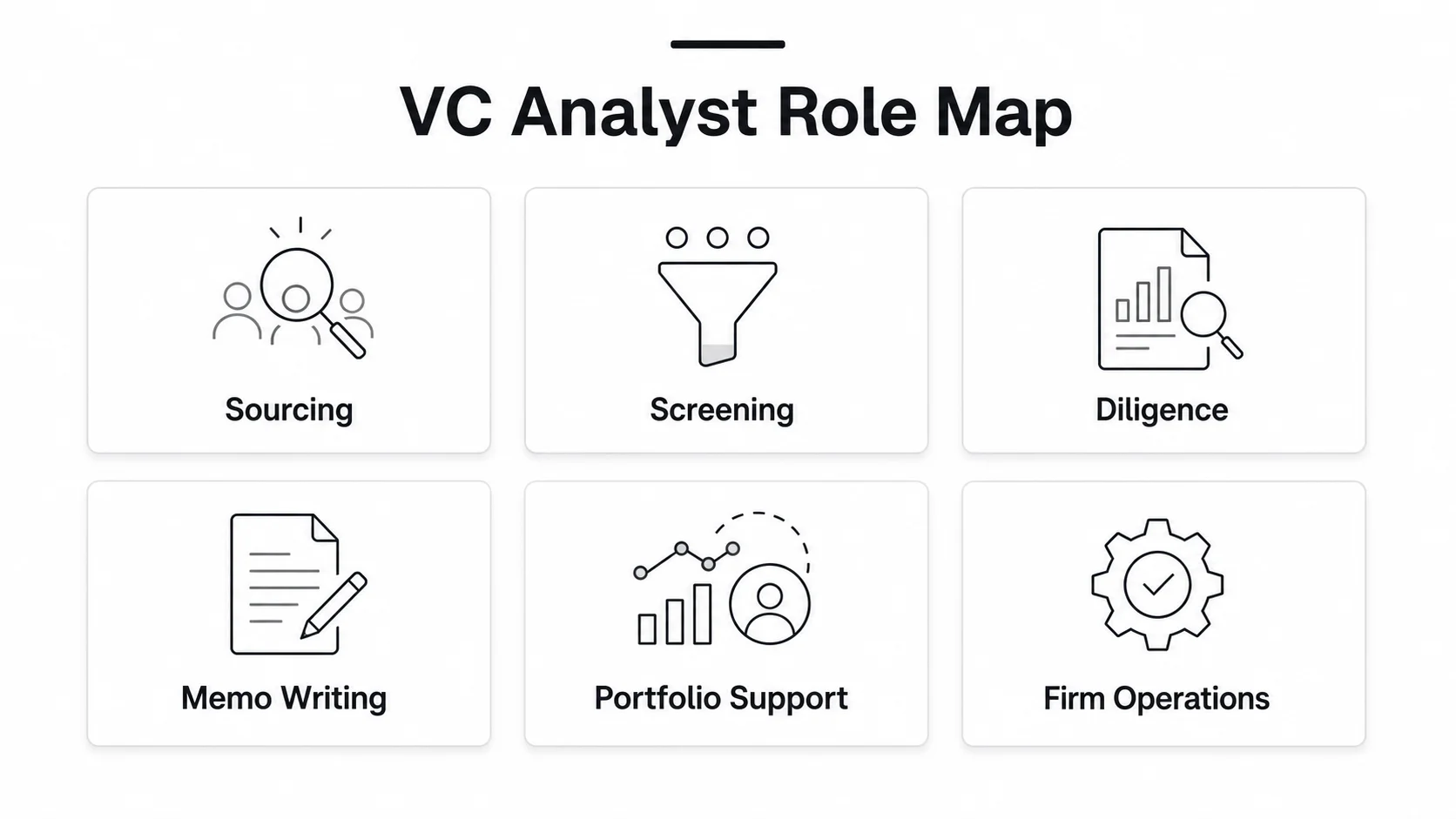
Copy-ready VC analyst job description template with responsibilities, skills, sourcing vs diligence seat signals, interview scorecard, and how candidates should read a posting.
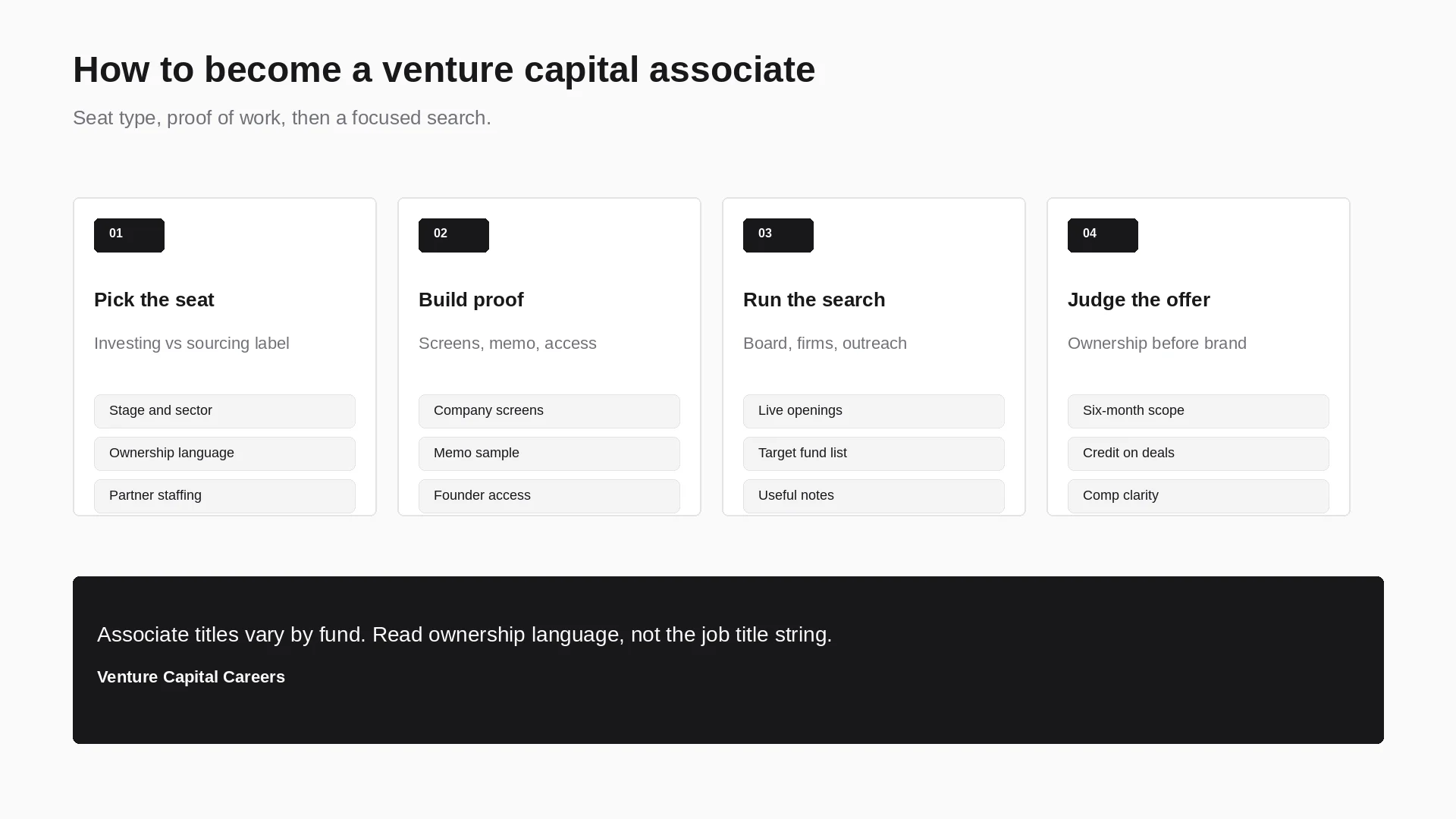
A practical guide to becoming a venture capital associate: what the seat is, which paths convert, how to prove you can do the work, and how to screen real associate openings.
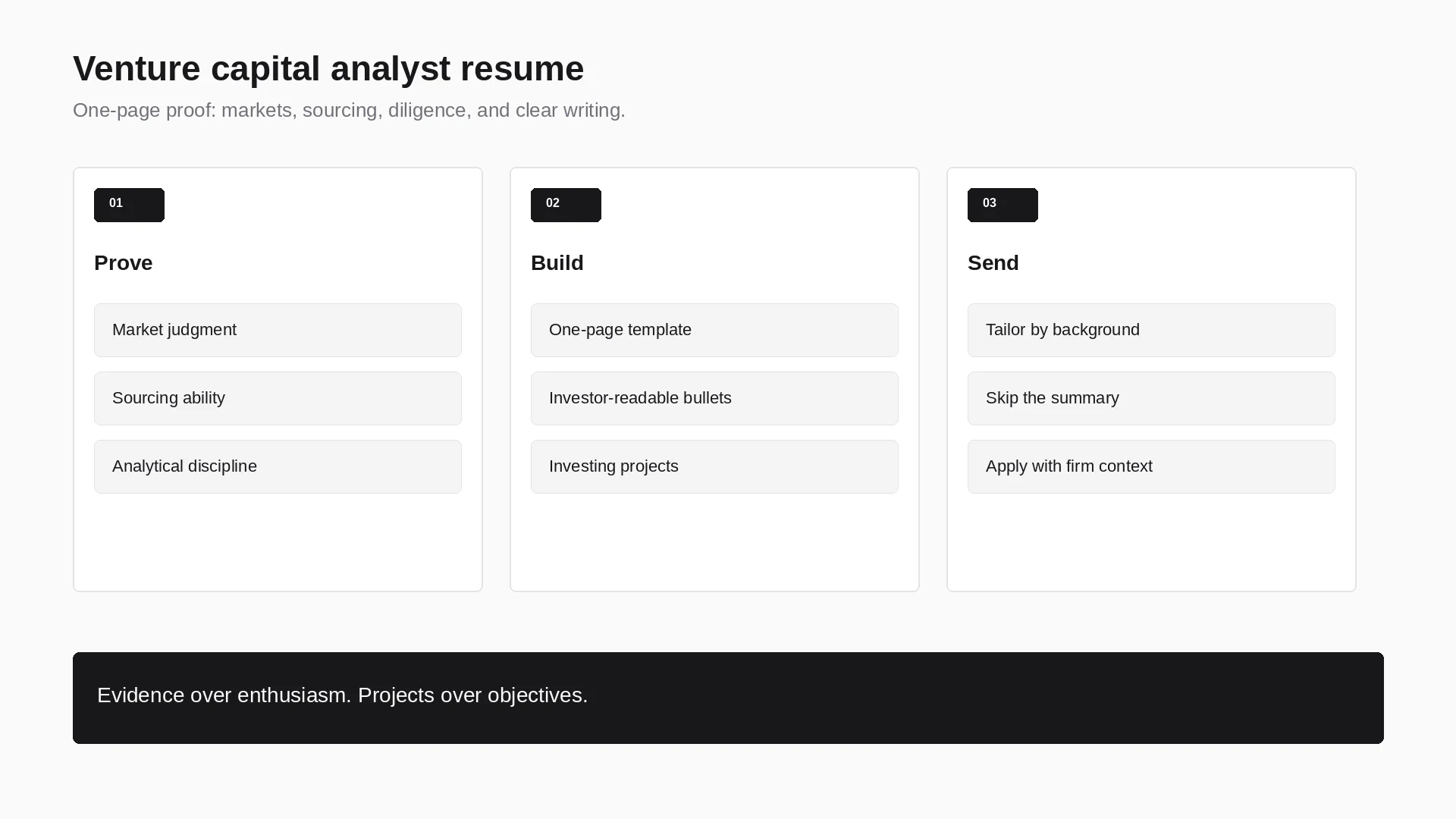
A VC analyst resume is a one-page proof document. Template, bullet formula, investing projects section, examples, and next steps for analyst applications.