

Send a short, individual thank-you email the same day as your venture capital interview, or within 24 hours at the latest. Thank the interviewer, reference one specific part of the conversation, reinforce why the role or firm fits, and close without asking them to make a decision.
A strong note is usually 80–140 words. It should feel like the final thoughtful minute of the interview, not a second cover letter.
The four-part VC interview thank-you email
Use this structure:
- Thank: appreciate the interviewer's time.
- Reference: name one real topic from your conversation.
- Reinforce: connect that topic to your interest or relevant experience.
- Close: restate interest and make it easy to continue the process.
The reference is what makes the note credible. In a VC process, that might be the firm's thesis, a portfolio-support challenge, a sector debate, a sourcing channel, or the way the team evaluates an unfamiliar market. Avoid a generic line that could follow any interview.
Keep the note accurate. A misspelled name, wrong fund, or copied detail from another interview creates more downside than a brief email ever needs to.
When to send it, who gets one, and what subject line to use
Send the note after you have written down the conversation details, but while the interview is still fresh. Same day is ideal; within 24 hours is a sound outer limit. Harvard Law School's interview follow-up guidance likewise recommends writing within 24 hours.
| Situation | Recipient rule | Timing |
|---|---|---|
| Recruiter or talent screen | Send one note to the recruiter | Same day |
| One-on-one interview | Send the interviewer an individual note | Same day |
| Panel interview | Send individual notes when you have the addresses | Same day or next morning |
| Back-to-back interviews | Personalize a short note to each interviewer | By next morning |
| No interviewer email | Ask the coordinator to forward a note or share the address | Within 24 hours |
Do not put several interviewers on one email unless the coordinator has clearly run the discussion as a single group conversation and individual addresses are unavailable. Separate notes let you reference separate conversations and avoid awkward reply-all traffic.
Useful subject lines include:
- Thank you — [Your Name] — [Role]
- Great speaking today — [Your Name]
- Thank you for the conversation about [topic]
- Follow-up from today's [Role] interview
Venture capital interview thank-you email templates
Treat each template as a frame. Replace every bracketed field and remove any sentence that does not sound like you.
After a first-round interview
Subject: Thank you — Maya Chen — Investment Analyst
Hi Jordan,
Thank you for speaking with me today about the Investment Analyst role. I especially enjoyed our discussion about how the team separates a promising market from a company that can actually build distribution within it.
That question is one reason the role appeals to me. My market-mapping work in vertical software has taught me to test customer access before getting excited about market size, and I would be keen to bring that discipline to the team.
Thanks again for your time. I remain very interested in the opportunity.
Best, Maya
After a partner interview
Subject: Thank you for today's conversation
Hi Priya,
Thank you for the thoughtful conversation this afternoon. Your point that a thesis should guide attention without becoming a filter that blocks unexpected companies stayed with me.
It sharpened my understanding of how the firm combines conviction with curiosity. That balance, along with the opportunity to learn from founders across the portfolio, makes me even more interested in the Associate role.
Thank you again, and I hope we have the chance to continue the conversation.
Best, Leo
After a case study or investment discussion
Subject: Thank you — case study discussion
Hi Alex,
Thank you for the discussion about my case study today. I appreciated the push on customer concentration and what evidence would change my view of the downside.
The conversation reinforced how much I enjoy turning an initial investment view into a testable set of questions. I would be excited to keep developing that judgment with the team.
Thanks again for your time and feedback.
Best, Sam
The note should not repeat the whole analysis. If the firm asked for revisions, send the revised work through the channel they specified. If you are still preparing, use the VC case study interview framework to structure the analysis before the conversation.
After a panel or several back-to-back interviews
Write one short note per person. Keep the opening and closing consistent if helpful, but change the middle:
Interviewer 1 reference: I appreciated your explanation of how the fund thinks about ownership targets when conviction is high.
Interviewer 2 reference: Our discussion about evaluating founder-market fit gave me a more precise way to separate domain access from founder adaptability.
Interviewer 3 reference: Your description of the first 90 days clarified how sourcing, market research, and portfolio work fit together at the analyst level.
Interviewers may compare notes. Reusing the same vague paragraph signals less care than sending three shorter, specific messages.
If the thank-you is late
Subject: Thank you for our conversation
Hi Taylor,
Thank you again for speaking with me on Tuesday about the Platform Associate role. I appreciated your explanation of how the team decides which portfolio requests deserve a repeatable program rather than one-off support.
I should have sent this sooner, but I did not want to miss the chance to say that the conversation strengthened my interest in the role.
Best, Noah
Do not write a long apology. Acknowledge the delay once, provide the useful note, and move on.
How to personalize the note for an investing team
The safest personalization comes from something the interviewer actually said. Write down the person's name and one discussion point as soon as the meeting ends.
| Conversation topic | Useful reference | Avoid |
|---|---|---|
| Investment thesis | A boundary, exception, or open question in the thesis | Repeating the website's sector list |
| Portfolio company | An operating challenge discussed in the interview | Pretending to know confidential details |
| Market or trend | A specific disagreement or evidence threshold | Declaring a hot take with no support |
| Sourcing | A channel, relationship, or screening tradeoff | Claiming a proprietary network you do not have |
| Diligence | A risk, customer question, or proof point | Re-answering every technical question |
| Team and role | How decisions, feedback, or ownership work | Generic praise about the culture |
Good personalization demonstrates listening. It does not need to demonstrate brilliance.
For the interview itself, prepare stories and investment answers with the venture capital interview questions guide. After the process, use a thank-you note to connect one of those answers to what you learned from the interviewer.
Should you attach a startup write-up or investment work sample?
Sometimes. A small work sample can help a VC firm picture how you think, but an unrequested deck can also create review work and look like an attempt to restart the interview.
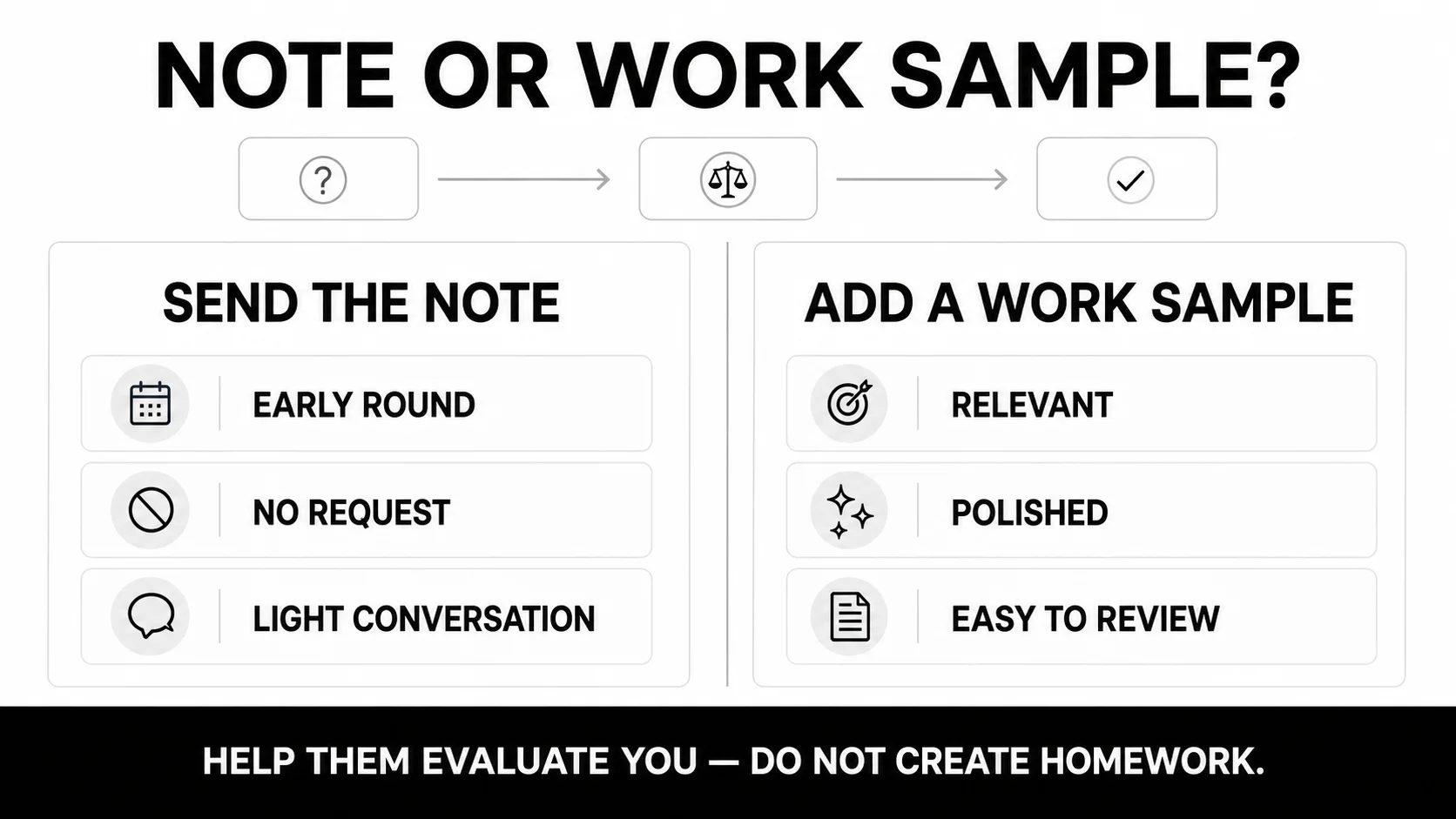
Use three gates:
- Relevant: the work directly continues a conversation or answers a request.
- Polished: it is stronger than the impression you already made.
- Easy to review: it takes a few minutes, opens cleanly, and does not demand feedback.
Add a work sample when the interviewer invited it, the conversation naturally opened a question you can answer well, or the role explicitly values market maps, memos, or sourcing judgment. Keep it compact: a short startup write-up, one-page thesis, or two-to-three-slide analysis can be enough.
Send only the note when the process is early, the conversation was light, the sample is speculative, or you would need to rush. Never send confidential employer work, private startup information, or a giant model without context.
If you attach something, explain it in one sentence:
> You mentioned the team is exploring developer infrastructure, so I attached a two-slide market map I had already been refining; no response is needed, but I thought it might make our discussion more concrete.
The standard is not “does this show effort?” It is “does this help them evaluate me without creating homework?”
What not to put in the thank-you email
| Mistake | Why it hurts | Better move |
|---|---|---|
| Long recap | Makes the interviewer reread the meeting | Reference one useful point |
| Generic praise | Sounds copied | Name a real discussion detail |
| Pressure for an update | Turns gratitude into a demand | Send a separate status follow-up later |
| New unsupported claim | Creates a fresh diligence problem | Share evidence only if it is relevant |
| Several attachments | Adds review friction | Send one compact sample at most |
| Correcting every weak answer | Reopens the worst moments | Correct only a material factual error |
| Asking for detailed feedback | Creates work before a decision | Invite further questions without demanding them |
If you made a material factual error, correct it briefly:
> One quick correction: I misstated the company's latest disclosed funding round. It was Series B, not Series A. Apologies for the error.
Do not use the email to rewrite a judgment call or explain why a weak answer was secretly good.
How to follow up if nobody replies
No reply to a thank-you email is normal. The note does not require a response, and silence is not reliable evidence about the hiring decision.
Separate the thank-you from a status check:
- If the team gave a decision date, wait until one business day after it passes.
- If no timeline was given, wait about five business days before a concise check-in.
- If a recruiter coordinates the process, ask the recruiter rather than every interviewer.
- After one unanswered status follow-up, wait. Repeated messages rarely improve the decision.
A simple status note is enough:
Subject: Investment Analyst process — Maya Chen
Hi Jordan,
I wanted to check whether there is an updated timeline for the Investment Analyst process. I remain very interested in the role and am happy to provide anything else the team needs.
Best, Maya
For relationship-building outside an active interview, use the separate venture capital networking email templates. Keeping the two purposes separate prevents a thank-you email from turning into a networking campaign.
Keep the next step grounded in the role and firm
A good follow-up starts with good interview notes. Record:
- what the fund invests in;
- what the interviewer emphasized;
- what the role owns in its first six months;
- one question you still have; and
- the date the team expects to decide.
Use the Venture Capital Careers companies directory to verify the firm's public strategy and the VC job board to compare live role descriptions. Do not insert research into the note merely to prove you found it. Use it to avoid errors and make one genuine connection.
Frequently asked questions
Do I need to send a thank-you email after a VC interview?
You should send one unless the recruiter explicitly asks candidates not to contact interviewers. Keep it short and specific; the goal is professional closure, not another evaluation round.
How long should a venture capital interview thank-you email be?
Aim for roughly 80–140 words. A useful note usually fits into three short paragraphs.
Should I email every interviewer?
Yes, when you have their addresses. Send individual notes with one distinct reference per conversation. If addresses are unavailable, ask the coordinator to forward a note.
Can a thank-you email fix a bad interview?
Usually not. It can correct one material factual error or add one relevant item, but it should not relitigate weak answers. Use the note to be accurate, attentive, and interested.
Should I send a work sample after a VC interview?
Only when it is relevant to the conversation, polished enough to strengthen your candidacy, and easy to review. An unrequested deck is not automatically more impressive than a concise note.
Related posts
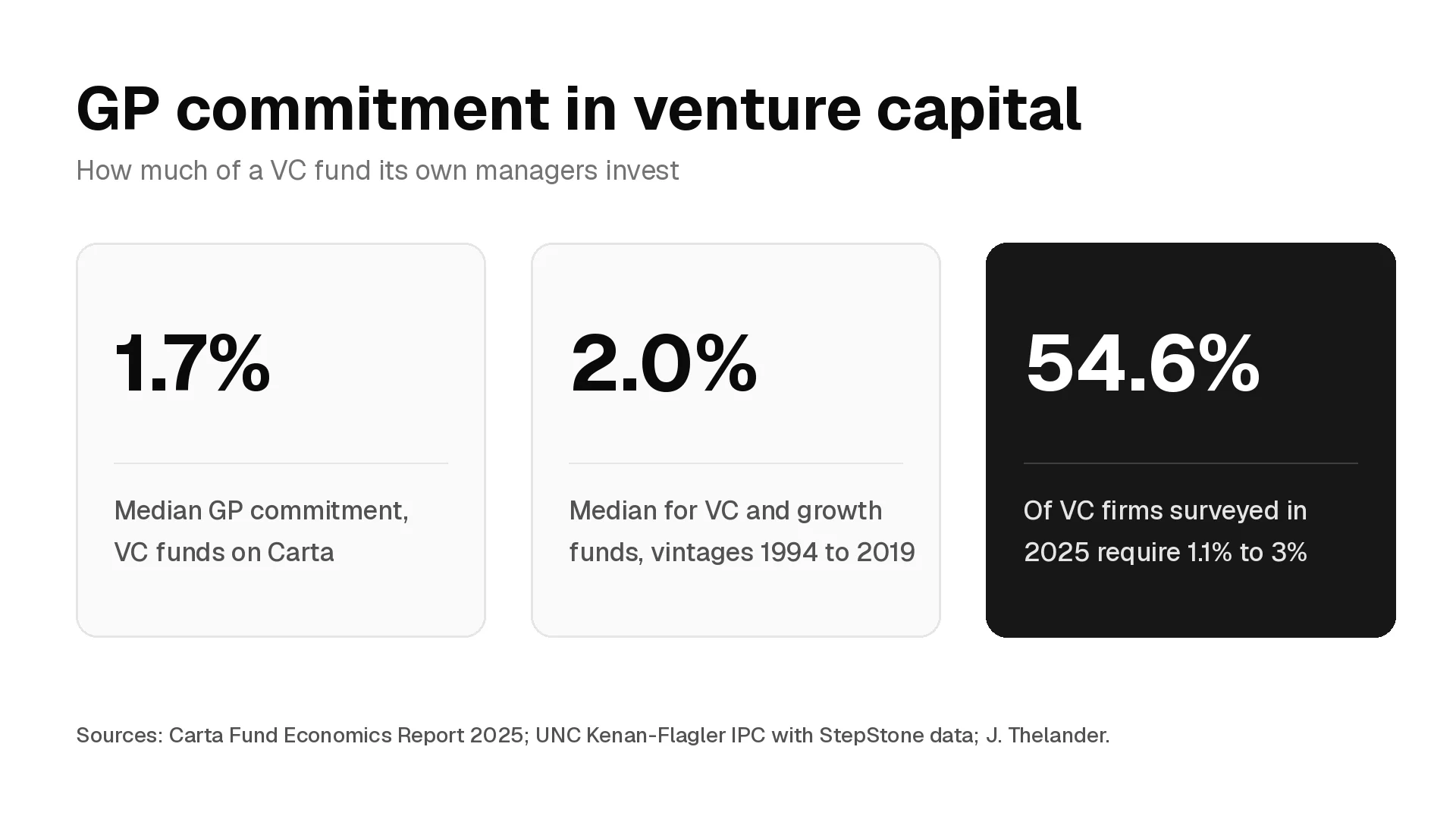
What a GP commitment is, how large it is in venture capital, how GPs fund it, where it sits in the LPA, what the returns evidence says, how firms split it across partners and principals, and what to ask before you accept a role with carry.
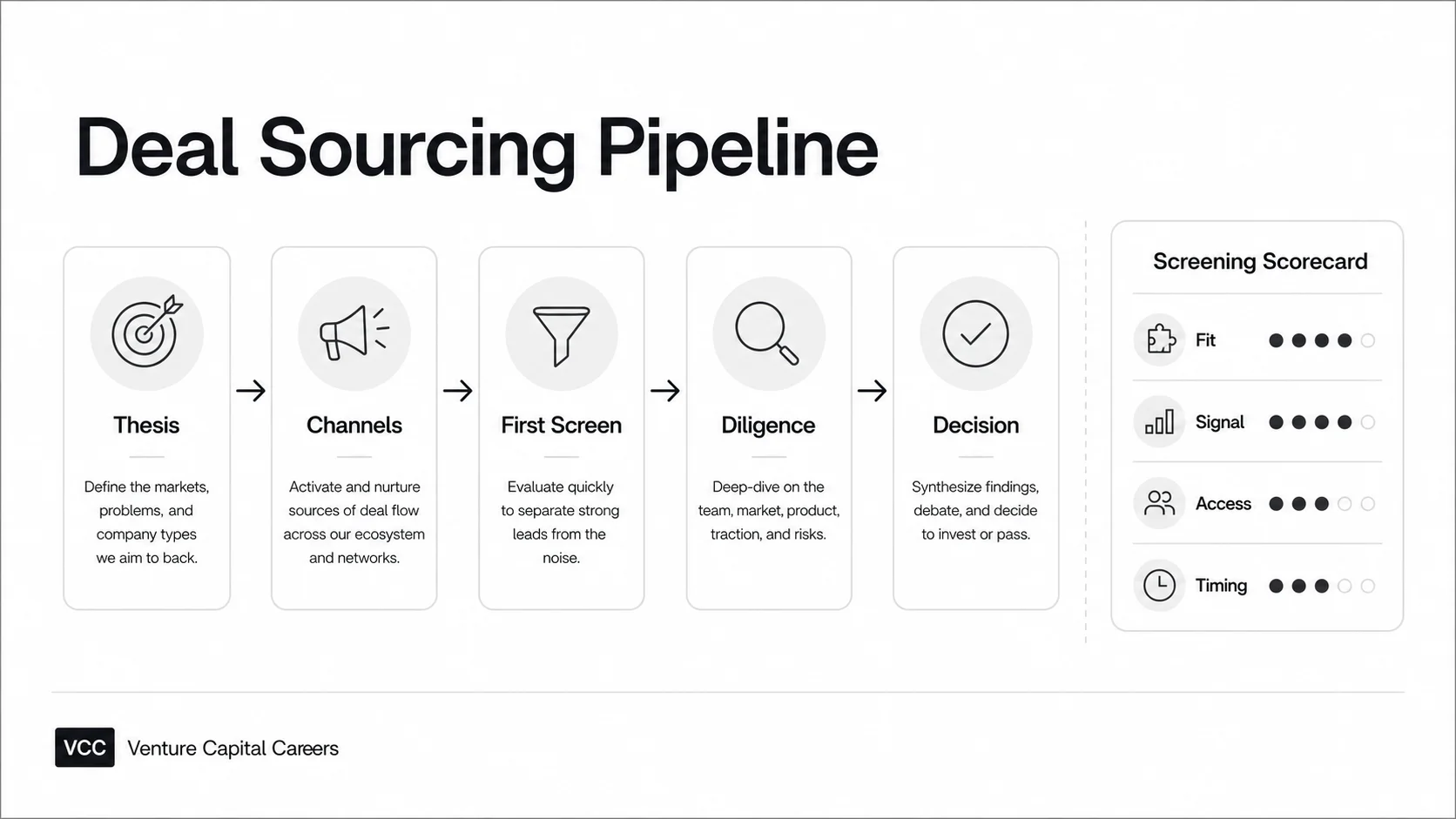
Most closed VC deals start with a relationship. See where deals come from by stage, how to work each sourcing channel, which signals show up early, and how analysts run a weekly sourcing process.
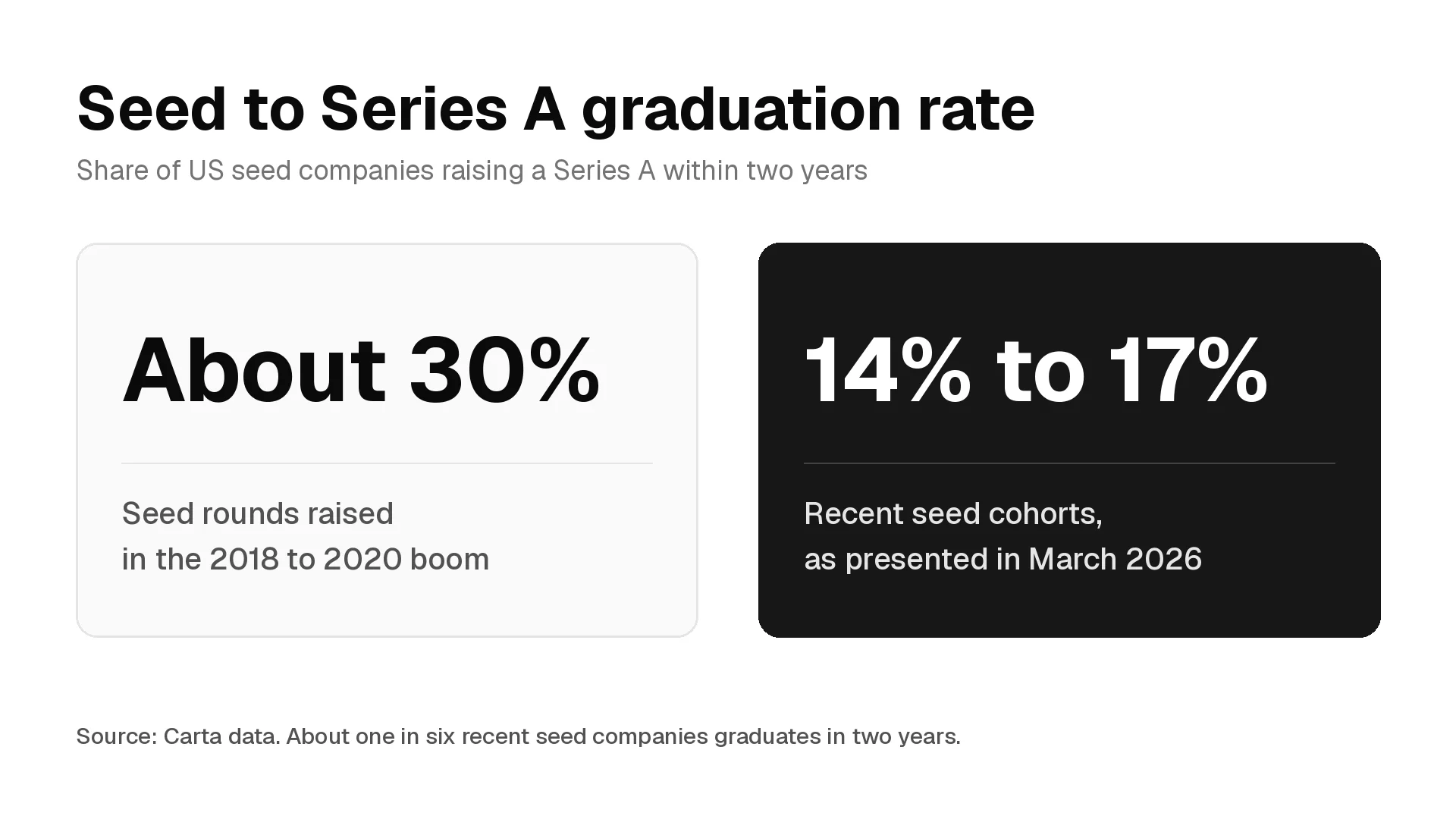
Seed to Series A graduation rates by cohort from Carta and Crunchbase, how long the jump takes, why rates fell after 2021, why published figures disagree, and how seed and Series A firms use the rate for reserves, LP reporting, portfolio reviews and interviews.