
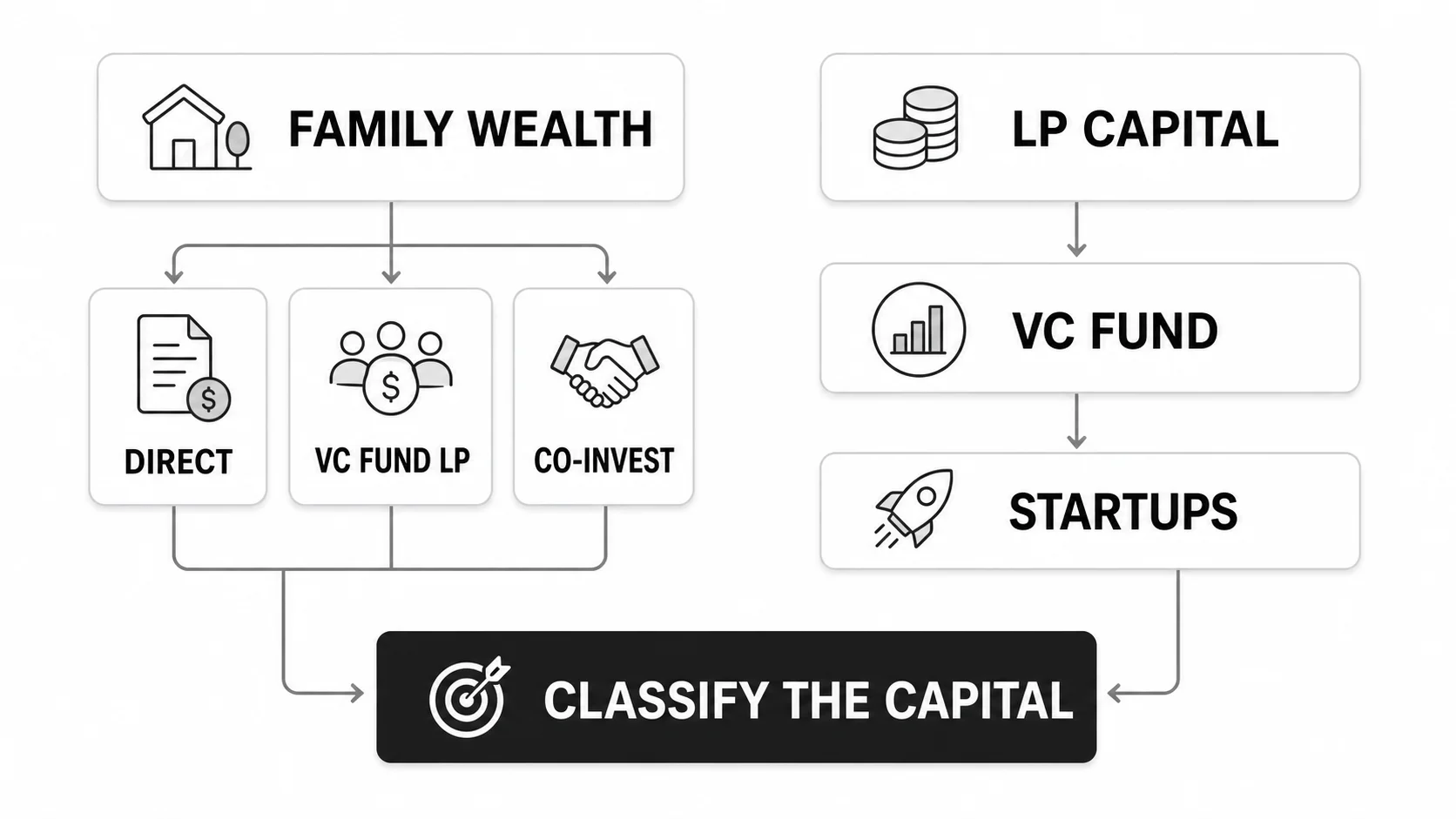
A family office invests or oversees one family's wealth. A venture capital firm invests capital committed by outside limited partners through a defined fund. That difference changes who the investor answers to, how decisions are made, how follow-on checks are funded, and what the investment team does every day.
It does not tell you whether a specific investor will be patient, fast, strategic, or founder-friendly. Some family offices never invest directly in startups. Others have dedicated venture teams, reserves, and an investment committee that make them operate much like a VC firm.
The useful question is not simply “family office or venture capital?” It is: What capital is being invested, under what mandate, by whom, with what ability to support the company later?
Family office vs venture capital at a glance
| Dimension | Family office | Venture capital firm |
|---|---|---|
| Capital source | One family's balance sheet or family-controlled entities | Capital committed by limited partners to a fund |
| Primary mandate | Preserve and grow family wealth across a wider portfolio; objectives may also include legacy, impact, or strategic interests | Generate venture returns within the fund's strategy, life, and agreements with LPs |
| Startup exposure | May invest directly, commit to VC funds, co-invest, use SPVs, or have no venture allocation | Core business is investing in startup and growth-company portfolios |
| Decision system | Can range from one principal to a professional investment committee | Usually partner-led with a documented investment process and committee |
| Time horizon | Can be flexible because there is no outside fund clock, but family liquidity and priorities still matter | Shaped by fund life, deployment period, reserves, exits, and the need to raise future funds |
| Portfolio logic | Startup risk sits beside public markets, property, private equity, credit, and other family assets | Power-law portfolio in which a small number of outcomes may drive fund returns |
| Follow-on capital | Depends on the family's allocation, liquidity, concentration limits, and willingness to recommit | Usually planned through reserves, ownership targets, and partner approval |
| Support | May offer deep sector access from the family's operating history, or little startup support | Often offers fundraising, recruiting, board, market, and portfolio resources, with quality varying by firm |
| Common roles | Investment analyst, associate, investment manager, director, CIO, portfolio or operating roles | Analyst, associate, principal, partner, platform, talent, and operating roles |
| Best first diligence question | How does this office participate in venture, and who can commit capital? | Which fund is investing, and what are its ownership and reserve strategies? |
“Family office” is not one standardized operating model. A single-family office serves one family. A multi-family office serves several families and may look more like an advisory business. A family-backed investment company may have a narrow sector mandate and professional team. Those structures can produce very different startup-investing behavior.
The US family-office rule is narrower still: it defines when an office serving family clients can be excluded from the Investment Advisers Act definition of investment adviser. That regulatory test is useful context, not a universal label for how an investor operates. Founders and candidates still need to inspect the actual mandate.
First classify how the family office participates in venture
Two family offices can describe themselves as active in venture while giving a founder completely different experiences. One may lead priced rounds from its balance sheet. Another may only commit to VC funds. A third may co-invest when a trusted lead offers an allocation.
Direct investor
The family office buys equity or a convertible security directly from the company. Its team may source and diligence the opportunity, negotiate terms, take a board or observer seat, and decide on follow-on checks.
Ask whether direct startup investing has a written mandate, dedicated allocation, named decision-maker, and repeatable process. A one-off investment driven by a family principal's interest can be legitimate, but it should not be mistaken for an institutional venture program.
Limited partner in a VC fund
The family office commits capital to a venture fund. The VC firm's general partners then select portfolio companies and negotiate their investments.
For the startup, this is VC capital. The family office is an LP, not a direct counterparty. Candidates considering the family office may still work on fund selection and manager diligence rather than startup deals.
Co-investor or SPV participant
The family office invests beside a lead VC or through a special purpose vehicle. The lead investor often controls diligence, documents, governance negotiations, and signaling to the next round.
Confirm whether the family office has independent information or pro rata rights, whether side arrangements exist, and who coordinates investors during a bridge or exit discussion.
Family-backed venture platform
Some family offices build dedicated venture teams with sector theses, check-size ranges, ownership targets, reserves, and an investment committee. Operationally, that team may resemble an institutional VC firm even though its capital ultimately comes from one family.
Classify it with five questions:
- Capital: Is the money on the family balance sheet, in a separate fund, or committed deal by deal?
- Mandate: Which stages, sectors, geographies, and concentration limits are approved?
- Authority: Who can approve the initial check, a bridge, a follow-on round, and an exit?
- Reserves: Is follow-on capital budgeted or reconsidered against the family's entire portfolio?
- Team: Who performs sourcing, diligence, portfolio work, reporting, and operating support?
That classification is more predictive than the name. J.P. Morgan's 2026 survey of 333 family offices found wide variation in operating-company connections and venture exposure; more than half reported no allocation to venture and growth markets. “Family office” therefore does not imply a direct startup-investing mandate.
How incentives shape investor behavior
A VC partner is accountable to a fund mandate and its LPs. The firm must deploy within agreed parameters, reserve capital across a portfolio, produce realizations within a finite fund life, and build a track record that supports the next fund. Those constraints can create pressure for venture-scale outcomes, but they can also make decisions, ownership strategy, and follow-on planning more legible.
A family office is accountable to family objectives. Startup investing competes with public markets, private equity, real estate, credit, operating-company needs, philanthropy, and family liquidity. The office may be able to hold an investment longer than a VC fund. It may also reduce direct investing when priorities, leadership, or portfolio conditions change.
This is why “patient capital” is not a diligence conclusion. Patience is optionality; behavior is evidence.
For founders, the revealing questions concern stressed situations:
- What happened when a portfolio company missed plan?
- Who approved the last bridge?
- Has the office supported a company through a down round?
- Has it blocked an exit that other shareholders wanted, or pushed for one sooner?
- Did a change in family leadership, liquidity, or allocation interrupt commitments?
For candidates, the same incentives shape the job. A VC investor is usually measured within a startup portfolio and fund cycle. A family-office investor may be evaluated across multiple asset classes, family priorities, and a much smaller set of decision-makers.
Terms, control, and follow-on support
Family-office terms are often described as flexible and VC terms as standardized. Both statements can be true without telling a founder whether the deal is good.
Flexibility can produce a clean agreement or an unusual right that complicates the next round. Standardization can impose meaningful investor protections or make later financing easier because new counsel and investors recognize the structure. Compare the actual documents and decision process.
| Issue | What to verify with a family office | What to verify with a VC firm | Why it matters later |
|---|---|---|---|
| Board rights | Whether the family, investment team, or external adviser will occupy the seat | Which partner takes the seat and how much time they commit | The named institution is less important than the person and their authority |
| Information rights | Reporting scope, family confidentiality needs, and who receives data | Standard portfolio reporting plus any fund-specific requests | Bespoke reporting can become an operating burden or disclosure risk |
| Protective provisions | Vetoes over financing, budgets, hiring, sales, or strategy | Which consent rights apply and whether they match market practice for the round | Minority rights can control stressed decisions |
| Pro rata | Whether future participation is a right, an intention, or dependent on family approval | Ownership target, reserve policy, and approval for follow-ons | A right does not prove the investor has allocated capital |
| Liquidation preference | Security, seniority, participation, and treatment with other investors | Same terms, plus how the VC expects them to evolve in later rounds | Nonstandard economics can block or distort future financing |
| Option pool | Whether expansion occurs before or after the investment and who bears dilution | Same, with the VC's hiring plan and ownership target | Option-pool treatment can materially change founder dilution |
| Bridge capital | Who can approve it, on what timeline, and from which pool | Reserve availability, partner sponsorship, and committee path | A company rarely gets to choose the timing of a cash shortfall |
| Next-round support | Introductions, signaling, sector relationships, and whether the office will share diligence | Fund network, partner signaling, follow-on strategy, and fundraising support | The next lead will read both the cap table and incumbent behavior |
The label does not replace the venture capital due diligence process. Founders should diligence investors with the same seriousness investors apply to companies.
For a VC firm, ask how its investment committee handles reserves and exceptions. For a family office, identify the equivalent authority even if there is no formal committee. A quick initial decision is not useful if a bridge later requires approval from a family council that the deal team cannot convene.
Support also needs names and outputs. “Strategic network” should become a list of customers, operators, recruiters, technical experts, or co-investors the investor can credibly engage. “Platform support” should become a responsible person, a defined service, and a record of delivery. A VC may have a formal platform team; a family office may offer unusually valuable access through an operating business. Neither claim should survive diligence without portfolio references.
Terms are legal documents, and facts vary by jurisdiction and round. Use this comparison to identify questions, then have qualified counsel review the actual financing.
Which investor fits? Three realistic funding scenarios
The stronger investor is the one whose mandate matches the company's financing path. The same family office can be ideal for one business and a liability for another.
Scenario 1: a capital-efficient company with strategic industry fit
Consider a profitable industrial software company that wants one growth round, access to large customers, and time to compound rather than a sequence of institutional rounds.
A family office may be the stronger fit when its wealth came from the same industry, its principals can open relevant doors, and its return expectations match the founder's intended path. Verify that startup investing comes from an approved allocation, promised help comes from named people, and references confirm how the office behaves when growth is slower than expected.
The risk is confusing a respected family name with an institutional investment process. Strategic fit is valuable only when the capital, authority, and support are real.
Scenario 2: a venture-scale company that will need several rounds
Consider an infrastructure startup with a large market, high technical risk, and a plan that requires multiple financings before material revenue.
A lead VC may be the stronger fit because venture capital funds are built to select high-growth companies, reserve across a portfolio, help recruit future investors, and manage institutional governance. Verify that the fund has enough time and capital remaining, the firm has a clear portfolio reserve strategy, and portfolio founders confirm its behavior in bridges and down rounds.
The risk is assuming a recognizable fund will supply unlimited follow-on capital. VCs ration reserves and may stop supporting companies that lose internal sponsorship or no longer fit the portfolio's return case.
Scenario 3: a specialized company that benefits from both
Consider a life-sciences company that needs an institutional lead for round discipline and a family office with deep healthcare relationships and a longer technical horizon.
A mixed syndicate can combine the VC's process, signaling, and fundraising network with the family office's sector access and patient balance sheet. It can also combine incompatible rights and expectations.
Before accepting the mix, settle four points:
- Lead authority: Who owns diligence, documents, board coordination, and investor communication?
- Follow-on plan: Which investor has reserves, which may invest opportunistically, and who can approve a bridge quickly?
- Information flow: Do reporting and confidentiality rights work for every investor?
- Exit alignment: What outcomes and timelines does each investor consider successful?
Choose a family office when its verified mandate, domain advantage, time horizon, and terms fit the company better than a fund model. Choose a VC when its startup specialization, reserve plan, governance, and follow-on network are more important. Choose both when one investor can lead and the other adds a distinct capability without introducing conflicting control.
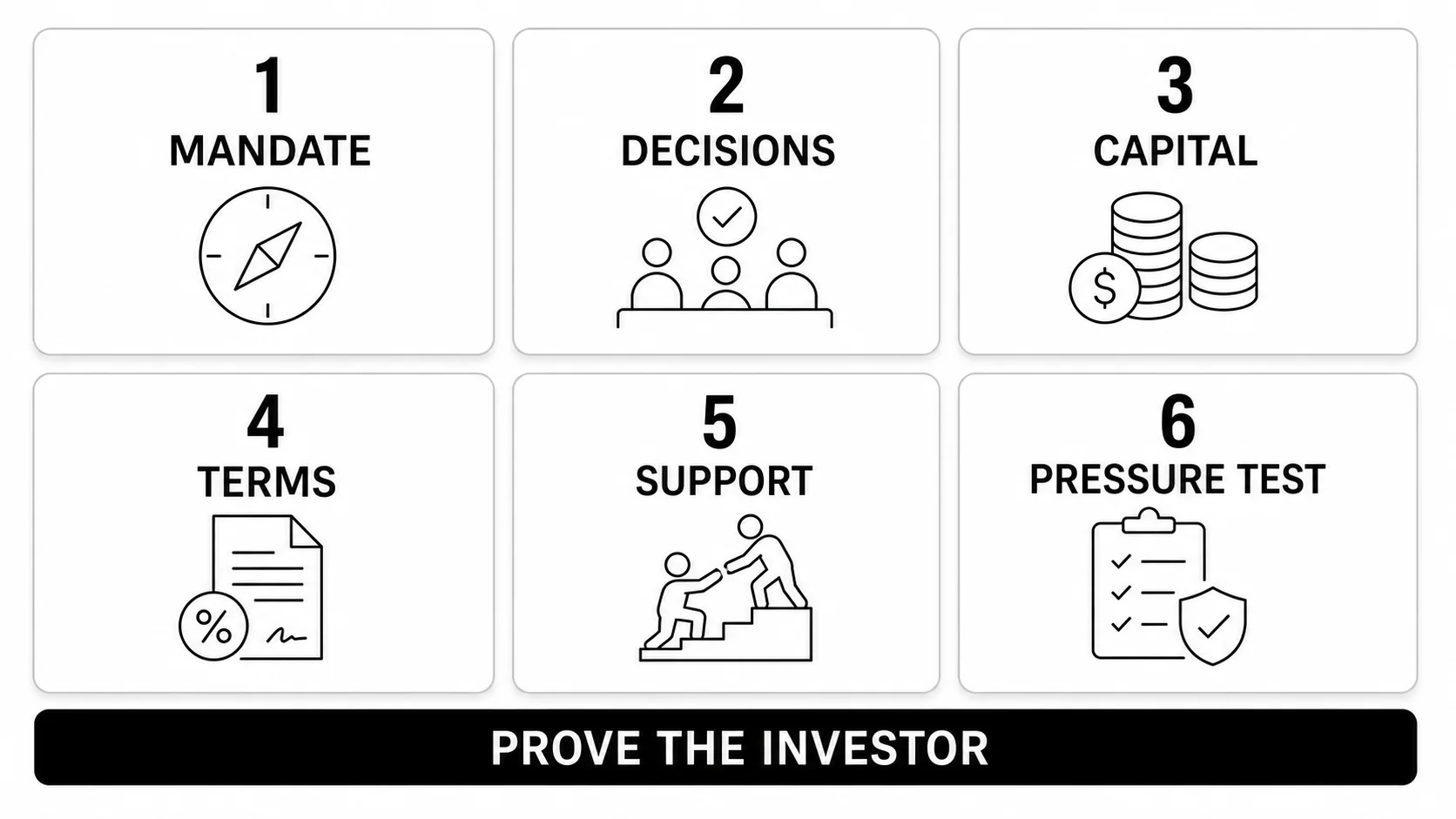
“Prove the investor”: a six-part diligence scorecard
An investor's strongest claims should be testable before the round closes. Score each dimension as claim, partially verified, or verified. A polished pitch without documents, named owners, or portfolio references remains a claim.
| Dimension | Evidence to request | Strong signal | Red flag |
|---|---|---|---|
| Mandate | Written stage, sector, geography, check-size, concentration, and ownership parameters | Startup investing is approved, funded, and repeated across a coherent portfolio | Deal depends on personal enthusiasm with no clear allocation or repeatable process |
| Decisions | Names and approval path for initial, follow-on, bridge, governance, and exit decisions | Deal lead can explain who decides, what evidence is needed, and how long exceptions take | “We move quickly” but later decisions require an undefined family or committee process |
| Capital continuity | Source of the initial check, reserve policy, remaining fund or allocation, and examples of follow-ons | Capital for the expected financing path is budgeted and decision rights are clear | Follow-on participation is promised but reconsidered from scratch against unrelated family needs |
| Terms and control | Term sheet, side arrangements, board plan, information rights, pro rata, protective provisions, and option-pool treatment | Rights are proportionate to the round and compatible with future financing | Bespoke vetoes, reporting demands, or economics that counsel expects a later lead to unwind |
| Operating support | Named people, time commitment, relevant portfolio examples, and specific recruiting, customer, technical, or fundraising help | Portfolio references can identify work the investor delivered and the result it produced | Value-add is described as access to a broad network with no responsible person or examples |
| Pressure test | References from a strong company, a company that missed plan, and one that raised a bridge or down round | Accounts remain consistent when performance deteriorated or incentives diverged | Investor offers only hand-picked winners or discourages contact with founders from difficult outcomes |
Reference calls that produce useful evidence
Ask for at least one reference outside the investor's obvious success story. Then ask:
- What changed after the money arrived?
- How did the investor behave when targets were missed?
- Did promised follow-on capital appear on time and under the expected process?
- Which introductions or operating help produced a measurable result?
- What would you negotiate or clarify differently?
Withers recommends aligning objectives and expected involvement early because family-office relationships, growth ambitions, and follow-on decisions can diverge. Its comparison of family offices and venture capital also shows why patience and personal trust can be strengths without replacing governance.
The same scorecard applies to a VC. Replace “family allocation” with fund reserves and partner sponsorship, then verify the firm's behavior across the same difficult situations. Institutional branding is not proof either.
How family-office and VC careers differ
A family-office investment role can include venture deals without being a venture capital job. The decisive variable is mandate breadth.
| Career dimension | Family-office direct investing | Venture capital |
|---|---|---|
| Mandate | May span public markets, funds, private equity, real estate, credit, direct deals, liquidity, and family priorities | Usually focused on startup and growth-company investing within a fund strategy |
| Daily outputs | Manager reviews, asset-allocation analysis, direct-deal memos, family reporting, liquidity work, portfolio updates | Sourcing notes, market maps, company diligence, investment memos, IC materials, reserve and portfolio reviews |
| Sourcing | Trusted networks, bankers, fund managers, operating-company relationships, co-investors | Founders, other investors, accelerators, sector networks, outbound research, portfolio referrals |
| Diligence | May combine manager selection, co-investment, and direct-company work | Repeated company, market, team, product, financial, and deal analysis |
| Internal stakeholders | Family principals, CIO, family council, tax/legal advisers, operating companies | Partners, investment committee, LP-facing team, platform and portfolio specialists |
| Feedback loop | Portfolio-level decisions and family satisfaction; direct deals may be infrequent | Investment decisions are frequent, but realized performance takes years |
| Promotion signal | Trust, judgment across the mandate, communication with principals, risk management, and selected deal outcomes | Sourcing quality, judgment, memo and IC performance, founder references, portfolio contribution, and fund results |
| Portability | Strong for allocator, co-investment, endowment, private markets, or another family office; startup depth depends on deal volume | Stronger direct signal for another VC fund or startup-focused investing role |
Family-office work may offer unusual access to a principal and broad investment context. It can also provide fewer repetitions of startup sourcing, diligence, and board work. VC work usually offers more repetitions within a narrower domain.
Neither is inherently the faster learning environment. A small family office with an experienced CIO and real direct-investment authority can teach more than a large fund role limited to sourcing. A famous VC brand can teach less than expected if the job does not include diligence, writing, or decision exposure.
Role titles do not resolve the ambiguity
“Investment associate” at a family office might spend most of the year evaluating external fund managers. At a VC firm, the same title might own sector sourcing and build investment-committee memos. Read the responsibilities for outputs:
- What will the person produce each week?
- How many direct startup investments did the team complete in the last year?
- Does the role attend or present to the decision forum?
- Who owns portfolio reporting, reserve recommendations, and follow-ons?
- Will the role work with founders after investment?
The VC career path helps decode institutional fund progression. The VCC investment-committee and due-diligence guides show the work a startup-focused role should encounter.
Which career fits you?
Choose family-office direct investing when...
- You want to judge capital allocation across asset classes rather than specialize immediately.
- You are comfortable working closely with a small number of principals.
- You value mandate flexibility and concentrated responsibility.
- You can verify that direct venture work is recurring, not an occasional side project.
- You want optionality into allocator, co-investment, private-markets, wealth, or broader investing roles.
Choose venture capital when...
- You want repeated exposure to startup sourcing, market work, diligence, and portfolio decisions.
- You want to build a sector or founder network.
- You want to learn fund ownership, reserves, LP accountability, and power-law portfolio construction.
- You prefer a clearer signal for future VC or startup-investing roles.
- You can verify access to substantive work beyond pipeline management.
Interview questions that expose the real job
- What percentage of the role is direct startup investing?
- What were the last three deliverables this role produced for an investment decision?
- Which meeting makes the decision, and what would I contribute to it?
- Who owns reserves and follow-on recommendations?
- How is performance evaluated before investments exit?
- What did the previous person in this role go on to do?
Specific answers are a stronger signal than title or brand.
How to research firms and roles
Use the Venture Capital Careers companies directory to examine VC strategies, stages, sectors, locations, and portfolio evidence. Then compare open VC roles by the outputs and decision access in the job description.
For each opportunity, record:
- capital source and mandate;
- direct-investment frequency;
- decision authority;
- expected work products;
- portfolio or multi-asset breadth;
- reporting line and performance criteria; and
- carried interest, equity, bonus, or other incentives described by the employer.
A role that says “family office” but offers repeated company diligence and follow-on ownership may build a credible venture track record. A role that says “venture capital” but consists only of lead generation may not.
Frequently asked questions
Is a family office the same as a venture capital firm?
No. A family office manages or oversees one family's wealth and may invest across many asset classes. A venture capital firm manages a fund committed by limited partners to invest in startup and growth companies. A family office can build a dedicated venture team that operates similarly to a VC, but the capital source and accountability remain different.
Do family offices invest directly in startups?
Some do. Others invest as limited partners in VC funds, join co-investments or SPVs, or avoid venture entirely. WealthBriefing's expert comparison of VC funds and family offices explains why direct investing requires different specialization from fund commitments. Verify the office's actual allocation and deal history.
Is family-office capital more patient than venture capital?
It can be. A family office is not required to return capital within an outside fund's life, so it may be able to hold an investment longer. That does not guarantee support. Family liquidity, succession, concentration limits, or changing priorities can still interrupt capital.
Are family-office terms more founder-friendly?
Not automatically. A family office can offer a simple, flexible deal or request bespoke rights that make the next round harder. A VC can request meaningful control or offer a familiar structure that later investors understand. Compare the term sheet, governance, reporting, pro rata, option-pool treatment, and bridge process.
Can a startup raise from both a family office and a VC?
Yes. A VC can lead the round while a family office adds capital or sector access. The combination works when lead authority, information rights, follow-on expectations, and exit objectives are explicit.
Is a family office a good route into venture capital?
It can be if the role includes repeated direct startup sourcing, diligence, investment writing, decision exposure, and portfolio work. If the role is mostly manager selection, public markets, or family reporting, it may build a strong allocator career but a weaker direct-VC signal.
What is the difference for an employee?
Family-office roles often trade specialization for breadth and close principal exposure. VC roles usually offer more repetitions of startup evaluation, founder interaction, investment-committee work, and portfolio construction. Team quality and decision access can outweigh the category.
Choose the operating model, not the story
For founders, the decision is not between “patient family money” and “aggressive VC money.” It is between two specific investors with particular mandates, people, rights, reserves, and records under pressure. Classify how the capital reaches the company, compare the documents, and call founders whose outcomes were difficult—not only the winners.
For candidates, the decision is not between two titles. It is between sets of work: multi-asset allocation and family accountability, or repeated startup investing and fund accountability. Use the mandate, recent deliverables, and decision access to determine which role builds the judgment you want.
The label starts the research. Evidence should finish it.
Related posts
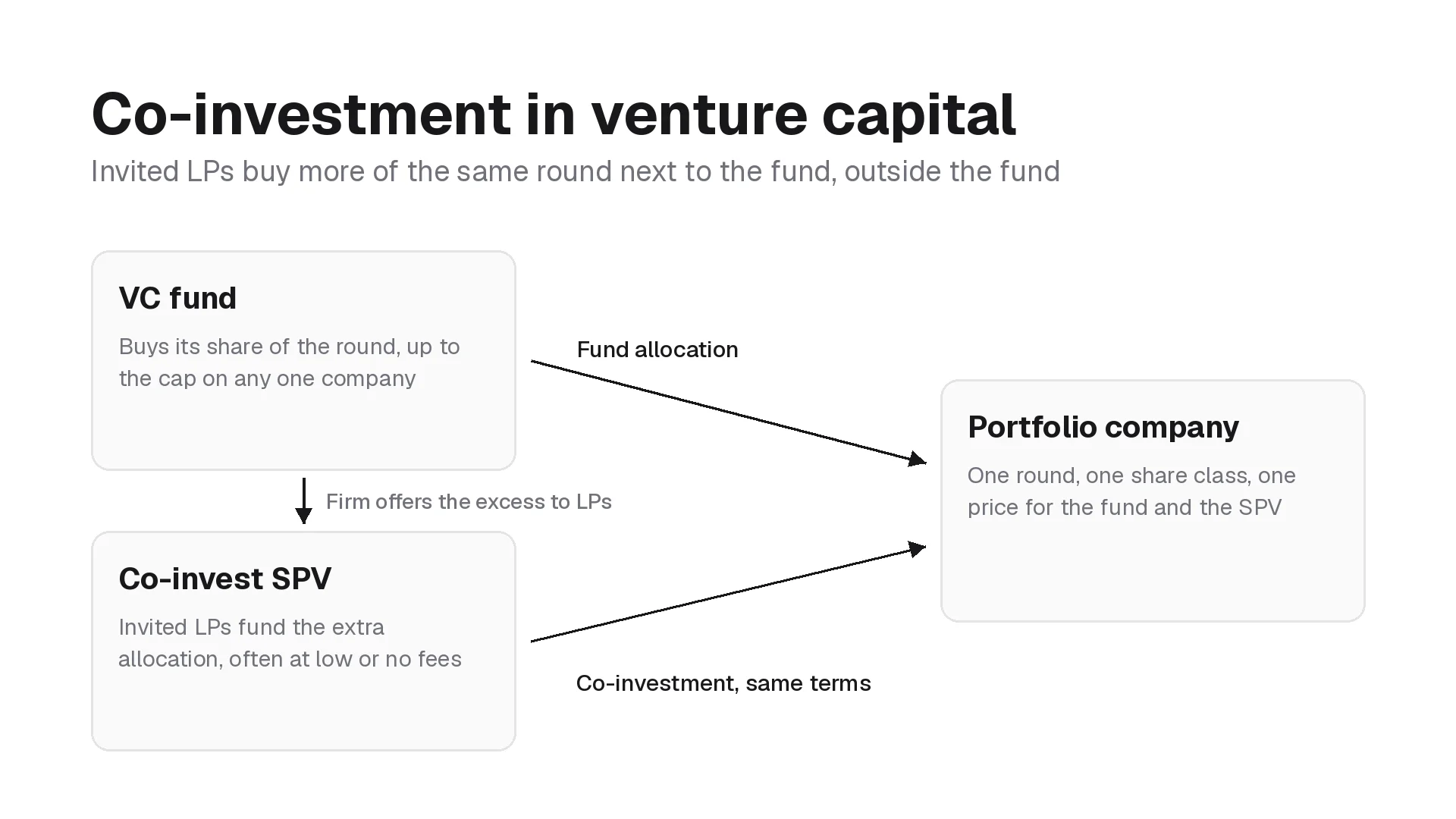
A venture capital co-investment lets LPs put money into one startup next to the fund, outside the fund, usually at lower fees. Here is how the offer works, what the terms cost, why late-stage venture co-investments carry extra risk, and what co-investment means for people who work at VC firms.
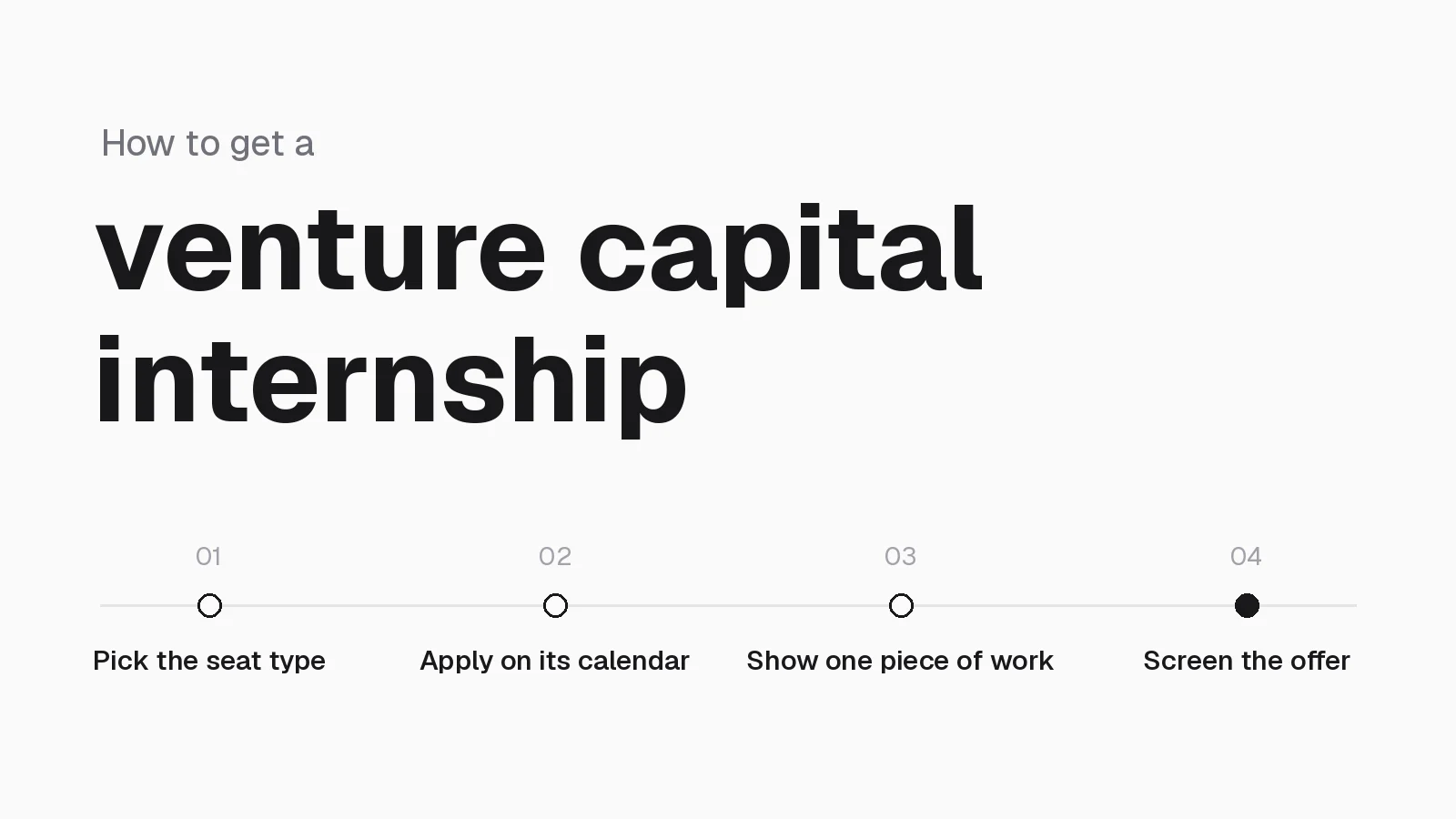
How to get a venture capital internship: the five internship types, which firms hire interns, when structured programs and small funds recruit, what interns are paid and when unpaid is legal, outreach with proof, interview questions, and how to screen an offer.
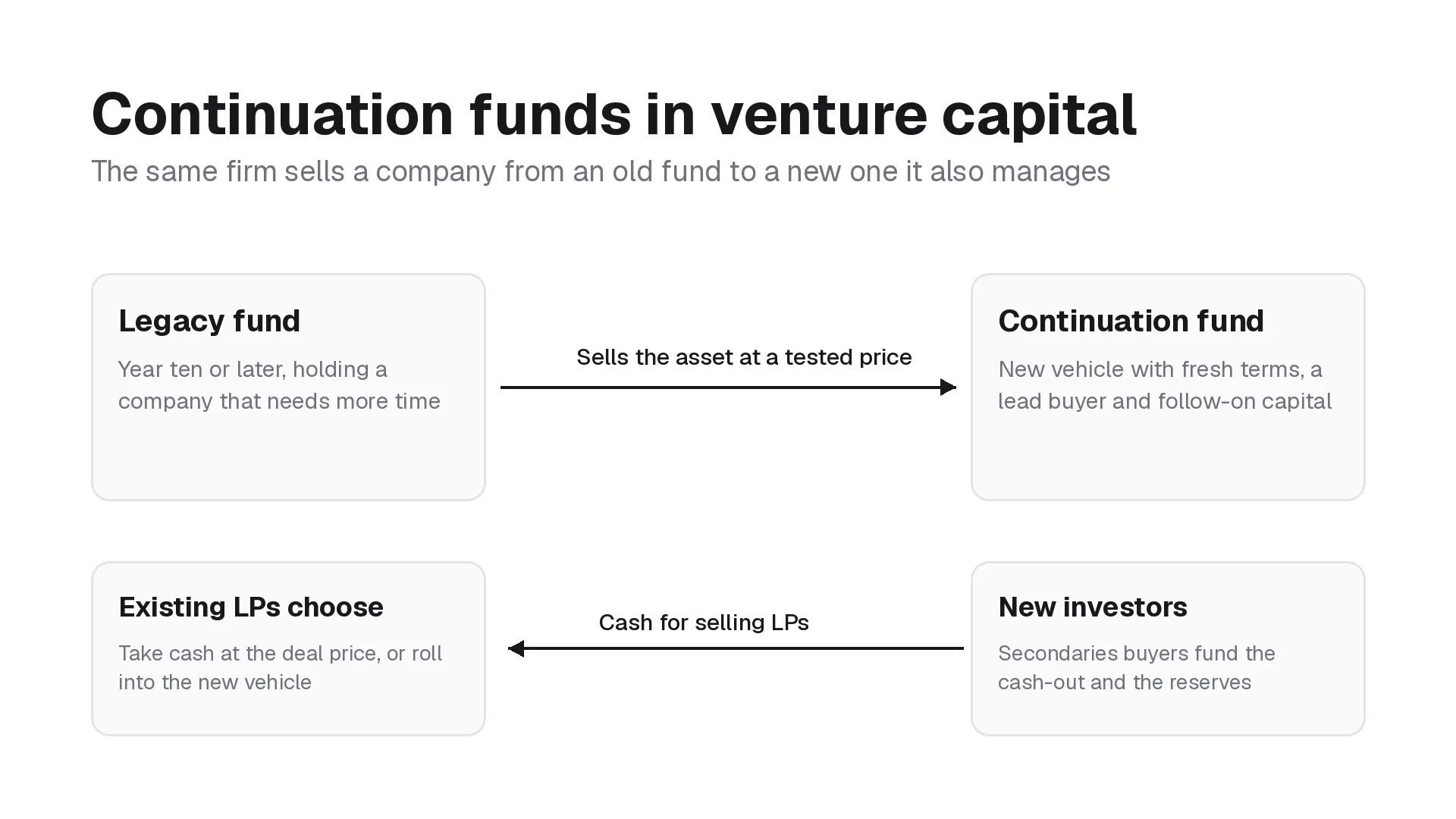
A continuation fund lets a VC firm sell a company from an old fund to a new vehicle it also manages, while LPs choose cash or a roll. Here is how the deal works, how price, fees and carry are set, and what it changes for people who work at the firm.