
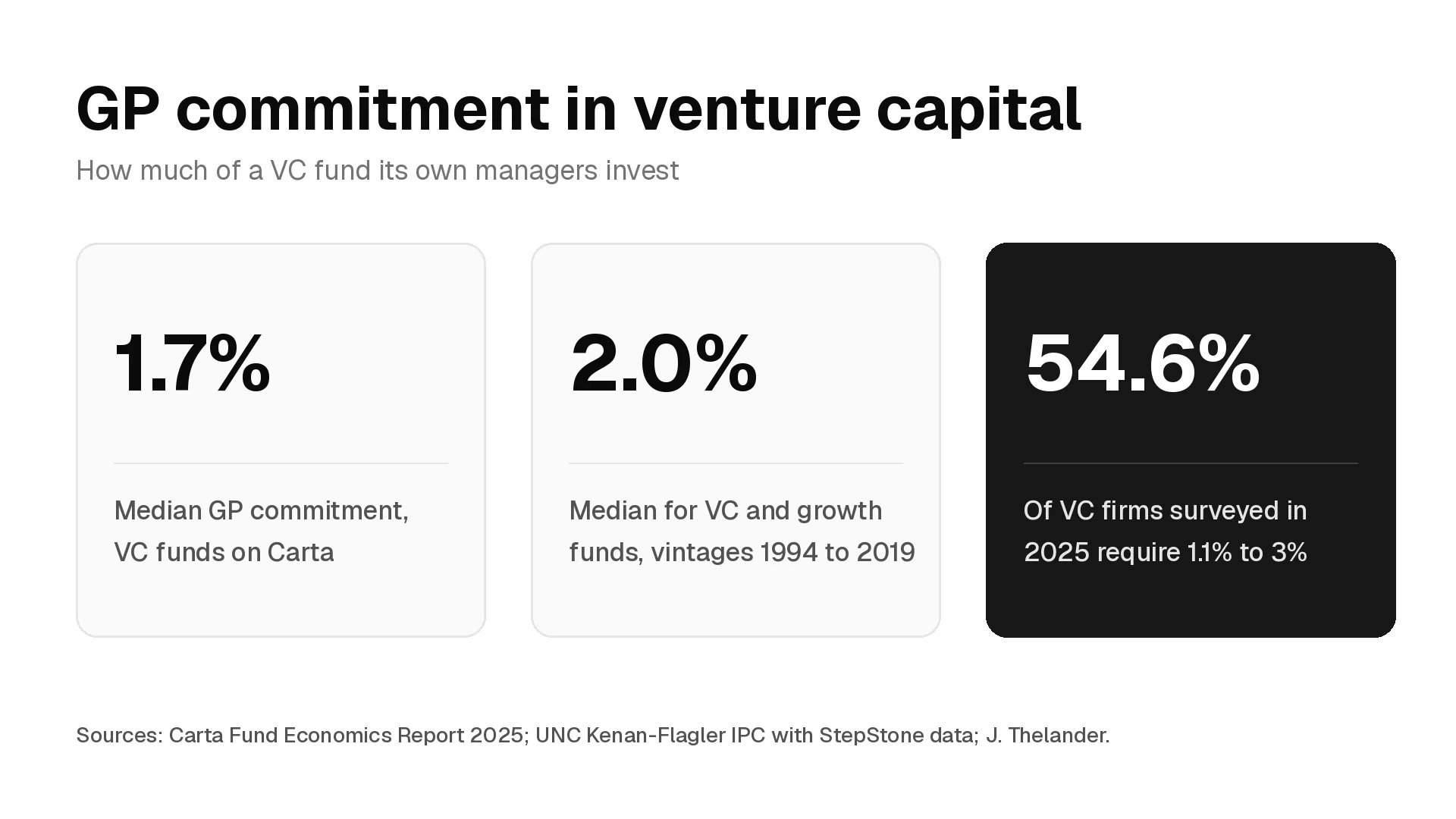
A GP commitment is the money a venture fund's general partner and its team invest in their own fund alongside the limited partners. In venture capital it is usually 1% to 3% of the fund. Across VC funds administered on Carta, the median GP entity commitment is 1.7% of fund size, and in a 2025 survey of VC firms by J. Thelander Consulting, 54.6% of responses put the required commitment between 1.1% and 3%.
The percentage is small, but the dollar amounts are large. On a $250 million fund, 1.5% is $3.75 million of personal capital, and someone at the firm has to write those checks. If you are joining a VC firm as a principal or partner, or being promoted into carry, part of that commitment may become yours.
What a GP commitment is
A venture fund is usually a limited partnership. Outside investors, the limited partners, commit most of the capital. The general partner entity manages the fund and makes the investments. The GP commitment is the capital that entity, its partners and sometimes its employees agree to put into the same fund on the same investments. The venture capital fund structure guide explains how the GP entity, the management company and the fund fit together.
Three things separate a GP commitment from the other economics in a fund:
- It is capital at risk. The money goes into the portfolio with the LPs' money. If the fund loses money, so does the GP.
- It is not carry. Carried interest is a share of fund profits paid for managing the fund. The GP commitment earns the same return as an LP dollar on top of that.
- It is not the management fee. Management fees pay for salaries and operations. Some firms convert part of the fee into the commitment through a fee waiver, which is why LPs ask how the commitment was funded.
The commitment is paid over time. It is usually called alongside LP capital as the fund makes investments, so a GP's cash goes out over the investment period rather than on day one.
How large GP commitments are in venture capital
Three primary data sets give a consistent picture. Most VC funds sit between 1% and 3%, small funds spread out more, and a minority commit far more.
| Source | Sample | Finding |
|---|---|---|
| Carta, Fund Economics Report 2025 | About 2,000 US funds on Carta | Median VC GP entity commitment 1.7% of fund size; private equity median 2.55% |
| Carta, same report | VC funds of $1M to $10M | Median 2%; 75th percentile 6.15% |
| Carta, same report | VC funds of $25M to $100M | Median 1.5%; 75th percentile 3.3% |
| Carta, same report | VC funds over $250M | Median 1.5%; 75th percentile 2.1% |
| UNC Kenan-Flagler IPC, StepStone data | 534 VC and growth funds, vintages 1994 to 2019 | Mean 2.7%; median 2.0%; 25th percentile 1.0%; 75th percentile 3.0%; 95th percentile 10.0% |
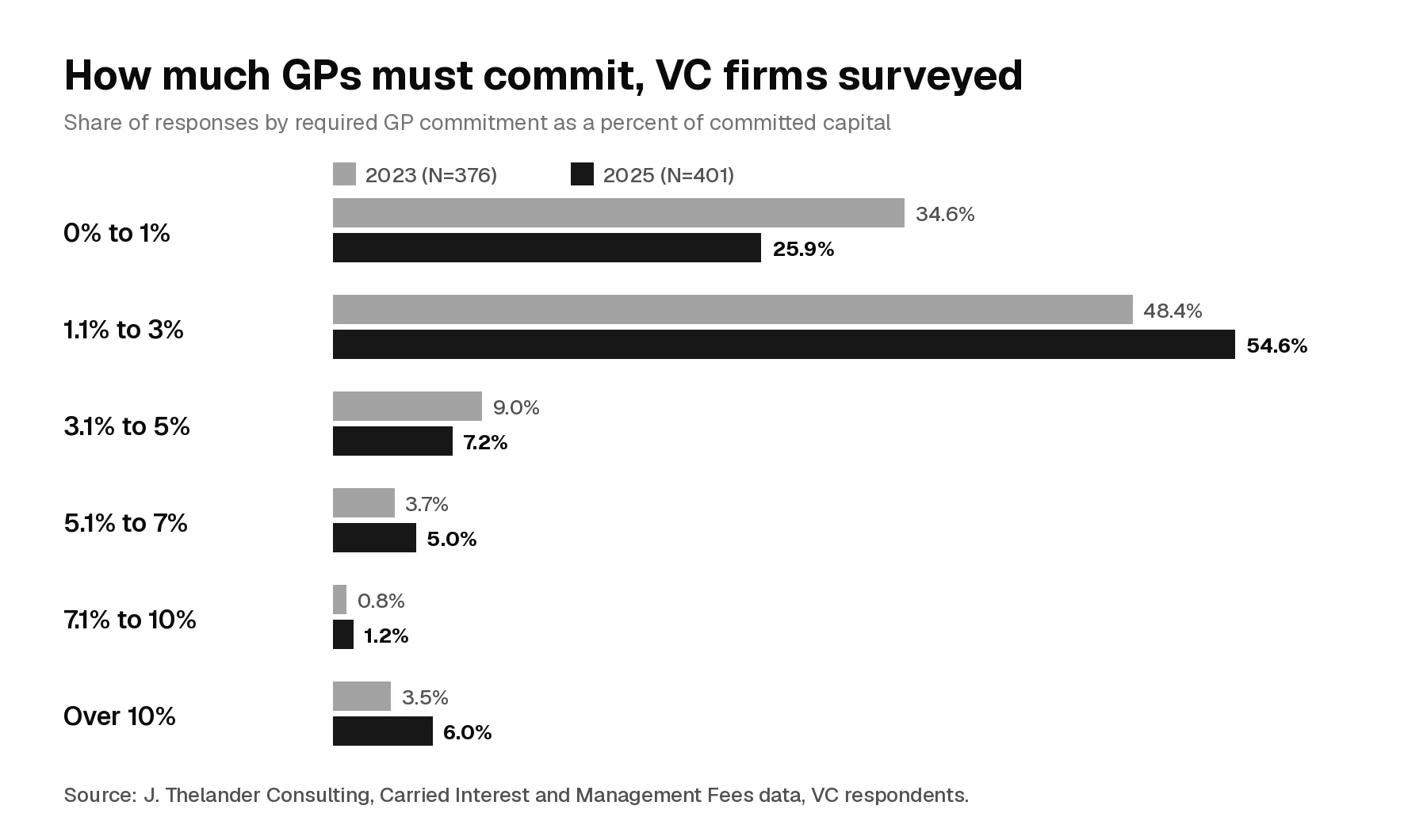
| J. Thelander Consulting survey, 2025 | 401 VC responses | 25.9% at 0% to 1%; 54.6% at 1.1% to 3%; 6.0% above 10% |
Sources: Carta Fund Economics Report 2025, Brown and Volckmann, Do GP Commitments Matter?, J. Thelander, Committing capital for your carry.
Two patterns matter for anyone sizing a commitment.
Small funds ask more, as a percentage. Carta's 75th percentile is 6.15% for funds under $10 million and 2.1% for funds over $250 million. LPs backing a small or first-time fund have less track record to rely on, so the GP's own money carries more weight.
Large funds ask more, in dollars. Carta's own example puts 2% of a $5 million fund at $100,000 and 1.5% of a $250 million fund at $3.75 million. A lower percentage at a bigger firm can still be a much larger personal check.
The direction is up. In the Thelander data, the share of VC responses in the 0% to 1% band fell from 34.6% in 2023 to 25.9% in 2025, while the 1.1% to 3% band grew. In the UNC data, the average VC and growth commitment rose from about 1% for 2005 vintage funds to about 2.5% for 2019 vintages, though not in a straight line.
How GPs fund the commitment
A 2% commitment on a $150 million fund is $3 million. Few partners hold that in cash, so firms combine several sources. LPs read each one differently.
Cash
Cash from the partners' own savings or past carry is the cleanest form. It is also what LPs prefer. ILPA, the main LP trade body, says in its Principles 3.0 that "the GP commitment should be contributed in cash as opposed to contributed through the waiver of management fees or via specialized financing facilities."
Management fee waivers
In a fee waiver, the GP gives up part of its future management fee and takes a priority share of fund profits instead. The waived amount counts toward the commitment. It lowers the cash the GP needs, but it means the "investment" only pays off if the fund has profits, and LPs see less of the GP's own money at risk.
Fee waivers also carry tax questions. In 2015 the IRS published proposed regulations on disguised payments for services that address management fee waiver arrangements. Anyone offered a waiver-funded commitment should get tax advice on the current treatment before signing.
Loans and financing
Banks and specialist lenders offer GP commitment loans, and some firms lend to junior partners against future carry or bonus. Financing lets a partner meet the commitment without the cash, but it adds debt that has to be repaid whether or not the fund performs. ILPA's position above covers "specialized financing facilities" as well as fee waivers.
Money from the wider team
The commitment often comes from more than the founding partners. Principals, partners and sometimes senior staff are asked to fund a share, and affiliates or family members of the partners may also be allowed to count. How the firm splits the commitment is the part that matters most for your career, covered below.
Where the GP commitment sits in the LPA
The limited partnership agreement, or LPA, sets the commitment. LPs, lawyers and anyone joining the partnership read the same few terms:
| Term | What to look for |
|---|---|
| Size | A percentage of total commitments, a fixed dollar amount or the lesser or greater of the two |
| Who can fund it | The GP entity only, or also partners, employees, affiliates and family vehicles |
| How it can be funded | Cash only, or fee waivers and financing allowed |
| Step-ups | Whether the dollar amount rises if the fund closes above target |
| Exposure | Pro rata in every deal, or room to pick deals; ILPA wants the whole interest in a pooled vehicle with no cherry-picking |
| Fees and carry | Whether the GP's own capital is charged management fees and carry; it often is not |
| Default | What happens if the GP or a partner misses a capital call |
ILPA's Principles 3.0 also ask that the GP's equity interest sit in a pooled vehicle whose share of the fund cannot shrink, so the commitment cannot quietly fall over the fund's life.
Why LPs care and what they check
LPs treat the GP commitment as a test of alignment. ILPA's principles say "the GP should have a substantial equity interest in the fund" and that alignment is best achieved when the GP's wealth comes mainly from profits on that equity commitment, after LPs' return requirements are met.
In diligence, LPs usually look past the headline percentage to four questions:
- How was it funded? Cash counts for more than fee waivers or loans.
- Who funded it? A commitment paid almost entirely by one founding partner tells LPs something different from one spread across the team.
- How big is it relative to the partners' wealth? $1 million means more from a first-time GP than from a partner with several funds of carry.
- Is it pro rata? LPs want the GP in every deal, not only the winners.
These questions show up in the fund lifecycle at fundraising, and they come back at every new fund. For the LP side of the relationship, see limited partner vs general partner.
Does a bigger GP commitment mean better returns?
The best public evidence is a 2024 study by Greg Brown and William Volckmann at UNC Kenan-Flagler's Institute for Private Capital, using StepStone data on 1,503 private equity funds. It found fund performance rose with GP commitment up to about 10% of committed capital.
| Commitment group | Funds | Average GP commitment | Average IRR | Average MOIC |
|---|---|---|---|---|
| Low, under 2.5% | 904 | 1.7% | 19.3% | 1.81x |
| Mid, 2.5% to 5% | 403 | 3.8% | 20.6% | 1.88x |
| High, above 5% | 196 | 11.1% | 21.3% | 1.94x |
Across all funds, moving from a 2.2% to a 4.4% commitment went with about 1.5 percentage points more IRR. The authors estimate a return-maximizing commitment of 10.5% for VC and growth funds on IRR and 12.6% on MOIC, far above what VC funds actually commit.
Read the result with three limits in mind. It shows association, not cause. It covers all private equity, so buyout funds dominate the sample. And the authors report that when imputed values are removed, the venture capital estimates become statistically unreliable. The safe reading is that larger commitments have not hurt returns, and LPs have some evidence for asking. The fund performance metrics guide explains IRR and MOIC if you need them.
How the GP commitment is split inside a VC firm
This is where the GP commitment becomes a career question. Firms do not publish their internal splits, but the patterns are visible in survey data and in how carry works.
The commitment often follows carry. Thelander describes the capital partners commit as "tied directly to the amount of carried interest they receive." When a principal or partner is given points in the carry pool, the firm may ask them to fund a matching share of the GP commitment.
Senior partners carry more of it. In Thelander's data, the median share of the total commitment funded by senior managing directors and senior partners rose from 12.5% in 2023 to 22.0% in 2025, with the 75th percentile at 33% in 2025. As commitments have grown, more of the load has moved to senior people, not to junior ones.
Junior investors are less exposed. Thelander's breakdown covers partner-level titles, and analysts and associates are less often asked to commit. Where a firm lets junior staff invest alongside the fund, that is usually optional rather than a required commitment. The associate offer negotiation guide covers what is negotiable at that level.
A worked example
Take a hypothetical $150 million fund with a 2% GP commitment, so $3 million in total. Two founding partners hold 42% of the carry each and a principal holds 16%. If the commitment is split the same way as carry, the principal owes $480,000. If the fund calls capital evenly over a five-year investment period, that is about $96,000 a year.
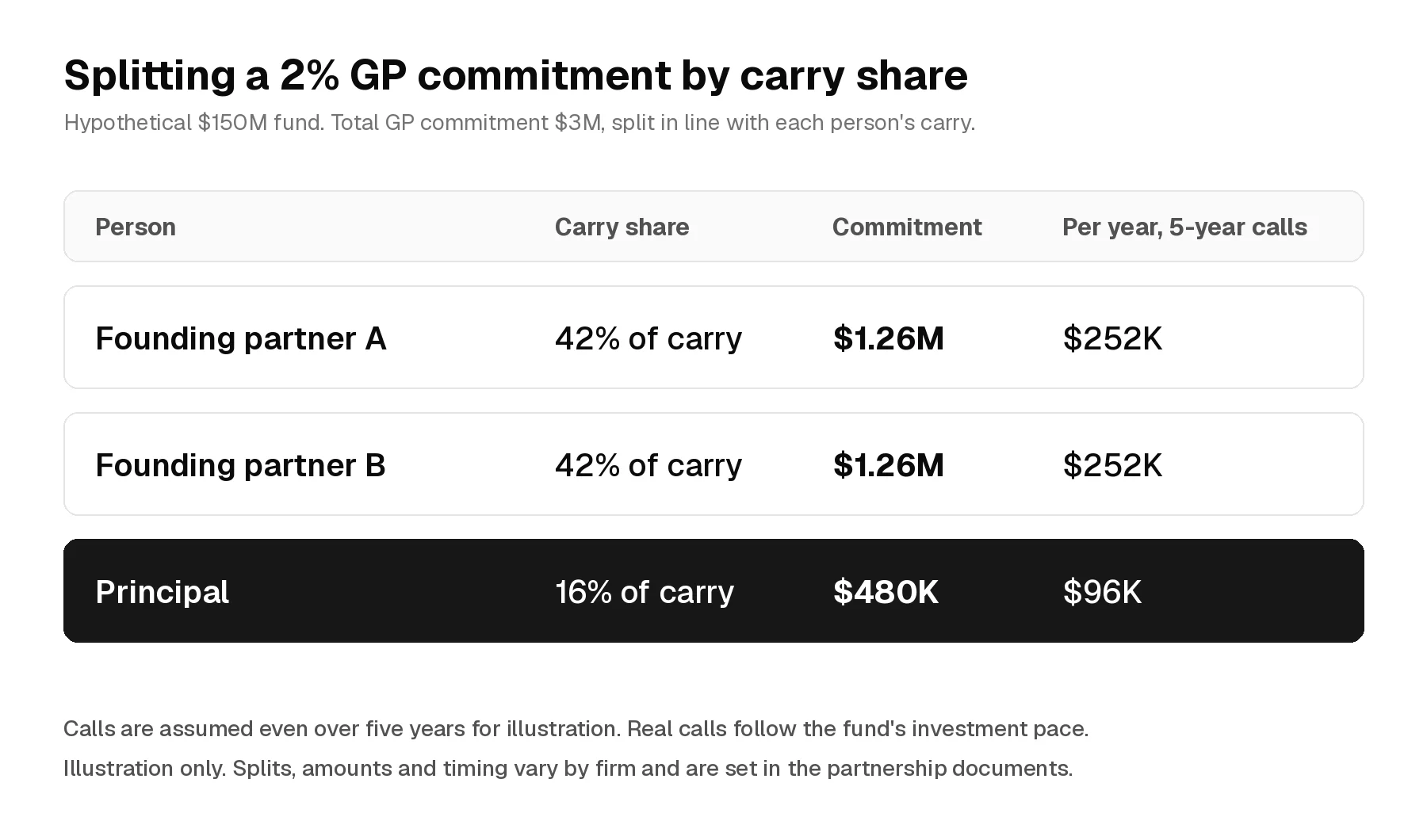
Set that against pay. A principal asked for $96,000 a year is funding the commitment from salary and bonus, before any carry has paid out. That is why a carry offer at principal level and above is really two numbers, the carry points and the capital required to hold them. The principal career guide and VC salary guide cover the pay side, and venture partner vs general partner explains why GP-level economics come with this obligation.
Questions to ask about the GP commitment before you accept a role
If an offer includes carry, ask about the commitment before you sign. These questions are standard, and a firm that answers them clearly is giving you a good signal.
- Is a personal GP commitment required for this role, and how much, in dollars and as a share of the total?
- Is it tied to my carry points, and will it rise if my carry rises in the next fund?
- How is it called, on the fund's capital call schedule or up front?
- Can it be funded through a fee waiver, a firm loan, deductions from bonus or a third-party lender? On what terms?
- Do I invest in the whole fund pro rata, and is my capital charged fees or carry?
- What happens to my commitment and my invested capital if I leave before the fund ends?
- What happens if I cannot meet a capital call?
The answers belong in the written documents, not in a conversation. Have your own lawyer and tax adviser review them. The carried interest guide covers vesting and leaver terms that sit next to the commitment.
How to answer GP commitment questions in a VC interview
GP commitment comes up in partner and principal interviews and in fund economics questions at every level. A strong answer gives the number, the reason and the nuance in under a minute:
"The GP commitment is the money the general partner and the team invest in their own fund next to the LPs. In venture it is usually 1% to 3%; Carta's median for VC funds is 1.7%. LPs want it because it puts the team's own money at risk alongside theirs, and ILPA prefers it in cash rather than fee waivers. Smaller and newer funds usually commit a higher percentage, while large funds commit more in dollars."
If you are interviewing for a senior seat, add how you would fund your share. That shows you understand the role carries capital at risk, not only upside. More practice questions are in the VC interview questions guide, and the partner job description shows where fund economics sit in the role.
FAQ
What is a typical GP commitment in venture capital?
Usually 1% to 3% of the fund. Carta reports a 1.7% median across VC funds on its platform, and the UNC and StepStone sample of VC and growth funds has a 2.0% median.
Is 1% still the standard GP commitment?
It is a common floor but no longer the norm for most funds. In Thelander's 2025 survey, only 25.9% of VC responses required 1% or less.
Can a management fee waiver count toward the GP commitment?
Many LPAs allow it, but LPs read it as weaker than cash. ILPA's Principles 3.0 ask for cash, and fee waivers raise tax questions that need professional advice.
Do associates have to make a GP commitment?
Usually not. Commitments are usually tied to carry and fall on partners and principals. Some firms offer junior staff an optional chance to invest alongside the fund.
Does the GP pay management fees and carry on its own commitment?
Often not. Many LPAs exempt the GP's own capital from fees and carry, but the LPA decides. Check it rather than assume.
Is the GP commitment paid all at once?
Usually not. It is called alongside LP capital as the fund invests, so it is paid over the investment period.
Find roles at VC firms
GP commitment questions start once you are near the partnership. To see which firms are hiring for principal, partner and investor roles, browse the VC firm directory and open venture capital jobs. To get new roles by email, create a free account. For how roles and economics change as you move up, read the venture capital career path.
Related posts
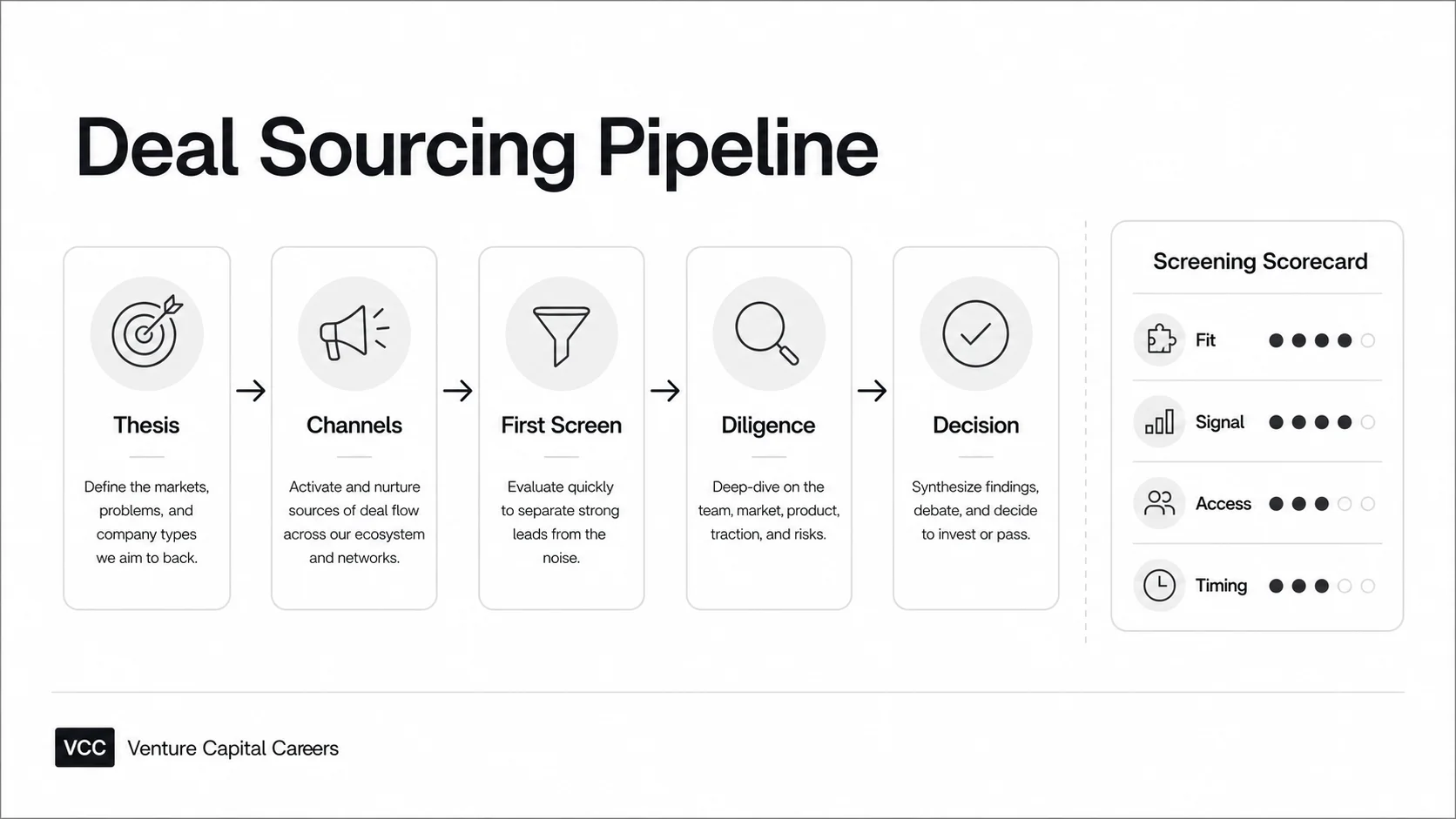
Most closed VC deals start with a relationship. See where deals come from by stage, how to work each sourcing channel, which signals show up early, and how analysts run a weekly sourcing process.
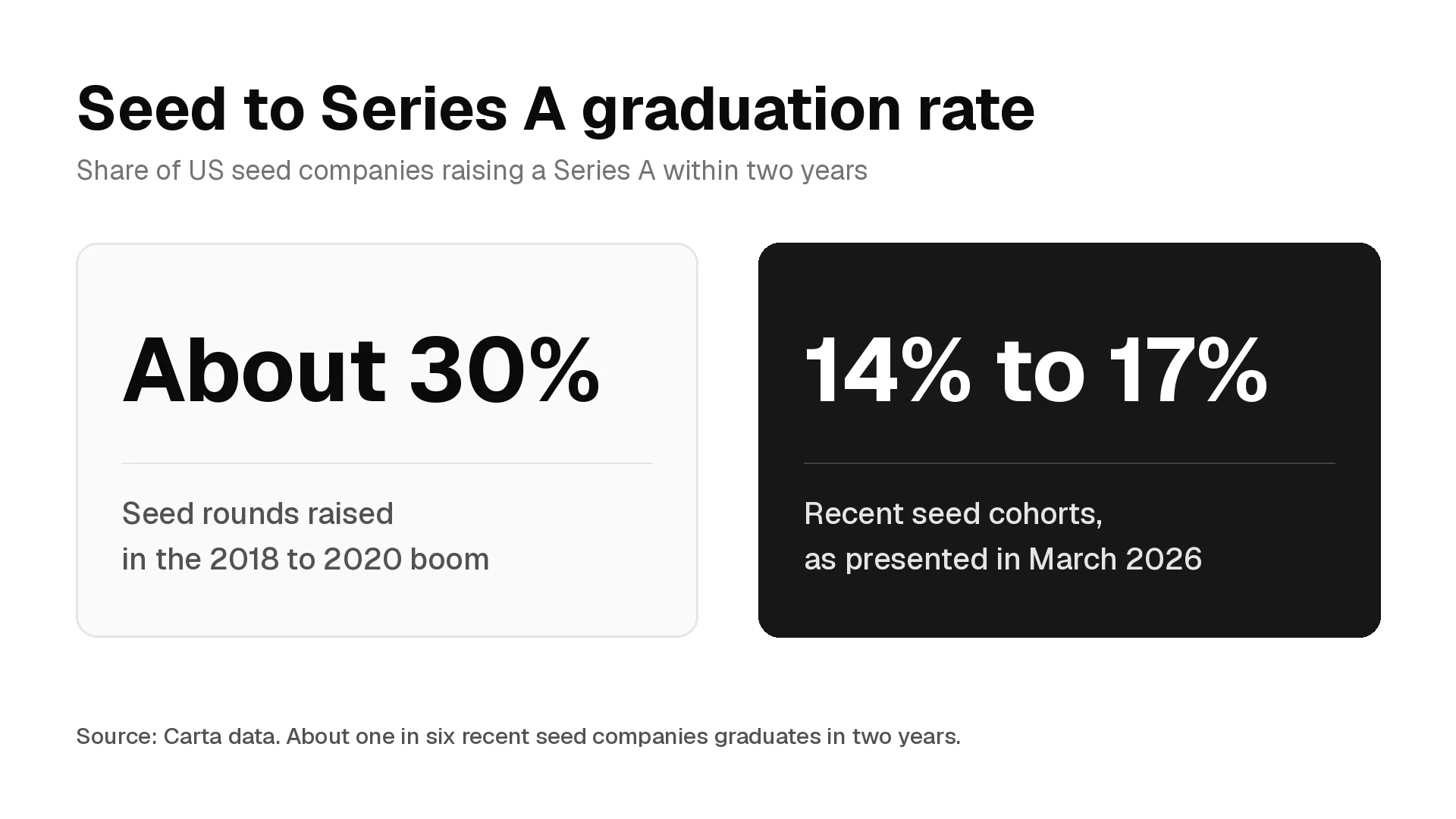
Seed to Series A graduation rates by cohort from Carta and Crunchbase, how long the jump takes, why rates fell after 2021, why published figures disagree, and how seed and Series A firms use the rate for reserves, LP reporting, portfolio reviews and interviews.
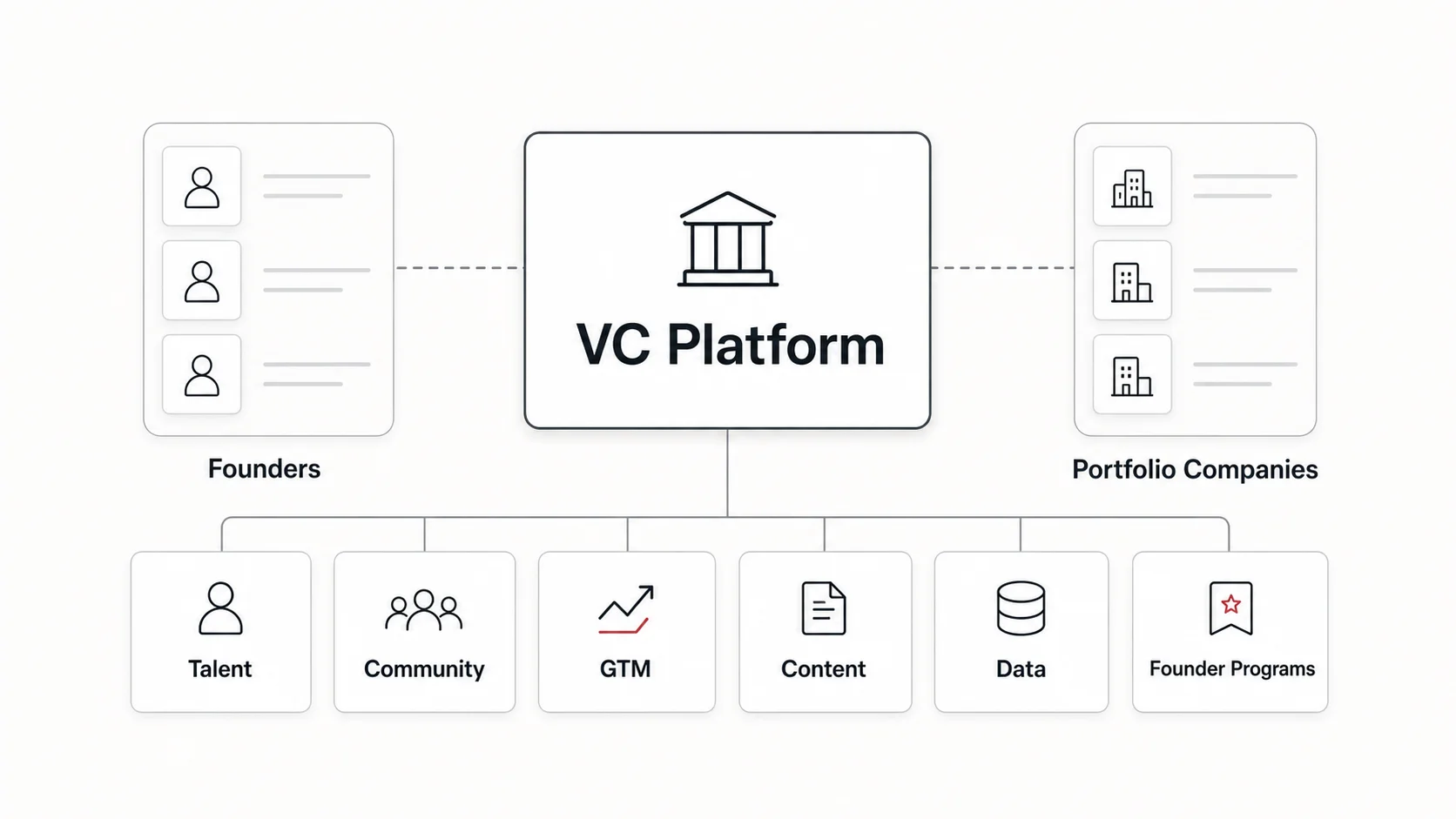
A venture capital platform role runs a VC firm's non-investing services for founders: talent, business development, community, marketing, and investment operations. Median platform pay is $165,000 base and $207,500 total cash.