
Non-consensus investing is backing a company that most investors have passed on or have not yet seen, for a specific reason you can state and test. It is where venture's biggest multiples come from, because you buy at a price set by the market's doubt and get paid when the market changes its mind. The catch is that the market has to change its mind before the company runs out of money, and the deal has to get past your own partnership first. In one survey of venture capitalists, 49% of funds said new investments need a unanimous partner vote.
For analysts and associates, non-consensus investing is part of the daily job. You are told to bring deals nobody else has. Then you have to explain why the other funds are wrong, write the memo, and survive the committee.
What non-consensus investing means
A consensus investment is one most informed investors agree is good. The round is competitive, the price reflects that agreement, and the investor's job is mostly winning access. A non-consensus investment is one where a material part of your case differs from what the market believes. Other investors have looked and passed, or the company sits where few of them look.
Two parts matter. The disagreement has to be specific, such as "buyers in this category will pay for software without a services contract," not "we believe in this founder." And you need a reason you can see what the passing investors cannot: an operating background, a customer relationship, or a technical judgment they lack. Without that reason, a non-consensus deal is just an unpopular one.
The idea is usually shortened to "non-consensus and right." Both halves carry weight. Being different only pays if you also turn out to be correct, and you only find out years later.
The consensus vs non-consensus 2x2
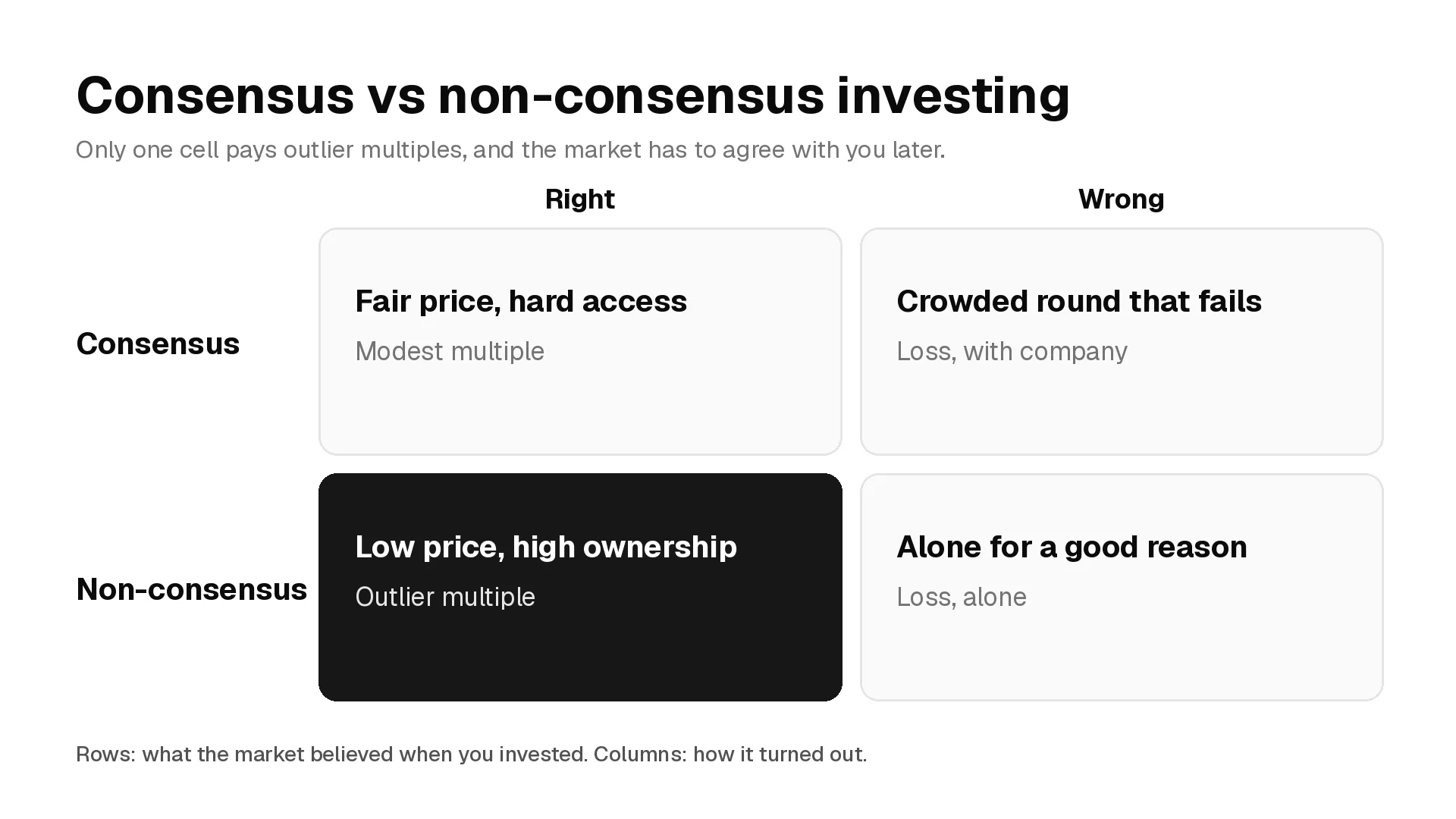
The standard picture is a two-by-two. One axis asks whether the market agreed with you when you invested. The other asks whether you turned out to be right.
| Right | Wrong | |
|---|---|---|
| Consensus | Competitive round, full price, hard access. You make money, often a modest multiple. | Crowded round in a hot category that fails. You lose money with plenty of company. |
| Non-consensus | Little competition, low price, high ownership. The market later agrees, and this is where outlier multiples come from. | You were alone for a good reason. The most common outcome of contrarian investing. |
The matrix comes from outside venture. Howard Marks drew it in his 2006 memo to Oaktree clients, Dare to Be Great, and reprinted it in Dare to Be Great II in 2014. His axes are conventional versus unconventional behavior and favorable versus unfavorable outcomes. Conventional behavior yields average results, good or bad. Above-average results sit in one cell only, unconventional behavior with a favorable outcome. Venture investors swapped in "consensus" and "right," and the logic carries over. You cannot beat the market by doing what the market does.
Read the matrix carefully. Consensus and right is a good result. Plenty of large venture outcomes came from competitive rounds that firms won on access. The matrix makes a narrower point. Consensus and right is priced in, so the entry price caps the multiple.
Why non-consensus and right pays
Price is the mechanism. Take one company and one $1 million check, bought at two moments.
| Non-consensus entry | Consensus entry | |
|---|---|---|
| Post-money valuation | $8M | $24M |
| Ownership at entry | 12.5% | 4.2% |
| Ownership at exit after later rounds halve it | 6.25% | 2.1% |
| Proceeds on a $1B exit | $62.5M | $20.8M |
| Multiple on the check | 62.5x | 20.8x |
The figures are illustrative, but the arithmetic holds at any scale. Same company, same check, same exit. The investor who bought while others doubted earns three times the multiple. In a business where a few companies return the fund, that gap decides whether a fund works. The power law in venture capital explains why a handful of outcomes matter so much.
The price you pay for the cheaper entry is risk. Most deals that look cheap because others passed are cheap for a reason. Non-consensus investing raises the payoff on the right calls and the number of wrong ones. That is why the reason behind your disagreement matters more than the disagreement.
Pre-consensus, non-consensus and contrarian are different bets
Investors use these words loosely. They describe three different bets, and each one needs a different thing to go right.
| Bet | What you are right about | Main risk | Who has to agree later |
|---|---|---|---|
| Pre-consensus | Timing. The market will like this category or company, you are just early. | Others arrive before you build a position | Next-round investors, soon |
| Non-consensus | A specific assumption the market rejects today | The market never changes its mind, or changes it too late | Next-round investors, once the evidence lands |
| Contrarian | The crowd is wrong, often about a category it dislikes | Disagreement becomes the goal instead of a finding | Everyone, eventually |
Pre-consensus is the most common version in practice. It means backing a category a year or two before it is fashionable. It carries less risk because you expect the market to agree. Truly non-consensus deals are harder. They need follow-on investors who still disagree with you today.
Time is the third axis the matrix leaves out. A non-consensus company has to become a consensus company for its investors to make money, because later rounds and exits need buyers who agree. If that takes five years and the company has eighteen months of cash, being right does not help. Every non-consensus case needs a view on how and when the market comes around.
Why VC firms drift toward consensus
Almost every firm says it backs non-consensus founders. Portfolios tell a more crowded story, and the reasons are structural.
Markups and the next fund
Exits take most of a decade. Until then, a fund shows progress through markups, the higher valuations its companies raise at. Hot companies in hot sectors get marked up fastest, and those marks appear in the fund performance metrics a firm shows LPs when raising its next fund. A non-consensus company can sit at cost for years while it proves itself.
Follow-on financing risk
A company the market doubts struggles to raise its next round. The fund then has to choose between writing more of the check itself and watching a company it believes in run short of money. Consensus deals come with a line of investors ready to lead the next round. That is a real advantage, and it pushes firms toward deals other firms already like.
Internal approval
A deal that excites one partner and worries three is hard to approve, and most firms require broad agreement. A deal everyone at the table already likes is easy. Over hundreds of decisions, the approval process selects for agreement.
Career risk
Marks quotes John Maynard Keynes on why institutions behave this way: "Worldly wisdom teaches that it is better for reputation to fail conventionally than to succeed unconventionally." Inside a VC firm, a missed consensus deal is a shrug, because everyone missed it. A non-consensus loss belongs to the person who championed it. For an associate who wants to make principal, that asymmetry is easy to feel.
Herding
Investors watch each other. A well-known firm's investment in a category reads as information, and money follows it. That is sometimes rational and sometimes just pattern matching on other investors' choices. Either way, it means the crowd is often where the market's attention already is, at prices that reflect it.
What the research shows
One of the few large studies on this question looked at founders rather than funds. Elizabeth Pontikes, then at Chicago Booth, and William Barnett of Stanford tracked 4,566 software organizations across 456 market categories from 1990 to 2002 and published the results in The Non-Consensus Entrepreneur in Administrative Science Quarterly in 2017.
Their findings line up with the 2x2:
- Spectacular financings in a market set off a flood of new entrants and of venture investment. Venture capitalists, the authors write, herd into hot markets too.
- Companies that entered a market after such a burst of hype were less viable on average. They were less likely to receive venture funding and less likely to go public.
- Companies that entered markets other founders were avoiding, including markets tainted by a recent public failure, were more likely to stay in the market, raise venture money, and go public. The heavy scrutiny they faced worked as a higher bar to entry.
Two cautions. The study covers software startups in one era and measures company outcomes rather than fund returns. It also describes averages. It does not say any unpopular company is a good one. Still, it is unusual evidence for something venture investors mostly argue from anecdotes. Following the crowd into a hot market has a measurable cost, and the scrutiny a non-consensus company faces can make it stronger.
Where non-consensus views come from
Good non-consensus views rarely come from wanting to be different. They come from seeing something a typical investor does not. Four sources produce most of them.
Founders the market has not found
Strong founders outside the usual networks often get fewer investor meetings. They may have built in an industry far from venture, raised no money before, or come in through a cold email. An investor who takes those meetings seriously sees deals before they are competitive. This is a deal sourcing edge more than a judgment edge, and it is the least risky kind, because the market is likely to agree once it meets the founder.
Markets after a public failure
After a well-known company in a category collapses, most investors stop taking meetings in it. The research above suggests founders who enter anyway are, on average, the more viable ones, because only strong teams push through that much skepticism. The question to ask is what killed the earlier company, and whether this team has a different answer to that specific problem.
Business models that look wrong
Some companies look bad on the metrics investors screen for, such as low prices, heavy services, or a small first market, because the business works in a way the screen does not capture. The non-consensus view is a claim about the model, like "revenue per customer will grow with the customer's volume," that can be checked against early data.
Domain knowledge the generalist lacks
An investor who ran the function the startup sells into knows which complaints buyers will pay to fix and which they only complain about. That knowledge lets you hold a view a generalist cannot test in a two-week process. It is also why many firms hire operators and specialists into investing roles, and why a strong investment thesis usually rests on one.
How to underwrite a non-consensus deal
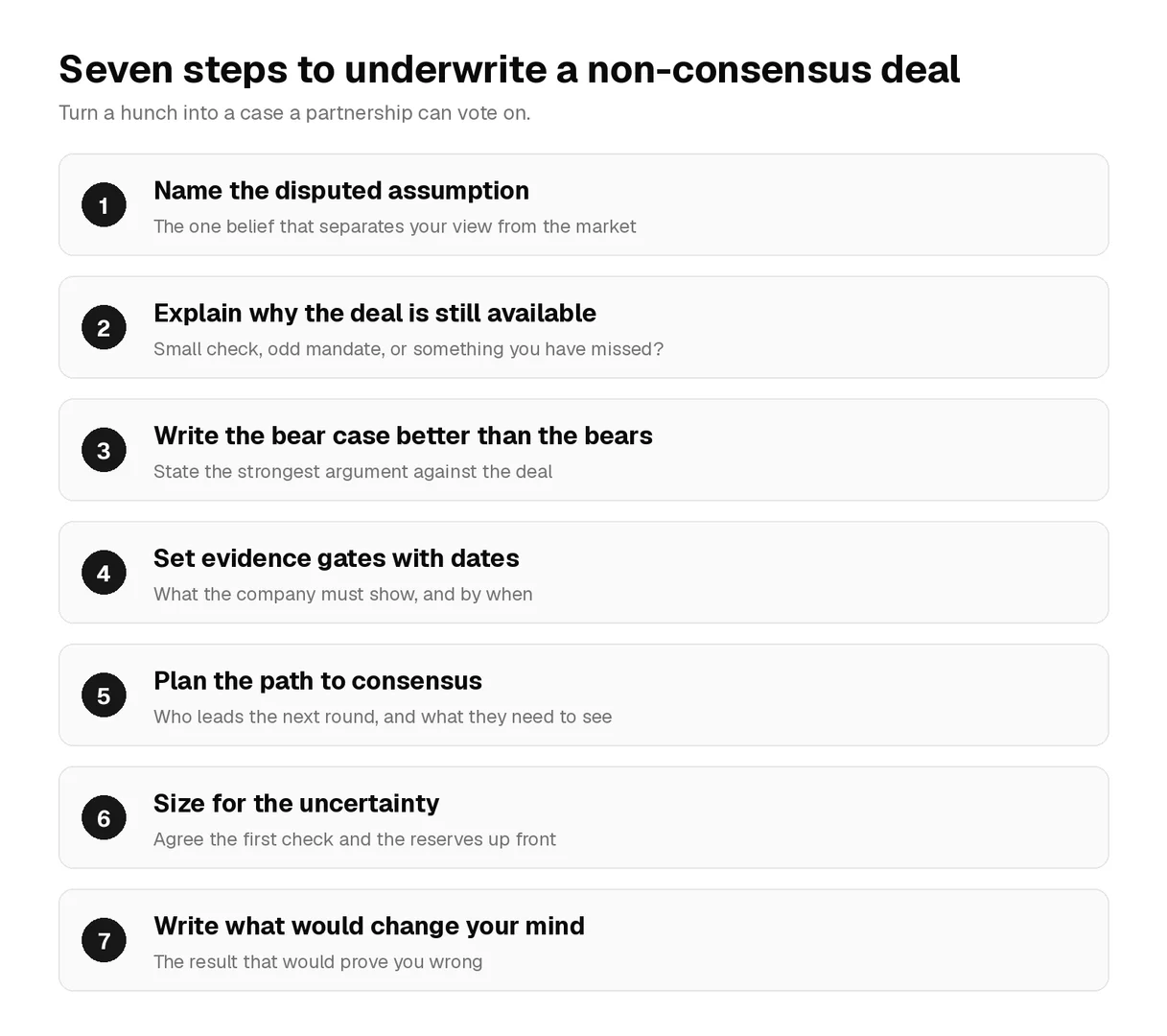
A non-consensus deal needs more diligence than a consensus one, because there is no crowd to check your work. These seven steps turn a hunch into a case a partnership can vote on.
- Name the disputed assumption. Write the one belief that separates your view from the market's. "Mid-sized manufacturers will adopt this without a consulting project" can be tested. "This is a huge market" cannot.
- Explain why the deal is still available. There may be an innocent reason other investors have not acted: the check is too small for large funds, the sector sits outside most mandates, or the evidence takes specialist knowledge to read. There may also be a bad one: they saw something you have not. Find out which.
- Write the bear case better than the bears. Talk to investors who passed, if you can. If you cannot state the strongest argument against the deal, you do not yet own the view.
- Set evidence gates with dates. Decide what the company must show, and by when, for your view to hold: repeat deployments, renewals, a cost that falls with scale. Check that the round funds those tests.
- Plan the path to consensus. Who leads the next round, and what will they need to see? A non-consensus case that cannot become a consensus case before the money runs out is a bet on a bridge round.
- Size for the uncertainty. Agree the initial check and the reserves up front. The follow-on investment decision should be a fresh one at the new price, not an automatic top-up.
- Write what would change your mind. If no result could disprove the view, it is not yet a thesis. Record the result that would prove you wrong, then check against it.
Most of this belongs in the venture capital investment memo. A section titled "the disagreement," with the assumption, the evidence, and the gates, makes the memo far easier to defend than a market overview that restates what everyone believes.
How investment committees handle non-consensus deals
The decision rule matters a lot for non-consensus deals. In a survey of 885 venture capitalists by Paul Gompers, Will Gornall, Steven Kaplan and Ilya Strebulaev, published as an NBER working paper, 556 respondents described how their fund approves new investments.
| Decision rule | Share of funds | What it does to a non-consensus deal |
|---|---|---|
| Unanimous vote | 49% | One skeptic can stop it. Champions need to win every partner or narrow the risk until no one objects. |
| Unanimous less one | 7% | One dissent is tolerated, so a single doubter cannot block it alone. |
| Consensus, with some partners holding a veto | 20% | Depends on who holds the veto and how they see the sector. |
| Majority of partners | 15% | A strong minority view can still lose, but one doubter cannot block it. |
| Independent decisions by partners | 4% | The friendliest rule. A partner can act on their own conviction. |
| Scoring | 2% | Depends on whether the score rewards upside or punishes uncertainty. |
| Other | 3% | Varies. |
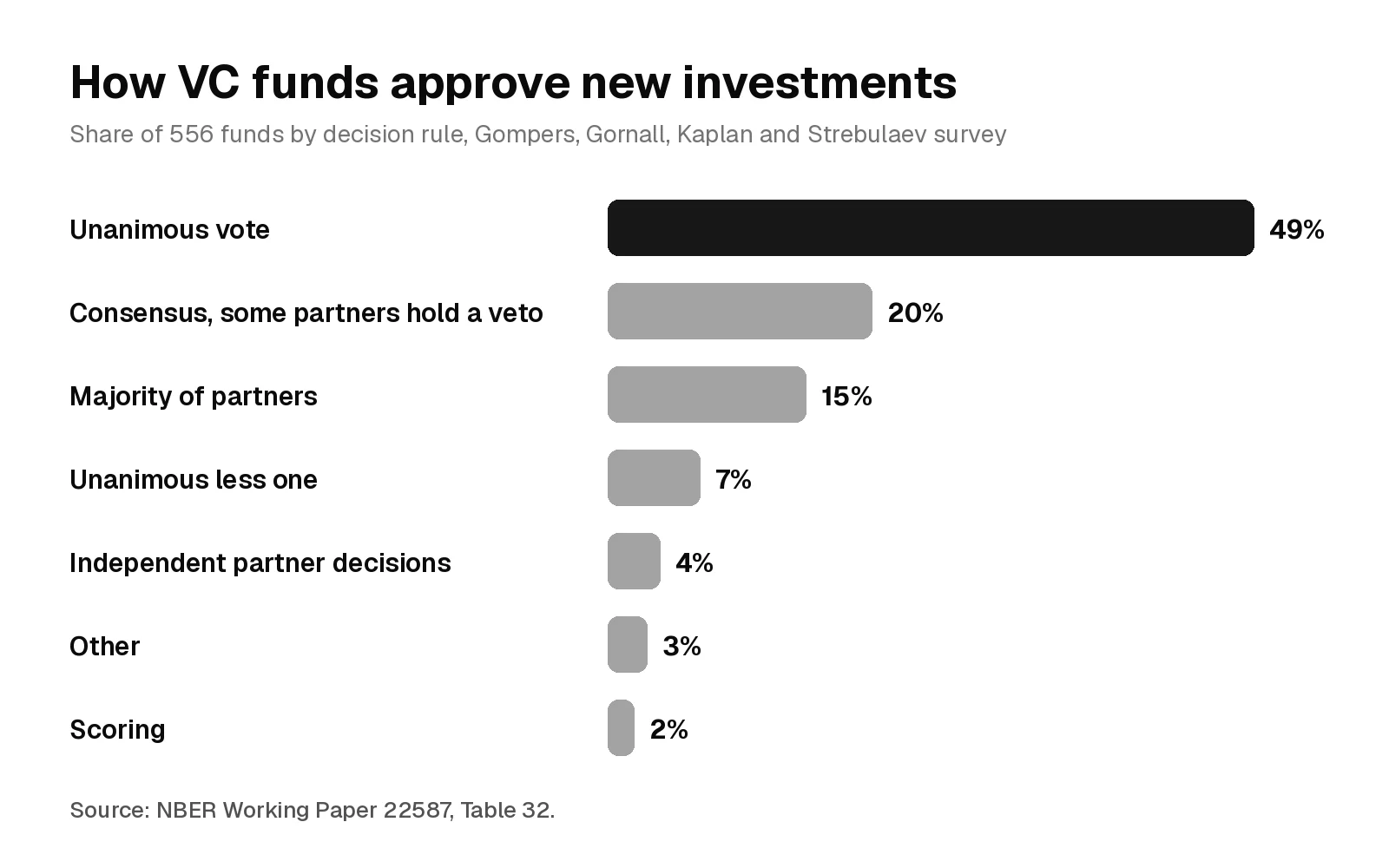
The splits are revealing. Unanimity was more common at smaller funds than at large ones, 56% against 40%, and much more common outside California, 55%, than inside it, 35%. Funds with higher IPO rates used unanimity less often, 40% against 52%. The survey does not show that the voting rule causes performance, but the pattern fits the idea that strict unanimity filters out the deals people disagree about.
Firms that want non-consensus deals without dropping their guard tend to use a few practices. The investment committee guide covers the process itself.
- A champion rule. A partner with strong conviction can lead a deal if they defend it and own the result, even when others are lukewarm.
- An assigned skeptic. One partner argues the bear case on purpose, so dissent is a role rather than a vote against a colleague.
- A shared minimum bar. The partnership agrees on a few things every deal must have, such as team quality, market size, and terms. Beyond that bar, conviction decides.
- Written dissent. Objections go in the memo with the date. Reviewing them later shows whether the doubters or the champion read the risk better.
- An anti-portfolio review. Some firms keep a list of companies they passed on that later broke out, and look at why. A strong yes that the committee overruled is the most useful entry on that list.
Where non-consensus investing goes wrong
The failure modes are as predictable as the herd's.
Contrarian as an identity
Some investors like being the only person in the room with a view, and work backward from that feeling to a deal. The result is a portfolio of non-consensus and wrong. The test is the sentence from step one. What do you know that the investors who passed do not?
Obscure is not undervalued
A company nobody has heard of in a category nobody covers may simply be a company nobody wants. Hard to find is a side effect of a real edge, never the edge itself. Ask whether the market has not seen the company, or has seen it and correctly passed.
Thinner diligence
"Nobody else gets it" can become a reason to stop asking questions. If your process is faster and lighter than a consensus investor's, you know less than they do, which is the opposite of an edge. Venture capital due diligence on a non-consensus deal should be the most thorough work in the pipeline.
Relabeling consensus deals after the fact
Winning a competitive round on access is a real skill. Calling it contrarian afterward, because the story sounds better, teaches the firm the wrong lesson about where its returns came from. Keep the original memo and the round dynamics on file, and describe the deal as it was.
Ignoring the clock
Being right in seven years does not help a company that needs a new round in eighteen months. Plenty of non-consensus losses come from a right thesis that the market accepted too late.
Is there still room for non-consensus investing?
The current market makes the question fair. The PitchBook-NVCA Venture Monitor for Q3 2026 reports that AI companies took 82.7% of US venture deal value in 2026 through September, the highest annual share in its data. In Q3, deals of $100 million or more were about 5% of deals by count and 75% of deal value. A small number of very large rounds is absorbing most of the money.
In practice, the room for disagreement depends on stage and fund size:
- Later stages. By Series B and beyond, companies have enough history to be scored against shared benchmarks, and competent investors tend to reach similar conclusions. Competition is mostly about access and price.
- Early stages. At pre-seed and seed there is little data to agree on. Two careful investors can reach opposite views on the same company, which is the gap non-consensus investing needs.
- Fund size. A large fund cannot build a meaningful position with a $100,000 check, so it concentrates on companies that are already legible. Small and specialist funds can afford positions the market has not priced.
For someone choosing where to work, this changes the job. At a large multi-stage firm, the skill on display is often access, meaning winning allocation in competitive rounds. At a seed or specialist fund, it is more often judgment on companies others pass on. Both are real investing jobs. They reward different habits.
Non-consensus investing in a junior VC's job
Analysts and associates rarely make the final call, but they shape what the partnership sees. Here is how the consensus habit and the non-consensus version differ across the work.
| Task | Consensus habit | Non-consensus version |
|---|---|---|
| Sourcing | Chase the round everyone is emailing about | Build lists in markets after a failure, or among founders outside the usual networks |
| First screen | "Who else is in?" | "What would the investors who passed have to be wrong about?" |
| Memo | Market overview that restates the common view | A section on the disagreement, the evidence, and the dated gates |
| Partner meeting | Seek comfort from everyone | Name the bear case first, and say what the deal needs from each skeptic |
| Portfolio work | Wait for the next round to validate the company | Track the milestones the next lead investor will ask for |
| Passes | Forget them | Log the reason and what would change your mind, then say no well |
When you bring a non-consensus deal to your partners, keep it to one page:
- The company in one sentence.
- The consensus view: what passing investors say and why.
- The disagreement: the one assumption you dispute.
- Why you can see it: your evidence or edge.
- The evidence today.
- The gates: what must be true, and by when.
- The path to consensus: who leads the next round and what they need.
- The size and the reserves.
- What would prove you wrong.
A one-page case like this does two things for a junior investor. It gives the partner something to argue with instead of a vibe to accept or reject. And it builds a record. Over two or three years, your logged calls on deals the firm passed and did are the best evidence of your judgment, long before any fund returns arrive. A venture capital fantasy portfolio does the same job for candidates who are not yet in a seat.
How to answer "what's a non-consensus view you hold?" in a VC interview
The question shows up in first rounds and partner interviews, sometimes as "what do you believe that most investors don't?" The interviewer is testing three things: whether you can find a real disagreement, whether you can back it, and whether you know what would make you wrong.
A strong answer has four parts:
- The view in one sentence. Specific enough that someone could disagree.
- The consensus you are disagreeing with. Show you understand why smart people believe it.
- Your evidence. What you have seen, built, or learned that others have not.
- The test. What result in the next year or two would prove you wrong, and what a company would need to show along the way.
A sample answer, to show the shape:
"Most investors I talk to see software for small trade businesses as too small, because each shop pays very little per seat. I think the better companies will earn most of their revenue from payments run through the software, so revenue per customer rises with the shop's volume instead of its headcount. I saw this in my last job selling to those shops. If, over the next two years, the companies in this space still can't get most customers onto their payments product, I'm wrong."
Three answers to avoid. A view that is already consensus, such as "AI will change software." A view that is only a preference, such as "I like climate." And a view with no test, where every outcome would somehow confirm it. Practise this alongside the other venture capital interview questions, and match your view to sectors the firm actually invests in.
Questions to ask a firm before you join
If you want to do non-consensus work, the firm's process matters more than its website. These questions get past the slogans:
- How does the partnership approve a new investment? Unanimous, majority, or partner discretion?
- Tell me about a deal the firm did where one partner was against it. How did it get through?
- Can a principal or associate sponsor a deal, or only partners?
- What is on your anti-portfolio, and did it change how you decide?
- How do you handle a company you believe in when other investors won't lead its next round?
- How much do markups matter when you raise the next fund?
Clear, specific answers with examples are a good sign. "We're very founder-first and think differently" is not an answer. How venture capitalists make investment decisions covers the rest of the process to probe.
Frequently asked questions
What is non-consensus investing in venture capital?
Investing in a company most informed investors have passed on or not yet seen, because you hold a specific, testable view they do not. If you are right, you bought at a price set by their doubt, and the multiple is far higher than in a competitive round.
What does "non-consensus and right" mean?
It is the non-consensus, right cell of the 2x2. You disagreed with the market when you invested, and you were correct. Consensus and right usually makes money at a modest multiple. Either kind of wrong loses money.
Who came up with the consensus vs non-consensus matrix?
The idea is usually traced to Howard Marks of Oaktree. His 2006 memo Dare to Be Great drew a two-by-two of conventional and unconventional behavior against favorable and unfavorable outcomes. Venture investors adapted it to consensus and right.
Is non-consensus the same as contrarian?
Not quite. Contrarian usually means taking the opposite side of a popular view. Non-consensus is broader. It includes companies the market has not seen at all, and its value comes from the reason behind the view, not from being opposite.
Can large VC funds invest non-consensus?
They can, but it is harder at the earliest stage. Small checks into unproven companies do not move a large fund, so big firms tend to compete on access to companies that are already legible. Large funds still make non-consensus bets, usually in categories or situations others avoid.
How can a junior VC bring a non-consensus deal to partners?
Lead with the disputed assumption, show your evidence, and state the gates and the path to the next round on one page. Name the bear case before the partners do, and log your call so your judgment builds a record.
Next steps
Research how individual firms invest before you interview, using the companies directory. When you are ready to apply, browse investing roles on the Venture Capital Careers job board, or create an account to get new roles by email.
Related posts
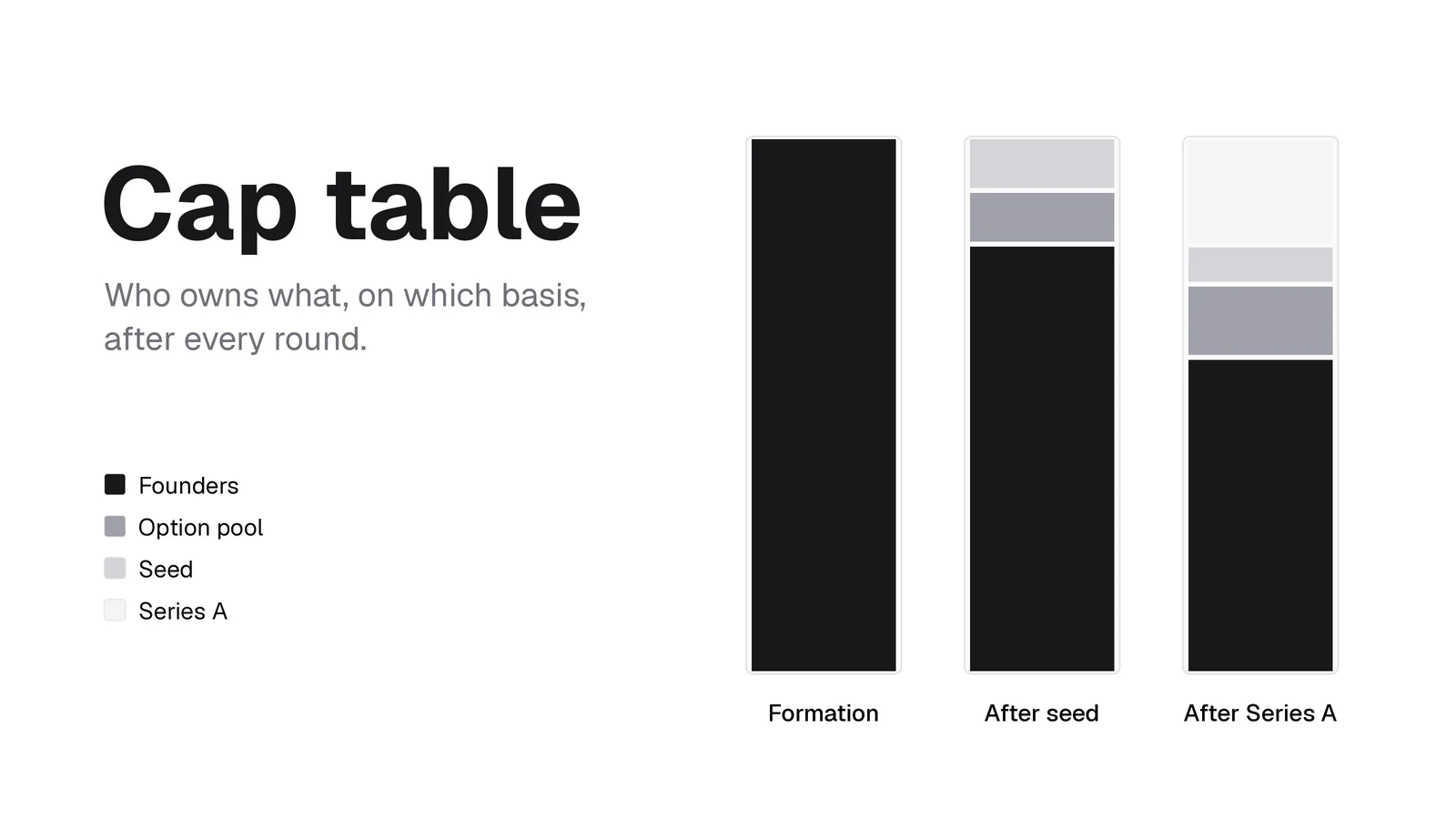
A cap table records who owns a company's shares, options, warrants, and convertible securities, and what percentage each holder owns on a stated basis.
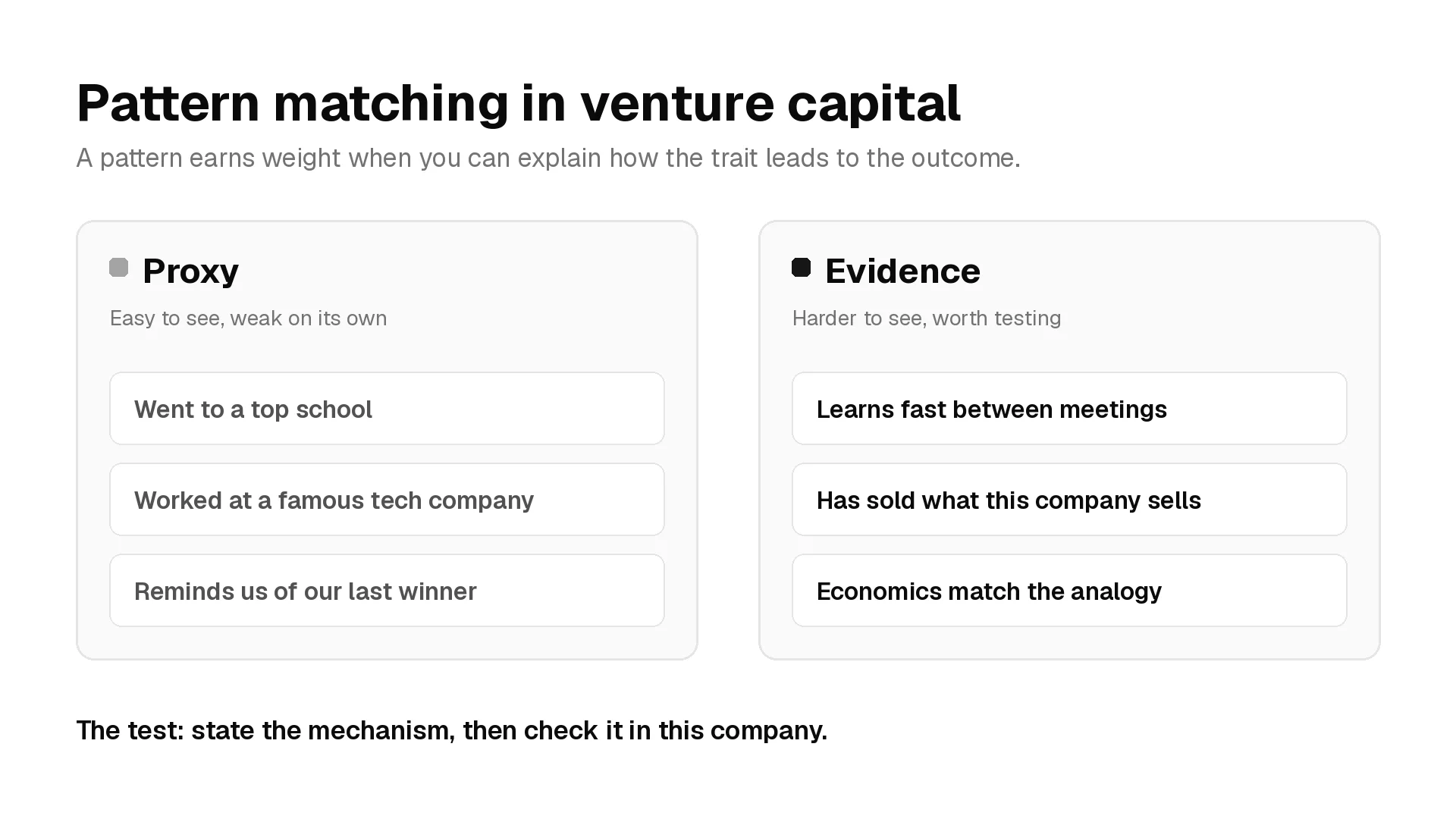
Pattern matching is how VCs judge new companies against past ones. When a pattern carries real information, when it is only a proxy, and how analysts and associates can use it well and talk about it in interviews.
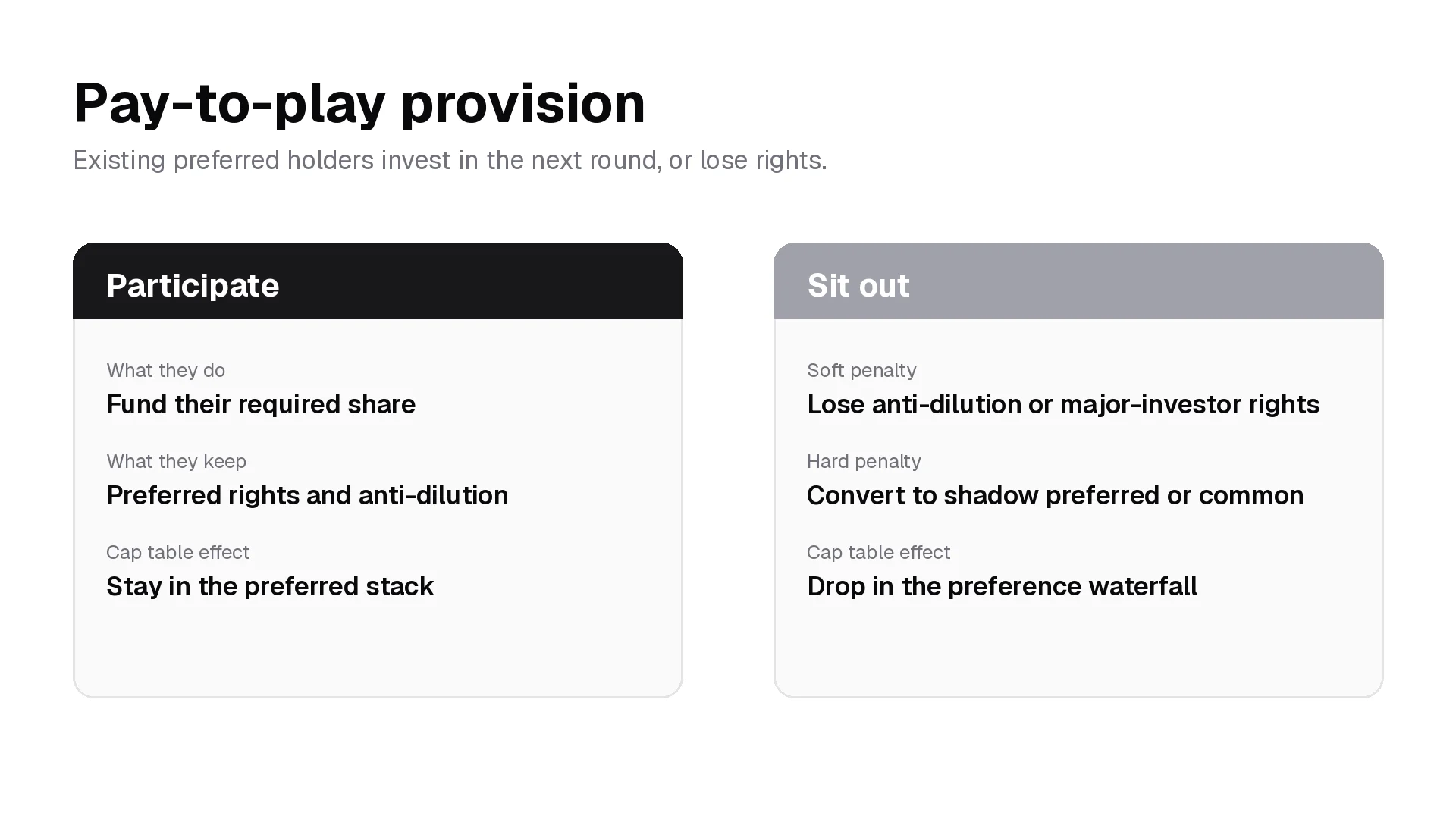
A pay-to-play provision requires existing startup investors to join a future financing, usually pro rata, or lose protections such as anti-dilution rights or preferred-stock status.