
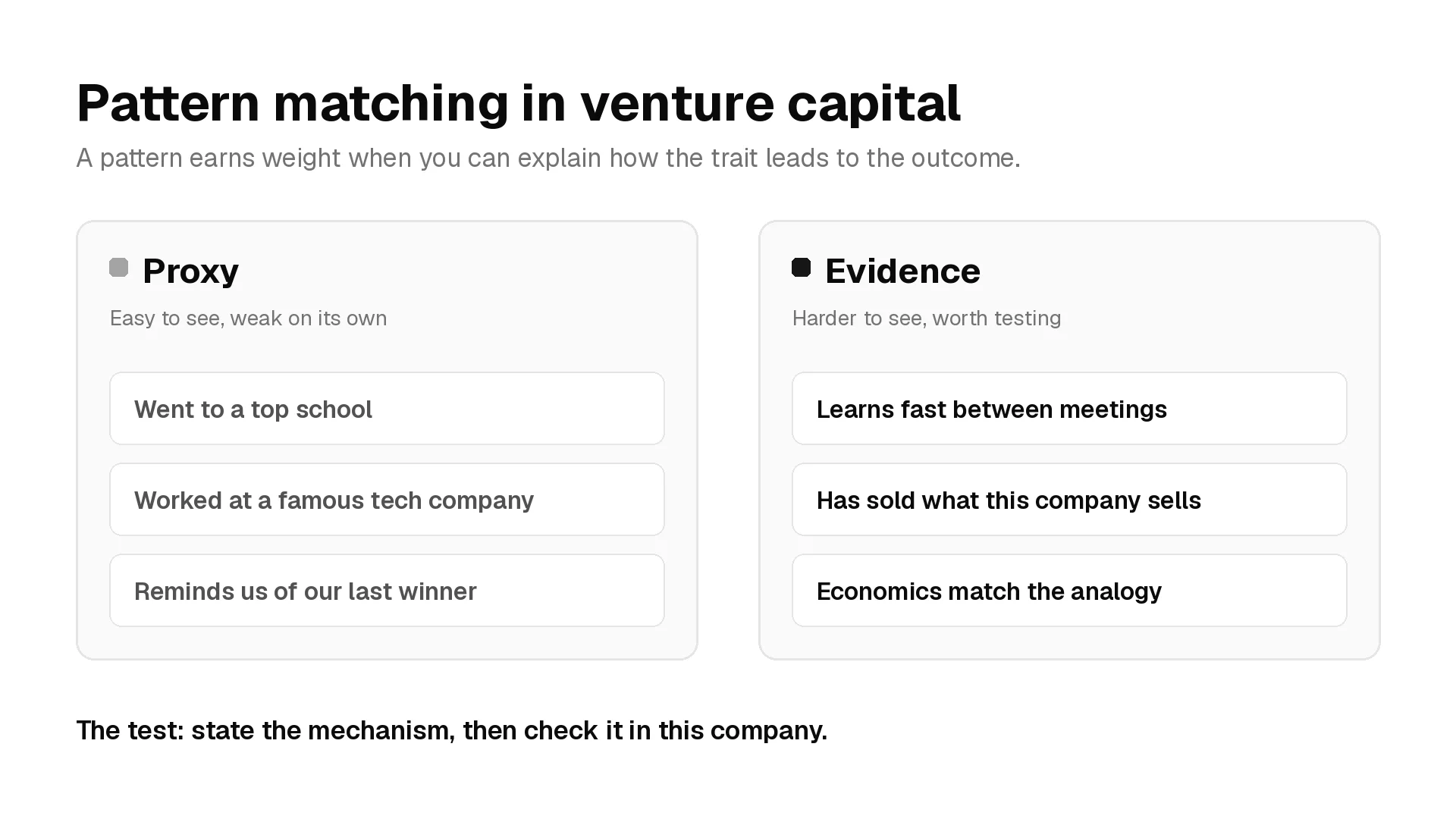
Pattern matching in venture capital is the habit of judging a new founder or company by how closely it resembles past investments that worked or failed. Every VC does it, because every firm sees far more companies than it can study. In a survey of 885 institutional VCs, the average firm screened 200 companies to make four investments in a year. A pattern earns its place when you can explain how the trait leads to the outcome, such as a founder who has already sold this product to this buyer. It becomes bias when it is a stand-in for evidence, such as a school, a former employer or a founder who reminds a partner of the last winner. If you screen deals at a VC firm, telling those two apart is part of your job.
What pattern matching means in venture capital
Pattern matching is reasoning by analogy. An investor meets a company, recalls companies that looked similar, and lets what happened to them shape the call on this one. The analogy can be about the business or about the people.
Company patterns cover the market, the business model, the sales motion, the pricing and the shape of early traction. "Usage-based pricing sold bottom-up to developers" is a company pattern. So is "marketplaces where supply is harder to get than demand."
Founder patterns cover background, behavior and fit with the problem. "Has run this function at a company three times larger" is a founder pattern. So is "went to the same school as our best founder," which is where the trouble starts.
Two words get used for the same mental process. People say pattern recognition when they mean it as praise and pattern matching when they mean it as criticism. Treat them as one skill with a good and a bad version.
Reliance on patterns rises as data falls. A seed investor may have a founder, a deck and a few customer calls. A growth investor has years of revenue, cohorts and margins. In the same survey, the team was more likely to be the single most important factor for early-stage investors than for late-stage ones. Early-stage judgments lean hardest on founder patterns, and founder patterns are the easiest to get wrong.
Why VCs rely on pattern matching
The first reason is volume. At 200 companies screened for four investments, most companies get a few minutes of attention before a pass. Nobody builds a model for each one. The screen runs on fast comparisons with things the investor has seen before.
The second reason is thin data at the stages where most VC jobs sit. With no revenue history, a team's past behavior is often the best evidence available. In the Gompers, Gornall, Kaplan and Strebulaev survey, 95% of VC firms named the management team as an important factor and 47% named it the most important. Business factors such as model, product and market were the most important for 37%. When half the industry ranks the team first, founder patterns carry a lot of weight.
The third reason is financing risk. A seed investor needs the company to raise again, and the next investors pattern match too. A company that fits what Series A investors are looking for is easier to fund, so early investors sometimes back the familiar on purpose. That is rational for the fund and a real cost for founders who do not fit.
The fourth reason is that experience compounds. A partner who has watched a dozen companies try the same enterprise sales motion knows where it usually breaks. That is pattern recognition at its best, and it is the reason firms value people who have seen many outcomes.
So the useful question is which patterns you let make the decision.
Useful patterns and lazy proxies
Use one rule. A pattern deserves weight when you can state the mechanism that links the trait to the outcome and then check it in this company. If the only support is "the last one like this worked," you are holding a proxy.
| What you notice | Proxy version | What it can tell you | Better test |
|---|---|---|---|
| Founder worked at a well-known tech company | "Ex-big tech, so strong" | Little on its own | What did they ship or sell there, and does it match this company's hardest problem? |
| Founder went to a top school | "Elite school, so smart" | Network access more than execution | How fast they learn between your first and second meeting |
| Repeat founder | "Second time, so safer" | Fundraising skill, some operating skill | What the last company taught them and what they are doing differently |
| Business looks like a famous winner | "X for Y" | Only as much as the economics match | Compare frequency, margins and acquisition cost directly with the analogy |
| Sector is hot | "Everyone is funding this" | Price and competition, not quality | Why this team wins if ten funded rivals already exist |
| Customers pull the product without much selling | Real pattern | Demand | Retention by cohort, not sign-ups |
| Founder knows the buyer cold | Real pattern | Speed to the right product | Can they name the buyer, the budget line and the switching cost? |
The top rows are where bias enters. The bottom rows are patterns worth keeping, as long as you test them in the company in front of you rather than assume them.
Where pattern matching goes wrong
Pedigree standing in for evidence
A school or an employer brand is easy to see in a two-minute screen and hard to argue with in a partner meeting. It is also a weak predictor once you control for what the person actually did. The fix is to write down the specific thing the pedigree is supposed to signal, then look for that thing directly.
Affinity
People like backing people who resemble them. Research on venture syndicates puts a price on it. In The Cost of Friendship, Paul Gompers, Vladimir Mukharlyamov and Yuhai Xuan studied 3,510 venture capitalists and 11,895 portfolio companies from 1975 to 2003. Co-investors who had worked at the same company had an 18% lower probability of investment success. Those from the same undergraduate school had a 22% lower rate, and those from the same ethnic minority group a 25% lower one. Similarity based on ability, such as both holding degrees from top universities, improved results. The data is old, so treat the sizes as historical. The direction is the point. Comfort and judgment are different things.
Recency
The most recent win or loss weighs the most. A fund that just lost money on a hardware company may pass on the next three hardware pitches without looking closely. A fund that just marked up a vertical software company may chase every lookalike. Note the date and outcome of the analogy you are using. If it is one company from last quarter, it is an anecdote.
Herding
Another respected investor in the round feels like evidence. Often it is a reason to skip your own work. Consensus deals also cost more, because everyone sees the same pattern at the same time. The power law in venture capital explains why being right and alone pays far more than being right with the crowd.
Old patterns in a new market
A pattern built in one market can fail in the next. Capital needs, sales cycles and exit routes differ between consumer apps, enterprise software, hardware and biotech. A rule learned from capital-light software, such as "never back a company that needs a large raise before revenue," screens out hardware, biotech and climate companies by default, whatever their prospects. Before applying a pattern, ask whether the conditions that made it true still hold.
Screening out the outlier
Venture returns come from a few companies that often look odd early. A strict pattern filter is good at removing companies that look unusual, and that is where some of the biggest outcomes sit. Passing on a company that later returns the fund costs more than backing one that fails, so a screen built only to avoid mistakes can fail the fund.
What the research shows about bias
Bias also enters through the questions asked in the meeting, after a founder has already got in the door. Dana Kanze, Laura Huang, Mark Conley and Tory Higgins studied question-and-answer sessions at TechCrunch Disrupt New York City from 2010 to 2016, covering 189 startups. According to the Harvard Kennedy School summary of the study, investors tended to ask men promotion questions, such as how they would acquire customers or what the revenue forecast looked like. They tended to ask women prevention questions, such as what retention looked like or whether the company was at breakeven. Male and female investors both did this. Founders raised $3.8 million less for every prevention question they were asked.
Founders tended to answer in the frame of the question. A prevention question drew a defensive answer, and the defensive answer read as a weaker company. In follow-up experiments, founders who answered prevention questions with growth-focused answers drew more funding.
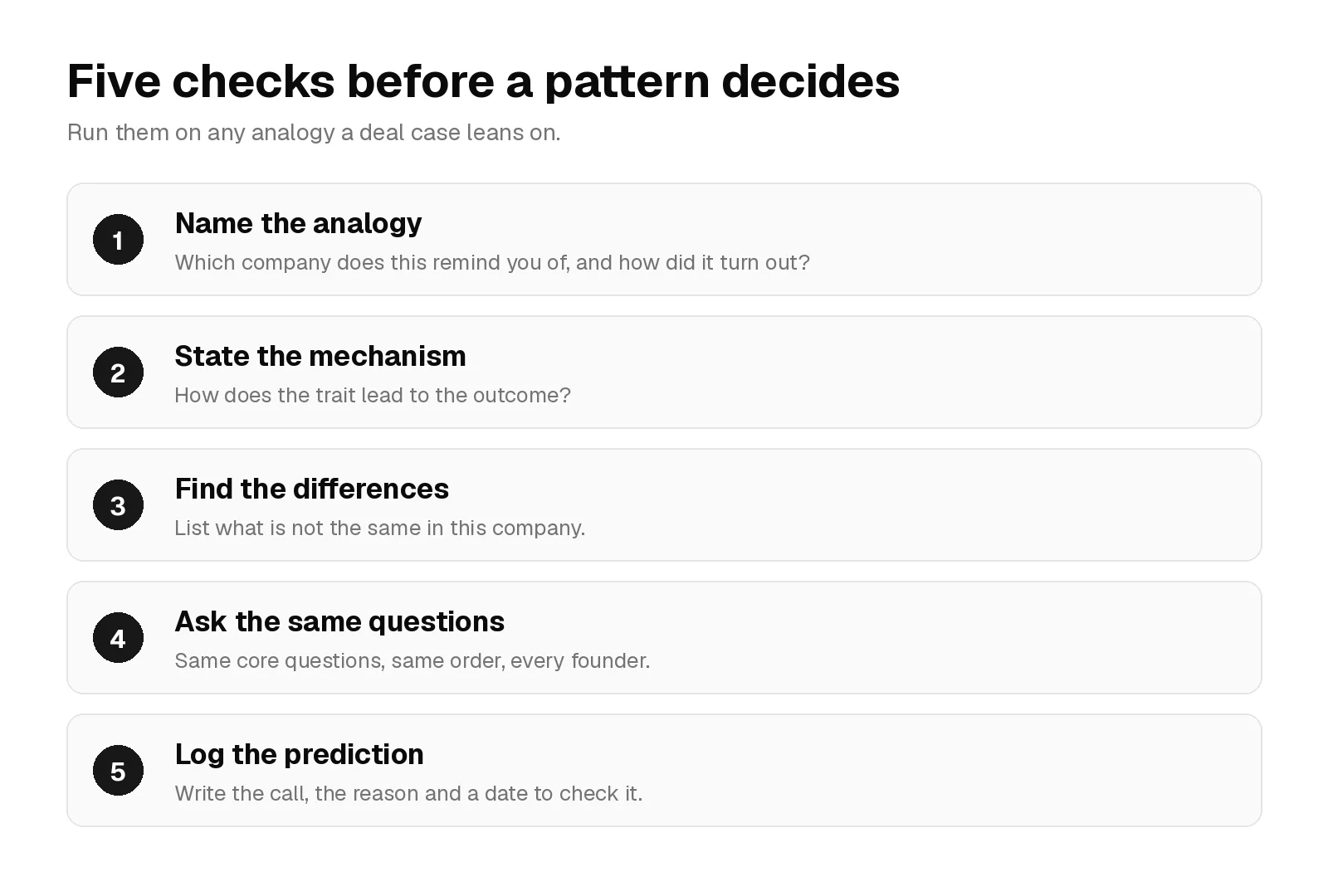
The lesson for the person asking is concrete. The question you choose shapes the answer you hear and the judgment you form. Ask every founder the same core questions in the same order, and you remove one channel for bias without slowing the meeting down.
How VC firms keep pattern matching honest
Firms that take this seriously build a few habits into the process. None requires a new tool.
- A fixed first-meeting question set. Same questions, same order, for every founder at the same stage. It also makes notes comparable across meetings.
- A scorecard written before the meeting. Score the criteria the fund's thesis says matter. A score you have to defend in writing is harder to bend toward a founder you simply liked.
- Pattern claims written out in the memo. List each analogy the case relies on, the evidence for the mechanism and the ways this company differs. Partners can then attack the analogy instead of the conclusion. The venture capital investment memo is where this belongs.
- A pre-mortem before the vote. Ask the team to assume the investment failed in three years and write down why. It surfaces the risks a flattering pattern hides from the investment committee.
- A false-negative review. Once a quarter, look at companies the firm passed on that raised strong next rounds. Record which pattern drove each pass. Reviewing wins is routine. The passes are where screening errors show up.
- A wider sourcing mix. The patterns you hold come from the companies you see. In the Gompers survey, over 30% of deals came through professional networks, 20% from other investors, 8% from portfolio companies, almost 30% were self-generated and only 10% arrived cold from founders. A network-heavy pipeline produces a network-shaped idea of what good looks like. Deal sourcing outside the usual channels is the most direct fix.
Pattern matching in a junior investor's job
Analysts and associates do much of the early screening, so pattern matching shows up in their work first.
| Part of the job | Where pattern matching shows up | What good looks like |
|---|---|---|
| Sourcing | Which companies you reach at all | Track where each lead came from and add channels you are missing |
| First screen | Two-minute passes on decks | Write a one-line reason for each pass and tag it as evidence or analogy |
| First meeting | Which questions you ask and how | Use the firm's question set and take notes in the same structure |
| Due diligence | Looking for proof of what you already believe | Find the customer or reference most likely to disagree |
| Memo | Comparables and analogies | Name the analogy, then list how this company differs |
| Partner meeting | A senior partner's analogy | Bring the data that tests it, politely and early |
| Portfolio work | "This looks like the one that died" | Check whether the cause of that failure is present here |
Junior investors are often the only people in the room with time to do the testing. A partner says "this reminds me of a company we lost money on." The analyst who comes back with three differences, and a reason they matter, is doing the job well.
How to build pattern recognition faster
Pattern recognition comes from seeing outcomes, and venture outcomes take years. Partners built theirs over a decade or more. You can shorten the loop.
- Keep a decision journal. For each company you screen seriously, write the date, your call, the one-sentence reason and a testable prediction. "Raises a Series A within 18 months" works. Review it every six months and score how often your reasons held up, not just your calls.
- Track your passes. Follow companies you passed on. When one raises a strong round, write down which pattern made you pass and whether it was a proxy.
- Read primary records. An S-1 registration statement shows several years of a company's financial history before it went public. Compare the earliest numbers for companies in your sector with what you see in decks today.
- Run a fantasy portfolio. A venture capital fantasy portfolio forces you to commit to calls in public and live with them.
- Ask for the mechanism. When a partner says "I've seen this before," ask what happened and why. You get the pattern and the reasoning behind it, which is the part worth keeping.
Firms hiring for analyst and associate seats look for this kind of judgment. The venture capital skills that matter most at junior levels include knowing why you believe what you believe.
How to answer pattern matching questions in a VC interview
Expect some version of these:
- "What patterns do you look for in founders?"
- "How would you avoid bias when sourcing?"
- "Tell me about a company you would have passed on that turned out well."
A strong answer has three parts. Name a pattern you use. Explain the mechanism behind it. Then say how you test it and where it fails.
A sample answer: "I give weight to founders who have already sold to the buyer they're targeting, because enterprise sales cycles are long and knowing the budget owner cuts months off the first deals. I test it by asking them to walk me through their last three customer conversations. Where I'm careful is with pedigree. A big-company background tells me someone has worked inside a large organization. It doesn't tell me they can sell from a blank page, so I look for evidence of that directly."
Avoid two answers. "I don't pattern match" is not credible, because everyone does. A list of schools and employers is the version interviewers are screening out. For more practice, work through common venture capital interview questions with the same structure.
Frequently asked questions
Is pattern matching bad in venture capital?
No. It is necessary at the volume VCs see. It goes wrong when a proxy such as a school or a resemblance to a past founder replaces evidence about the company. The test is whether you can explain how the trait leads to the outcome.
What is the difference between pattern matching and pattern recognition?
They describe the same process. Pattern recognition is the term people use approvingly, for experience that spots real signals. Pattern matching is usually used critically, for decisions driven by surface resemblance.
Why do seed investors rely on pattern matching more than growth investors?
They have less data. With little revenue history, the team's past behavior and the shape of the business are much of what is available, so analogies carry more weight.
How can an analyst reduce bias in their own screening?
Use the same question set for every founder, write down the reason for each pass, separate evidence from analogy, and review your passes as carefully as your wins. A decision journal makes all four easier.
Does pattern matching only affect founders?
No. It shapes who gets hired into VC firms as well. A team drawn from the same few schools and employers shares the same networks, and networks drive most sourcing. Candidates without the usual background can help by showing their judgment directly, through written work and a record of calls.
Next steps
If you want to put this to work at a firm, browse open analyst and associate roles on the Venture Capital Careers job board, and use the companies directory to research firms by stage and focus before you apply. To get new roles by email, create an account. For how the full process runs from first meeting to IC vote, read how venture capitalists make investment decisions.
Related posts
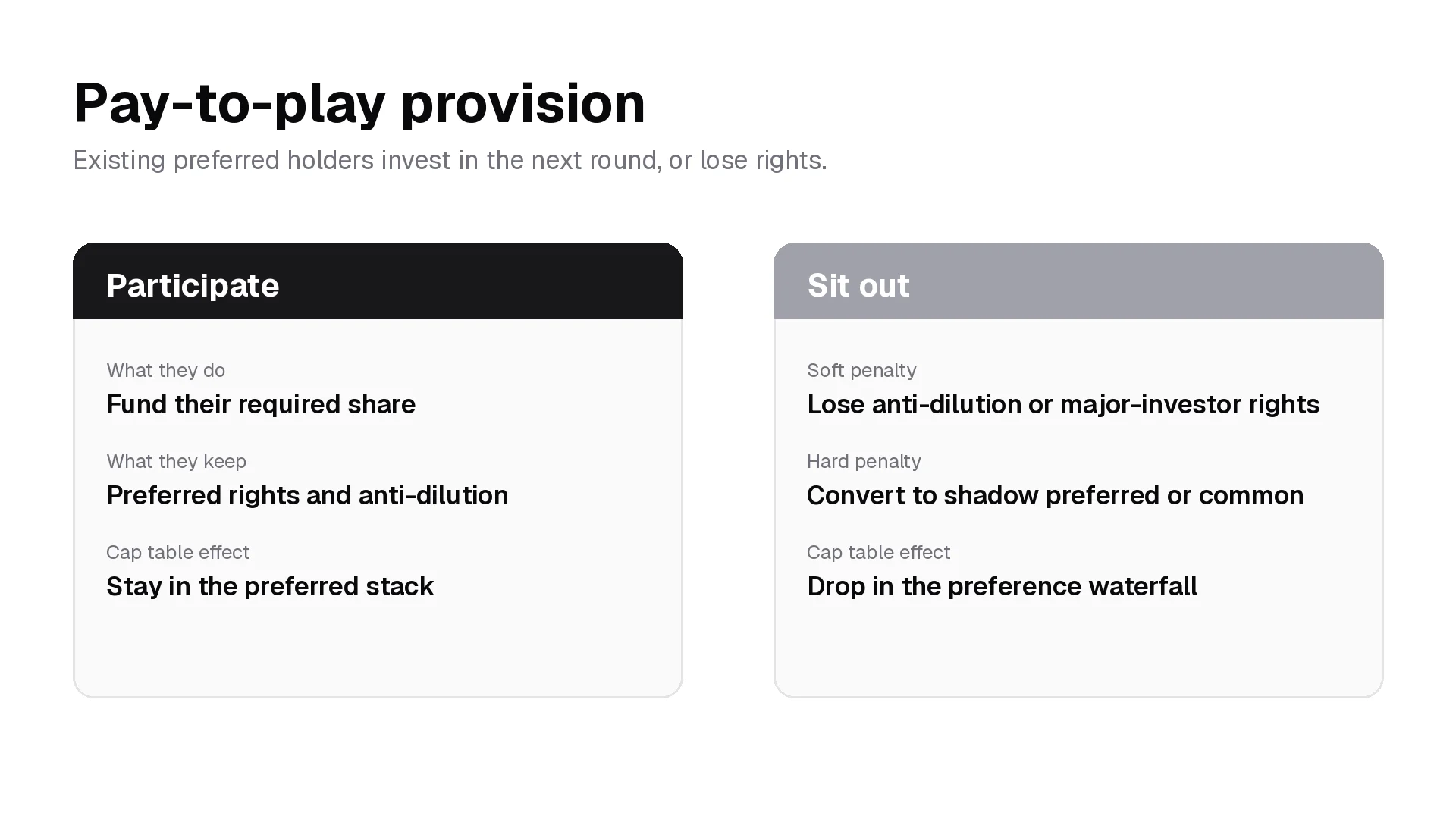
A pay-to-play provision requires existing startup investors to join a future financing, usually pro rata, or lose protections such as anti-dilution rights or preferred-stock status.
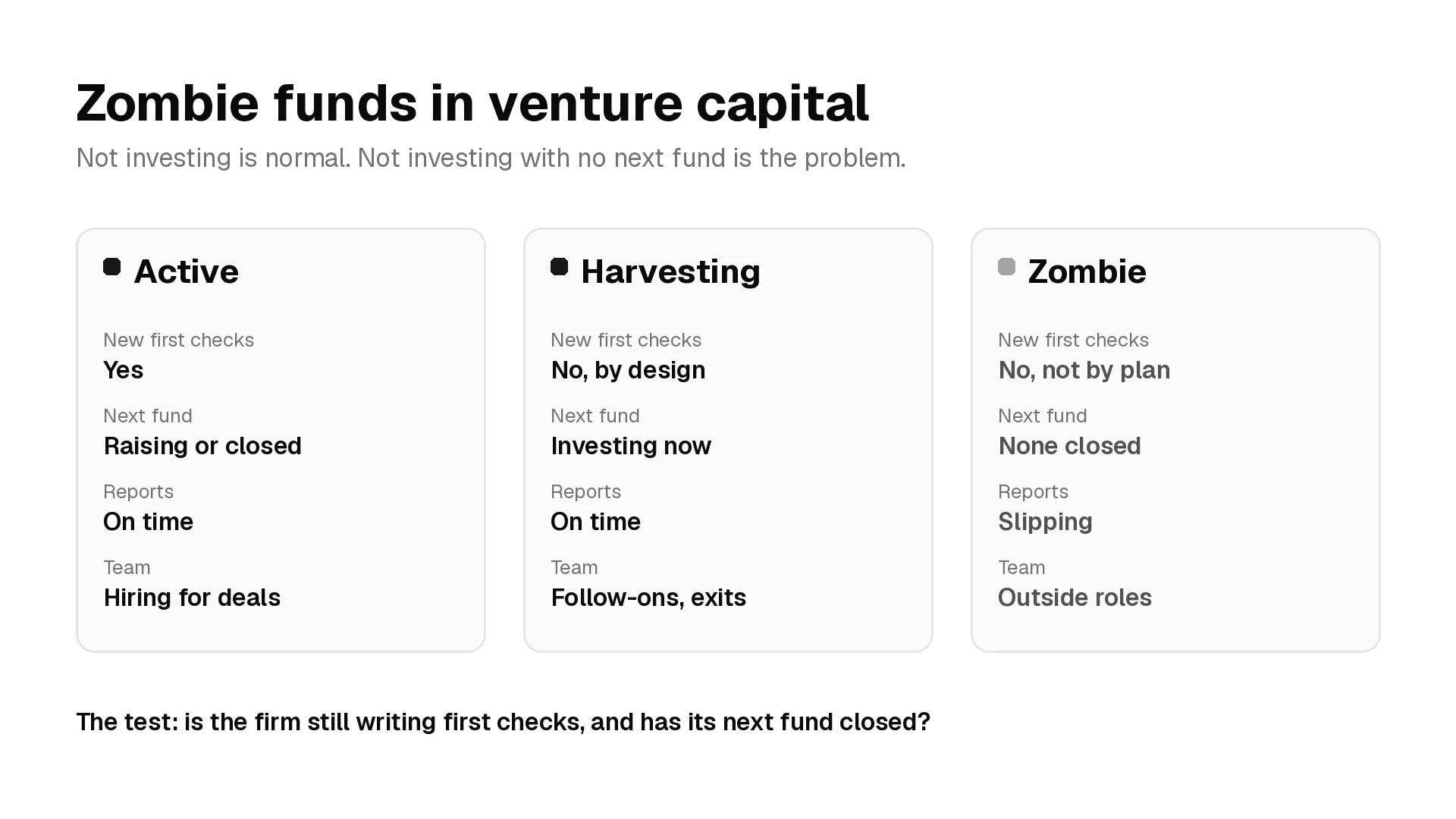
A zombie fund still exists but has stopped investing with no successor fund behind it. How to tell one from a fund in normal harvest, the records to check before you accept an offer, and what it means for salary, carry and your next role.
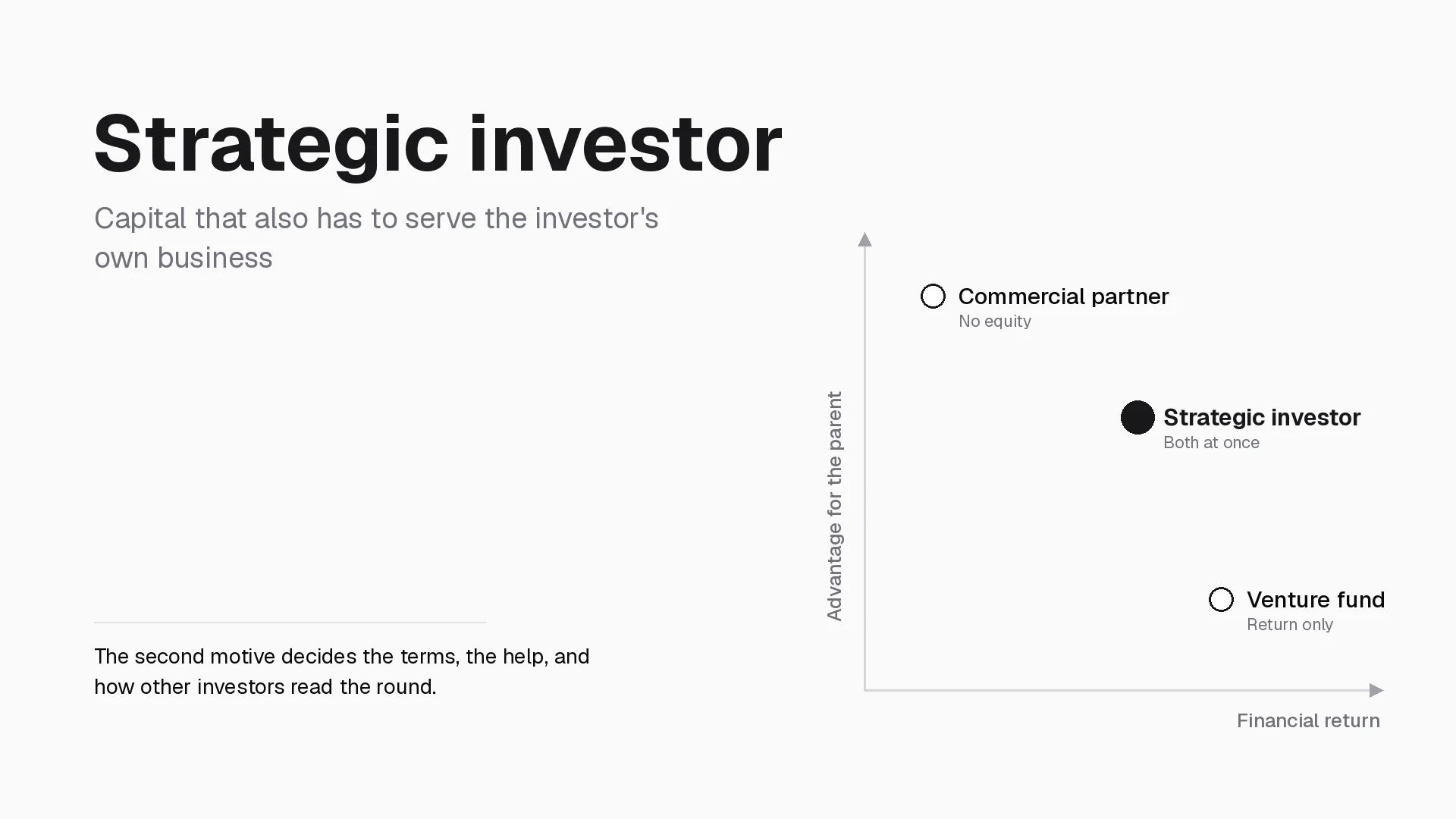
A strategic investor backs a startup for financial return and for an advantage tied to its own business. Types, deal structures, the terms to narrow, 2026 corporate venture data, and how VC leads read a corporate on the cap table.