
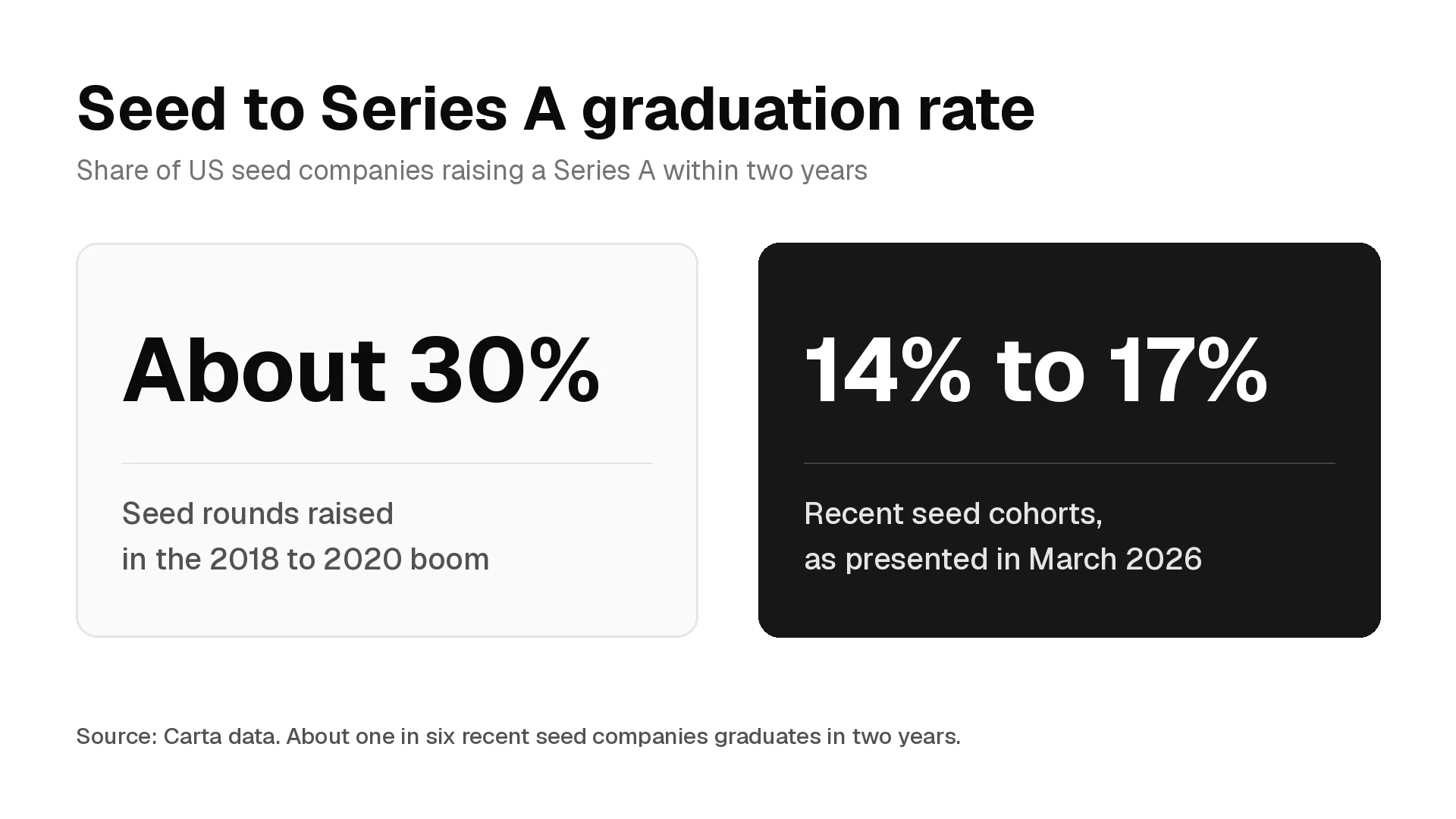
About one in six US seed-funded startups now raises a Series A within two years of its seed round. Carta's cap-table data shows 14% to 17% of recent seed companies reaching Series A at the 24-month mark, against roughly 30% in the 2018 to 2020 boom, and no quarterly cohort since Q3 2021 has hit 30% at two years. Measured over a longer window and counting exits, Crunchbase found that 36% of the 2021 seed class and 20% of the 2022 class had moved beyond seed, compared with 51% to 61% for earlier classes.
For a seed fund, that rate decides how many companies will need follow-on money, how long capital stays tied up and how many chances the fund has at a winner. For a Series A fund, it sets how many seed companies will be ready to pitch. For anyone working at a VC firm, it is a figure partners expect you to know and to read correctly.
What the seed to Series A graduation rate measures
The seed to Series A graduation rate is the share of companies that raised a seed round in a given period and later raised a Series A. Three choices change the answer, so every published figure needs them stated:
- The cohort. Which companies count as seed-funded: all priced and unpriced seed rounds, or only first seed rounds above a size floor. Crunchbase, for example, groups US companies by the year of their first seed round of $1 million or more.
- The window. Graduation within 12 months, 24 months or "so far". A two-year rate and a lifetime rate for the same cohort can differ widely, because many companies graduate in year three.
- What counts as graduating. A priced Series A only, or any later round or exit. Crunchbase's "beyond seed" measure counts a Series A or later round, or an exit; Carta's cohort tables count companies that raised a Series A.
The rate is a seed-stage outcome, but investors use it more than founders do. It drives reserves, fund timelines and the supply of companies that reach Series A.
Seed to Series A graduation rates by cohort
The two largest public data sets measure different things, so they are shown separately below. Each figure is as published by the source.
| Source and definition | Cohort | Result |
|---|---|---|
| Carta, Series A within 2 years of seed | Q2 2018 seed rounds | 27.4% (9.9% in year 1, 17.5% in year 2) |
| Carta, Series A within 2 years of seed | Q4 2019 seed rounds | 32.6% |
| Carta, Series A within 3 years of seed | Q1 2021 seed rounds | 38% |
| Carta, Series A within 2 years of seed | Every quarterly cohort since Q3 2021 | below 30% |
| Carta, Series A within 2 years of seed | Recent cohorts, as presented in March 2026 | 14% to 17% |
| Carta, Series A within 1 year of seed | Q1 2024 seed rounds | 8.2% |
| Crunchbase, beyond seed (Series A or later, or exit), measured to early 2025 | Earlier US classes of first $1M+ seed rounds | 51% to 61% |
| Crunchbase, same definition | 2021 class | 36% |
| Crunchbase, same definition | 2022 class | 20% |
Carta's figures come from its 12,249-round cohort analysis of seed rounds raised from Q1 2018 to Q3 2025, its time-to-graduation breakdown, its cohort chart by sector and location and Peter Walker's March 2026 presentation of the same data. Crunchbase's come from its cohort analysis of US seed companies, which treats the 2023 and 2024 classes as too recent to score.
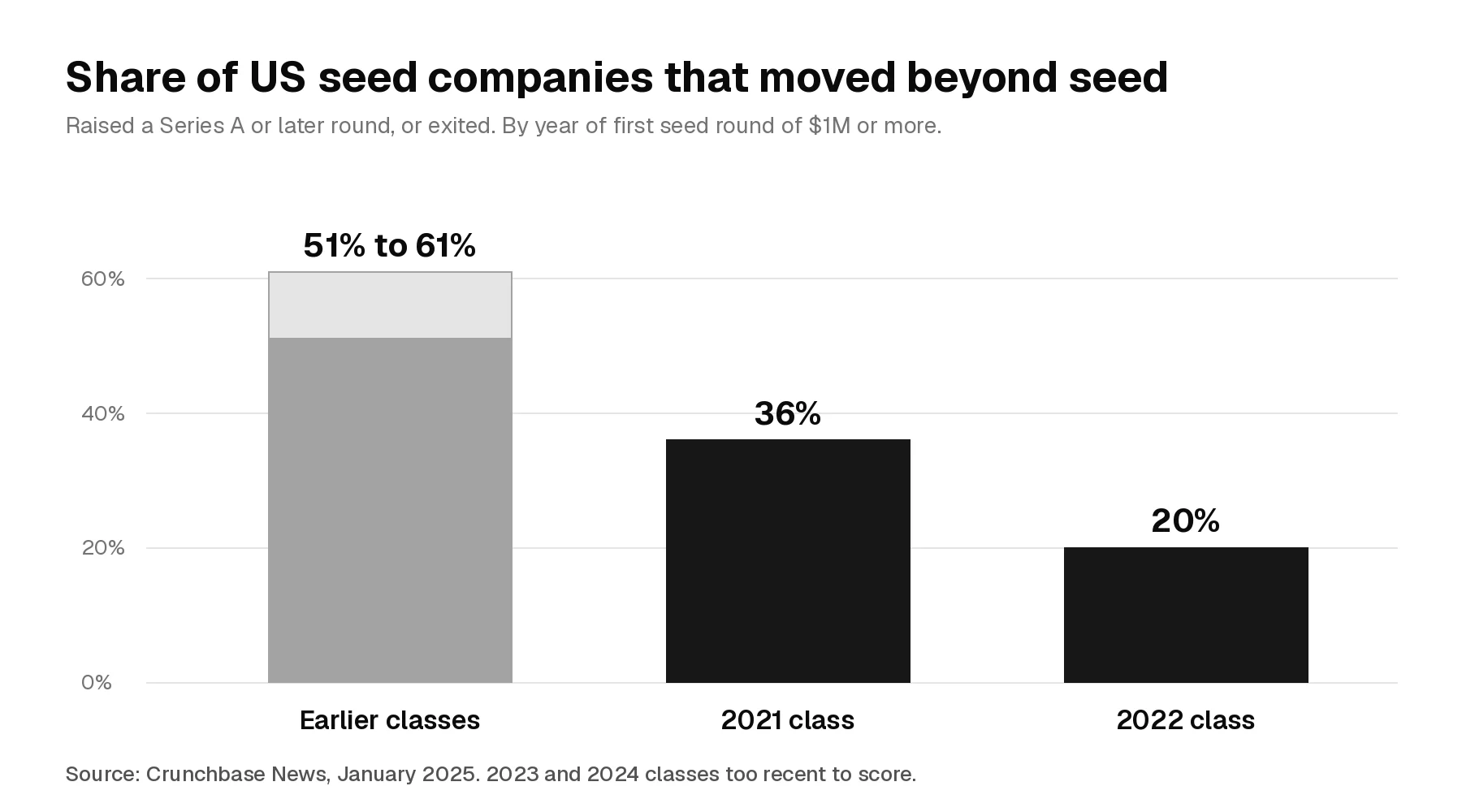
Two patterns hold across both data sets. Graduation fell for every cohort that raised seed during or after 2021, and the fall shows up across industries and US locations rather than in one sector. Carta's May 2025 cohort chart found the share reaching Series A within two years had fallen every year since the start of 2021, regardless of industry or location.
How long the jump from seed to Series A takes
Most companies that graduate do it in the second year after their seed round. In Carta's Q2 2018 cohort, 9.9% raised a Series A in the first 12 months and 17.5% in the following 12. Year three still matters: about 14% to 15% of 2019 seed companies raised their Series A in year three. After that the odds fall away, with only about 5% of eventual graduates making the jump in year four.
The boom compressed that timeline. Around 2020, about 18% of Carta's seed companies raised a Series A within a year. By the Q1 2024 cohort, that first-year share was 8.2%. Carta's Peter Walker reported in March 2026 that the median time from seed to Series A fell to about 1.9 years in the second half of 2025, after several years of increases.
Timing matters to investors for two reasons. A company still at seed in year four is far less likely to graduate at all, so a portfolio full of older seed companies has a lower expected graduation count than its headline rate suggests. And every extra quarter at seed is a quarter in which the company may ask its existing investors for a bridge round.
Why graduation rates fell after 2021
The causes show up in the data and in what Series A investors now ask for.
- More seed companies than Series A slots. The 2021 and 2022 seed classes were large, and Carta noted that the glut of seed companies waiting to graduate may itself make Series A investors choosier.
- A higher bar. The traction needed for a Series A moved up while many 2021 and 2022 companies were still building toward the old bar. A seed investor quoted by Crunchbase put the new requirement as "meaningful traction, early signs of product-market fit and good growth".
- Longer seed stages. Crunchbase found that since 2023 companies have been staying longer at seed and raising more seed rounds. Companies that cut growth to reach breakeven can find it harder to show Series A traction later.
- Bridges instead of new rounds. Carta's 2025 cohort analysis found bridge rounds happening at higher rates, which keeps companies alive at seed without moving them to Series A.
The same seed investor described the market as "going back to where it's two-plus years to get to an A". Walker's March 2026 presentation pointed the same way: graduation rates appear to be ticking back up slightly, but not to boom levels.
Why the published rates disagree
Published graduation rates for the same period range from below 10% to above 50%. Most of the gap comes from method, not from one source being wrong.
| Method choice | Effect on the rate |
|---|---|
| Shorter window (12 or 24 months) | Lower. Many companies graduate in year three. |
| Lifetime or "so far" window | Higher, and keeps rising as a cohort ages. |
| Counting exits and later rounds as graduation | Higher. Crunchbase's "beyond seed" measure does this. |
| Only first seed rounds above $1M | Changes the mix toward larger, better-funded seeds. |
| Only companies on one cap-table platform | Reflects that platform's customer base. |
| Young cohorts | Understated until the cohort has had three or more years. |
| Round labels taken from announcements | A seed extension named a Series A, or the reverse, moves the count. |
When you quote a rate, give the source, the cohort, the window and what counted. "Carta shows 32.6% of Q4 2019 seed rounds reached Series A within two years" can be checked. "Only 15% of startups make it" cannot.
Survivorship cuts the other way too. A median time-to-Series-A figure only includes companies that raised one, so it says nothing about the companies still waiting. Read the time and the rate together.
How VC firms use the graduation rate
Inside a fund, the graduation rate is a planning input more than a market statistic. Different seats use it for different decisions.
Seed funds: reserves and portfolio size
A seed fund reserves part of its capital to follow on in its best companies, usually at the Series A. The graduation rate tells the fund how many companies will need that money. Take a hypothetical $50 million seed fund with $45 million to invest after fees. It writes 30 initial checks of $1 million and holds $15 million in reserve.
| 30% graduate | 15% graduate | |
|---|---|---|
| Companies raising a Series A | 9 | 4 or 5 |
| Reserve available per graduate | about $1.7M | about $3M to $3.75M |
| Companies left at seed | 21 | 25 or 26 |
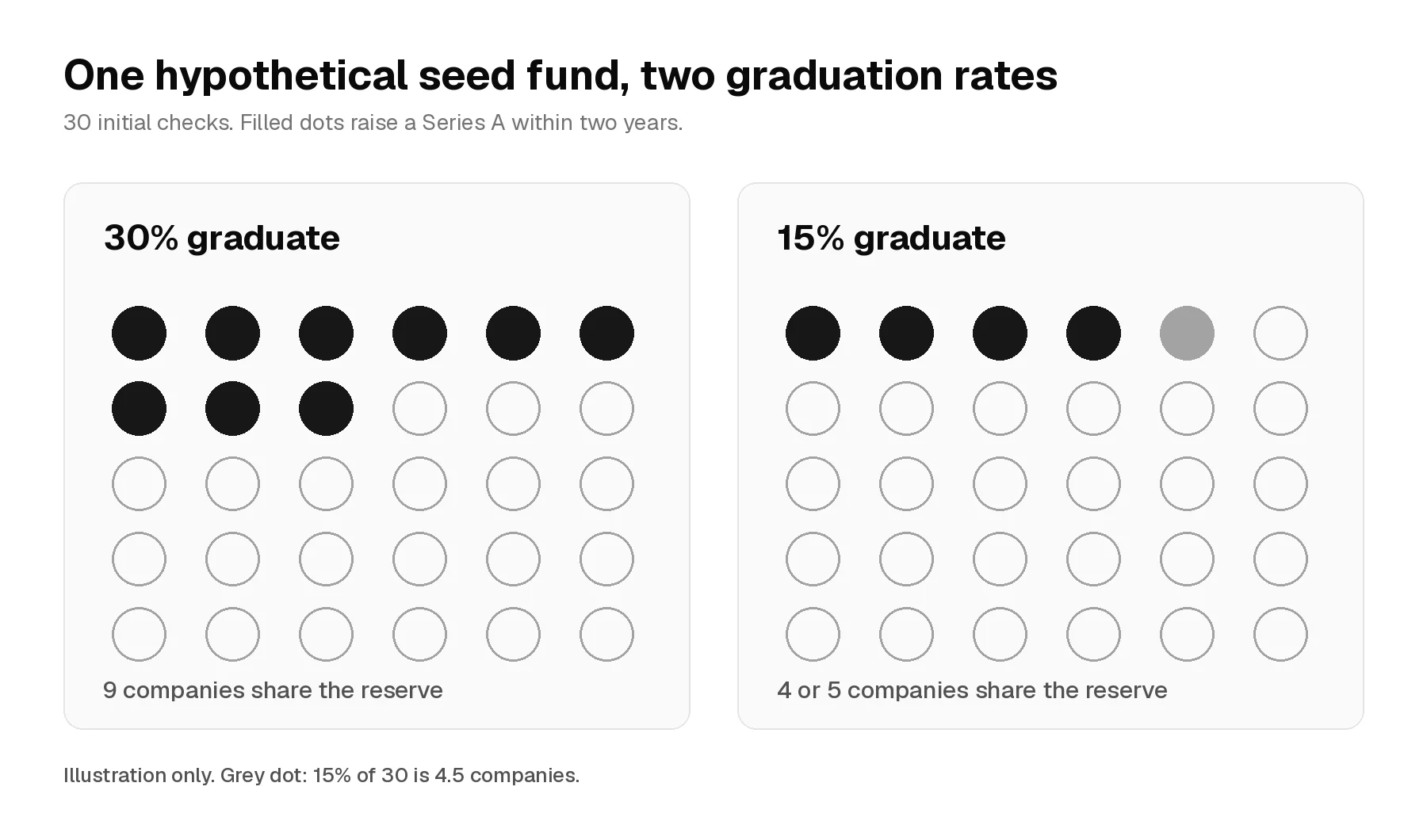
At the lower rate, the fund either concentrates its reserves in fewer graduates or spends them on bridge rounds for companies stuck at seed. That choice is the core of reserve strategy and follow-on decisions. It also changes the odds of the fund producing an outlier. Returns in venture follow a power law, and a company that never raises a Series A rarely becomes the one that returns the fund. One response is to write more initial checks so the expected number of graduates stays up.
Fund models and LP reporting
Fund models use a graduation assumption to project follow-on deployment, the timing of marks and the date of the next fundraise. If a fund raised on a 30% assumption and its portfolio is tracking at 15%, its marks will lag and its next fund may be harder to raise. Crunchbase reported in early 2025 that small and mid-sized funds were already finding it harder to raise follow-on funds.
Limited partners ask about it directly. Expect questions such as: what share of the portfolio has raised a Series A, how that compares with the market cohort, how many companies have taken a bridge, and how much of the reserve has gone to companies that later raised a Series A versus companies that did not. The same numbers sit behind a fund's performance metrics in its early years, before exits.
Series A funds: pipeline supply
For a Series A fund, a lower graduation rate means fewer seed companies are ready, but the ones that qualify are often stronger. Associates at Series A firms often track which seed funds' portfolios are producing graduates and use that as a sourcing signal. A seed fund with a high graduation rate is a referral source worth knowing.
What happens to seed companies that don't graduate
A company that has not raised a Series A has not necessarily failed. Crunchbase found that most of the non-graduating seed companies in the 2021 and 2022 classes were either still in the seed pool or had shut down. The paths in between are:
- Bridge or seed extension. Existing investors put in more money to buy time, often on a SAFE or convertible note. Carta's data shows bridges rising since 2021.
- Further seed rounds. Crunchbase found more companies raising multiple seed rounds since 2023.
- Profitability. Some companies aim for breakeven and stop raising. They count as non-graduates even when they are healthy.
- Acquisition. Small sales and acquihires return some capital. Crunchbase's "beyond seed" figure counts exits; Carta's Series A rate does not.
- Shutdown. The company winds down and investors write off the position.
For investors there is an upside to faster answers. An Uncork Capital managing partner told Crunchbase that firms want to "push your money into your winners" and that it helps to learn sooner when something is not working.
Graduation rates in VC jobs and interviews
In a portfolio review. Analysts and associates at seed funds often prepare the data behind a portfolio review: which companies raised a Series A, which took a bridge, how long each has been at seed and how much reserve each has used. Show the portfolio's rate next to a market cohort with the same window, so the partners compare like with like.
In an interview. Questions like "How do you think about the seed market right now?" or "How would you size reserves for a seed fund?" invite a graduation-rate answer. A strong answer names the source and window, gives the number, and says what it changes: "Carta shows 14% to 17% of recent seed companies at Series A after two years, roughly half the 2018 to 2020 rate. For a seed fund that means fewer companies to reserve for, more bridge requests and longer time to marks." More practice questions are in our VC interview questions guide, and the same reasoning works in a case study interview.
Before you join a seed fund. A fund's graduation record says a lot about its next five years, including whether it can raise its next fund and pay carry. Fair questions in a final round or at the offer stage:
- What share of the last fund's companies have raised a Series A, and over what period?
- How much of the reserve is left, and how much has gone to bridges?
- When does the firm expect to raise its next fund?
You can research seed and Series A firms, their focus and their open roles in the VC firm directory.
Seed to Series A graduation rate FAQ
What percentage of seed startups raise a Series A?
For recent US cohorts, about 14% to 17% reach a Series A within two years of their seed round, based on Carta data. Over a longer window more will graduate. Crunchbase found 36% of the 2021 seed class and 20% of the 2022 class had moved beyond seed by early 2025, counting later rounds and exits.
What is a good seed to Series A graduation rate for a seed fund?
Compare a fund's rate with a market cohort that raised seed at the same time and is measured over the same window. Carta cohorts from 2018 and 2019 reached about 27% to 33% at two years; recent cohorts are about half that. A fund well above its cohort is selecting or supporting companies better than the market.
How long does it take to go from seed to Series A?
Most graduates raise their Series A in the second year after seed. Carta reported a median of about 1.9 years in the second half of 2025.
Why do different sources give different graduation rates?
They use different cohorts, windows and definitions. A two-year Series A rate from cap-table data will be lower than a lifetime "beyond seed" rate that counts exits.
Does a company that misses Series A count as a failure?
Not always. It may still be raising seed rounds, may be profitable, or may have been acquired. Many do shut down, but a graduation rate alone does not tell you how many.
Find seed and Series A roles
If you want to work on these decisions, start with firms whose stage matches. Browse the VC firm directory to research seed and Series A investors, see open venture capital jobs, and create a free account to get new roles by email.
Related posts
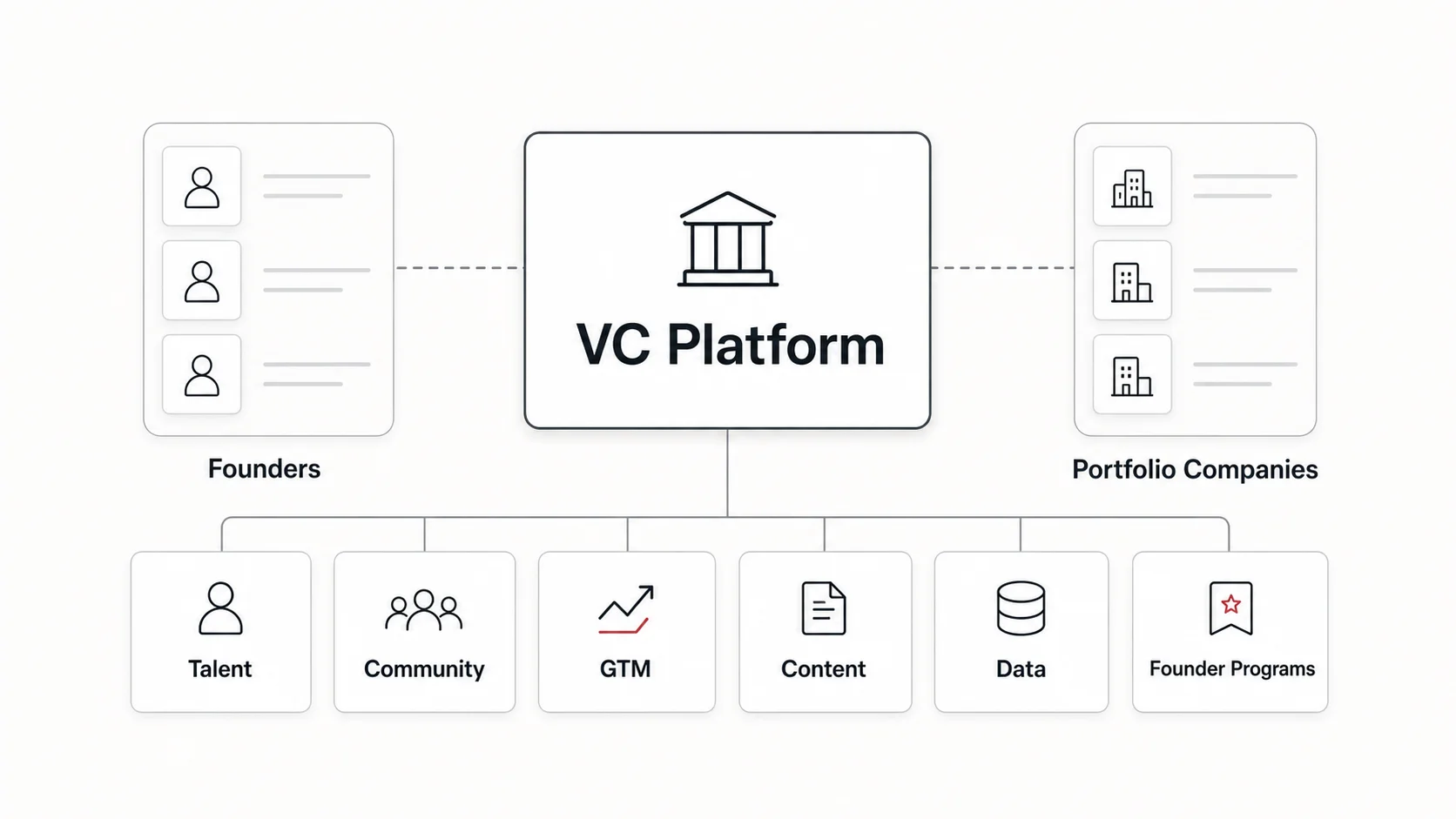
A venture capital platform role runs a VC firm's non-investing services for founders: talent, business development, community, marketing, and investment operations. Median platform pay is $165,000 base and $207,500 total cash.
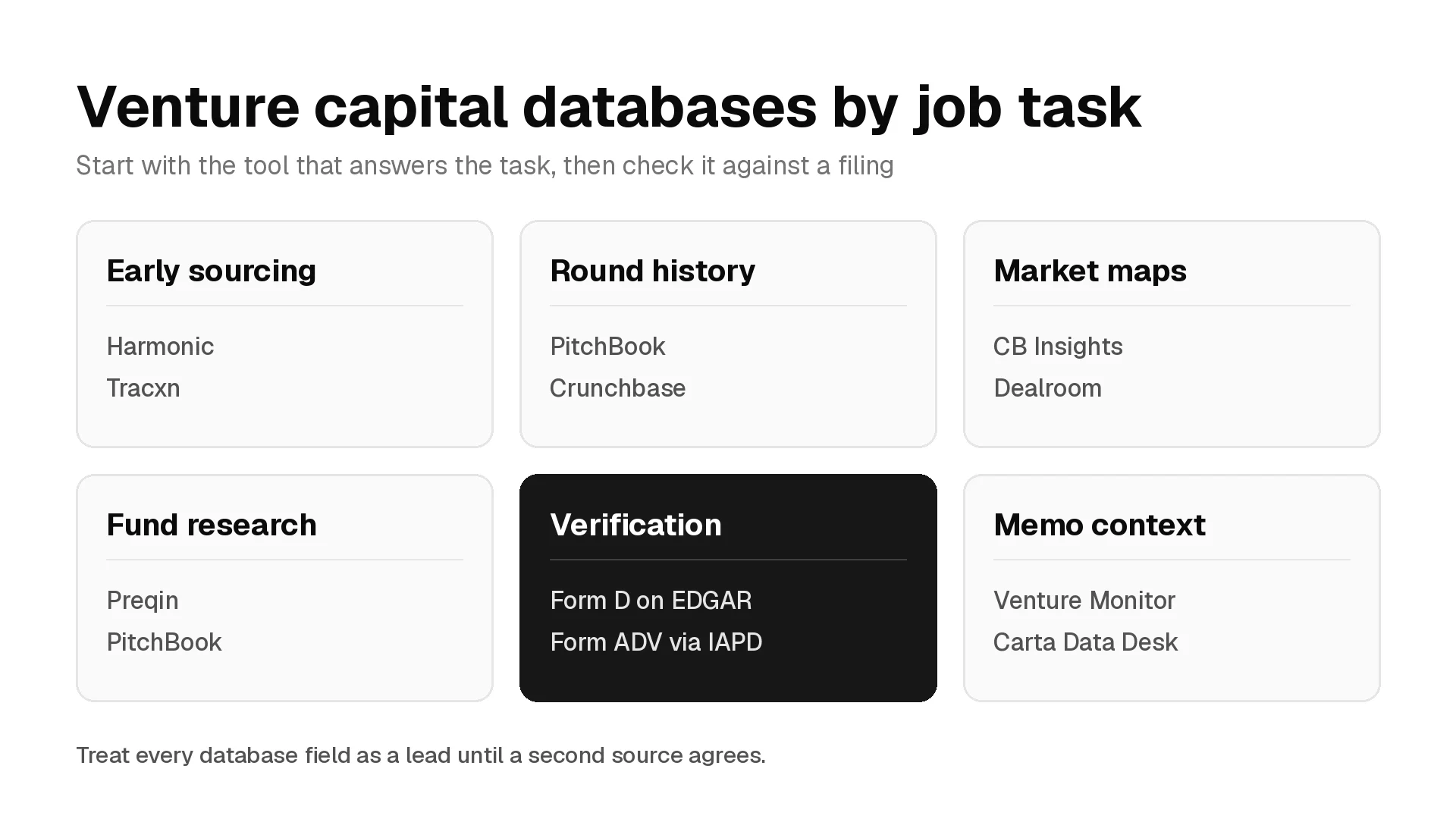
PitchBook, Crunchbase, CB Insights, Dealroom, Tracxn, Harmonic and Preqin compared by the VC task each one serves, with the free SEC filings that verify a record, a four-check round verification, student access limits and how database work reads in recruiting.
Venture capital due diligence is how a VC firm tests a startup before investing. The average deal takes 83 days to close and 118 hours of diligence. Process, checklist, red flags, and timing by stage.