Best Venture Capital Newsletters for Aspiring Investors
Compare nine current venture capital newsletters by use case, then build a reading system that improves your VC research, interviews, and job search.
The best venture capital newsletters are not simply the ones with the most subscribers. They are the ones that help you do a specific investing job better. For an aspiring investor, a useful stack should cover deal activity, original reporting, company analysis, market judgment, and career opportunities without turning your inbox into a second full-time job.
Start with three publications, not thirty: one fast news source, one analytical source that matches your sector, and one career or operator source. Read them with an output in mind. A short deal note or market observation you can defend in an interview is more valuable than a week of passive scrolling.
This guide compares nine current venture capital newsletters by use case. Each selected publication was checked against its official page on 23 July 2026. Formats, frequency, and paid plans can change, so confirm the latest terms before subscribing.
The best venture capital newsletters at a glance
| Newsletter | Best for | What to extract | Good first output |
|---|---|---|---|
| StrictlyVC | Fast venture and startup awareness | Funding moves, people changes, and firms to watch | Three-bullet daily deal log |
| Axios Pro Rata | Concise deal context | Why a transaction or market move matters | One-paragraph market brief |
| Newcomer | Original startup and VC reporting | Firm dynamics, fundraising context, and industry signals | Source-backed firm note |
| The Generalist | Company and market analysis | Business model, competitive edge, and sector narrative | Company thesis card |
| Clouded Judgement | SaaS metrics and valuation | Public-company benchmarks and operating drivers | SaaS benchmark table |
| Data Driven VC | Data, AI, and modern sourcing | Tools, datasets, and repeatable research methods | Sourcing experiment |
| First Round Review | Operator judgment | How strong teams build, sell, hire, and scale | Diligence question bank |
| a16z newsletters | Sector thesis development | Specialist views across AI, crypto, consumer, and other themes | Sector signal log |
| GoingVC | VC careers and job discovery | Roles, career advice, and industry education | Weekly target-role list |
There is no universal number-one VC newsletter. StrictlyVC can be more useful before a morning networking call, while Clouded Judgement may be more useful when preparing a SaaS case study. Choose based on the decision or deliverable in front of you.
How we selected these VC newsletters
The shortlist uses five filters.
- Investor relevance: the publication regularly covers venture firms, startups, markets, company building, or investing tools.
- Distinct job to be done: each source earns its place by helping with a different task, rather than repeating the same funding headlines.
- Career usefulness: a candidate can turn the material into a note, question, thesis, work sample, networking message, or application action.
- Official verification: the publication had a current official newsletter, signup, about, or archive page when checked.
- Signal density: the publication offers enough original context or disciplined curation to justify attention.
This is not a ranking by audience size, prestige, or price. Those measures do not tell you whether a newsletter will improve your work. The better question is: what will you be able to explain, write, or decide after reading it?
Best for daily deal awareness: StrictlyVC and Axios Pro Rata
StrictlyVC
StrictlyVC is a strong opening source for people, deals, and activity across the venture ecosystem. TechCrunch currently lists it in its newsletter archive as a publication for the information industry movers and shakers need to start their day.
Use it as a scanner, not an assignment to read every item. Save only the developments that affect a target sector, firm, or company. After a week, your notes should answer: which investors are active, what types of rounds are getting done, and what changes in people or strategy deserve follow-up?
For recruiting, a useful output is a three-bullet deal log:
- what happened;
- why it may matter to the company or market;
- which firm or role you should research next.
Axios Pro Rata
Axios Pro Rata is another compact source for deal activity across private markets. Its value is compression: it can help a candidate understand which transactions or market shifts deserve deeper research before opening a dozen tabs.
Do not copy its summaries into interview answers. Choose one item, find a primary source or company announcement, and write your own view. A concise newsletter should be the start of diligence, not the end of it.
Subscribe to both only if daily deal awareness is essential to your current goal. Otherwise, choose the one whose format you consistently process and use the time saved for deeper work.
Best for original reporting: Newcomer
Newcomer focuses on the intersection of technology and venture capital. Its official description emphasizes reporting and analysis on startups, funding, investors, and the internal dynamics of Silicon Valley.
This makes it useful when surface-level deal news is not enough. Original reporting can help you understand why a firm is changing direction, how a fundraising market is behaving, or which company narratives deserve skepticism.
The candidate advantage comes from source discipline. Separate three layers in your notes:
- reported fact: what the publication says happened;
- interpretation: what the writer believes it means;
- your implication: how it changes your view of a company, sector, or fund.
That separation prevents an interview answer from sounding like a recycled article. It also makes your research easier to update when new evidence appears.
Best for company and market analysis: The Generalist
The Generalist is useful for studying how a long-form narrative connects a company, market, and investment question. Its coverage spans venture capital, technology sectors, companies, and investing strategies, with some material reserved for paid subscribers.
Read it to study analytical structure as much as content. Notice how a strong company analysis moves from market context to business model, advantage, risks, and future scenarios. Then rebuild the argument independently for a company relevant to your target fund.
A practical company thesis card has five lines:
- the customer problem;
- why now;
- the company’s wedge;
- the evidence that the wedge can expand;
- the strongest reason the thesis could fail.
This is compact enough for networking preparation and strong enough to become the skeleton of a longer venture capital investment memo.
Best for SaaS metrics: Clouded Judgement
Clouded Judgement is a strong specialist choice for candidates interested in cloud and software. Its official description centers on weekly, data-driven analysis of public cloud and SaaS valuation trends and the operating metrics behind them.
Public-company analysis does not translate directly to an early-stage startup. That limitation is part of the learning. Use the newsletter to build benchmark awareness, then ask which metrics are observable, reliable, and relevant at the startup’s stage.
For example, your note might compare growth, gross margin, retention, sales efficiency, and valuation context across a small peer group. The conclusion should not be “startup X deserves the same multiple.” It should be a better question: what would need to be true about growth quality, market size, and durability for the current private valuation to make sense?
This habit improves case-study preparation because it connects numbers to an investment argument rather than treating a spreadsheet as the answer.
Best for data-driven sourcing: Data Driven VC
Data Driven VC covers data, AI, investor workflows, tools, and research methods. Its official newsletter page currently describes three weekly formats designed to help readers become better investors with data and AI.
The best way to use it is experimentally. When an issue introduces a tool, dataset, or sourcing approach, define one narrow test:
- Write the sourcing question.
- Choose a repeatable signal, such as hiring velocity, product launches, developer activity, or a new regulatory approval.
- Build a list of ten companies.
- Manually review false positives.
- Record whether the method surfaced anything your usual search missed.
The result can become a small, credible work sample. It also gives you something concrete to discuss when an interviewer asks how you would source in an unfamiliar sector. If you want a broader process, use VCC’s venture capital deal-sourcing guide.
Best for operator judgment: First Round Review
First Round Review is not primarily a stream of venture deals. Its official page describes tactical startup advice, detailed operator stories, templates, and practical resources. That operator focus is precisely why it belongs in an investor’s reading stack.
Junior investors often need to judge plans they have never personally executed. Operator material helps you ask better questions about go-to-market, product, hiring, management, and scaling. Convert each useful framework into diligence prompts rather than treating it as a universal playbook.
For example:
- What evidence would show this sales motion is repeatable?
- Which hire is the current bottleneck, and why now?
- What customer behavior signals real product dependence?
- Which operating assumption becomes dangerous at twice the current scale?
Over time, this becomes a personal question bank. Bring the most relevant questions into founder meetings, case studies, and interviews.
Best for sector thesis development: a16z newsletters
The a16z newsletter hub offers several publications spanning broad technology news and specialist themes. The right choice depends on the sector you want to understand, not on the brand alone.
Use a specialist newsletter to maintain a sector signal log. For each meaningful development, record:
- the signal;
- the value chain it affects;
- who benefits or loses;
- whether it changes market timing, competitive advantage, or regulation;
- what evidence would disprove your interpretation.
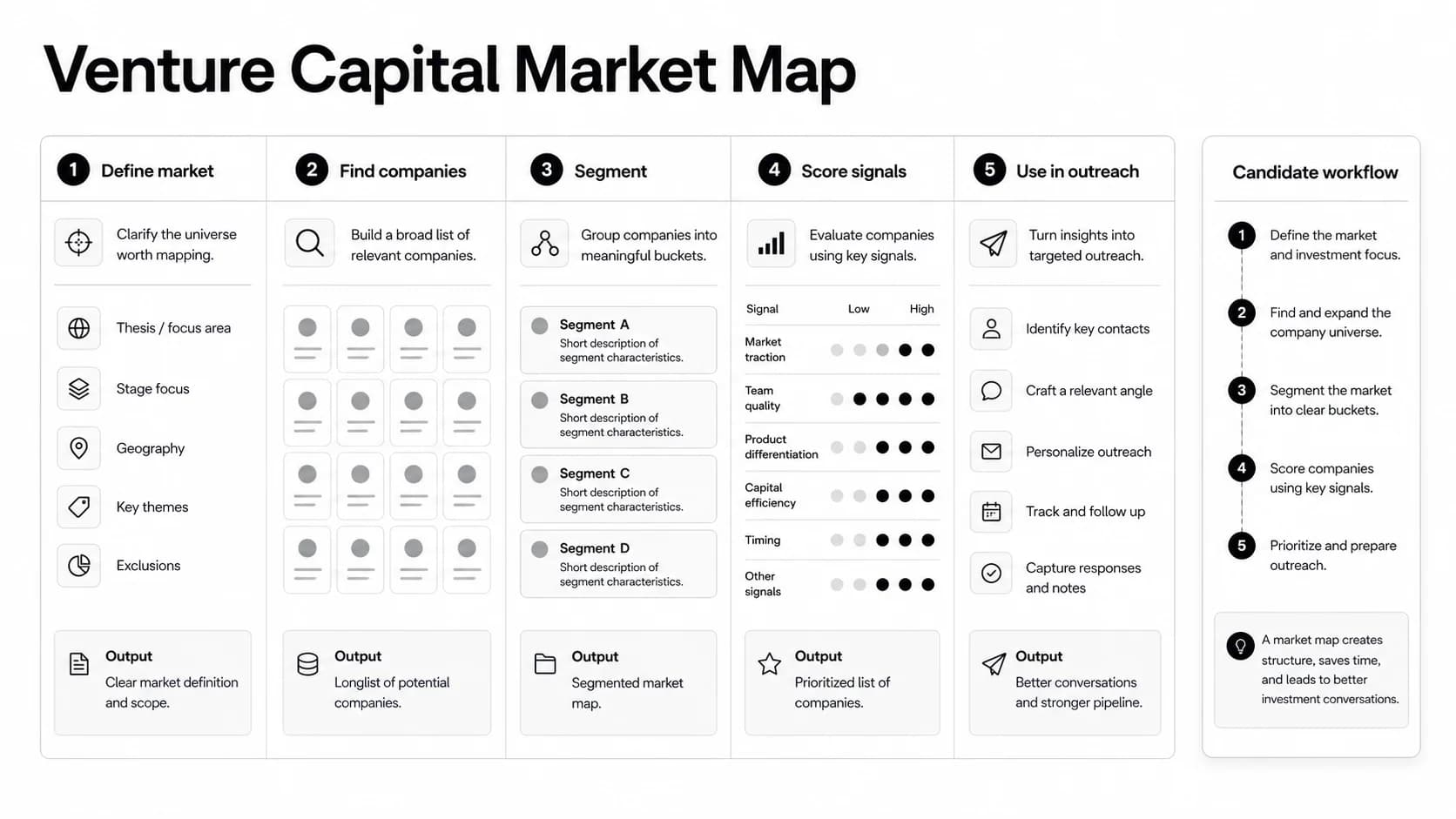
After four to six weeks, group repeated signals into a venture capital market map. The map is more valuable than a folder of saved links because it shows how you organize a market and where you would search for investable opportunities.
Firm-authored content naturally reflects the firm’s interests and worldview. Read it as a well-informed perspective, not neutral consensus. Compare the thesis with company evidence, independent reporting, and skeptical sources.
Best for VC careers and job discovery: GoingVC
GoingVC is the most directly career-oriented publication in this shortlist. Its official page says it covers VC jobs, career tips, research, and industry news.
Use career newsletters for discovery, then move quickly to firm research. For every relevant role, capture the fund’s stage, sector, geography, recent investments, team structure, and the work the job description actually emphasizes. “Associate” can mean sourcing-heavy at one firm and diligence-heavy at another.
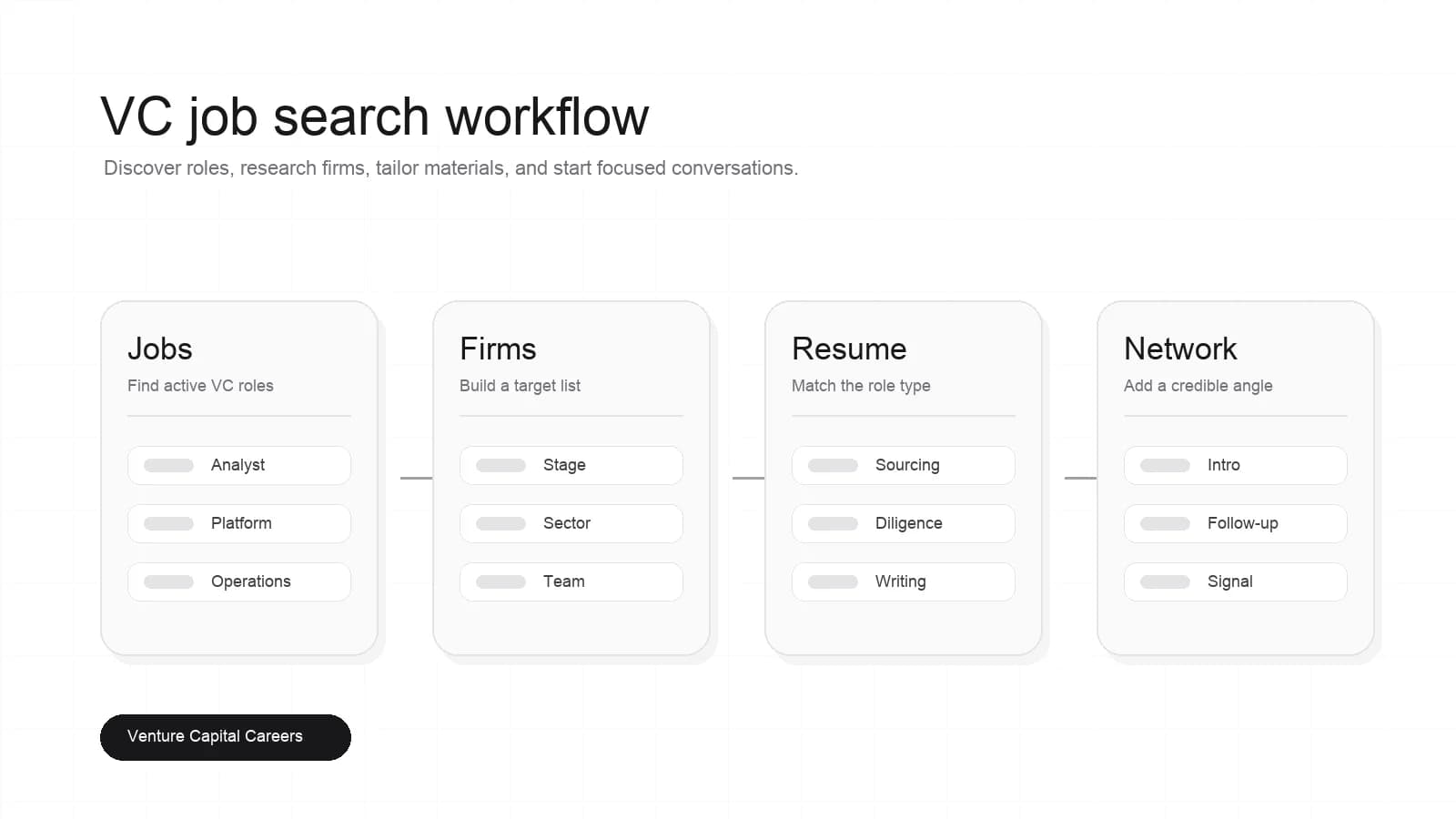
Do not let a newsletter become the only place you search. Browse current roles on the Venture Capital Careers job board and use the companies directory to build a target list even when a firm is not hiring today.
Build a VC newsletter stack for your goal
Choose one source from each column: awareness, depth, and action.
| Goal | Awareness | Depth | Action |
|---|---|---|---|
| Prepare for generalist VC interviews | StrictlyVC or Pro Rata | Newcomer or The Generalist | GoingVC plus VCC interview guides |
| Target SaaS investing roles | StrictlyVC | Clouded Judgement | Build a SaaS benchmark note and company memo |
| Develop a sector thesis | Pro Rata | Relevant a16z specialist newsletter or The Generalist | Create a market map and target-firm list |
| Demonstrate sourcing ability | StrictlyVC | Data Driven VC | Run one sourcing experiment and document results |
| Improve founder diligence | Newcomer | First Round Review | Build a question bank and test it on a company |
A starter stack should fit into a limited weekly research budget. If you repeatedly save an issue without producing a note, decision, question, or action, unsubscribe or pause it. Attention is an investment resource too.
Turn reading into interview evidence
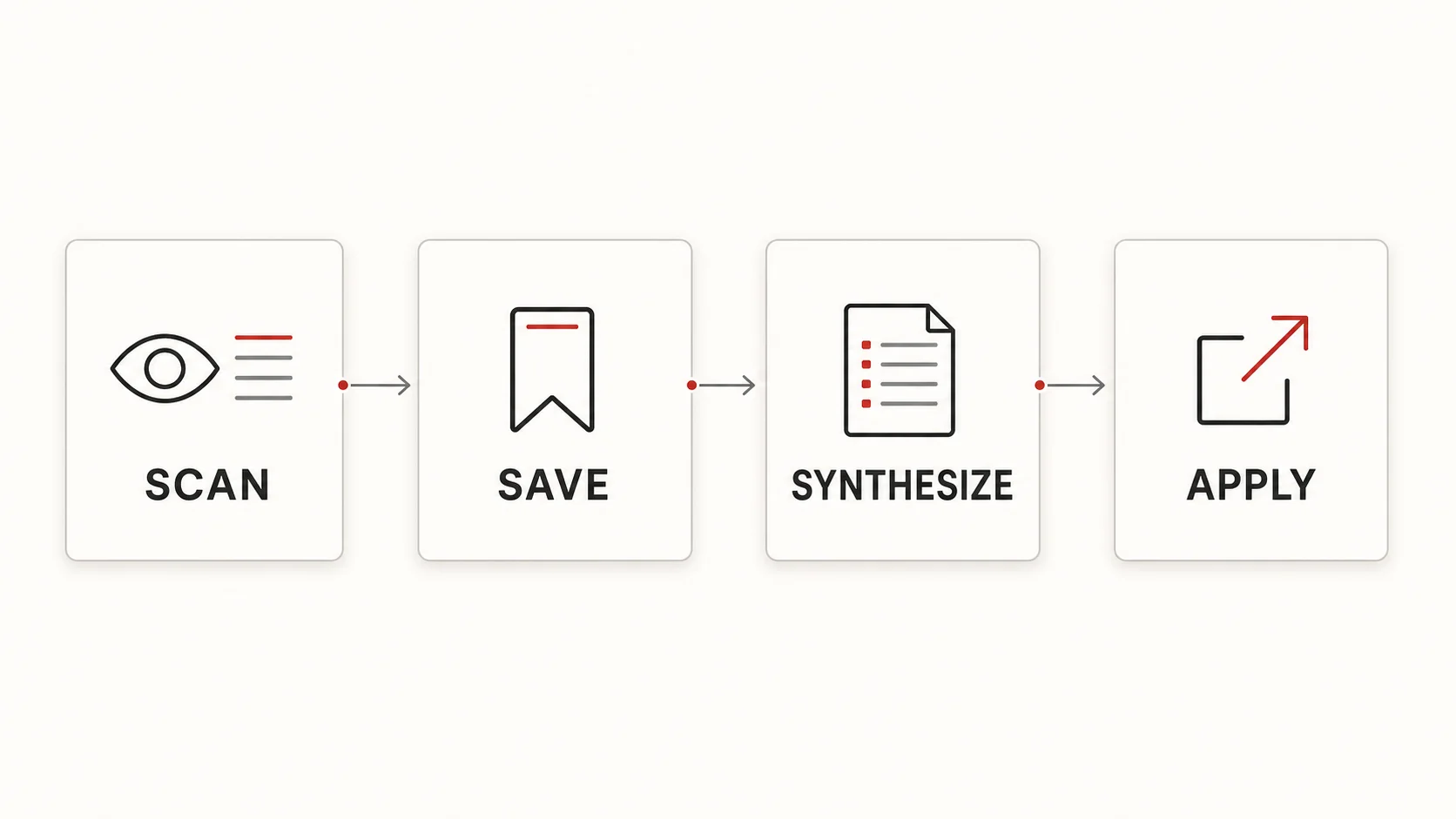
Use a four-stage routine: scan, save, synthesize, apply.
1. Scan for relevance
Read subject lines and opening summaries. Ignore items outside your target sectors unless they change the broader funding or regulatory environment. The goal is triage, not completion.
2. Save only evidence
Keep links that contain a primary fact, useful dataset, novel framework, or credible counterargument. Do not save something merely because it sounds intelligent.
3. Synthesize in four lines
Use this reusable note:
Signal: What changed?
Meaning: Why might it matter?
Evidence: What supports or challenges the interpretation?
Action: Which company, firm, question, or role should I investigate next?
4. Apply the note
Each week, turn one note into a visible artifact:
- a 150-word deal note;
- a one-page company thesis;
- a market-map entry;
- a new diligence question;
- a tailored networking message; or
- a researched job application.
This creates compounding career value. A candidate with six concise, defensible notes has more to discuss than someone who claims to “follow the market closely.” Use your strongest artifact when preparing for VC interview questions or a VC case-study interview.
Common newsletter mistakes
Subscribing before defining a goal
An inbox cannot decide whether you are preparing for interviews, learning SaaS, building a climate thesis, or finding roles. Set the goal first, then select sources.
Confusing frequency with insight
A daily email may be valuable for awareness but weak for deep judgment. A less frequent specialist analysis may produce more useful interview evidence. Match cadence to the task.
Repeating the author’s thesis
Interviewers can tell when a view has been borrowed wholesale. Record the author’s case, find disconfirming evidence, and explain your own conclusion.
Treating reported claims as primary evidence
Use newsletters to discover companies and events, then check company announcements, regulatory filings, product documentation, job postings, or original datasets where possible.
Building an archive instead of a body of work
Saved links create no signal on their own. Notes, maps, memos, and thoughtful questions do. Delete aggressively and publish selectively.
Frequently asked questions
What is the best venture capital newsletter for beginners?
Start with one concise deal source such as StrictlyVC or Axios Pro Rata, one deeper source such as Newcomer or The Generalist, and GoingVC for career discovery. Three complementary sources are easier to use consistently than a long list.
What is the best VC newsletter for SaaS investors?
Clouded Judgement is the specialist pick in this guide because it focuses on SaaS valuation trends and operating metrics. Pair it with a broader deal source and remember that public-company benchmarks require stage-aware interpretation when applied to startups.
Are paid VC newsletters worth it?
They can be when the original reporting, data, or analysis changes a decision or saves meaningful research time. Test the free material first, define the output you expect, and review whether you used the publication after a month. Do not pay for prestige or unread archives.
How many venture capital newsletters should I read?
Three is a strong starting point: awareness, depth, and career or operator action. Add another only when it fills a specific gap. If two newsletters repeatedly produce the same notes, keep the one you use more effectively.
Can reading newsletters help me get a VC job?
Reading alone is a weak signal. The career value comes from synthesis and application: informed interview answers, investment memos, market maps, sourcing experiments, thoughtful networking messages, and better-targeted applications. When your work samples are ready, browse open venture capital roles and research firms in the VCC companies directory.
The best venture capital newsletter stack is the smallest one that reliably changes your work. Choose by task, produce one artifact each week, and let the quality of your thinking—not the size of your inbox—show that you are ready to invest.