

If you want one place to start, read Venture Deals for deal mechanics, The Venture Mindset for investment judgment, Secrets of Sand Hill Road for a founder-facing view of VC firms, or The Business of Venture Capital for fund operations. The right first book depends on what you need to do—not which title appears most often on a bookshelf.
The strongest reading plan mixes mechanics, judgment, operating empathy, strategy, and history. It also produces work. Annotate a term sheet. Write an investment memo. Compare two firms. Explain a non-consensus thesis. Books can supply frameworks; applying them is how you discover whether you understand venture capital.
The best venture capital books at a glance
| Book | Best for | Primary lesson | Produce after reading | Main limitation |
|---|---|---|---|---|
| Venture Deals | Founders, candidates, lawyers, junior investors | Term sheets, control, economics, and negotiation | A marked-up term sheet with five questions | Reference-like; not a full account of fund management |
| The Business of Venture Capital | Emerging managers, investors, fund operators | How GPs raise, invest, manage portfolios, and work with LPs | A one-page fund model and reserve policy | Dense; too much for a reader who only needs fundraising basics |
| The Venture Mindset | Investors, executives, operators | Decision-making under uncertainty and asymmetric outcomes | A decision journal with kill and double-down criteria | Broader than the day-to-day craft of VC |
| Secrets of Sand Hill Road | Founders and first-time investors | How a VC firm raises capital, evaluates deals, and governs companies | A reverse-underwriting memo on what a fund needs from a deal | One influential firm's institutional lens is not the whole market |
| The Power Law | Readers who want modern industry context | How outliers, firm culture, and incentives shaped global VC | A comparison of two firms' decision models | Narrative history, not a practical manual |
| Mastering the VC Game | Founders choosing and managing investors | Fundraising as a long-term relationship | An investor-reference and board-fit checklist | Some market examples reflect an earlier era |
| Zero to One | Candidates and investors building a thesis | Contrarian thinking, differentiation, and market structure | A falsifiable investment thesis | A provocative lens, not a universal company scorecard |
| The Hard Thing About Hard Things | Investors assessing founders and operators | Leadership when every available choice is bad | Five founder-reference questions for a difficult scenario | Not a venture capital textbook |
| 7 Powers | Investors analyzing durable advantage | Seven mechanisms that can protect long-run returns | One power hypothesis with evidence and disconfirming facts | Many early startups do not yet have a demonstrable power |
| VC: An American History | Readers seeking rigorous institutional history | How risk capital evolved from whaling finance to Silicon Valley | An incentives map across one historical and one modern deal | Academic and slower than narrative histories |
| Creative Capital | Readers interested in VC's institutional origins | Georges Doriot, ARD, and patient company-building | A short memo on capital, governance, and time horizon | Biography, not a current deal playbook |
| eBoys | Candidates curious about partnership dynamics | How Benchmark debated and made decisions during the internet era | An investment-committee observation checklist | The portfolio context is deliberately dated |
How we chose these books
A book earns a place here only if it teaches a distinct part of the work: deal mechanics, fund operations, investment judgment, founder empathy, company strategy, or industry history. Twelve near-identical startup books would create the illusion of depth while leaving the same gaps.
Audience fit matters as much as reputation. A founder preparing for a financing should not begin with an academic history. A first-time fund manager needs more than a founder's term-sheet manual. An aspiring analyst who can repeat VC vocabulary but cannot form a view on a company still has work to do.
Currentness matters where the facts can change. Editions were checked against official author and publisher pages on August 24, 2026. Retail prices, sales ranks, and star ratings are excluded because they fluctuate and do not establish whether a book fits your task.
Finally, every recommendation needs a limitation. A list that treats every title as essential is not making decisions; it is avoiding them.
1. Venture Deals — best for term sheets and deal mechanics
Brad Feld and Jason Mendelson's Venture Deals remains the clearest first book for understanding how a venture financing is negotiated and documented. The official book site describes it as a guide to the deal process for entrepreneurs, investors, lawyers, and students, and confirms that the book is in its fourth edition.
Its durable idea is that a term sheet is not a list of isolated clauses. Economics and control interact. Valuation can look attractive while liquidation preferences, option-pool treatment, anti-dilution protection, board rights, or protective provisions shift the actual outcome.
Read it if you need to follow a financing conversation without bluffing. Keep it nearby as a reference rather than forcing yourself to treat every chapter as narrative. It is not the best book for learning how a fund raises from LPs, constructs a portfolio, or develops an investment thesis.
Use it to produce: take a sample venture capital term sheet and mark five terms that change economics or control. For each one, write what the investor is protecting and what the founder gives up.
2. The Business of Venture Capital — best for fund operations
The Business of Venture Capital moves one level up from a single deal to the institution writing the check. It covers raising a fund, structuring investments, managing a portfolio, working with LPs, and planning exits. That makes it the most useful broad reference for an emerging manager or someone joining an investment team and trying to understand why fund strategy shapes deal behavior.
There is an important edition note. The official book site lists a fourth edition for Fall 2026 as a pre-order. As of August 24, 2026, treat the third edition as the available reference and the fourth as forthcoming until the publisher confirms release. The new edition's stated scope—building a firm, investing in startups, and driving returns—also shows why this book belongs in a different category from a founder-only fundraising manual.
Read it when questions about ownership targets, reserves, portfolio construction, follow-ons, LP expectations, or firm-building keep surfacing. Skip it as your first book if your immediate problem is decoding one term sheet.
Use it to produce: sketch a hypothetical fund with check size, ownership target, number of initial investments, reserve ratio, and follow-on rules. Then test whether those choices fit together. The venture capital fund structure and fund lifecycle explain the mechanics around that exercise.
3. The Venture Mindset — best for investment judgment
Ilya Strebulaev and Alex Dang focus on how venture-style decision makers act when information is incomplete and outcomes are asymmetric. Penguin Random House describes The Venture Mindset as a nine-principle playbook for making bets, encouraging dissent, and deciding when to stop an initiative. It was published in 2024, making it one of the newer books in this selection.
The useful shift is from “How can I be certain?” to “What must be true, what could make the upside unusually large, and what evidence should change my mind?” That is valuable for investment committees, corporate innovation teams, and candidates trying to show judgment rather than borrowed confidence.
The limitation is scope. This is a decision-making book with venture examples, not a manual for sourcing, term sheets, or fund administration.
Use it to produce: create a decision journal for one company. Record the base rate, upside case, key disagreement, kill criteria, next evidence, and date for revisiting the decision. That turns an interesting mental model into an auditable process.
4. Secrets of Sand Hill Road — best for founders learning how VCs work
Scott Kupor explains the machinery on the other side of a founder's pitch: how firms raise money, evaluate opportunities, negotiate terms, and govern portfolio companies. The publisher's description explicitly spans VC fundraising, deal selection, term sheets, and boards.
That institutional view helps founders understand why a promising company can still be wrong for a particular fund. Fund size, ownership targets, reserve strategy, partnership process, and return requirements affect the answer. The same perspective helps candidates stop treating every firm as interchangeable.
The caveat is that the book reflects one prominent firm's model and the wider Silicon Valley institution around it. Firms differ by stage, geography, sector, ownership strategy, and decision rights.
Use it to produce: reverse-underwrite a target firm. Estimate the type of outcome a new deal must create for the fund, then list which company, round, and ownership characteristics fit. Compare that model with firm profiles in the Venture Capital Careers companies directory.
5. The Power Law — best narrative history of modern VC
Sebastian Mallaby's The Power Law explains modern venture capital through firms, investors, companies, and the outlier returns that define the asset class. Its strength is narrative: the reader sees how partnership culture, founder power, market timing, and a small number of extreme successes shaped Silicon Valley and venture capital beyond it.
The publisher frames the book as reported history and analysis of venture firms in the United States and China. Read it when you want to understand why VC does not behave like a conventional diversified investment strategy—and how that logic influences investor behavior.
Do not expect a term-sheet walkthrough or a ready-made sourcing playbook. The book makes the industry legible; it does not train every task inside it.
Use it to produce: compare two firms on thesis, partnership structure, ownership strategy, follow-on behavior, and tolerance for unusual founders. Explain which differences are structural and which are cultural.
6. Mastering the VC Game — best founder–investor relationship guide
Jeffrey Bussgang writes from both sides of the table. His author page for Mastering the VC Game emphasizes the challenge of choosing the right investor and building a productive relationship after the financing—not merely winning a term sheet.
That is the reason to read it. Capital is not interchangeable once an investor has board influence, information rights, follow-on discretion, and a relationship with the founding team. Reference calls on an investor deserve the same seriousness as investor diligence on a founder.
Some companies and market examples come from an earlier venture era. The relationship questions remain useful even when the names and financing environment change.
Use it to produce: write an investor-reference checklist covering behavior in difficult rounds, board preparation, founder replacement, follow-on decisions, introductions, conflict, and exits. Ask for examples, not adjectives.
7. Zero to One — best for contrarian thesis-building
Peter Thiel and Blake Masters argue that important companies create something meaningfully new rather than fighting for marginal share in an established market. For a venture reader, the value is not agreement with every claim. It is the discipline of articulating a differentiated future and identifying why a company might have a path away from commodity competition.
Read Zero to One when an investment thesis sounds like a market-size slide with no view. It can sharpen questions about proprietary insight, market structure, distribution, technology, and timing.
Do not turn its ideas into a universal checklist. “Monopoly” rhetoric can conceal weak evidence, and a contrarian claim is not valuable merely because it is contrarian.
Use it to produce: write a one-sentence non-consensus investment thesis. Add three observations that could prove it right and two that would falsify it.
8. The Hard Thing About Hard Things — best for operating empathy
Ben Horowitz's book is not a VC textbook, which is precisely why it belongs. Investors judge leaders who must hire executives, restructure teams, manage cash, communicate bad news, and make decisions with no clean option. A reader who understands only pitch decks and financing terms will miss much of the work after the check.
Read it to improve management-team diligence and board empathy. Its crisis stories are most useful when they generate better questions, not when they become heroic templates copied into the wrong situation.
Skip it if your only current need is fund mechanics. Return when you are preparing founder references, evaluating executive judgment, or supporting a company through a difficult quarter.
Use it to produce: draft five reference questions about a real leadership tradeoff. Ask what the person decided, which information was missing, who absorbed the cost, and what changed afterward.
9. 7 Powers — best for durable-advantage analysis
Hamilton Helmer's 7 Powers gives investors a precise vocabulary for durable strategic advantage: scale economies, network economies, counter-positioning, switching costs, branding, cornered resource, and process power.
The best use is not labeling. It is testing mechanism and benefit. If a company claims network effects, what improves as the network grows, for whom, and why can a rival not reproduce it? If switching costs matter, who bears them and when do they become visible?
Early-stage companies often have a plausible path to power rather than a proven power. Treating aspiration as evidence is a common analytical error.
Use it to produce: add a “power hypothesis” section to an investment memo. Name the proposed power, evidence that it is forming, the benefit it creates, the barrier it raises, and the facts that would disconfirm it.
10. VC: An American History — best academic history
Tom Nicholas takes the longest institutional view in this selection. Harvard University Press describes VC: An American History as a history of risk capital from nineteenth-century whaling finance through modern Silicon Valley. The book connects incentives, intermediation, skewed returns, government, institutions, and technological development.
Choose it over The Power Law when you want analytical history and the roots of the model. Choose The Power Law when you want a faster narrative centered on modern firms, personalities, and company outcomes. Reading both is useful, but they are not substitutes.
This is slower, denser reading. It will not prepare you to negotiate a current term sheet next week.
Use it to produce: map capital provider, intermediary, operator, incentive, risk, and payoff in one historical case and one modern startup financing. Look for what changed—and what did not.
11. Creative Capital — best biography of VC's institutional origins
Spencer Ante's Creative Capital follows Georges Doriot and the development of American Research and Development Corporation. It makes the origins of institutional venture capital personal: a model emerged through people making choices about capital, governance, technology, and time horizon.
Read it for the company-building philosophy behind early venture capital and for the tension between patient development and financial return. A biography can show motives and institutional formation in a way a technical reference cannot.
It is not a current playbook. Legal structures, markets, and firm operations have changed. Its value is the question it leaves with the reader: what kind of company-building partner is long-duration capital supposed to be?
Use it to produce: write a short note on how your preferred investment model balances time horizon, governance, technical risk, and founder support.
12. eBoys — best inside account of a venture partnership at work
Randall Stross's eBoys observes Benchmark during the internet boom. The book's value is proximity to a partnership: debate, conviction, uncertainty, company support, and the social process behind investment decisions.
The early-internet setting is both strength and limitation. It provides a bounded historical case rather than a sanitized collection of timeless principles. Some companies, markets, and assumptions are dated; partnership behavior remains recognizable.
Read it if you are curious about what happens between a first meeting and a collective decision. Skip it if you need a systematic introduction to fund economics.
Use it to produce: build an investment-committee observation checklist: who frames the decision, how dissent appears, which evidence changes the room, what remains unresolved, and who owns the next step.
Which VC book should you read first?
If you are trying to break into VC
Start with Venture Deals, then The Venture Mindset, then The Power Law. That sequence gives you mechanics, judgment, and industry context. Produce a marked-up term sheet and a two-page memo on a company you genuinely find interesting. Those artifacts give you more to discuss than “I am passionate about startups.” When you are ready to test the market, browse current VC roles and tailor your preparation to the firms actually hiring.
If you are a founder preparing to raise
Start with Secrets of Sand Hill Road, then use Venture Deals as a reference, followed by Mastering the VC Game. Produce a target-firm map, an issues list for counsel, and investor-reference questions. The goal is not to become your own lawyer. It is to understand the incentives and ask better questions.
If you already work in venture capital
Start with the weakest part of your current practice. Read The Venture Mindset for decision process, 7 Powers for company analysis, or The Hard Thing About Hard Things for operating empathy. Produce one change to your memo template, reference process, or post-investment work. Reading without a changed behavior is entertainment.
If you are building or joining a fund
Start with The Business of Venture Capital, then VC: An American History, then The Power Law. Produce a fund model, a portfolio-construction memo, and a statement of what your partnership will do differently. If those three documents contradict one another, the strategy is not ready.
A 30-day venture capital reading plan
| Week | Read | Apply | Finished output |
|---|---|---|---|
| 1: Mechanics | Selected chapters from Venture Deals | Annotate a sample term sheet; identify economics and control | Five-clause issues list |
| 2: Judgment | The Venture Mindset or Zero to One | Keep a decision journal on one company | Thesis, base rate, disconfirming evidence, next test |
| 3: Context | The Power Law or VC: An American History | Compare two firms using public information | One-page firm-model comparison |
| 4: Work product | Revisit the most relevant chapters | Write, edit, and explain a company view | Two-page investment memo and five-minute verbal case |
Use the final week to close gaps, not to add another book. Research the company, market, competitors, founders, and relevant firm. Then have someone challenge the memo. If you cannot explain what evidence would change your recommendation, keep working.
What books cannot teach you about venture capital
Books cannot reproduce the judgment developed through sourcing, founder meetings, reference calls, investment committee, portfolio work, missed deals, and incorrect decisions. They also age: market structure, financing norms, and firm strategies move faster than most publication cycles.
A better practice loop is:
- Read a framework.
- Analyze a live company, fund, or financing.
- Write a decision and the evidence behind it.
- Discuss it with someone willing to disagree.
- Update the view when new facts arrive.
If your goal is a venture career, use books to make your work more rigorous—not to postpone doing the work. Research firms, publish or privately circulate thoughtful analysis, and prepare for venture capital interview questions with examples that show how you think.
Frequently asked questions
What is the best venture capital book for beginners?
Venture Deals is the best starting point for deal mechanics. If you want a broader founder-facing overview first, choose Secrets of Sand Hill Road. If your goal is investment judgment rather than financing vocabulary, start with The Venture Mindset.
Is Venture Deals still worth reading?
Yes. Its fourth edition remains a practical reference for term sheets and the relationship between economics and control. It is less useful as a standalone education in LPs, portfolio construction, sourcing, or investment judgment, so pair it with a book that covers your next task.
Which venture capital book is best for founders?
Start with Secrets of Sand Hill Road to understand the institution, then use Venture Deals for financing terms and Mastering the VC Game for investor selection and the long-term relationship.
What should an aspiring VC read before interviews?
Read Venture Deals, one judgment book such as The Venture Mindset or Zero to One, and one history such as The Power Law. More important: turn the reading into a term-sheet analysis and an investment memo you can defend.
Should I read The Power Law or VC: An American History?
Choose The Power Law for reported narrative history of modern firms and outlier investing. Choose VC: An American History for a longer, more academic account of the institutions and incentives behind risk capital. Read both if history is central to your work.
Can books alone prepare you for a venture capital job?
No. Books can teach vocabulary, frameworks, and context. Firms still evaluate judgment, curiosity, relationships, sourcing ability, communication, and evidence that you can analyze companies. The useful test is whether your reading changes the quality of the work you can show.
Related posts
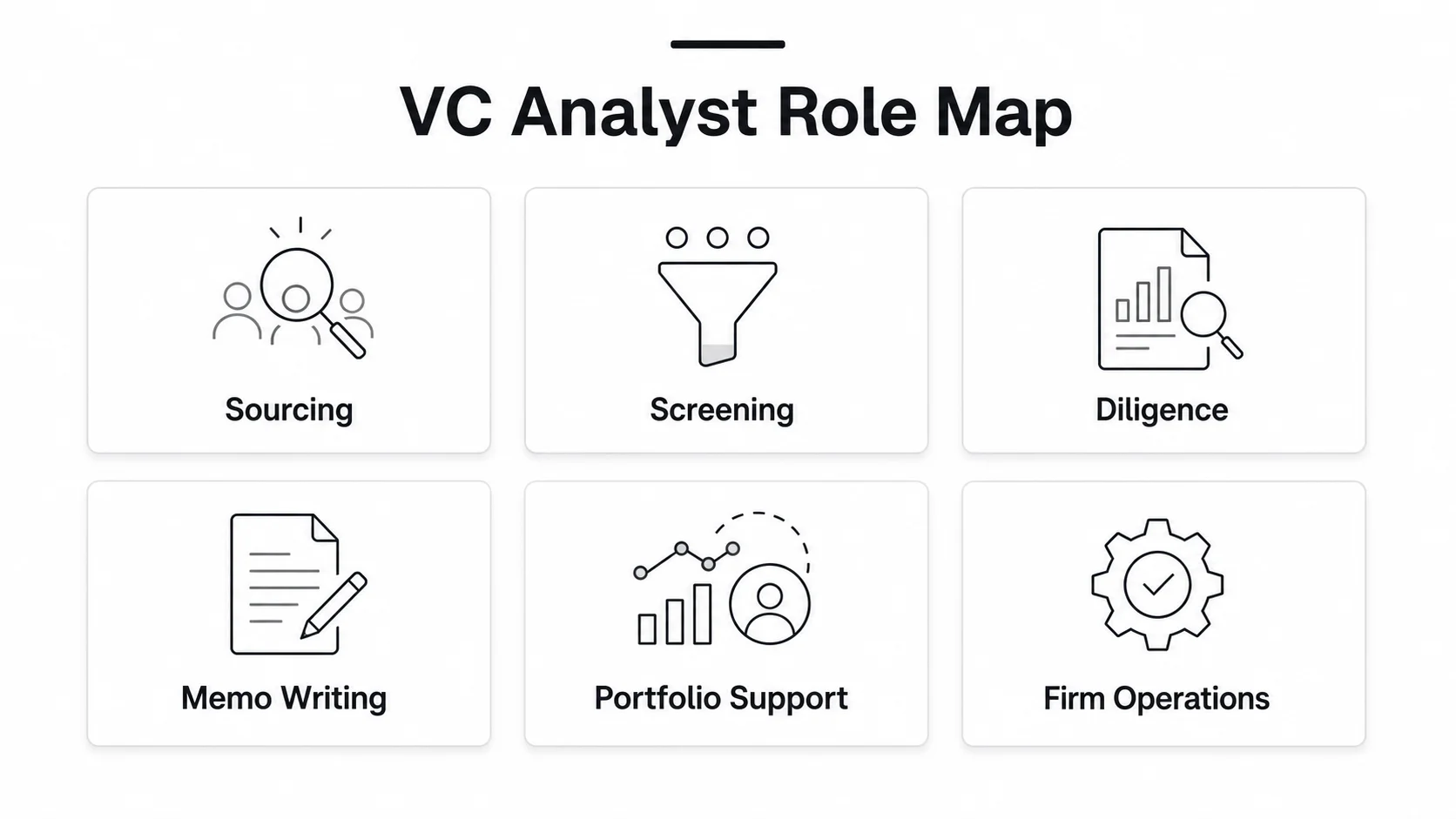
Copy-ready VC analyst job description template with responsibilities, skills, sourcing vs diligence seat signals, interview scorecard, and how candidates should read a posting.
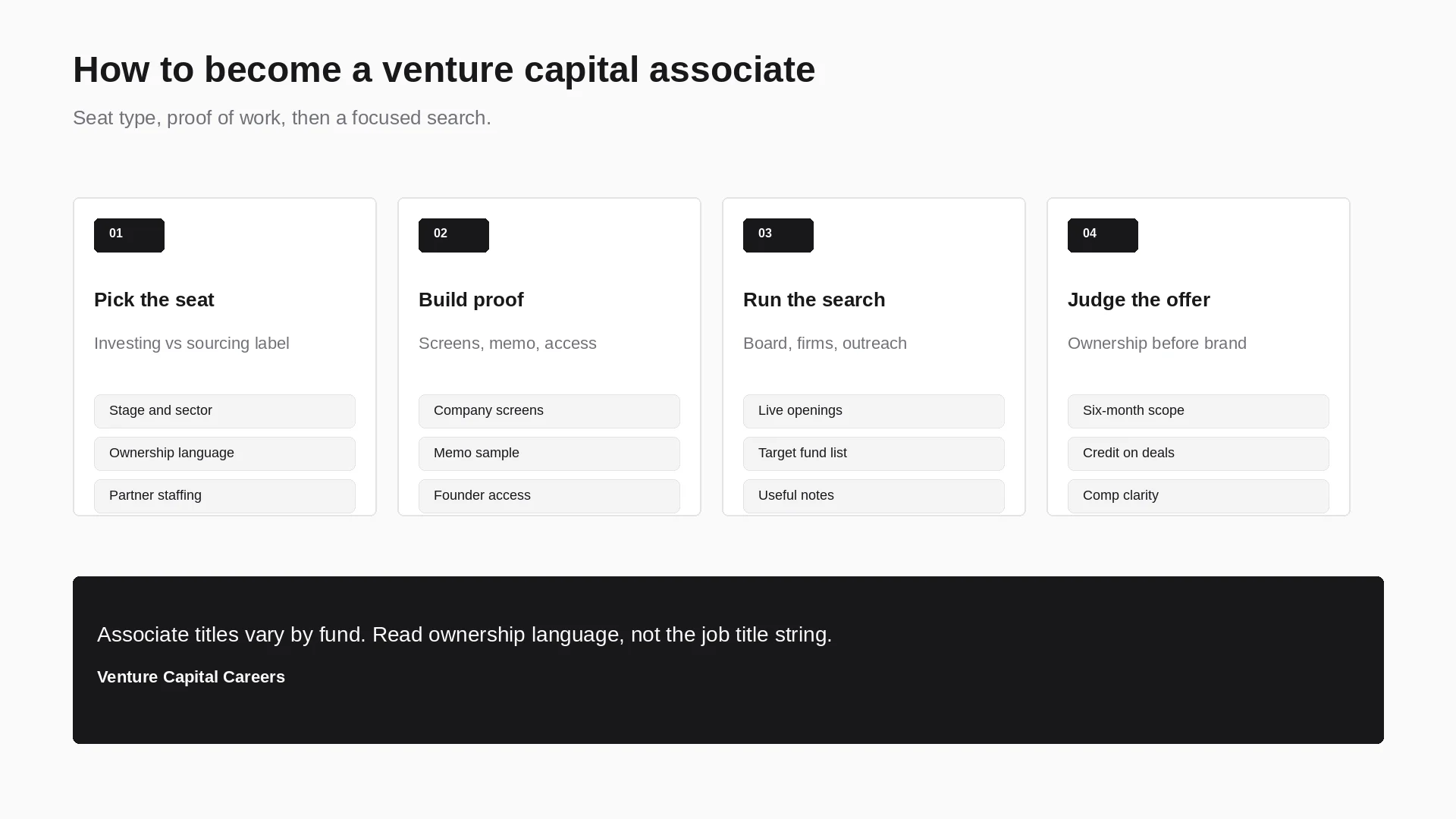
A practical guide to becoming a venture capital associate: what the seat is, which paths convert, how to prove you can do the work, and how to screen real associate openings.
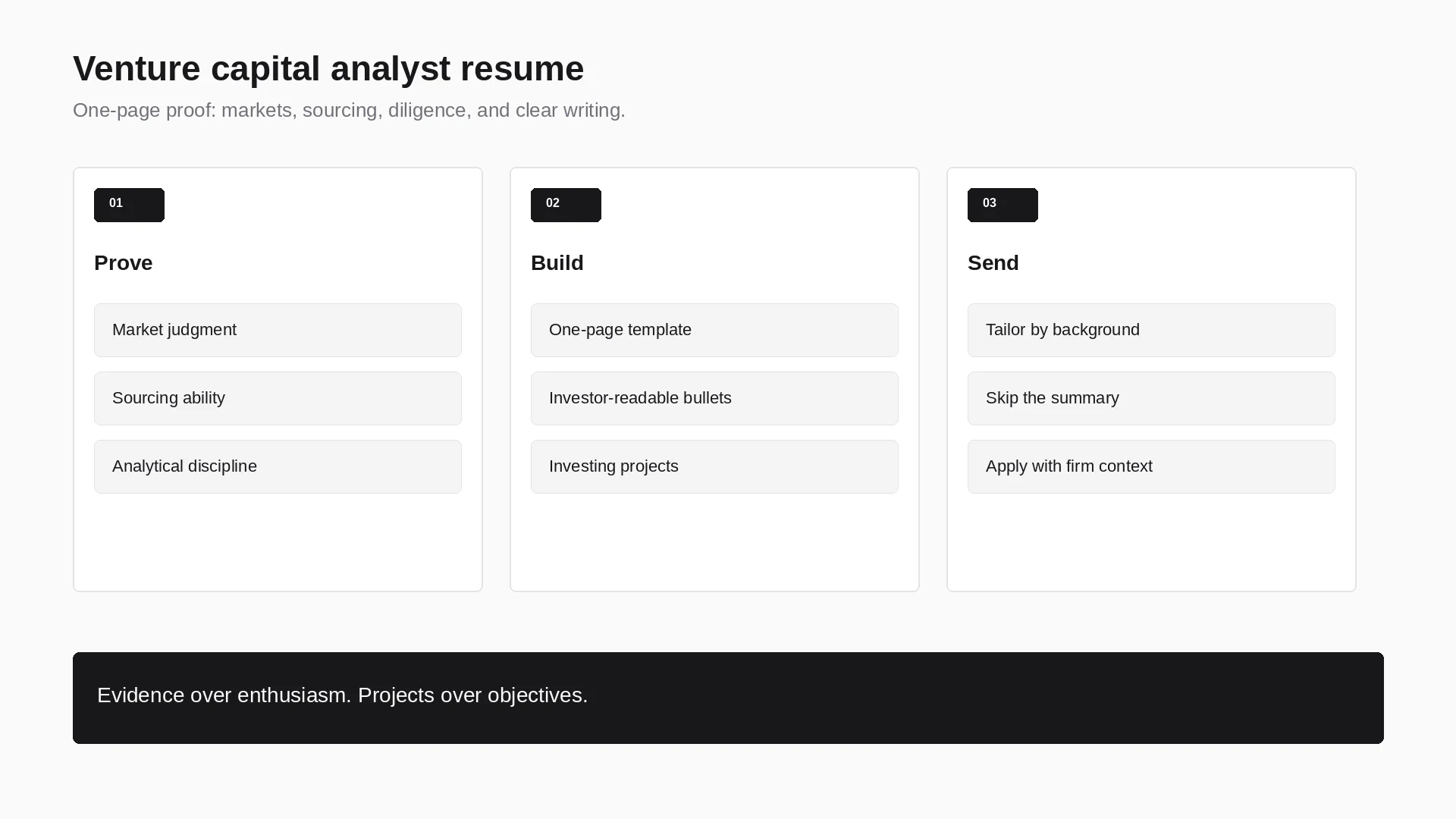
A VC analyst resume is a one-page proof document. Template, bullet formula, investing projects section, examples, and next steps for analyst applications.