

The first hiring decision after a funding round is not which job to post. It is whether the assumptions behind the fundraising plan still hold. Reconcile the cash that actually arrived, the commitments made during the round, the company's current burn, and the milestones the capital must unlock. Then authorize roles one at a time against those milestones.
A useful post-funding plan connects four things: capital, capability, milestone, and evidence. It also preserves the right to pause. Funding gives the company more options; it does not make every box on the pitch-deck org chart correct.
| Stage | Core question | Output |
|---|---|---|
| Reconcile | What resources and constraints do we have now? | Agreed cash and commitment baseline |
| Prioritize | Which missing capability blocks the next milestone? | Ranked capability gaps |
| Authorize | Is a full-time role the right response, with an owner and budget? | Approved role card |
| Hire | Can we source, assess, decide, and onboard well? | Controlled recruiting process |
| Reforecast | What did the evidence change? | Release, pause, or resequence decision |
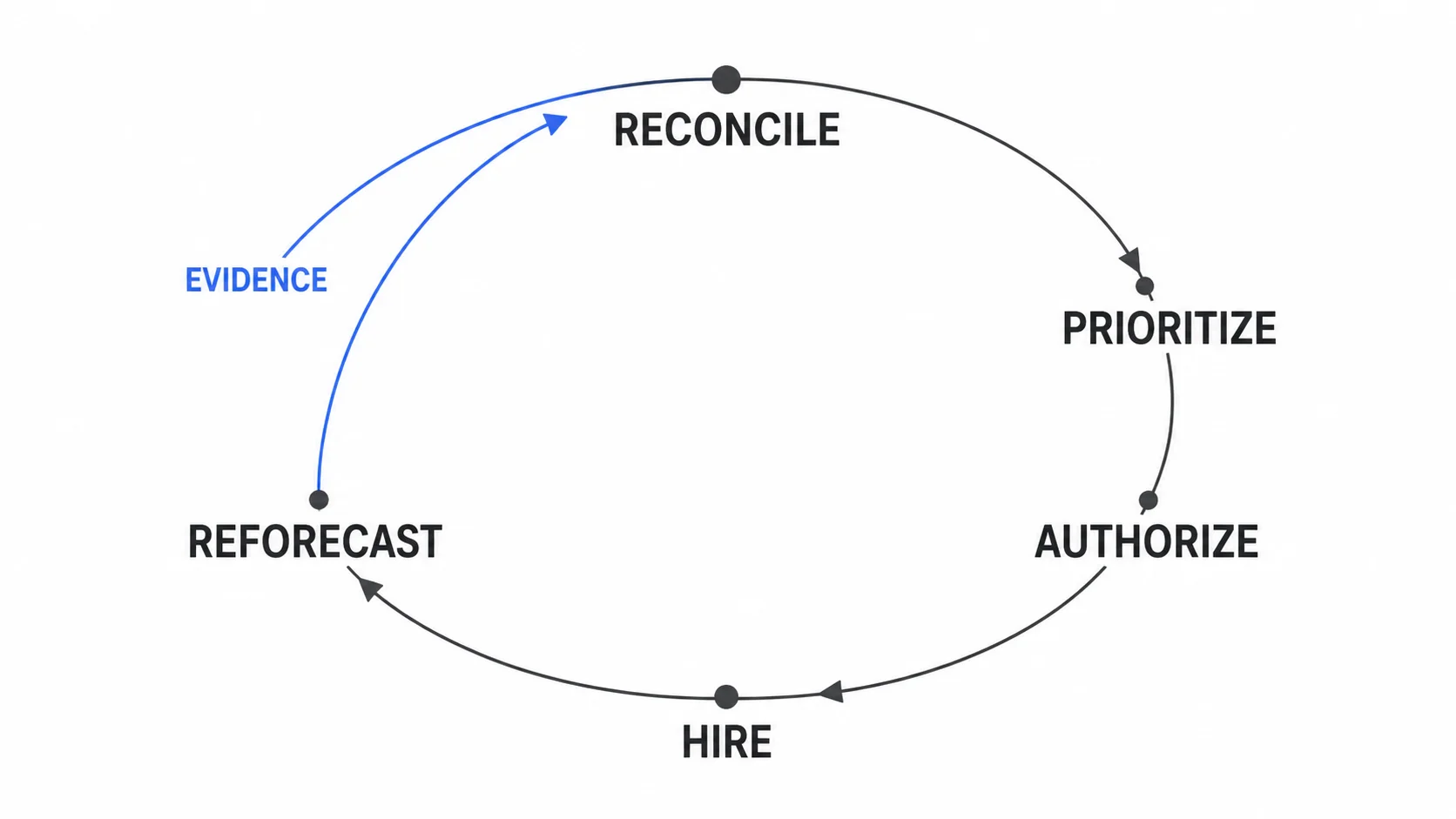
Funding does not validate the old headcount plan
The hiring slide used during fundraising is a hypothesis. Between the first investor conversation and cash landing in the bank, the round size, timing, product roadmap, revenue outlook, option-pool treatment, team composition, and market conditions can all change.
That makes two statements importantly different:
- Budget available: the cash plan can support this spend under stated assumptions.
- Role authorized: the company has decided that this capability is the best current use of that budget, a manager can support it, and a defined outcome justifies opening the role.
Do not turn one into the other automatically. A company can afford a vice president and still need two individual contributors first. It can have budget for five engineers and still lack the technical leadership or product clarity to deploy them well. It can have a sales target that appears to require more account executives while its actual bottleneck is onboarding, product reliability, or qualified pipeline.
The same discipline improves the next financing story. Connect headcount to business goals, role scope, budget, timing, and equity planning. After the round, the job is to keep that connection current rather than preserve the spreadsheet for appearances.
Step 1: Reconcile the round before opening roles
Create one post-close baseline owned jointly by the CEO and finance lead. The purpose is not to rebuild the entire company model. It is to remove ambiguity about what can be committed and what remains conditional.
Cash and commitments
- Confirm the net cash available after transaction costs and any immediate obligations.
- Reconcile current burn and non-headcount commitments against the final operating plan.
- Record commitments made to the board, investors, customers, or critical partners that affect team capacity.
- Separate funded work from work that still depends on revenue, a product milestone, or a later financing.
Equity and role assumptions
- Check whether the final option-pool position matches the hiring model.
- Identify roles likely to require scarce or senior talent before promising start dates.
- Confirm who can approve compensation, equity, location, employment structure, and exceptions.
- Route transaction-, equity-, tax-, and employment-specific questions to qualified finance, legal, and people advisers.
The seed funding and Series A funding articles explain how financing stage changes the evidence investors expect. The cap table guide owns the detailed equity mechanics. Use those inputs here, but keep this plan focused on what the company will do next.
Downside room
A hiring plan should not spend every available dollar in its base case. Define which assumptions protect the plan and what would cause the company to slow it. The reserve does not need to be a universal percentage. It needs to be explicit enough that leaders know whether a missed revenue milestone, delayed launch, longer sales cycle, or new capital need changes the next role.
Before opening a requisition, the leadership team should be able to answer:
- What milestone is this capital meant to unlock?
- Which assumptions changed during the round?
- Which commitments are fixed, and which are conditional?
- Who owns the cash, equity, and hiring approvals?
- What evidence would make us pause the next wave?
If those answers disagree across the CEO, finance lead, and hiring manager, the company does not have a hiring problem yet. It has a planning problem.
Step 2: Translate milestones into capabilities
Start with the operating constraint, not a target org chart. A milestone says what must become true. A capability describes what the team must be able to do repeatedly to make it true. A role is only one possible way to add that capability.
| Milestone | Missing capability | Evidence to inspect | Possible response |
|---|---|---|---|
| Release a reliable enterprise product | Production hardening and security ownership | Incident pattern, roadmap, customer requirements, current technical ownership | Reassign ownership, specialist contractor, senior engineer, or security lead |
| Make a sales motion repeatable | Qualified pipeline creation and disciplined deal execution | Founder-led sales notes, win/loss reasons, cycle stages, implementation load | Improve process, hire enablement/operations, or add a sales role |
| Enter a regulated workflow | Regulatory and quality operating discipline | Required approvals, customer diligence, internal controls, adviser input | Specialist adviser, compliance hire, quality lead, or delayed entry |
| Produce decision-ready financial reporting | Forecast, cash control, and management reporting | Close quality, forecast variance, board requests, current owner capacity | Fractional finance support, controller, finance lead, or better process |
This prevents a common mistake: hiring the title that appeared in a benchmark org chart without proving that it resolves the company's constraint. Sometimes the correct response is a full-time hire. Sometimes it is clearer ownership, a temporary specialist, a tool, a narrower plan, or another month of evidence.
Start with the bottleneck, not the loudest request
Functional leaders can each make a credible case for more headcount. The leadership team's job is to compare those requests across the company.
Ask five questions:
- Bottleneck severity: What milestone fails if the capability remains missing?
- Time to productivity: How long after the person starts before the capability changes the outcome?
- Dependency order: What must exist before this role can succeed?
- Reversibility: Can the company test the need with a smaller or temporary intervention?
- Manager readiness: Who will make decisions, give context, and evaluate the work?
Seniority is not priority. A senior hire with no operating context or ready team can have a longer path to useful output than a well-scoped individual contributor. A role with an impressive title can also conceal two separate needs that should not be bundled.
Step 3: Prioritize roles with a decision matrix
Use a simple high/medium/low assessment rather than inventing a precision score. The discussion matters more than the arithmetic.
| Candidate role | Bottleneck severity | Time to useful output | Dependencies ready? | Alternative available? | Manager ready? | Decision |
|---|---|---|---|---|---|---|
| Senior product engineer | high | medium | yes | limited | yes | authorize first wave |
| First account executive | medium | medium | no—qualification and onboarding still unstable | founder-led test | yes | hold until process evidence improves |
| Finance lead | high | medium | yes | fractional support available | CEO capacity is constrained | test interim model, define full-time trigger |
The rows are hypothetical. Replace them with the company's actual roles and evidence. A role moves up the list when its absence blocks a milestone, prerequisites exist, the company can manage it, and a smaller intervention is unlikely to work. It moves down when the work is undefined, another bottleneck comes first, or onboarding would overload the team.
Name the outcome before the job description
“Own growth” is not an outcome. “Establish a qualified pipeline and a repeatable weekly review that lets the company decide whether to add the next seller” is closer. The outcome does not have to be a revenue promise. It should describe the operating capability the new person must create.
Use this sentence:
We are considering [role or intervention] because [capability] currently limits [milestone]. Within the first [review period], we expect evidence of [observable output]. We will revisit the plan if [assumption or trigger] changes.
Step 4: Build base, upside, and downside headcount plans
One forecast forces leaders to pretend they know more than they do. Three scenarios make uncertainty actionable.
- Base plan: roles justified by current evidence and required under the operating plan already approved.
- Upside plan: additional roles released only after a product, revenue, customer, regulatory, or delivery signal appears.
- Downside plan: roles paused, changed to temporary support, or resequenced when evidence weakens or cash needs change.
| Capability or role | Base action | Upside release condition | Downside pause condition | Next review |
|---|---|---|---|---|
| Production reliability | Open one authorized role | Release a second role after workload and incident evidence supports it | Narrow roadmap if ownership remains unclear | Leadership operating review |
| Commercial capacity | Keep founder-led motion and authorize operations support | Add seller after qualification and onboarding become repeatable | Pause if pipeline quality or implementation capacity weakens | Revenue and delivery review |
| Finance and reporting | Use defined interim owner | Convert to full-time when complexity and recurring workload justify it | Extend interim model if needs remain episodic | Monthly close and board-cycle review |
Triggers should be observable, but they do not need fake universal numbers. “When the product launches” is often too vague; “after the launch produces a stable support pattern and the team can name the next constraint” is more useful. “When revenue grows” is weak; “after qualified demand and delivery capacity show that an additional seller will not outrun onboarding” is a real decision rule.
The scenario model also improves honesty with investors and employees. It shows that management understands the plan will change and has decided in advance how new evidence changes the sequence.
Step 5: Authorize each role before recruiting
An approved role needs a compact decision record. Call it a role authorization card, requisition brief, or hiring memo. The name matters less than the fields.
| Field | Required answer |
|---|---|
| Problem | What constraint exists now? |
| Milestone | Which company outcome does the capability unlock? |
| Intervention | Why is a full-time role better than reassignment, a contractor, a tool, or a narrower plan? |
| First 90-day outcome | What useful operating evidence should exist after the person starts? |
| Decision rights | What can this person decide, recommend, or own? |
| Manager and collaborators | Who supplies context, feedback, and dependent work? |
| Budget owner | Who approved the fully loaded cost assumptions and equity decision path? |
| Start window and ramp | When can the company absorb the hire, and what must happen before full productivity? |
| Dependencies | Which systems, data, customers, processes, or leaders must be ready? |
| Stop or revisit trigger | What evidence cancels, pauses, or changes the role? |
The card becomes the source for the job description and interview scorecard. If the role is framed as outcomes and decision rights internally but advertised as a generic task list, candidate assessment will drift back toward familiarity and charisma.
Do not publish a requisition because the company wants to “start collecting resumes.” Open it when there is a real role, an accountable decision process, and a credible candidate experience.
Check whether the company can actually hire and onboard
Headcount capacity and hiring capacity are different. The financial model may support four hires while the company can only assess and onboard one well.
| Capacity question | Evidence of readiness | Failure signal |
|---|---|---|
| Who owns sourcing? | Named founder, recruiter, hiring manager, or partner with protected time | Everyone assumes someone else is building the pipeline |
| Who screens evidence? | Written scorecard and trained interviewers | Each interviewer tests a different role |
| Who decides? | Decision owner, meeting cadence, and exception path | Strong candidates wait while stakeholders relitigate scope |
| Who approves the offer? | Compensation, equity, location, and legal review path | Terms are invented at the finish line |
| Who onboards? | Manager, first work, access, context, and feedback rhythm | The new hire arrives before the company can use them |
| Who measures the result? | First review date and observable outputs | Success means only that the role was filled |
A recruiter can add sourcing and process capacity. They cannot repair an undefined role, absent manager, or unresolved compensation authority. Choose founder-led recruiting, an internal recruiter, fractional or embedded help, or an agency based on the work that is missing—not a fixed hiring-volume rule.
Built In's before-during-after framework makes a useful distinction: candidate relationships can begin before a round closes, but the hiring plan must stay aligned with the final financing. The practical guardrail is simple: do not imply that an unapproved or unfunded role is real. Warm a relevant network if needed; commit only when the role card passes.
A 90-day post-funding hiring sequence
The sequence below is a control rhythm, not a promise that every company should complete a hiring wave in 90 days.
Days 0–15: reconcile and freeze assumptions
- Confirm the post-close cash and commitment baseline.
- Compare the pitch-deck org plan with current product, revenue, and operating evidence.
- Rank capability gaps and assign an executive owner.
- Draft base, upside, and downside scenarios.
- Pause any requisition whose scope or budget no longer matches.
Days 15–30: authorize roles and build decision systems
- Complete a role authorization card for the first wave.
- Turn the 90-day outcome into an interview scorecard.
- Choose the sourcing owner, interview panel, decision owner, and offer approval path.
- Prepare an honest candidate message about stage, constraints, outcomes, and decision rights.
- Make onboarding work visible before the first interview begins.
Days 30–60: open the first wave and protect decision quality
- Open only the roles the company can assess and onboard well.
- Review pipeline quality and decision delay, not just application volume.
- Remove interview stages that do not produce distinct evidence.
- Keep hiring managers accountable for fast, evidence-based decisions.
- Recheck whether changed product or commercial evidence affects the role.
Once a role is authorized, employers can post it on Venture Capital Careers, review the employer information, or use the talent directory when that channel fits the role. These are execution steps, not substitutes for role design.
Days 60–90: onboard, measure, and reforecast
- Compare planned and actual start windows.
- Check manager load and the quality of first work.
- Update the cash plan for actual offers and revised start dates.
- Test whether the first wave changes the original bottleneck.
- Release, pause, or resequence the next roles.
Do not judge the plan only by hires completed. A good first wave can reveal that the company needs fewer roles, a different sequence, or more management infrastructure before scaling further.
Use a capital-to-capability ledger
The leadership team does not need every interview note in its operating review. It needs one view of how capital is becoming capability and whether the expected evidence is appearing.
| Capability or role | Milestone | Executive owner | Start window | Budget owner | Ramp evidence | Release trigger | Pause trigger | Status | Next review |
|---|---|---|---|---|---|---|---|---|---|
| Example: production reliability owner | Enterprise release | CTO | Agreed window | Finance lead | Incident ownership, release process, customer readiness | Evidence supports additional build capacity | Roadmap or ownership remains unclear | authorized | Product review |
| Example: commercial operations | Repeatable sales motion | CEO / revenue lead | Agreed window | Finance lead | Qualification, forecast, and handoff discipline | Seller capacity becomes the constraint | Product or onboarding remains the constraint | test interim support | Revenue review |
Keep the ledger short enough to use. Link to the full role card when a decision needs detail. The board or investors may review material changes, but management still owns the operating plan. The startup board meeting preparation framework can help turn a material headcount change into a decision-ready discussion rather than a slide of open positions.
The ledger is also where hiring and finance stop telling different stories. Planned start dates, offer terms, ramp assumptions, and paused roles should feed back into the cash forecast. The forecast should then change the next release decision.
Write a candidate message that survives diligence
A funding announcement can create attention. It is not a durable reason to join.
Strong candidate messaging answers:
- Why now: What changed in the product, customer, or company that makes the role necessary?
- Outcome: What should this person make true in the first meaningful review period?
- Scope: What do they own, influence, and explicitly not own?
- Stage: Which systems and resources exist, and which must still be built?
- Constraints: What is genuinely hard about the work?
- Team: Who makes decisions and how will the person work with founders or leaders?
“We raised a round and are hyper-scaling” hides the decision. “Customer demand now exceeds our implementation capacity; this role will own the operating system that turns signed customers into successful launches” gives a serious candidate something to evaluate.
Avoid promising a fixed expansion path when the headcount plan is scenario-based. Candidates can handle uncertainty. They need to know which parts are known, which remain assumptions, and how the company makes decisions.
Common post-funding hiring mistakes
Treating the pitch-deck org chart as approval
The fundraising model described a possible use of capital. Reconcile it before turning titles into requisitions.
Dividing the round by an average salary
Headcount is not interchangeable capacity. Cost also extends beyond salary and varies by role, location, employment structure, equipment, benefits, equity, recruiting, and ramp. Model the real decision with qualified finance and people owners.
Opening dependent roles in parallel
If a manager, process, product decision, or operating system must exist first, opening every role together creates churn rather than speed.
Ignoring interview and manager capacity
A vacancy is not progress when the company cannot assess candidates promptly or onboard the person into useful work.
Using the funding announcement as the employer proposition
Capital is context. The work, scope, team, and decision quality are the proposition.
Measuring starts instead of useful output
Track whether the missing capability is improving. A filled role that does not change the bottleneck should update the plan.
Failing to define pause triggers
A plan without a pre-agreed way to slow down encourages leaders to defend sunk decisions after the evidence changes.
Post-funding hiring plan checklist
Reconcile
- [ ] Confirm net cash, current burn, non-headcount commitments, and decision authority.
- [ ] Update role and option-pool assumptions with qualified owners.
- [ ] Record which milestones and commitments are fixed or conditional.
- [ ] Define the evidence that would slow the next wave.
Prioritize
- [ ] Name the current operating bottleneck.
- [ ] Map milestones to capabilities before titles.
- [ ] Test reassignment, process, tool, adviser, or temporary-support alternatives.
- [ ] Rank roles by severity, ramp, dependencies, reversibility, and manager readiness.
Authorize
- [ ] Complete a role card with outcome, decision rights, owner, cost path, dependencies, and stop trigger.
- [ ] Build the interview scorecard from the role outcome.
- [ ] Confirm sourcing, interviewing, offer, and onboarding owners.
Hire
- [ ] Open only the roles the company can assess and onboard well.
- [ ] Explain stage, outcomes, scope, and constraints honestly to candidates.
- [ ] Review evidence and decision delay throughout the process.
Reforecast
- [ ] Update cash and start-date assumptions from actual offers.
- [ ] Check whether the new capability changed the bottleneck.
- [ ] Release, pause, or resequence the next roles.
- [ ] Record the decision and next review in the ledger.
Frequently asked questions
Should a startup hire immediately after raising funding?
Not automatically. First reconcile the final round and current operating evidence. Open the first role when its capability is tied to a real milestone, prerequisites exist, the company can manage it, and the cost fits the current scenario.
Which role should a startup hire first?
The role that resolves the most important current bottleneck after dependencies and manager readiness are considered. It is not always the most senior role or the one most visible in a benchmark org chart.
How far ahead should a hiring plan look?
Far enough to expose capability, cash, equity, management, and recruiting dependencies—but in enough scenarios that leaders can change the sequence. The useful horizon varies by financing stage, business model, talent scarcity, and milestone timing.
What if the company raised less than planned?
Rebuild the base case from net cash and the smallest credible milestone set. Pause roles that depend on upside evidence, test temporary interventions where appropriate, and avoid keeping the original org chart by quietly reducing the cash buffer.
How should investors or the board review the plan?
Review the material assumptions, capital allocation, milestone connection, scenario triggers, and major changes. Management should retain a clear operating owner. Use the ledger to focus the discussion instead of presenting every requisition.
When should a startup hire a recruiter?
When sourcing and process ownership are the constraint, the role scope is stable, hiring managers can assess candidates, and onboarding capacity exists. If the company has not decided what it needs, a recruiter will inherit ambiguity rather than solve it.
Hire against evidence, not the announcement
A financing is a chance to remove the company's most important constraints. The hiring plan should make that logic visible: which capability matters, why a role is the right response, what evidence should change, and when the company will review the decision.
Authorize the first wave, build the process to treat candidates well, and preserve the ability to pause. Then take the first real role into market and schedule the evidence review before releasing the next one.
Related posts
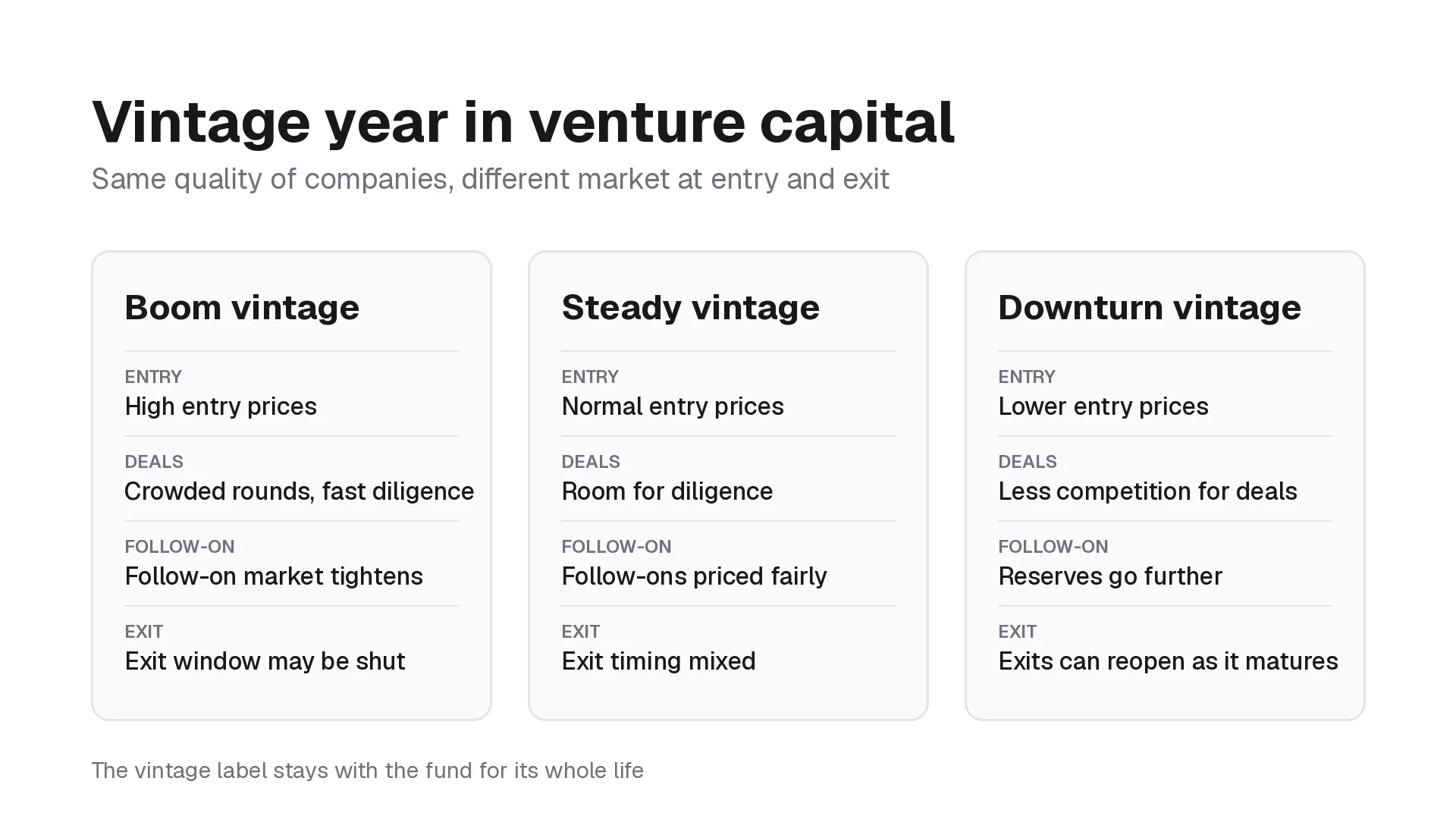
A vintage year is the year a venture fund starts investing, and it decides which funds you can fairly compare. Here is how vintage gets assigned, why it moves returns, and what it means for the job, carry, and interviews at a VC firm.
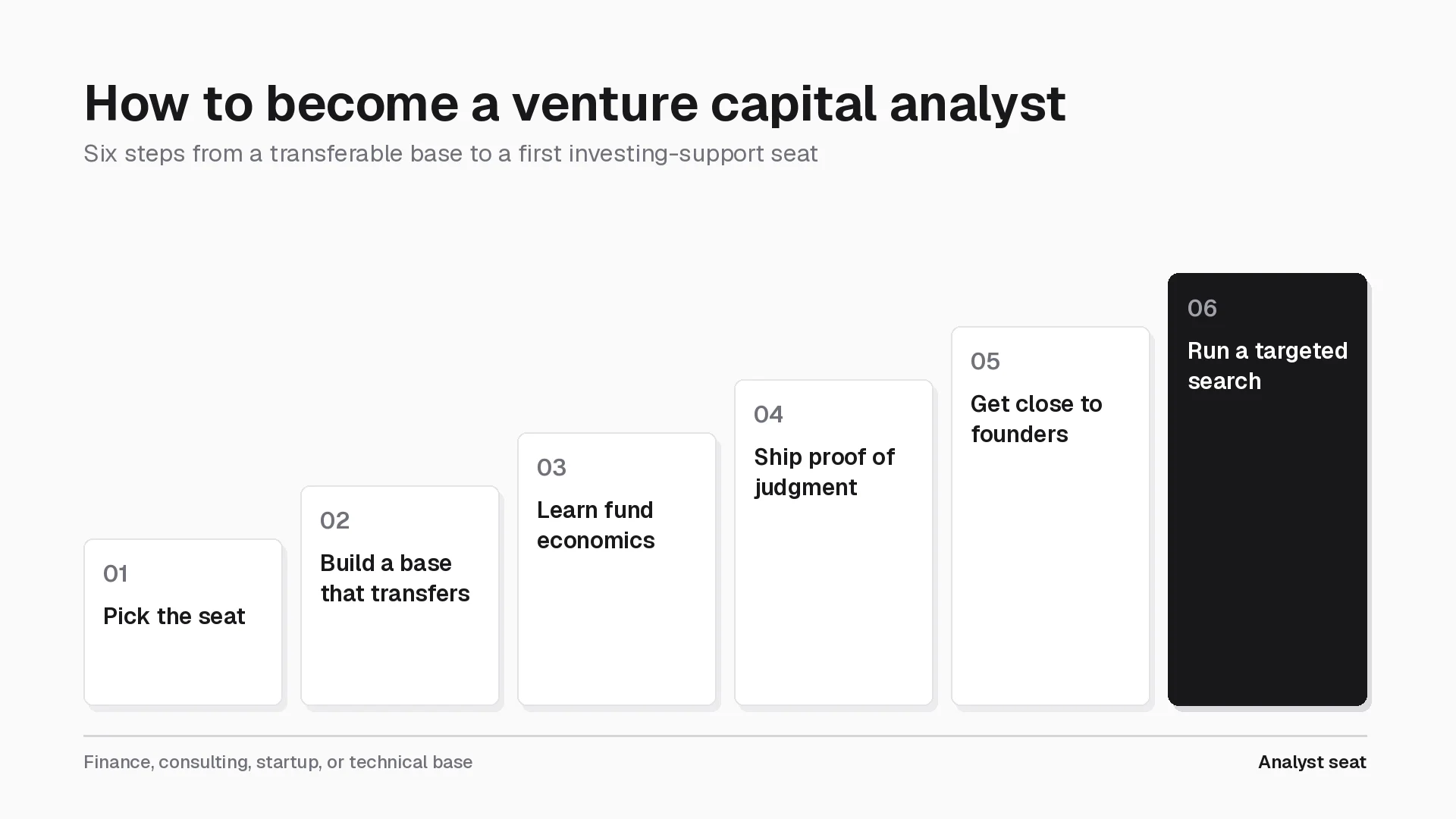
How to become a venture capital analyst in six steps: pick the seat, build a transferable base, ship proof of judgment, and target the firms that still hire analysts. Includes entry routes, interviews, salary, and exit paths.
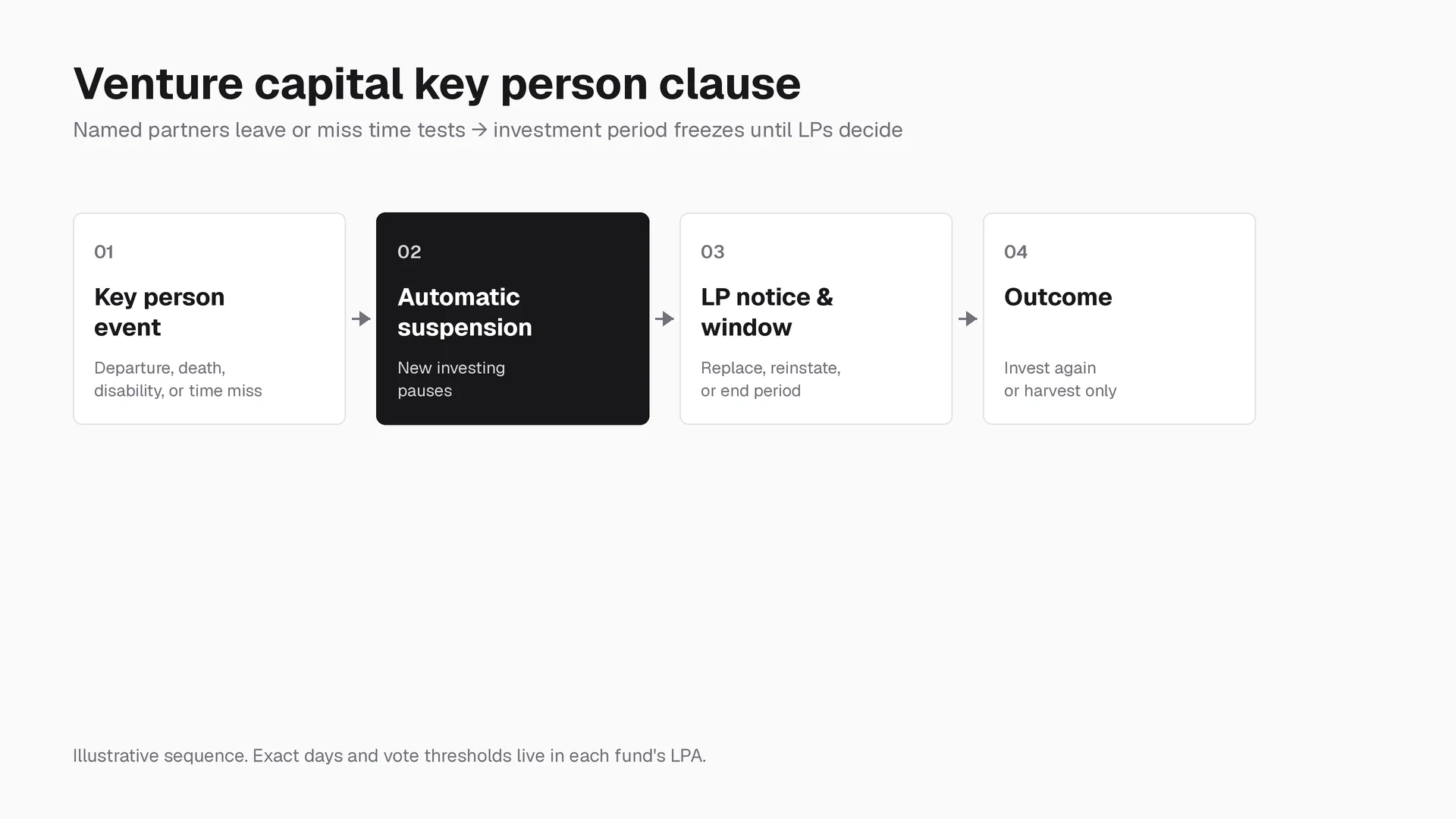
A key person clause names the partners a venture fund depends on and can freeze new investing if they leave. Here is how the trigger works, what still happens during a suspension, and what it means for your job search and seat.