
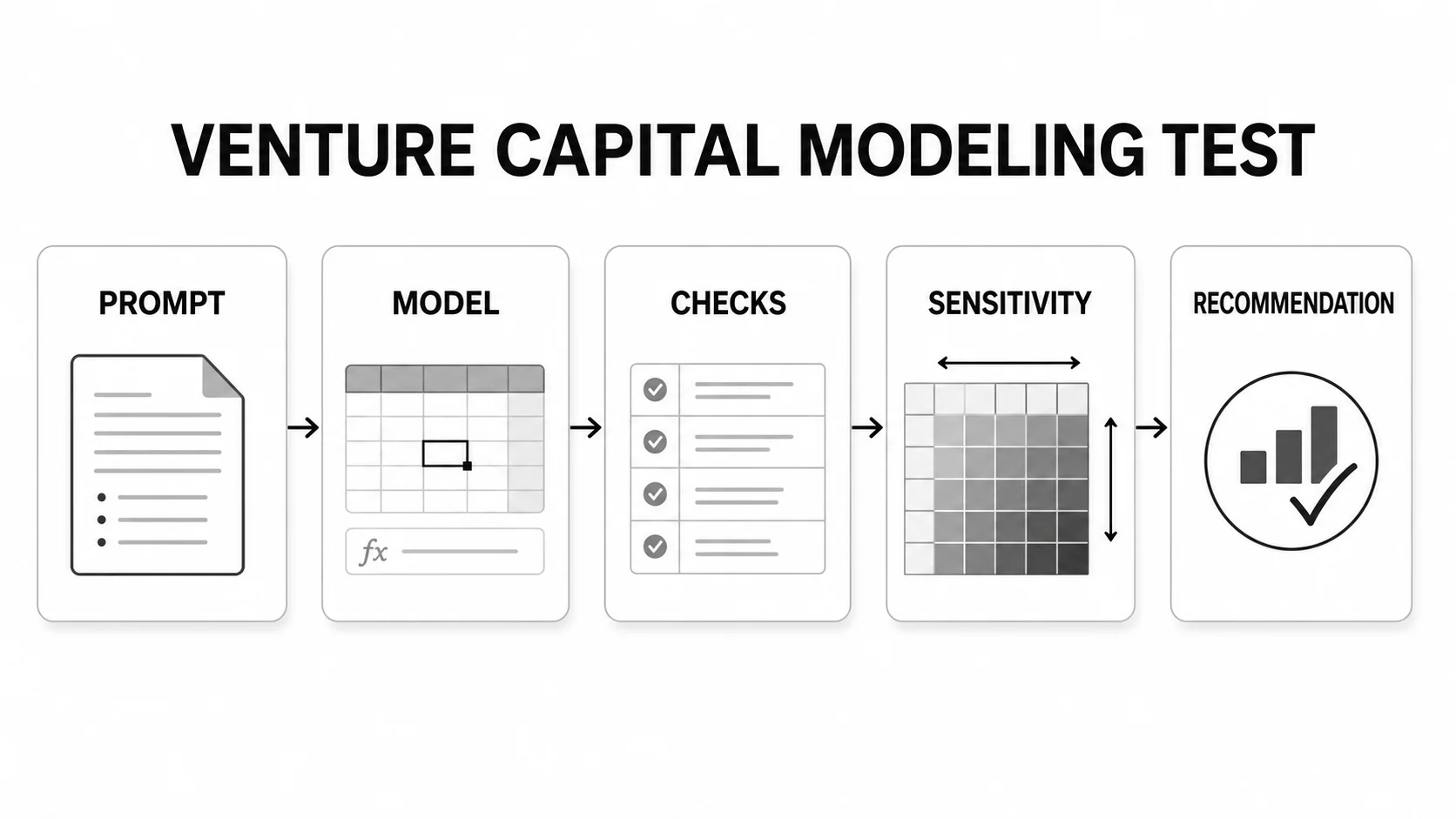
A venture capital modeling test asks you to turn incomplete company information into a model that supports an investment decision. It may focus on revenue drivers, runway, a financing and cap table, entry valuation, exit outcomes, or a combination of those tasks.
The right response is not the largest spreadsheet you can build. It is the minimum auditable model that answers the fund's question, shows which assumptions drive the result, and gives you enough evidence to recommend invest, pass, or continue diligence. The expected depth changes with the fund's stage and the data in the prompt.
What a venture capital modeling test actually tests
A modeling exercise tests more than spreadsheet mechanics. The reviewer is usually looking for five things:
- Prioritization: Did you identify the two or three variables that drive the investment outcome?
- Financial fluency: Can you translate a business model into revenue, cost, cash, ownership, and return logic?
- Assumption quality: Are your inputs explicit, internally consistent, and defensible?
- Error control: Can another person follow the model and trust that the outputs reconcile?
- Investment judgment: Can you explain what the model supports, what it cannot prove, and what you would investigate next?
Formal cases and modeling exercises are possible in VC recruiting, but they are not universal or standardized. Mergers & Inquisitions' VC recruiting overview describes them as less common than research, firm-specific, and deal questions. The format depends on the firm's stage, sector, role, and interview process. A seed fund may give you a deck and ask for a compact runway or ownership analysis. A growth investor may expect a fuller operating forecast and returns case. Some firms will skip the spreadsheet and ask for a market or company recommendation instead.
The model is therefore not the final product. It is evidence for a decision. If you can build a technically polished workbook but cannot say why the company is attractive, which assumption matters most, or what could break the thesis, you have only completed half the exercise.
Use the firm's prompt as the source of truth. For the wider qualitative round, prepare separately with VCC's venture capital case study interview framework and VC interview questions.
The four modeling-test archetypes
Most VC modeling exercises are one of four archetypes, or a combination of them.
| Archetype | Prompt clues | Core output | Common trap |
|---|---|---|---|
| Operating model | Forecast revenue, customers, margins, burn, or runway | Driver-based operating forecast with downside case | Building a full accounting model when two operating drivers answer the question |
| Cap table | Model a round, option pool, dilution, SAFE conversion, or exit waterfall | Ownership bridge by stakeholder and round | Mixing pre-money and post-money ownership or applying dilution in the wrong order |
| Return case | Assess valuation, entry ownership, exit outcomes, or fund return | Exit-value range, proceeds, MOIC, and sensitivities | Treating one exit multiple as certain or ignoring dilution |
| Model plus recommendation | Build a model and present an invest/pass view | Auditable workbook plus memo or slides | Spending all available time on Excel and leaving no clear conclusion |
First identify the archetype. Then list the outputs the reviewer must be able to find. If the prompt asks, "How much capital does the company need before breakeven?", the answer requires a cash and runway model. It does not automatically require a debt schedule, deferred-tax schedule, or detailed balance sheet.
If the prompt asks for ownership after a financing, build the cap table before forecasting five years of revenue. If it asks whether an entry valuation can produce an acceptable outcome, start with ownership, dilution, exit value, and proceeds. VCC's venture capital method valuation article covers the deeper mechanics when that method is relevant.
Write the archetype and required outputs at the top of your scratch page before opening Excel. That small step prevents the most common strategic error: solving the exercise you practiced instead of the exercise you were given.
How model depth changes by investment stage
The same prompt should produce a different model at a seed fund and a growth-stage fund because the evidence is different. A useful principle, also reflected in this stage-sensitive financial-modeling overview, is that modeling becomes more decision-relevant as a company matures and produces more operating evidence.
| Fund focus | Evidence likely available | Model emphasis | Usually keep light |
|---|---|---|---|
| Pre-seed / seed | Product plan, early users, pricing, headcount, cash, proposed round | Driver cases, burn, runway, financing need, ownership, large sensitivities | Detailed margin build, working capital, point-estimate valuation |
| Series A / B | Revenue history, customer or cohort data, sales productivity, gross margin, hiring plan | Revenue drivers, unit economics, cash needs, dilution, milestone scenarios, exit range | Full debt mechanics and false precision beyond the evidence |
| Growth stage | Multi-year financials, retention, cohorts, pipeline, margins, operating costs | Detailed operating build, KPI trends, scenario cases, valuation, ownership, return outcomes | Early-stage proxy metrics when company data exists |
At seed, the model is a map of possible futures. Its main value is exposing capital requirements and the assumptions that must hold. At growth stage, there is enough history to test forecast credibility, sales efficiency, cohort behavior, and operating leverage.
When data is missing, do not silently invent precision. Use a simple assumption, label it, and show the sensitivity. A range that makes the decision boundary visible is more useful than a single unsupported number.
A practical rule is:
- Build historical detail only where it helps you set or test an assumption.
- Forecast the drivers that change the investment conclusion.
- Model ownership and cash whenever financing changes either one.
- Stop adding detail when another schedule would not change a decision, sensitivity, or check.
This is the minimum-auditable-model standard: enough structure for another investor to trace the logic, but no complexity that exists only to make the workbook look substantial.
VC modeling test vs LBO modeling test
A venture capital model and an LBO model can both end with an investment return, but the path is different.
| Dimension | VC modeling test | LBO modeling test |
|---|---|---|
| Main uncertainty | Product-market fit, growth, financing, dilution, and exit scale | Entry price, leverage, cash generation, debt paydown, and exit multiple |
| Capital structure | Equity rounds, SAFEs or notes, option pools, preferred terms | Debt tranches, interest, mandatory amortization, cash sweep |
| Forecast precision | Often wide ranges with sparse data | More anchored to mature-company history |
| Core returns bridge | Entry ownership → dilution → exit proceeds | Entry equity → debt paydown → exit equity |
| Decision focus | Can this become a fund-relevant outcome, and what must be true? | Can cash flow support leverage and produce the target equity return? |
| Common failure | False precision and over-modeling | Broken debt mechanics or cash-flow sweep |
Importing an LBO template into a VC exercise can signal poor prioritization. You may spend time on debt, working capital, or accounting detail while missing the ownership bridge, financing need, or customer-level driver that decides the case.
That does not mean VC models can be sloppy. They still need consistent periods, clean formulas, traceable assumptions, and reconciled outputs. The difference is where precision belongs. In early-stage investing, precision should sit in the mechanics—how revenue drivers connect, how dilution flows, how cash changes—not in pretending the fifth-year forecast is known.
When the prompt is ambiguous, ask one concise clarifying question if the process allows it: "Would you like the model to focus on operating runway, ownership and returns, or both?" If you cannot ask, choose the smallest structure that covers the stated deliverables and make the choice visible.
A 90-minute practice build order
Ninety minutes is a useful practice scenario, not a universal VC test duration. The goal is to train prioritization under pressure. If your actual exercise is longer, preserve the sequence and use the extra time for deeper diligence, cleaner sensitivities, and a stronger written output.
| Time | Task | Deliverable |
|---|---|---|
| 0-10 minutes | Read the prompt twice; list required outputs, units, periods, and constraints | Build plan and explicit finish line |
| 10-25 minutes | Create tabs or sections, input assumptions, timeline, and output skeleton | Auditable workbook structure |
| 25-55 minutes | Build the core operating, cap-table, or return mechanics | Base case that runs end to end |
| 55-70 minutes | Add the most decision-relevant downside and sensitivity | Decision boundary, not scenario clutter |
| 70-80 minutes | Run checks and repair errors | Reconciled model |
| 80-90 minutes | Write the recommendation and improve readability | Clear conclusion and usable handoff |
The key is to get one complete path working before adding detail. A partial base case plus five unfinished schedules is weaker than a simple model that produces a defensible answer.
Use consistent visual conventions: one style for inputs, one for formulas, one for linked outputs. Keep units and dates visible. Put the headline outputs where a reviewer can find them in seconds. Under time pressure, avoid decorative formatting that does not improve navigation or expose an error.
For a take-home exercise, add a research log, source notes, a fuller downside case, and a short memo. Do not use the longer deadline as permission to create complexity without decision value.
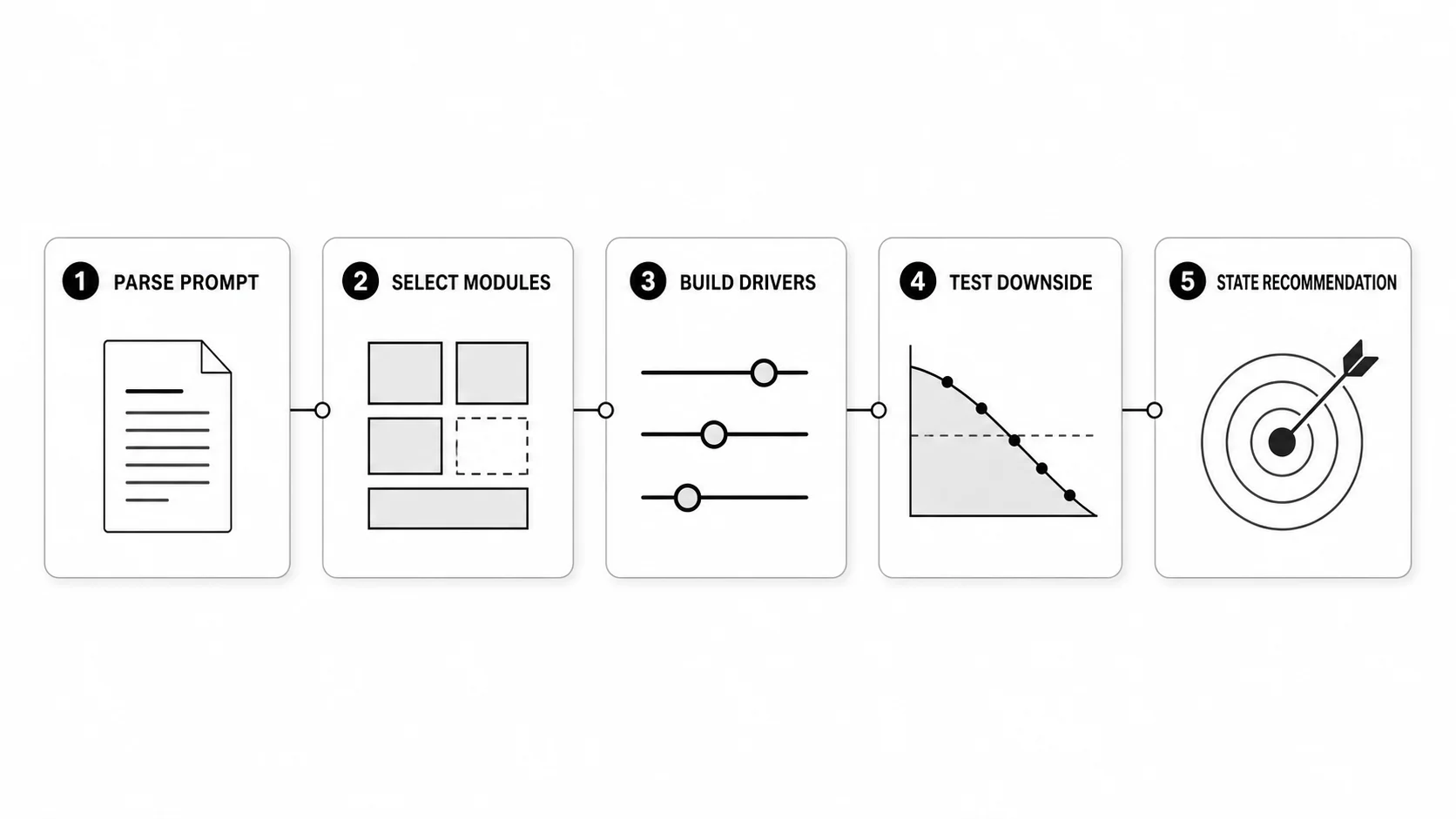
The minimum model that can answer the investment question
Imagine a Series A SaaS company with two years of monthly revenue, customer counts, gross margin, operating costs, cash, a proposed financing, and an entry valuation. The prompt asks whether the investment can produce an attractive outcome without another round before a stated milestone.
Build:
- A revenue bridge driven by starting customers, new customers, churn, and average revenue per customer.
- Gross profit and operating costs at a level that exposes burn.
- Cash balance and runway, including the proposed financing.
- Entry ownership and a simple dilution assumption if another round is plausible.
- An exit-value range and investor proceeds.
- Base, downside, and one decision-relevant sensitivity.
Do not automatically build:
- A detailed debt schedule when there is no debt.
- A full fixed-asset roll-forward when capital expenditure is immaterial.
- Monthly working-capital lines unsupported by the prompt data.
- Five customer segments when one or two explain the business.
- A single "precise" exit multiple without a range.
The decision rule is simple: every module must answer one of four questions.
- How does the company grow?
- How much cash does it need?
- What will the investor own?
- What outcome can that ownership produce?
If a schedule does not change one of those answers, support a check, or satisfy an explicit instruction, it is probably optional.
Revenue can grow and returns can still disappoint if entry valuation is too high, dilution is heavy, or the exit range is unrealistic. The spreadsheet should make those tradeoffs obvious.
Model checks before you submit
Run a deliberate QA pass. Do not rely on the absence of spreadsheet error messages.
- Inputs and formulas: Inputs are visibly distinct. Formula cells do not contain unexplained hard-coded values.
- Units and periods: Dollars, thousands, millions, percentages, monthly periods, and annual periods are labeled and used consistently.
- Signs: Revenue, costs, cash outflows, financing inflows, and investor proceeds follow one sign convention.
- Timeline: Opening balances, financing dates, cohort starts, and exit timing align with the intended period.
- Cash and runway: Beginning cash plus financing minus burn equals ending cash. The runway date moves correctly when assumptions change.
- Ownership: Pre-money and post-money ownership, option-pool changes, security conversion, and later dilution reconcile to 100%.
- Valuation and returns: Exit value, ownership at exit, proceeds, and return multiples use the same case and timing.
- Sensitivities: Changing an important input changes the expected outputs in the right direction.
Then test economic sense. If churn rises, does revenue fall? If the financing is delayed, does runway shorten? If entry valuation increases for the same check size, does ownership decline? If a larger future round is required, do current-investor proceeds reflect dilution?
Add a small checks box with clear OK or error flags for the most important reconciliations. Reopen or recalculate the workbook before submission; broken external links, manual calculation mode, hidden errors, and unsupported add-ins can turn a correct model into an unusable file.
How modeling tests are likely to be scored
Firms rarely share an exact rubric, but you can review your work through six lenses:
| Dimension | Strong submission | Weak submission |
|---|---|---|
| Correctness | Mechanics reconcile and outputs move logically | Broken formulas, inconsistent timing, or unexplained plugs |
| Structure | Inputs, calculations, checks, and outputs are easy to trace | Scattered assumptions and opaque formulas |
| Assumptions | Major assumptions are explicit and defensible | Precision is invented or key inputs are hidden |
| Decision relevance | Model isolates the drivers that determine invest/pass | Workbook contains detail without a decision boundary |
| Sensitivity | Downside tests the thesis and shows what must be true | Many scenarios change labels but not insight |
| Communication | Recommendation follows from the model and states limits | Workbook ends without a view or overclaims certainty |
Correctness is necessary, but it is not sufficient. A clean model with a weak investment conclusion suggests you can operate Excel but have not yet shown investor judgment. A thoughtful conclusion built on broken mechanics is equally weak.
Reviewers also notice how you handle tradeoffs. Score your practice models before checking an answer key: did you finish the core model, state and test assumptions, and investigate the downside?
How to explain your recommendation
Your conclusion should be short enough to say before the reviewer asks a follow-up question. Use four parts:
- Decision: Invest, pass, or continue diligence.
- Key driver: The one assumption or operating mechanism that creates the outcome.
- Downside: The scenario that breaks the thesis or requires more capital.
- Next diligence: The evidence that would most change your confidence.
A concise example:
Example: I would continue diligence rather than commit at the proposed terms. The base case can reach the target outcome if customer retention holds and the company reaches the next milestone without an additional round. The downside case requires more capital, dilutes entry ownership, and reduces proceeds below the fund's likely threshold. I would next validate retention by cohort and the hiring plan that drives the cash requirement.
Avoid presenting the model as proof. A spreadsheet converts assumptions into consequences; it does not validate the assumptions. Say which inputs came from the prompt, which you estimated, and where the recommendation is most sensitive.
If your answer is "pass," make it specific. "The company is risky" is not an investment conclusion. "At the proposed valuation, even the strong operating case does not produce enough ownership-adjusted upside for the downside financing risk" is.
For a take-home assignment, the same logic can lead the executive summary of an investment memo. Keep the workbook and the written recommendation consistent: the memo should not cite a base-case output from one version while the submitted spreadsheet shows another.
A focused preparation plan
Preparation should produce repeatable judgment, not a folder of templates you cannot adapt.
- Build one model from a blank workbook. Practice translating a short company description into drivers, outputs, and checks without relying on a memorized layout.
- Drill ownership mechanics. Model a priced round, option-pool change, and one later dilution event.
- Drill one return case. Connect entry ownership to an exit range and investor proceeds. Review venture capital fund performance metrics so you can discuss MOIC without confusing it with fund-level IRR.
- Run a timed test. Use the 90-minute scenario above. Finish, submit to yourself, then audit it as if you were the reviewer.
- Run a take-home test. Add sources, a downside case, and a one-page recommendation. Check whether every extra schedule changes the decision.
Keep an error log. Record the mistake, why it happened, the check that would have caught it, and the workbook convention that prevents it next time. Common entries include off-by-one timing, reversed signs, ownership not summing, circular references, and sensitivity tables linked to the wrong output.
Before a real interview, research the target firm's stage, sectors, check sizes, and portfolio through the VCC companies directory. A growth-stage software investor and a pre-seed biotech fund will not value the same model modules.
Common mistakes
| Mistake | Why it hurts | Better approach |
|---|---|---|
| Building before defining the output | Encourages familiar schedules instead of prompt-specific work | Write the required outputs and archetype first |
| Overbuilding | Creates more formulas to break and less time to interpret them | Add a schedule only when it changes a decision or supports a check |
| Copying an LBO structure | Buries the ownership, financing, and operating drivers that matter in venture | Start from the VC investment question |
| Hiding assumptions | Makes the model difficult to review or defend | Put material inputs in a labeled assumptions block |
| Treating a point estimate as truth | Hides the uncertainty in early-stage forecasts | Show the range that changes the recommendation |
| Skipping ownership, dilution, or cash | Disconnects company growth from the investor outcome | Model runway and ownership when more capital is possible |
| Submitting without a recommendation | Makes the reviewer infer your view | State the decision, driver, downside, and next diligence |
| Polishing before the model works | Consumes time without fixing incomplete mechanics | Complete the calculation path, run checks, then format |
Frequently asked questions
Are modeling tests common in VC interviews?
They appear in some processes, especially for investing roles that require quantitative company analysis, but they are not universal. A firm may use a cap-table exercise, a simple operating model, a return case, a broader investment case, or no spreadsheet at all. Ask the recruiter about format and deliverables when appropriate.
Do I need a full three-statement model?
Only when the prompt, company stage, or available data makes it decision-relevant. Many early-stage tests can be answered with a driver-based revenue and cost model, cash runway, ownership, and return outputs. Growth-stage exercises may justify more detail.
Should I use Excel or Google Sheets?
Use the tool specified by the firm. If the prompt does not specify one, Excel is a safe default for a file-based finance exercise, while Google Sheets can work for collaborative or browser-based tasks. Avoid unsupported add-ins, macros, or external links unless explicitly allowed.
Which startup metrics should I know?
Know how revenue connects to the business model. Depending on the company, that may include customers, average contract value, retention, churn, gross margin, customer acquisition cost, payback, burn, and runway. Do not force SaaS metrics onto a marketplace, consumer, hardware, or biotech company.
Can the correct recommendation be to pass?
Yes. An evidence-based pass can demonstrate stronger judgment than an optimistic invest recommendation. Explain whether the problem is valuation, ownership, financing risk, operating assumptions, fund fit, or missing evidence—and what would change your mind.
Put the preparation into context
The best practice model is matched to the investor evaluating it. Research the firm's stage, portfolio, sectors, and likely decision questions before you decide which modules deserve the most attention.
Build a focused firm list, then browse open venture capital roles to see where your background and technical preparation fit. If you are actively applying, create a candidate account so the modeling work supports a broader search rather than becoming an isolated technical drill.
The aim is not to produce the largest workbook. It is to make the investment logic inspectable: what must be true, what breaks first, what the investor could own, and what outcome that ownership can produce.
Related posts
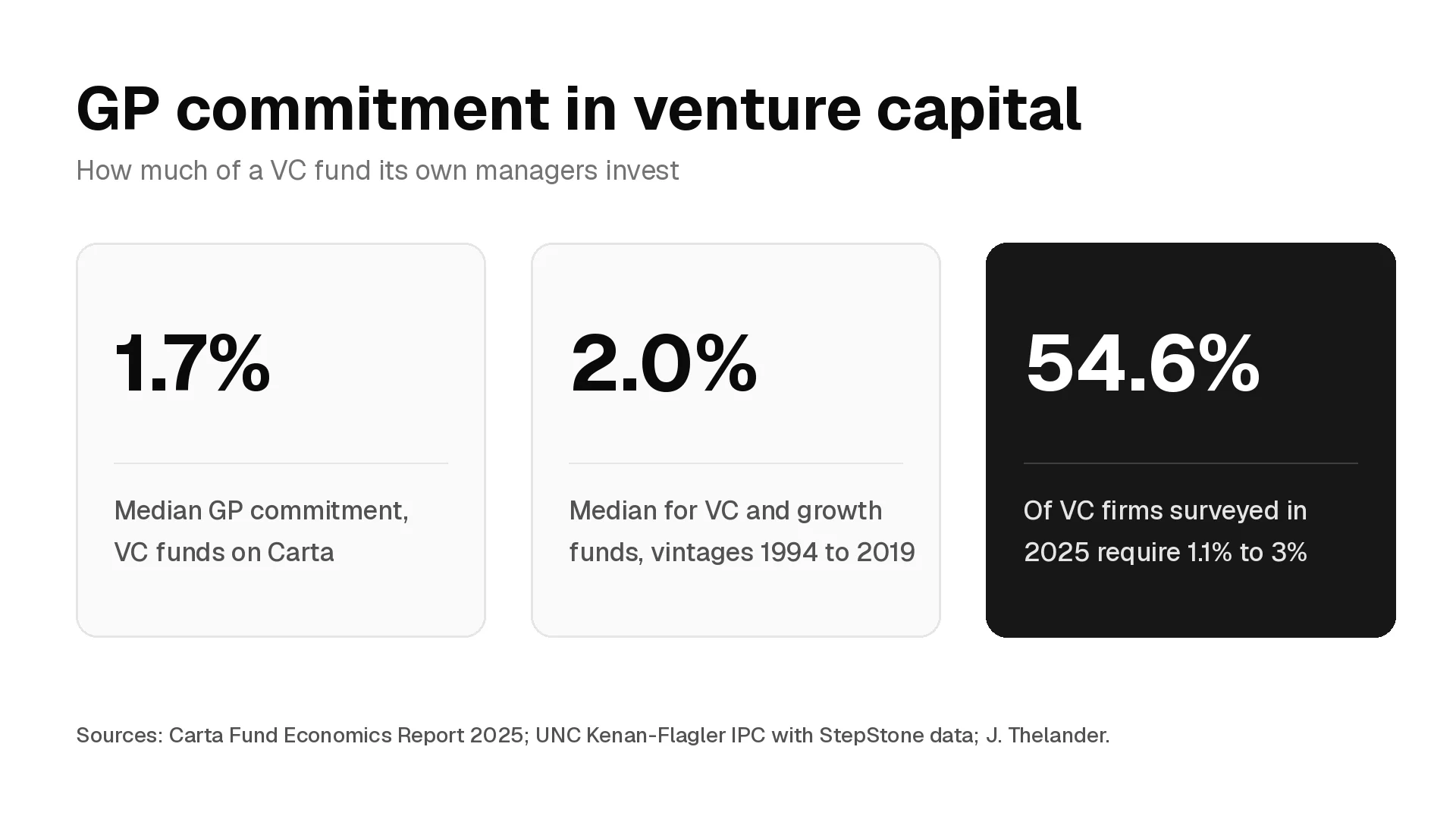
What a GP commitment is, how large it is in venture capital, how GPs fund it, where it sits in the LPA, what the returns evidence says, how firms split it across partners and principals, and what to ask before you accept a role with carry.
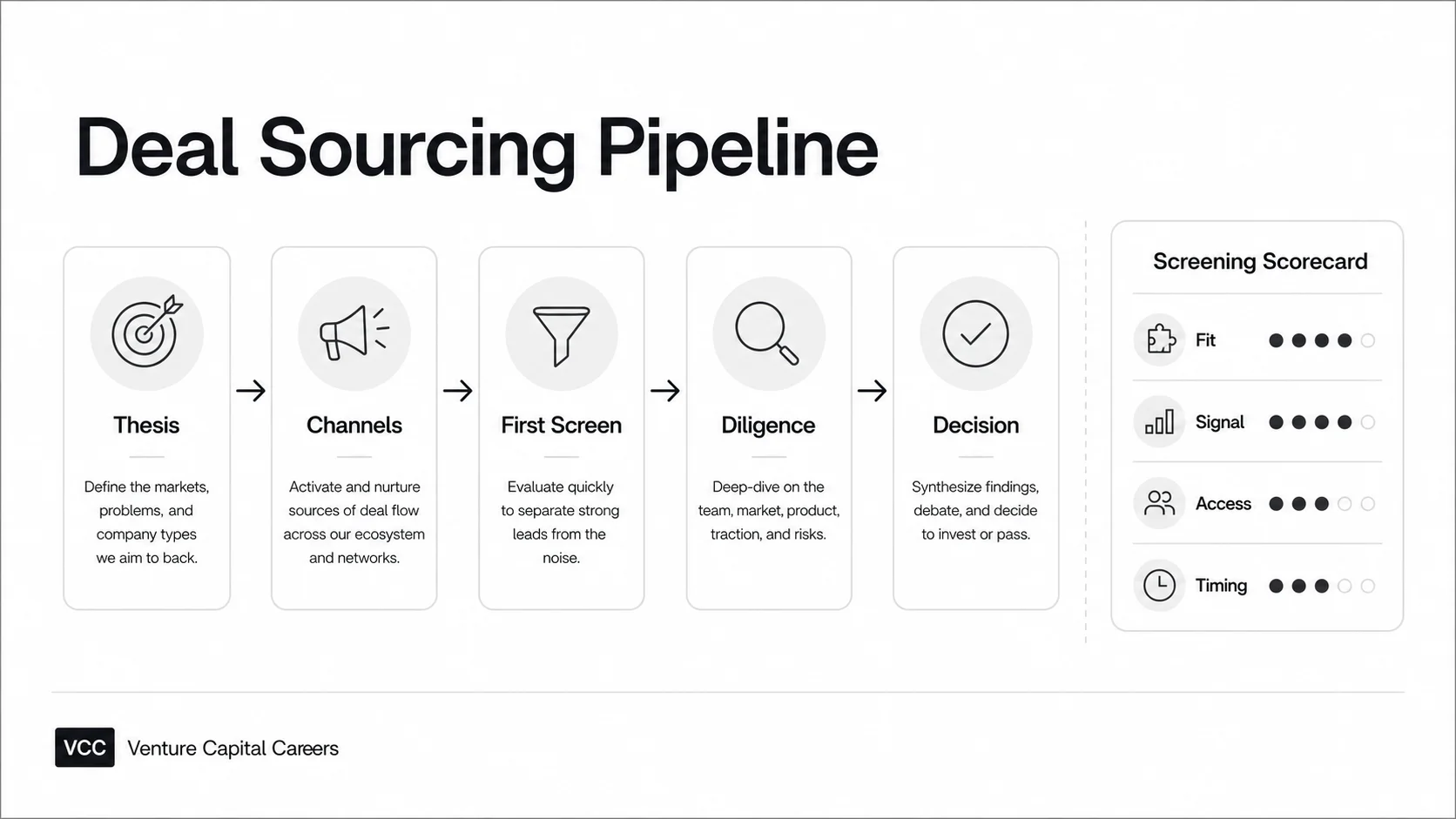
Most closed VC deals start with a relationship. See where deals come from by stage, how to work each sourcing channel, which signals show up early, and how analysts run a weekly sourcing process.
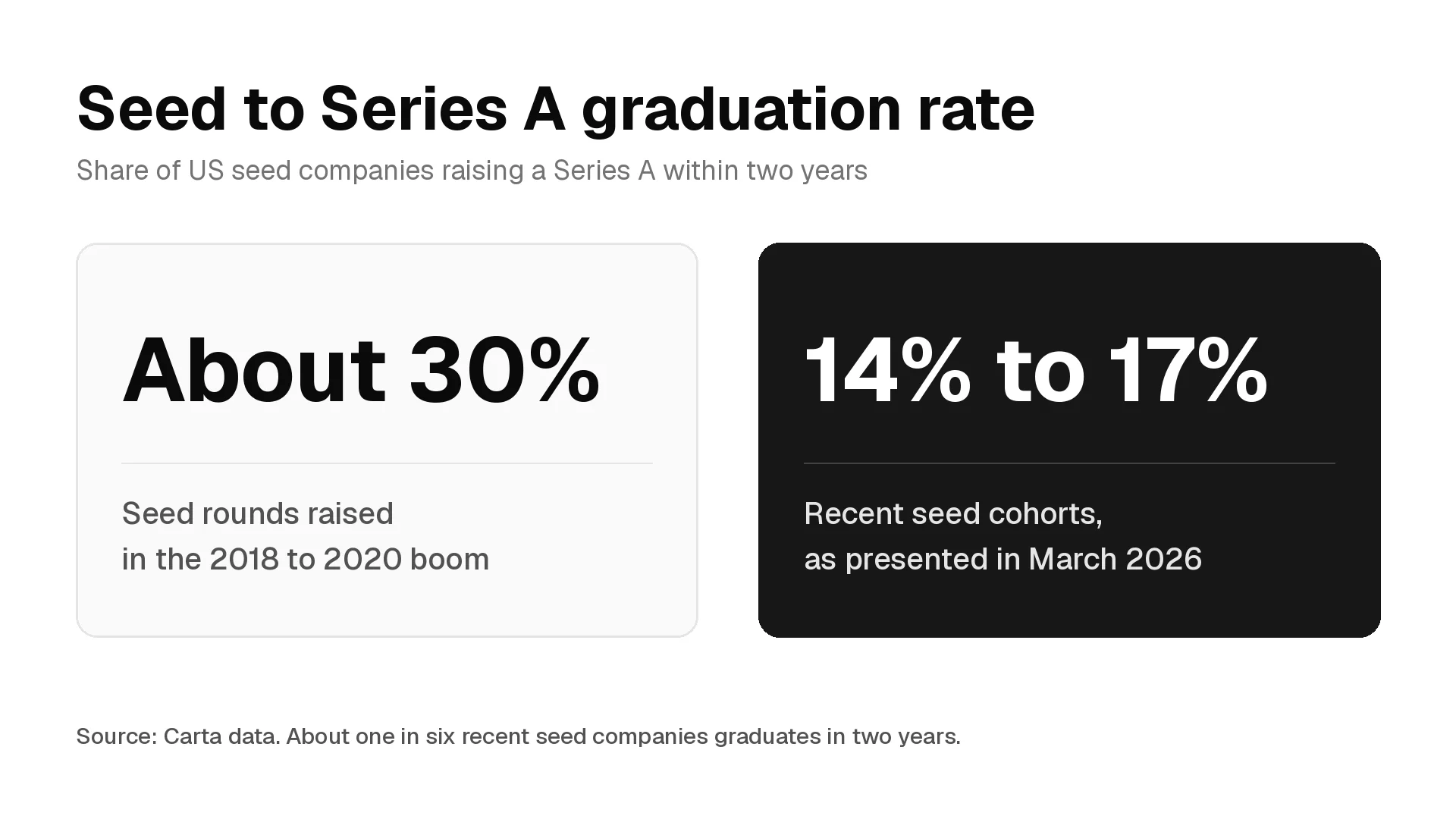
Seed to Series A graduation rates by cohort from Carta and Crunchbase, how long the jump takes, why rates fell after 2021, why published figures disagree, and how seed and Series A firms use the rate for reserves, LP reporting, portfolio reviews and interviews.