
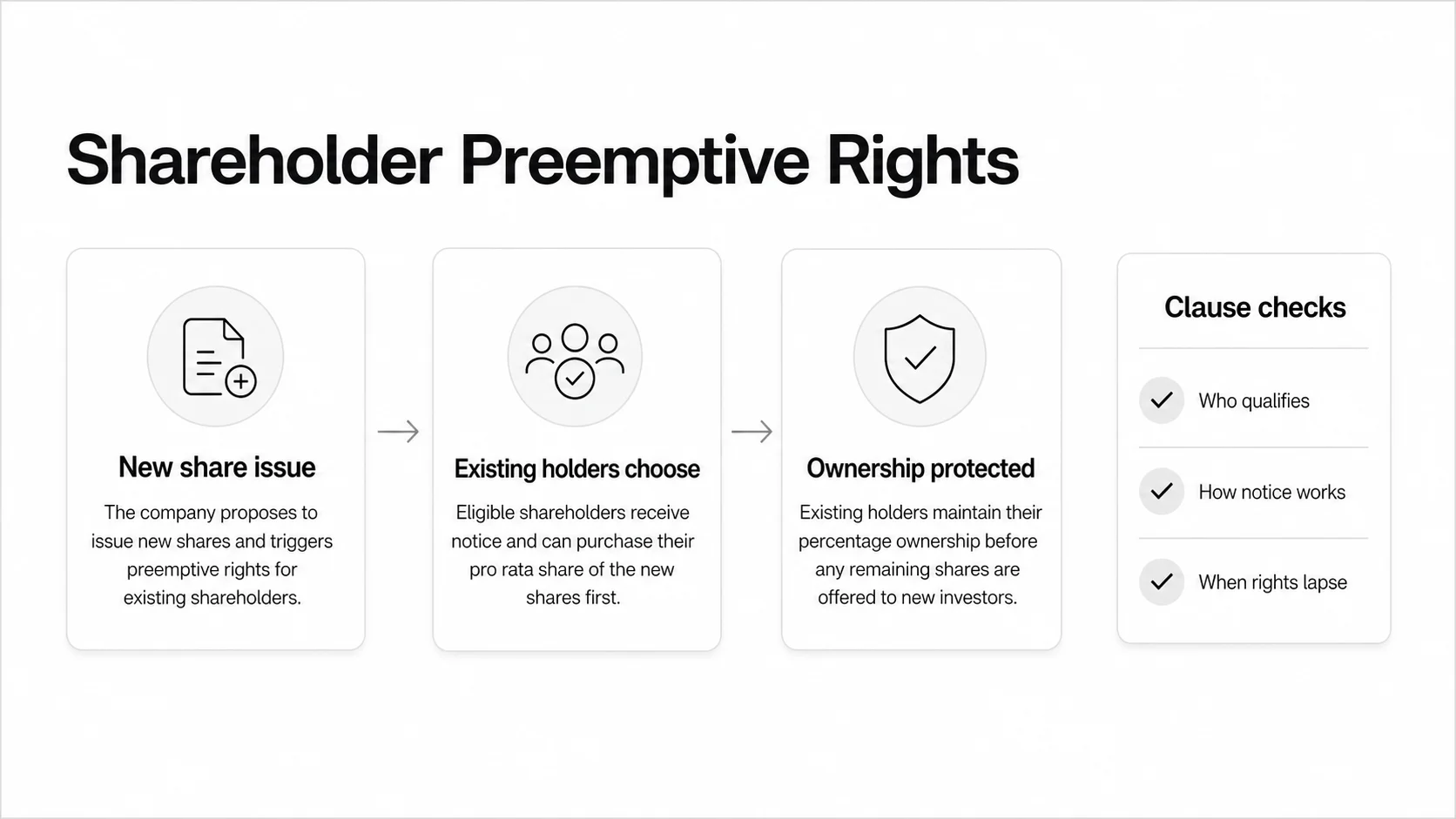
Shareholder preemptive rights give existing shareholders the first opportunity to buy newly issued shares before the company sells those shares to new investors. The point is simple: if the company creates more shares, an existing holder can buy enough of the new issuance to preserve the same ownership percentage.
That makes preemptive rights a dilution-control tool. They do not guarantee that a shareholder avoids dilution automatically. The shareholder usually has to receive notice, decide whether to participate, and fund the purchase within the required window.
Preemptive rights are also document-specific. They may come from a statute, the company's charter, a shareholder agreement, or an investor rights agreement. In the United States, many corporations do not have automatic preemptive rights unless the governing documents provide for them. Cornell's Wex definition makes the same core point: the right is meant to protect current shareholders from dilution, but it is usually set out in the corporate charter when recognized.
This is not legal advice. The exact rule depends on the company's jurisdiction, charter, agreements, share class, and financing documents. The practical question is whether the documents give a specific holder a right to participate in the next issuance, and on what terms.
What are shareholder preemptive rights?
A preemptive right is a right of first opportunity in a new share issue. If a company plans to issue additional shares, eligible existing shareholders get the chance to buy their pro rata portion before outsiders receive the shares.
For example, assume an investor owns 10% of a startup before a new financing. If the company issues new shares and the investor has preemptive rights, the investor may be allowed to buy enough of the new shares to stay at roughly 10%, subject to the agreement's limits and the investor's ability to fund the purchase.
Preemptive rights sit within the broader set of legal rights shareholders may have. Depending on the company and jurisdiction, shareholder rights can include voting rights, inspection or information rights, dividend rights, transfer rights, litigation rights, and rights connected to new issuances. Preemptive rights are the part of that toolkit focused on future share issuance.
How preemptive rights work in a new share issue
The process usually follows a predictable sequence.
- The company approves a new issuance of shares or securities.
- The company identifies which existing holders qualify for preemptive rights.
- Eligible holders receive notice describing the securities, price, deadline, and how many shares they may purchase.
- Each holder decides whether to exercise, waive, or ignore the right.
- The company sells any unpurchased shares to the new investor or other permitted buyers.
The key detail is the pro rata allocation. A shareholder does not normally get a right to buy the whole financing. The right usually covers the amount needed to preserve that shareholder's percentage ownership, unless the documents also include oversubscription rights or other allocation mechanics.
Why shareholders ask for preemptive rights
Shareholders ask for preemptive rights because new share issues can dilute both economics and control.
| Concern | How preemptive rights help |
|---|---|
| Ownership dilution | The holder can buy new shares to maintain its percentage ownership. |
| Voting dilution | The holder can preserve voting influence if the new shares carry voting power. |
| Economic exposure | The holder can keep participating in upside if the company raises at an attractive valuation. |
| Information discipline | The company must notify eligible holders before completing covered issuances. |
| Relationship management | Existing investors are not surprised by a financing that changes the cap table. |
In venture capital, the right matters most when an early investor wants to keep ownership through later rounds. It can also matter for founders, angels, family offices, strategic investors, and major common shareholders who do not want to be diluted without an opportunity to participate.
Where preemptive rights appear
Preemptive rights can be statutory or contractual.
Statutory preemptive rights come from corporate law. Some statutes make clear that shareholders have no preemptive right unless the company's articles or charter opt in. Arizona's corporate statute is one example of an opt-in approach: it says shareholders do not have preemptive rights to unissued shares except to the extent the articles provide for them, and it also describes written waiver and exceptions in that statutory scheme. See Arizona Revised Statutes section 10-630.
Contractual preemptive rights come from the company's own documents. They may appear in:
- Articles of incorporation or the corporate charter.
- A shareholder agreement.
- An investor rights agreement.
- A financing agreement tied to a preferred stock round.
- A side letter for a major investor.
That distinction matters because the same phrase can be used differently across jurisdictions and documents. A legal journal abstract on preemptive rights describes this statutory-versus-contractual split and notes that the phrase can cover both new share issuances and transfer-related arrangements in some contexts. See Kluwer Law's Business Law Review abstract.
Preemptive rights vs pro rata rights, anti-dilution, and ROFR
Preemptive rights are often confused with nearby investor protections. They are related, but not interchangeable.
| Right | Trigger | What the holder can do | Main purpose |
|---|---|---|---|
| Preemptive right | Company issues new shares | Buy a pro rata portion before shares go to others | Preserve ownership percentage in a new issuance |
| Pro rata right | Usually a future financing round | Invest enough to maintain ownership, often under an investor rights agreement | Preserve fund ownership through later VC rounds |
| Anti-dilution provision | Company issues shares at a lower price than a prior preferred round | Adjust conversion economics under the preferred stock terms | Protect preferred holders from down-round price dilution |
| Right of first refusal | A shareholder wants to sell existing shares | Company or other holders can buy before the shares transfer to a third party | Control transfers of existing shares |
For deeper context, read Venture Capital Careers on pro rata rights, anti-dilution provisions, right of first refusal, and term sheets.
The cleanest distinction is this: preemptive rights are about the company's issuance of new shares. ROFR is usually about a holder's sale of existing shares. Anti-dilution is about price protection. Pro rata rights are the VC-market version of future participation rights, often negotiated in investor rights agreements.
Waiver of preemptive rights
A waiver of preemptive rights means the shareholder gives up the opportunity to buy the new shares for that issuance, or sometimes gives up the right more broadly if the document says so.
Waivers can take several forms:
- Round-specific waiver: the holder waives rights for one financing.
- Written consent: the holder signs a consent approving the issuance without exercising.
- Deemed waiver: the holder fails to respond before the deadline, if the documents treat silence as a waiver.
- Blanket waiver or amendment: the documents are amended to remove or narrow preemptive rights going forward.
Do not treat waiver language as boilerplate. A waiver can change the shareholder's ownership, voting influence, future participation rights, and negotiating leverage. Before signing, a holder should know whether the waiver applies only to a specific issuance, whether it covers convertible securities or options, whether the price and investors are known, and whether the waiver affects future rounds.
Clause checklist for founders and investors
Use this checklist when reviewing a preemptive rights clause or financing notice with counsel.
| Question | Why it matters |
|---|---|
| Who qualifies? | The right may apply only to major investors, a class of shares, accredited investors, or holders above a threshold. |
| What securities are covered? | Shares, preferred stock, SAFEs, convertible notes, options, and warrants may be treated differently. |
| What issuances are excluded? | Employee equity, option plans, acquisition consideration, strategic deals, and conversion shares may be carved out. |
| How is the pro rata amount calculated? | The clause should specify whether ownership is measured before or after conversion and whether the holder can oversubscribe. |
| What notice is required? | The notice should describe price, security type, deadline, payment method, and consequences of not responding. |
| How long is the exercise period? | A short deadline can make the right difficult to use; a long deadline can slow the financing. |
| Can the right be transferred? | Some rights stay with the original investor; others may transfer with the shares or to affiliates. |
| What happens after waiver or lapse? | The company may be able to sell remaining securities to others, sometimes only within a defined time or at a minimum price. |
Law firm explainers often emphasize clear definitions, eligibility, process, deadlines, priority, and dispute-resolution mechanics in shareholder agreements. The Merton Lawyers overview is a useful example of that clause-level framing, though local law and document practice will vary.
When preemptive rights help, and when they slow a financing
Preemptive rights are most useful when the company wants to treat existing holders fairly and maintain confidence before issuing more equity.
They help when:
- A minority investor needs protection against unexpected dilution.
- A lead investor wants confidence that it can support future rounds.
- A founder wants to avoid surprising early backers.
- A company wants a disciplined process for follow-on participation.
They can slow a financing when:
- The company needs a fast bridge round.
- A strategic investor or new lead requires clean allocation.
- The cap table has many small holders who all need notice.
- The issuance is for employee equity or acquisition consideration.
- Existing holders use the process to delay a round they do not intend to fund.
The best clauses handle this tradeoff directly. They protect meaningful holders while giving the company enough flexibility to run employee option plans, close urgent financing, and issue securities that should not require a full preemptive rights process.
If you are modeling investor participation across rounds, compare this topic with follow-on investment and pre-money valuation. The economics of ownership maintenance only make sense when the financing math is clear.
Why VC candidates should understand preemptive rights
Preemptive rights show up in term sheets, investor rights agreements, cap table modeling, and diligence memos. Analysts and associates may need to understand whether a fund can maintain ownership, whether a new round triggers existing investor rights, and whether a waiver is routine or strategically important.
For candidates studying venture deal mechanics, this is the kind of term that separates surface-level interview prep from real investing fluency. Browse open roles on the Venture Capital Careers job board and use the companies directory to research firms that regularly negotiate startup financings, investor rights agreements, and follow-on allocations.
Frequently asked questions
Are preemptive rights automatic?
Not always. Preemptive rights depend on the jurisdiction and the company's governing documents. Many companies only have them if the articles, charter, shareholder agreement, or investor rights agreement provides for them.
Do common shareholders have preemptive rights?
Sometimes. Common shareholders may have preemptive rights if the relevant statute or company documents grant them. In many startup financings, negotiated participation rights are more commonly held by preferred investors or major investors than by every common shareholder.
Are preemptive rights the same as pro rata rights?
No. They overlap in purpose, but they are not always the same. Preemptive rights are often framed as a legal or charter-based first opportunity to buy new shares. Pro rata rights are commonly negotiated investor rights that let an investor maintain ownership in future VC rounds.
What is a waiver of preemptive rights?
A waiver is a shareholder's agreement not to exercise the preemptive right for a covered issuance, or to give up the right under specified terms. The waiver should be read carefully because it can affect ownership, voting power, and future participation.
Can a company issue shares without offering them to existing shareholders?
Yes, if no preemptive right applies or if the issuance falls within an exception. Common exceptions can include employee equity, securities issued on conversion of earlier instruments, acquisition consideration, or issuances approved under specific document procedures.
Are preemptive rights good for founders?
They can be. Preemptive rights can reassure investors and make future support easier. They can also create process friction if the cap table is broad or the company needs to close a financing quickly. Founders should negotiate the scope, exceptions, notice period, and waiver mechanics before the clause becomes a bottleneck.
Related posts

What a GP commitment is, how large it is in venture capital, how GPs fund it, where it sits in the LPA, what the returns evidence says, how firms split it across partners and principals, and what to ask before you accept a role with carry.
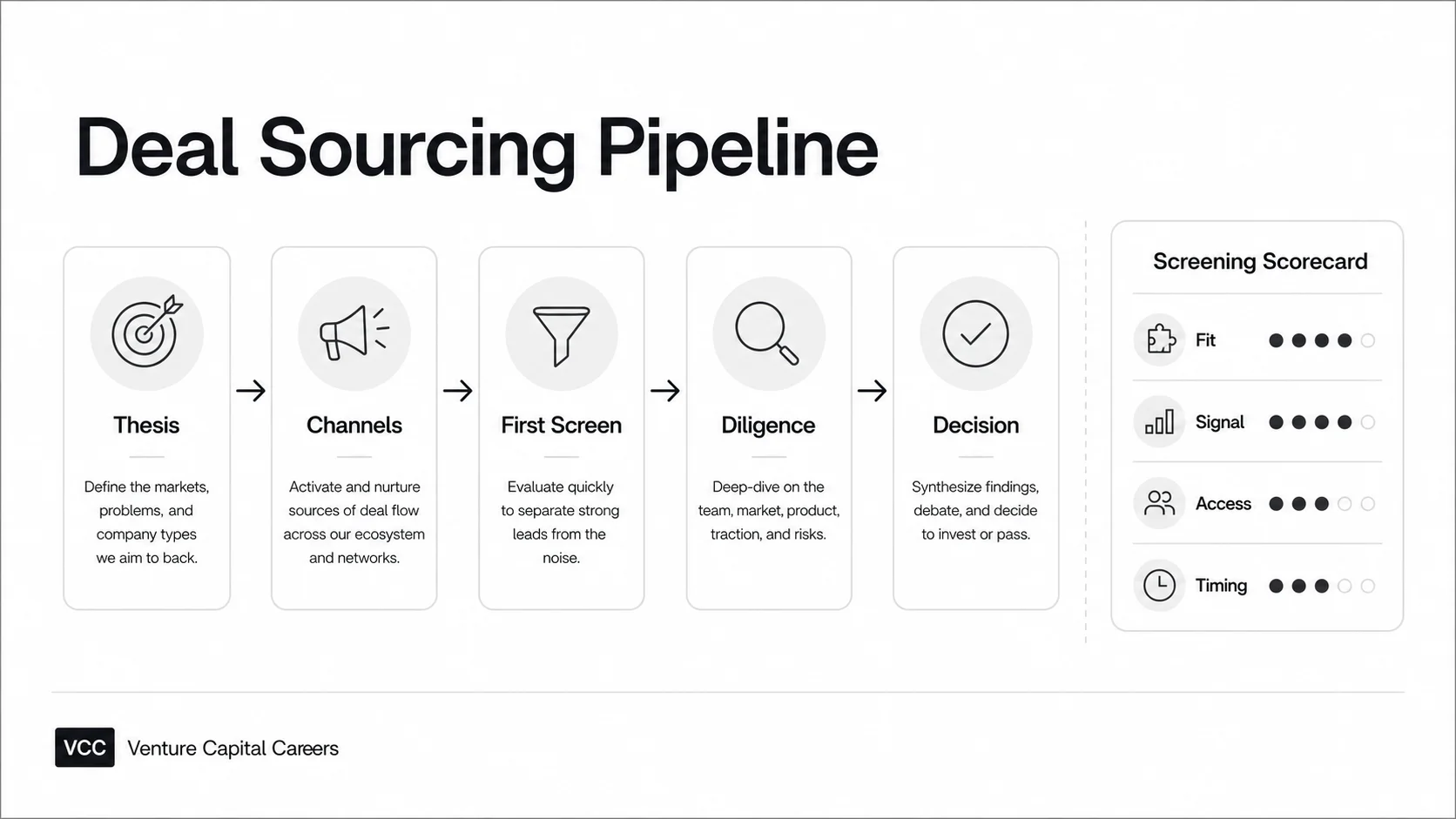
Most closed VC deals start with a relationship. See where deals come from by stage, how to work each sourcing channel, which signals show up early, and how analysts run a weekly sourcing process.
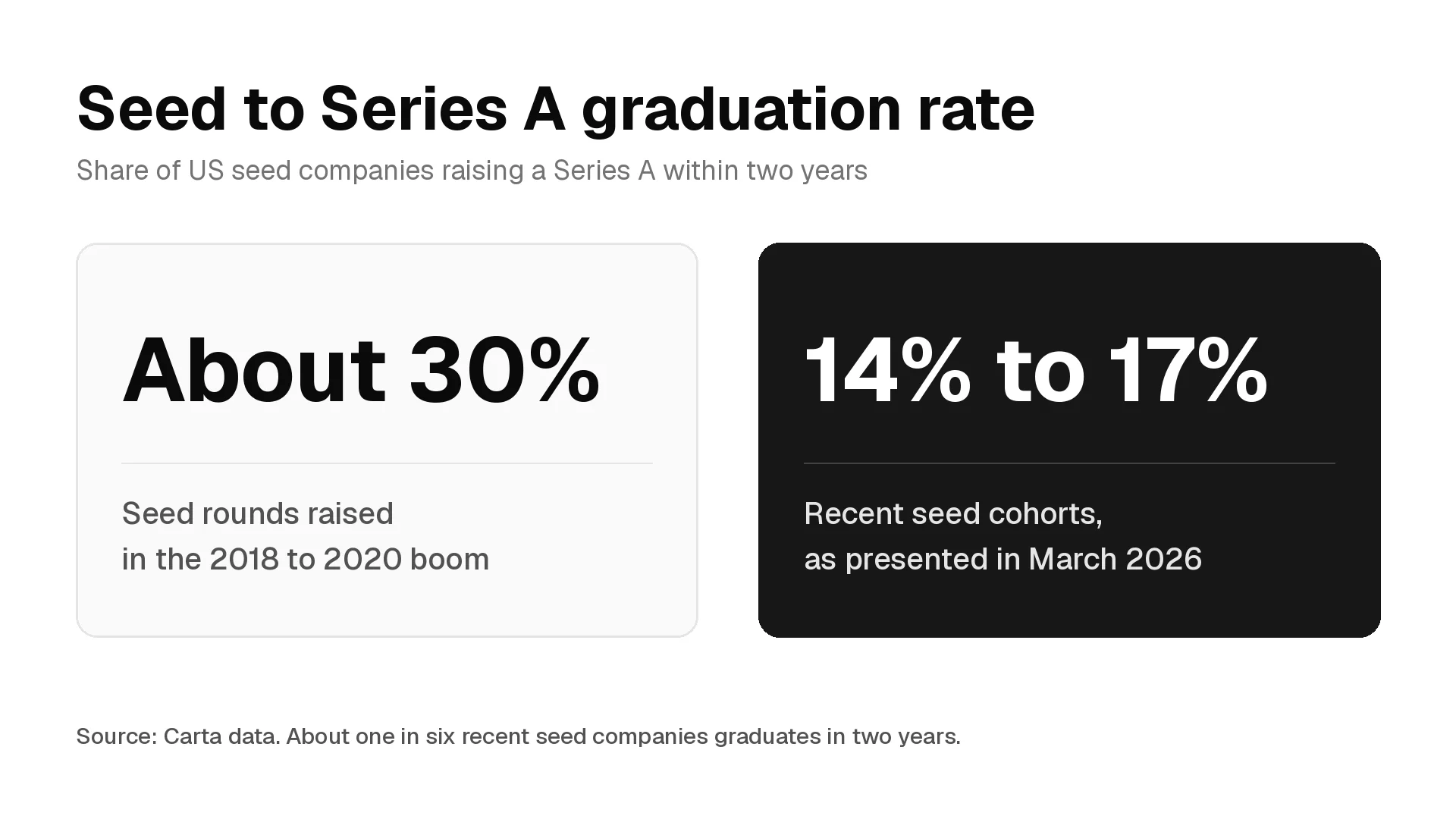
Seed to Series A graduation rates by cohort from Carta and Crunchbase, how long the jump takes, why rates fell after 2021, why published figures disagree, and how seed and Series A firms use the rate for reserves, LP reporting, portfolio reviews and interviews.