
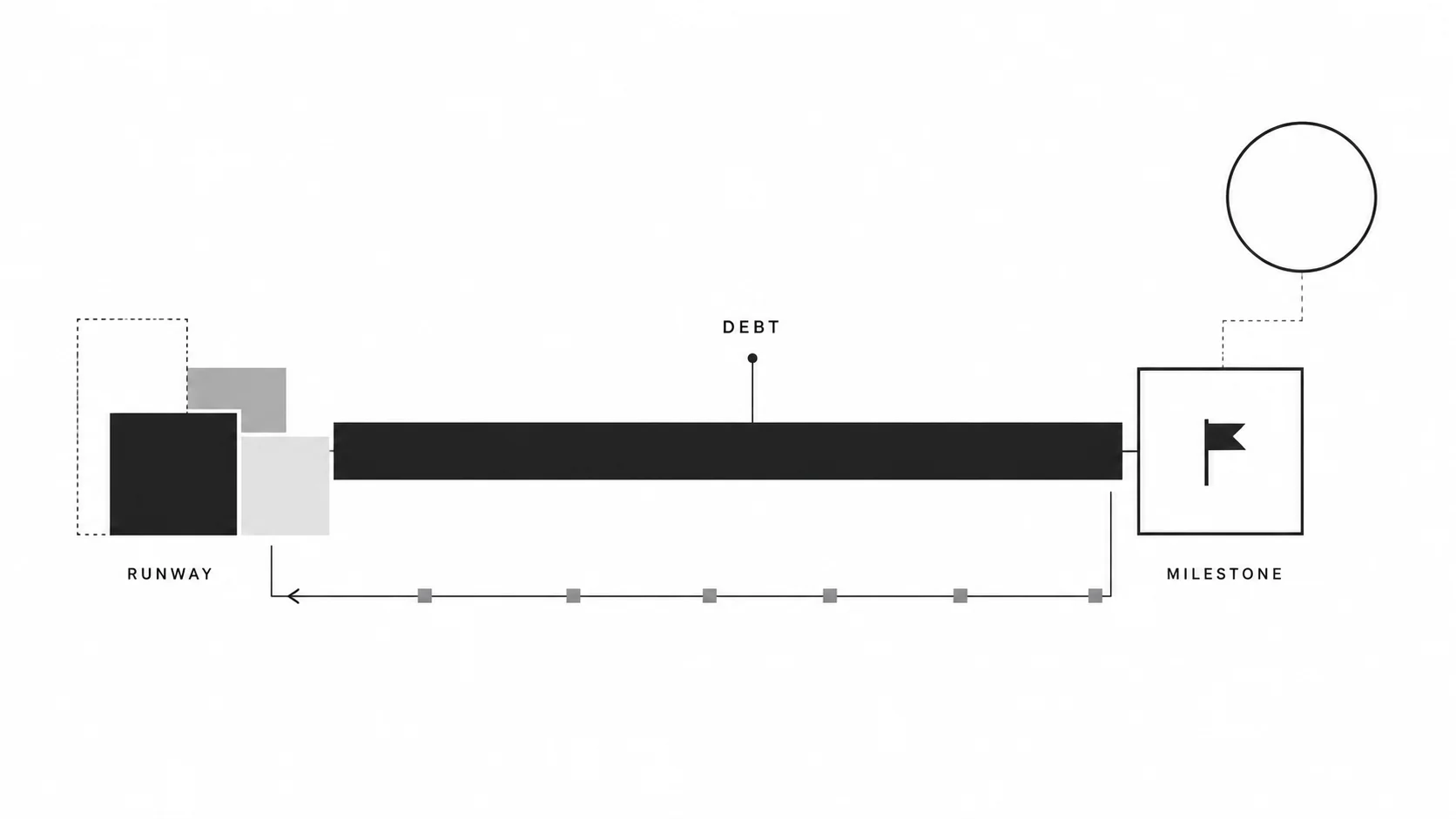
Venture debt is a loan for venture-backed, high-growth companies that may not yet have the profits or hard assets a conventional bank expects. It usually complements a recent equity round rather than replacing one. The company receives cash now, pays interest, repays principal on a schedule, and may grant warrants that let the lender buy equity later.
The trade is less immediate dilution in exchange for fixed cash obligations, lender rights and possible future warrant dilution. Venture debt works when it finances a defined milestone and the company has a credible source of repayment. It becomes dangerous when it merely postpones an equity raise without fixing the underlying financing need.
Venture debt in one minute
The basic flow is:
- A company raises equity or demonstrates credible investor support.
- It agrees a facility with a specialist bank or non-bank venture lender.
- It draws all or part of the commitment during a defined window.
- It pays interest, often before principal amortization begins.
- It reports financial and operating information and complies with covenants.
- It repays from cash generation, a later financing, an exit, or another documented source.
- If the repayment plan fails, the documents determine whether the lender stops further draws, increases pricing, accelerates the loan, restructures, or enforces security.
| Venture debt is | Venture debt is not |
|---|---|
| Contractual debt with a maturity date | Equity that can wait indefinitely for an exit |
| Usually part of a broader venture financing plan | A substitute for product-market fit or workable unit economics |
| Potentially less dilutive than issuing the same amount of equity today | Necessarily dilution-free once warrants are included |
| Flexible when terms and cash flows align | Flexible by default regardless of the loan documents |
The useful question is not “How much can we borrow?” It is “What credible event repays this debt if the operating plan is late?”
How venture debt financing works
Venture debt is negotiated, so the documents—not a market stereotype—control the economics. Most facilities can still be understood through four connected parts.
Facility and draw period
The facility is the maximum amount the lender commits, subject to the agreement. The company may receive it at closing or draw it in tranches. Later tranches can depend on dates, revenue, another equity close, product milestones, minimum liquidity, or lender approval.
An undrawn commitment is not the same as cash. A plan that assumes every tranche will be available should identify each condition and the date it expires. The most valuable tranche is often the one the company can still draw when the plan is under pressure.
Interest-only period and amortization
During an interest-only period, the borrower pays interest but does not reduce principal. When that period ends, scheduled principal payments begin, usually increasing monthly cash outflow sharply. Some structures use a balloon payment at maturity. Others amortize principal over the remaining term.
J.P. Morgan’s overview distinguishes amortized schedules from interest-only structures followed by a final bullet payment. Whichever structure appears in a term sheet, model the actual dates and payments rather than relying on the label.
Security, warrants and covenants
The lender may take a security interest in company assets. The collateral package, exclusions, permitted liens and treatment of intellectual property matter because they shape the lender’s remedies and the company’s ability to raise more debt.
Warrants are a separate equity-linked cost: they give the lender a right to purchase shares under defined terms. Covenants govern what the company must do or avoid doing. They can cover reporting, minimum liquidity, revenue, additional debt, acquisitions, asset sales, dividends and other decisions.
Repayment, refinancing and maturity
Principal must ultimately be repaid. Silicon Valley Bank’s venture-debt explanation frames access to future capital as an important source of repayment for many venture-backed borrowers. That makes timing central: the company needs enough liquidity and progress to reach the next financing or another repayment event before the loan becomes a constraint.
Refinancing is a possible outcome, not a repayment strategy by itself. A lender evaluating a refinance will see the company’s actual performance, remaining runway, existing liens and upcoming maturity. If the original thesis has weakened, replacement capital may be smaller, more expensive or unavailable.
Who qualifies—and what lenders actually underwrite
Venture backing can validate a company, but it does not guarantee approval. A lender is underwriting the probability of full repayment, not simply the quality of the pitch deck.
Common inputs include:
- Investor support: who invested, whether existing investors have reserves, and how they are likely to respond if the company needs more capital.
- Liquidity and burn: current cash, restricted cash, monthly burn, debt service and the date the company approaches a minimum-cash threshold.
- Operating evidence: revenue quality, customer concentration, gross margin, retention, bookings or technical milestones, depending on the business.
- Milestone credibility: whether the debt funds a specific achievement that improves financing or repayment options.
- Capital plan: timing and size of the next equity round, likely investor appetite and what happens if it slips.
- Collateral and priority: assets, existing liens, intercreditor issues and the lender’s position relative to other creditors.
- Reporting quality: whether management can produce timely, reliable financial information and forecasts.
The source of repayment should be explicit. A practical hierarchy is:
- Contracted or highly visible operating cash flow. Strongest when timing and amount can cover scheduled payments with headroom.
- Asset or receivables conversion. Useful when the facility is tied to equipment, inventory or collectible invoices.
- A planned equity financing. Credible only when milestones, timing, investor support and downside alternatives are documented.
- An acquisition or other liquidity event. Too uncertain to carry the case alone unless the process and backup plan are real.
- Refinancing the debt. Weakest when it is merely an assumption that another lender will appear.
Size the facility backward from the conservative repayment case. If a company can service $1.5 million safely but a lender offers $3 million, the offer does not create repayment capacity. It only creates the option to assume more risk.
A company can be unable to draw, breach a covenant, or lose fundraising flexibility while it still has cash in the bank. That is why downside liquidity—not just base-case runway—belongs in the underwriting model.
What venture debt really costs
The headline interest rate is only one component. The European Investment Bank describes venture-debt pricing as a combination that can include regular interest, deferred interest, fees and equity participation. A borrower should model five cost buckets.
| Cost bucket | What to capture | Why it matters |
|---|---|---|
| Cash interest | Benchmark, spread or fixed rate; payment dates; default interest | Directly reduces runway every month or quarter |
| Fees | Upfront, commitment, unused-line, legal, monitoring, amendment, prepayment and end-of-term fees | Can materially change effective cash cost |
| Warrants | Coverage, exercise price, share class, term, adjustments and exercise mechanics | Creates potential future dilution and cap-table complexity |
| Constraints | Minimum cash, revenue tests, reporting, lender consent and restricted actions | Can reduce operating and financing flexibility before default |
| Downside financing cost | Waiver, amendment, restructuring, refinance and default scenarios | The facility is often most expensive when the plan is weakest |
Compare offers in one scenario model. Use the same draw dates, operating plan, equity valuation assumptions and exit cases for every lender. A lower rate can lose to higher fees, earlier amortization, more warrants, tighter covenants or a shorter draw window.
Worked example: a $3 million facility
Assume a company has:
- $10 million of cash before the debt draw;
- $800,000 of monthly operating burn before debt service;
- a $3 million term loan drawn immediately;
- an illustrative fixed annual interest rate of 10%;
- 12 months of interest-only payments; and
- 24 months of principal-and-interest amortization after that.
The 10% rate is a hypothetical modeling input, not a claim about current market pricing. Fees, warrants, taxes, changing burn, tranche conditions and covenant effects are excluded from the payment calculation.
Step 1: calculate the interest-only payment
Monthly interest is:
`$3,000,000 × 10% ÷ 12 = $25,000`
For the first 12 months, operating burn plus debt service is $825,000 per month. Starting with $13 million after the draw, the company has about $3.1 million left after month 12.
Step 2: calculate the amortizing payment
Amortizing $3 million over the next 24 months at the same illustrative rate produces a monthly principal-and-interest payment of approximately $138,435. Monthly cash use becomes roughly $938,435 if operating burn does not change.
The company can fund 15 full months and part of month 16 under these simplified assumptions. By contrast:
- cash before debt suggests 12.5 months of runway;
- adding $3 million and ignoring debt service suggests 16.25 months; but
- including scheduled debt service produces about 15.3 months.
The facility adds roughly 2.8 months over the no-debt case—not the 3.75 months implied by simply dividing the loan by burn.
Step 3: stress the financing date
If management plans to raise equity in month 12, the base case appears workable. If the round slips to month 16, the company approaches the market with little cash, scheduled amortization and less negotiating leverage. A minimum-liquidity covenant could create pressure even earlier.
The decision should therefore be tested against at least three cases:
| Case | Equity or repayment event | Question |
|---|---|---|
| Base | On the planned date | Does the milestone justify the financing and leave adequate cash? |
| Delay | Three to six months late | Can the company pay debt service and stay above covenant thresholds? |
| Downside | Lower growth plus delayed capital | Is there a credible cost reduction, waiver, insider financing or asset plan? |
The same model should separately estimate warrant dilution. If the company compares debt with issuing $3 million of equity, it should compare the lender’s full economic package with the ownership sold—not assume that debt has zero equity cost.
When venture debt is a good fit—and when it is not
Venture debt works best when it funds a specific milestone and the company has more than one plausible way to repay. It is most dangerous when it turns a financing problem into a later financing emergency.
| Decision | Signals | Practical response |
|---|---|---|
| Accept | Specific use; credible repayment event; downside headroom; supportive investors; manageable covenants; payment schedule fits cash flow | Confirm the model, documents, board approval and monitoring owner |
| Renegotiate | Good use of proceeds but short draw window, early amortization, narrow covenant cushion, expensive warrants or restrictive consent rights | Trade facility size or price for time, flexibility, cure rights or lower equity cost |
| Decline | Debt funds recurring losses with no milestone; repayment depends entirely on an uncertain round; downside case breaches liquidity; documents constrain necessary financing or operations | Raise equity, cut burn, stage spending, or use financing tied more closely to the asset or revenue |
Good uses of venture debt
- Extending runway after an equity round to reach a measurable product, revenue or regulatory milestone.
- Financing equipment, inventory or working-capital timing when the asset or cash conversion supports repayment.
- Bridging to a financing grounded in investor engagement and achievable milestones.
- Funding an acquisition when integration costs, cash flows and downside liquidity are modeled.
- Creating a modest liquidity buffer when the company can service the debt without relying on that buffer.
Weak uses of venture debt
- Paying ordinary expenses while the business model remains unresolved.
- Avoiding an equity valuation conversation when the company actually needs permanent risk capital.
- Borrowing the maximum available because it appears cheaper than dilution.
- Funding a plan that works only if every growth and financing assumption lands on time.
- Using a covenant-heavy facility when strategic flexibility is the company’s main asset.
Debt can be sensible even when the company is not profitable. The dividing line is not profitability alone; it is whether the company has a credible repayment path, adequate time and room for error.
Venture debt versus other financing
Different instruments solve different problems. Treating them as interchangeable hides the source of risk.
| Financing | Repayment | Dilution | Typical underwriting focus | Best suited to | Main failure mode |
|---|---|---|---|---|---|
| Venture debt | Contractual interest and principal | Usually limited immediate dilution; warrants may dilute later | Venture backing, liquidity, growth, milestones and future capital access | Milestone or runway financing for venture-backed growth companies | Cash pressure, covenant breach or refinancing risk |
| New equity | No scheduled repayment | Immediate ownership dilution | Team, market, traction, return potential and terms | Long-duration risk and uncertain payback | Down round, control trade-offs or excessive dilution |
| Traditional bank loan | Contractual interest and principal | Usually none | Cash flow, profitability, collateral and credit history | Predictable businesses or asset-backed needs | Inability to meet payments or collateral requirements |
| Convertible note or SAFE | Instrument-specific; often designed to convert into equity | Deferred and uncertain until conversion | Investor appetite and future financing terms | Early-stage bridge to an equity round | Unexpected conversion economics or cap-table complexity |
| Revenue-based financing | Payments linked partly to revenue under the contract | Often none, though terms vary | Recurring revenue quality and collection history | Businesses with predictable revenue | High effective cost or cash drag during growth |
| Equipment or receivables finance | Paid from scheduled cash flow or asset conversion | Usually none | Asset value, invoices and obligor quality | A defined asset or working-capital need | Borrowing-base decline or asset/customer concentration |
For deeper mechanics, see VCC’s explanations of convertible notes, SAFEs versus convertible notes, cap tables and down rounds.
Banks versus venture debt funds
Both banks and non-bank funds can provide venture debt. The useful comparison is the actual offer and relationship, not a blanket assumption about the category.
| Dimension | Specialist bank | Non-bank venture debt fund |
|---|---|---|
| Funding model | Often lends from a bank balance sheet and may pair credit with treasury or banking services | Typically invests a dedicated private-credit or fund vehicle |
| Underwriting | May combine venture criteria with bank risk, deposit and regulatory considerations | May have a wider mandate for bespoke or higher-risk structures |
| Facility design | Can include term debt, revolvers and banking products | Can offer tailored tranches, larger risk positions or negotiated structures |
| Economics | May price differently because funding sources and relationship economics differ | May seek more return through rate, fees, warrants or structure |
| Covenants and flexibility | Varies by lender, company and facility | Varies by fund mandate, return target and downside view |
| Relationship question | What happens if bank strategy, deposit relationship or risk appetite changes? | What happens if portfolio policy, fund term or concentration limits change? |
Ask both categories the same questions: Who controls amendments? What happened in recent borrower restructurings? Can the lender fund every committed tranche? How does it behave when a milestone is missed but the company remains viable? Which terms are policy, and which can be negotiated?
Venture debt term-sheet checklist
A term sheet is not the final loan agreement, but it sets the commercial perimeter. Model each line before comparing offers.
| Area | Terms to inspect | Board-ready question |
|---|---|---|
| Facility | Commitment, tranches, draw conditions, draw expiry, use restrictions | How much is unconditionally available, and for how long? |
| Interest | Fixed or floating basis, benchmark floor, cash/PIK split, default rate | What is cash interest in every month of the downside case? |
| Repayment | Interest-only period, amortization, balloon, maturity | When does monthly debt service step up? |
| Fees | Upfront, commitment, unused, legal, monitoring, amendment, prepayment, end-of-term | What cash leaves the company even if it draws less or repays early? |
| Warrants | Coverage, exercise price, share class, term, adjustments, exercise method | What dilution appears under base and high-exit values? |
| Security | Assets covered, IP treatment, permitted liens, subordination | What future financing or strategic action could the lien block? |
| Covenants | Minimum cash, revenue, recurring revenue, additional debt, acquisitions, asset sales, dividends | How much cushion exists in the delayed-round case? |
| Reporting | Frequency, budgets, compliance certificates, board materials, notice duties | Can the finance team produce this accurately and on time? |
| Default and cure | Events, grace periods, materiality, cross-default, MAC language, remedies | What can trigger default without a missed payment, and can it be cured? |
| Exit and future capital | Prepayment, change of control, lender consent, intercreditor terms | Does the facility complicate the next round, acquisition or exit? |
Use VCC’s term-sheet overview for the broader financing context. Then have experienced counsel review the actual term sheet, loan agreement, security documents and warrant. A checklist can expose questions; it cannot resolve deal-specific legal consequences.
Model before signing
- Monthly cash balance through maturity, not only through the next round.
- Base, delayed and downside operating cases.
- Every fee on its contractual date.
- Floating-rate sensitivity where applicable.
- Warrant dilution at multiple share prices and exits.
- Covenant headroom and the month each threshold is tightest.
- Early repayment, amendment and refinancing costs.
- The effect on later equity, additional debt, an acquisition and a sale.
What happens when the plan slips
A missed internal milestone is not automatically a loan default. The agreement defines the trigger. But deterioration can produce consequences before a payment is missed.
- The forecast weakens. Management updates runway, covenant and financing scenarios.
- A draw becomes unavailable. Conditions for a future tranche may no longer be satisfied.
- A covenant is approached or breached. The company may seek a waiver or amendment, often with new economics or controls.
- An event of default occurs. Depending on the documents, default interest, draw suspension, acceleration or other remedies may become available.
- The capital structure is renegotiated. Existing investors, new investors and the lender may debate fresh equity, subordination, maturity extension, asset sales or a restructuring.
- The lender enforces rights. Outcomes depend on the security, jurisdiction, creditor priority and facts.
Debt generally sits ahead of equity in the capital structure. That priority matters in a sale or failure because proceeds may repay secured creditors before reaching preferred or common shareholders. VCC’s liquidation-preference explainer covers the separate ordering among equity claims.
Talk to the lender early when the model changes. A company with time, reliable reporting and investor alignment has more options than one that discloses a problem at the covenant deadline.
What founders, boards, investors and candidates should know
Venture debt is a cross-functional decision. The model fails when everyone assumes somebody else owns the downside.
| Participant | Core responsibility |
|---|---|
| Founder or CEO | Define the use, milestone, strategic alternatives and lender relationship |
| CFO or finance lead | Build cash, payment, covenant, warrant and downside models; manage reporting |
| Board and existing investors | Test the capital plan, investor support, conflicts, repayment path and failure case |
| Counsel | Review authority, loan, security, warrant, covenant, default and intercreditor terms |
| Lender | Underwrite, fund committed amounts under the documents, monitor and administer the facility |
For venture investors and candidates, debt fluency changes how a company is evaluated. A new facility affects runway, follow-on needs, cap-table outcomes, negotiating leverage and exit distributions. Understanding those links is useful in diligence, portfolio work and investment-committee discussions—not only in credit roles.
Readers exploring that work can review how venture capital works, research firms in the VCC companies directory, or browse open venture capital roles.
Frequently asked questions
Is venture debt non-dilutive?
It can avoid issuing a large block of equity at closing, but “non-dilutive” is incomplete when the loan includes warrants. Model both immediate ownership preserved and potential future warrant dilution.
What is a typical venture debt interest rate?
There is no reliable universal rate. Pricing varies with the benchmark, lender, company risk, stage, facility structure, fees, warrants, security and market conditions. Compare live term sheets on an all-in basis instead of relying on a published range.
How much venture debt can a startup raise?
The offered amount depends on the lender and the company. The safer amount is the principal the company can service under a conservative case while maintaining covenant headroom and a credible source of repayment.
Can a pre-revenue startup qualify?
Sometimes, particularly with strong institutional backing, liquidity and milestone evidence. Qualification does not mean the debt is appropriate: a pre-revenue company may have less internal cash flow available for repayment and greater dependence on future equity.
Are venture debt loans secured?
Many are secured, but the collateral package varies. Review exactly which assets are covered, how intellectual property is treated, what liens are permitted and how the security affects later financing.
What happens if a startup cannot repay?
The outcome depends on the documents and facts. The lender may stop additional draws, charge default interest, require a waiver or amendment, accelerate repayment, negotiate a restructuring or enforce security. Early communication and credible reporting can preserve more options.
Is venture debt the same as a convertible note?
No. Venture debt is generally intended to remain debt and be repaid, even when paired with a warrant. A convertible note is designed to convert into equity under specified terms, commonly around a future financing.
The decision rule
Use venture debt when it finances a defined milestone, the payment schedule fits a conservative cash plan, and the company retains options if timing slips. Renegotiate when the use is sound but the documents remove too much time or flexibility. Decline when repayment depends on optimism rather than a credible source.
Related posts
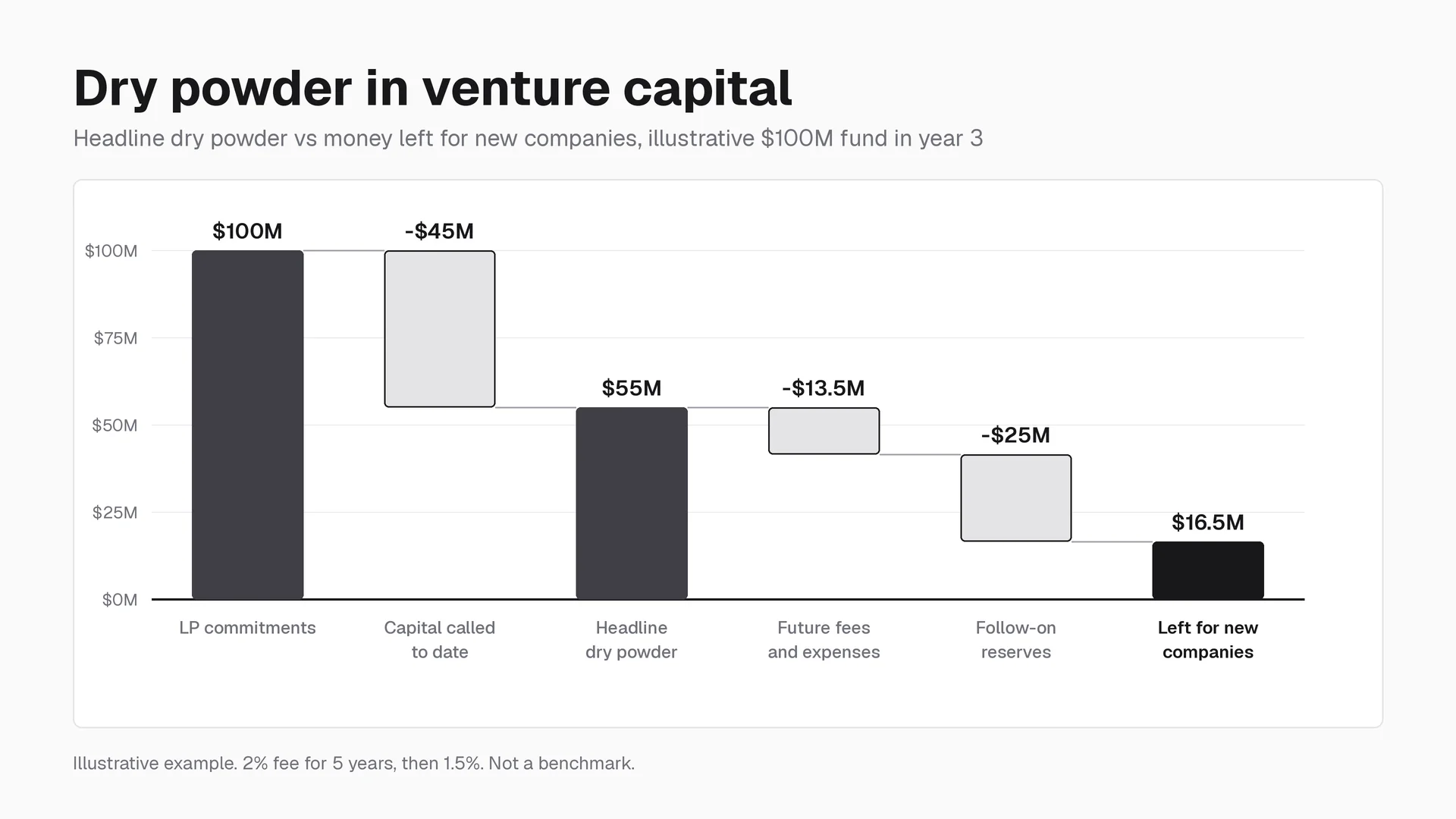
Dry powder in venture capital explained: the formula, a worked $100M fund example showing how little headline dry powder is left for new companies, current US and global data, and what a firm's dry powder tells you about hiring and the junior job.
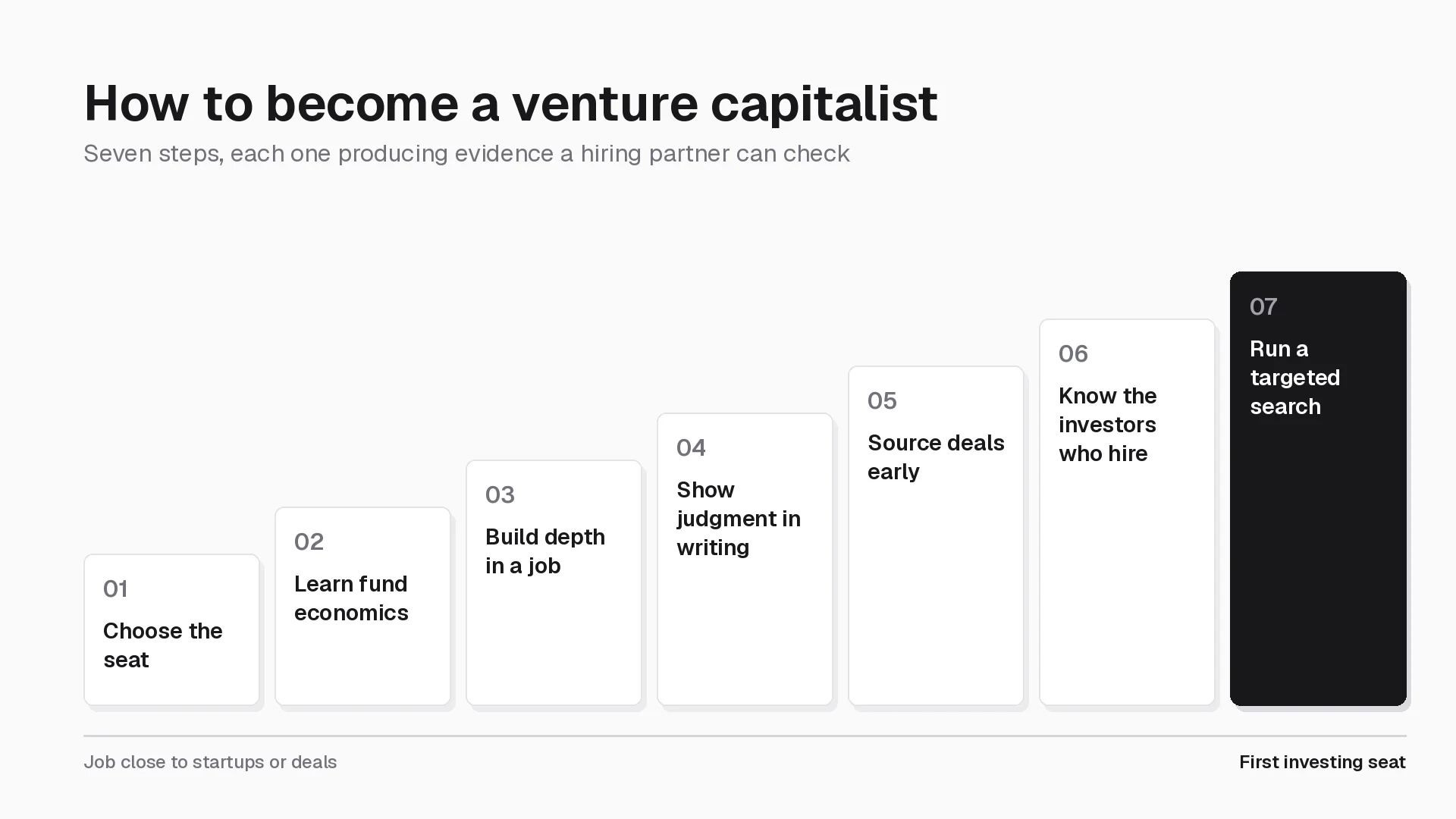
How to become a venture capitalist in seven steps: choose the seat, build depth, prove judgment in writing, source early, and run a targeted search. Includes entry paths by background, how fund size limits hiring, MBA placement data, and licensing.
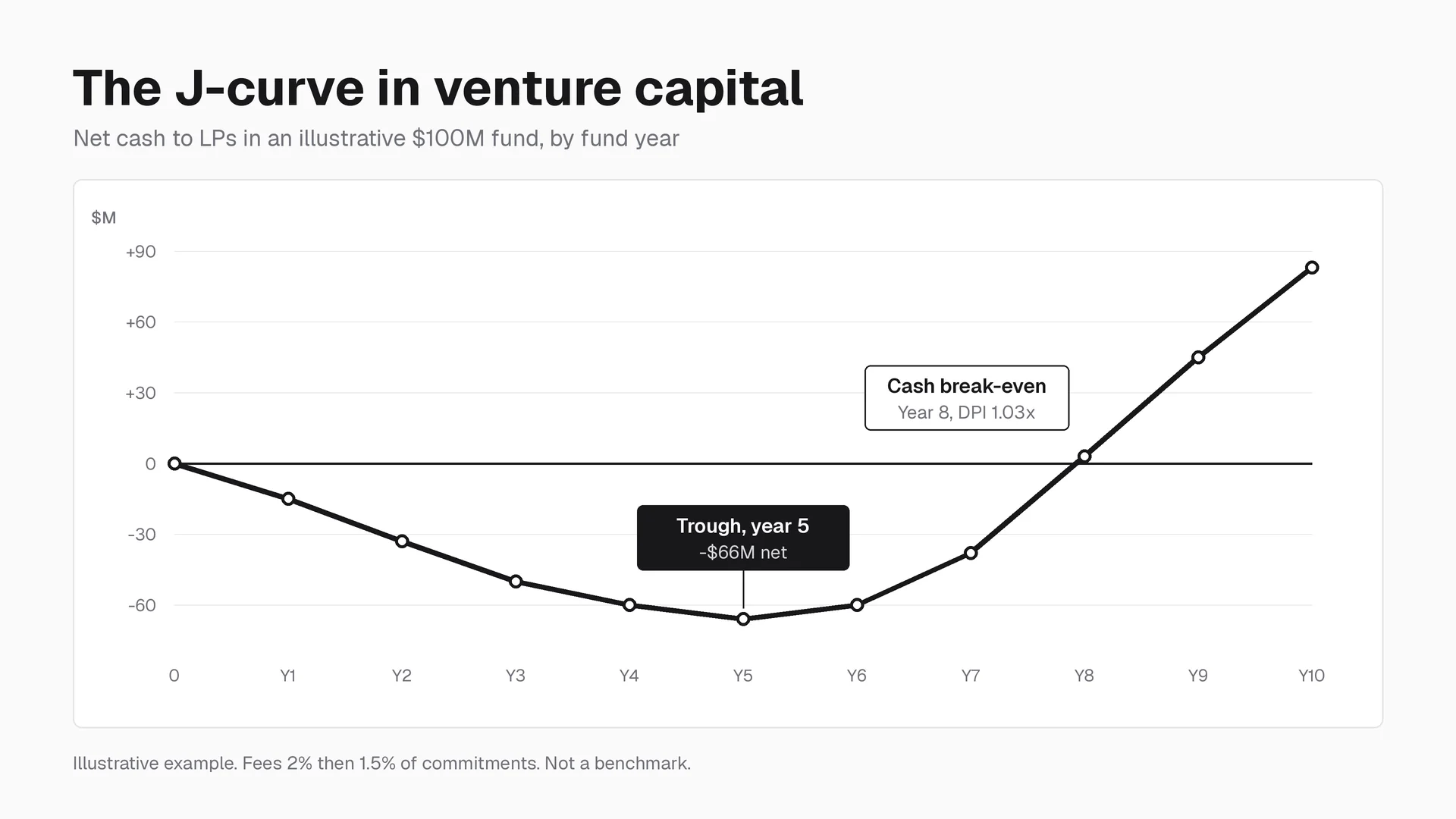
The J-curve in venture capital explained with a worked $100M fund example, current vintage data on DPI and IRR, a check for telling a normal trough from a weak fund, and what the curve means for VC carry, offers, and interviews.