
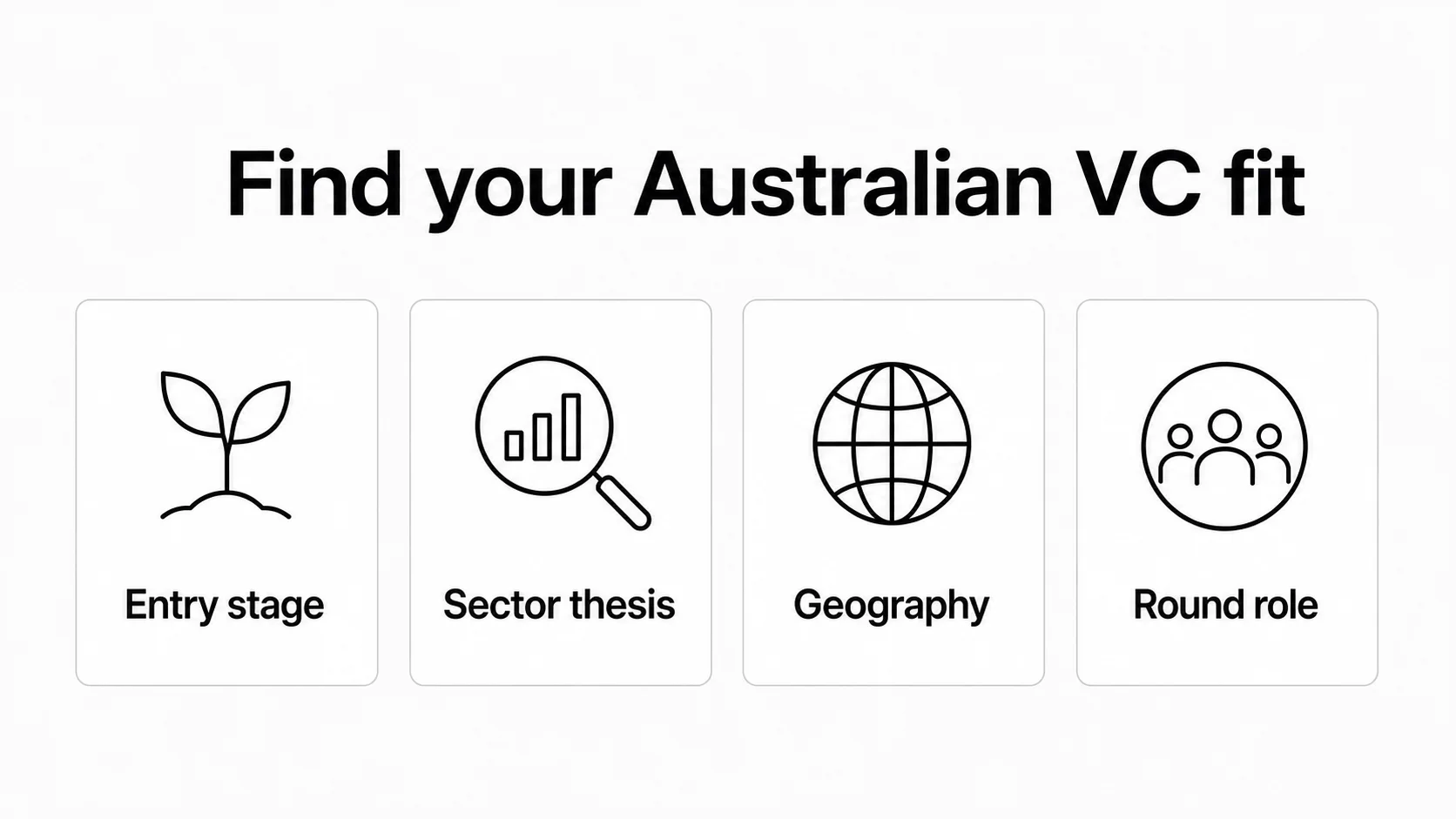
Australia's venture market includes first-cheque funds, multi-stage technology investors, specialist deep-tech and climate funds, life-science platforms, and later-stage software investors. Most firms cluster around Sydney and Melbourne, but their mandates often cover Australia and New Zealand, the wider Asia-Pacific region, or selected global markets.
The useful question is not which list is longest. It is which firms fit your entry stage, sector, geography, and round role. The 18 investors below had a live official site and a clear Australian or ANZ venture mandate when checked in July 2026. Founders can use the Venture Capital Careers companies directory for further firm research; candidates can browse the VC-specific job board.
Australian VC firms at a glance
Start with the closest use case:
- Inception or first institutional cheque: Antler Australia, Archangel Ventures, Flying Fox Ventures, or Investible.
- Seed and multi-stage ANZ technology: Blackbird, AirTree, Square Peg, Folklore, Carthona, Tidal, or OIF Ventures.
- Series A and scaling software: EVP or Five V Capital.
- Deep tech and climate: Main Sequence or Virescent Ventures.
- Life sciences and research commercialisation: Brandon Capital, OneVentures, or Uniseed.
Stage labels are not interchangeable. A pre-seed round may fund validation and the first team; seed funding usually expects stronger product and market evidence; a Series A round normally asks whether a repeatable growth engine is emerging.
| Firm | Best fit | Entry stage | Focus | Geography |
|---|---|---|---|---|
| Antler Australia | Founders at inception who value a structured residency and co-founder network | Inception / pre-seed | Technology, generalist | Australia with global Antler network |
| Archangel Ventures | Australian teams seeking a first institutional cheque | Pre-seed | Technology, generalist | Australia |
| Flying Fox Ventures | Very early ANZ companies that want operator-led support | Pre-seed / seed | Technology, generalist | Australia and New Zealand |
| Investible | Early companies that fit either a generalist or climate vehicle | Pre-seed to Series A | Technology; dedicated climate strategy | Asia-Pacific with an Australian base |
| Blackbird | Ambitious ANZ technology founders seeking a long-term, multi-stage partner | From the beginning; follow-on across stages | Technology, broad | Australia and New Zealand |
| AirTree | ANZ technology companies from early formation through growth | Seed and growth strategies | Technology, broad | Australia and New Zealand |
| Square Peg | APAC founders in software-heavy categories who want repeat backing | Early stage, commonly seed / Series A | AI, fintech, SaaS | Australia/New Zealand and wider APAC |
| Folklore | Australian or New Zealand tech teams seeking a first-cheque-to-long-term partner | Early stage | Technology, broad | Australia and New Zealand |
| Carthona Capital | Founders wanting a thematic, hands-on investor that can follow on | Pre-seed, seed, Series A | Technology, thematic | Australia with selective global investing |
| Tidal | Product-led software and AI teams changing how work gets done | Pre-seed / seed | AI, B2B software, systems of work | Australia and selected US opportunities |
| OIF Ventures | Technology companies with product or early commercial validation | Seed, pre-Series A, Series A; later-stage vehicle also available | Technology, sector-agnostic | Australia with US network |
| EVP | AI-first software businesses at an inflection point | Series A | B2B software, AI | Australia / New Zealand |
| Five V Capital | B2B software companies with product-market fit and scale readiness | Series A / Series B | B2B software | Australia and New Zealand |
| Main Sequence | Scientists and engineers commercialising defensible deep technology | Early stage / company creation | Space, climate, intelligence, food, health, industrial productivity | Australia with global ambition |
| Virescent Ventures | Climate companies with measurable emissions and commercial impact | Pre-seed to late-stage growth | Energy, mobility, food/agriculture, circular economy, industry | Australia |
| Brandon Capital | Life-science companies moving from proof of concept toward commercialisation | Seed through expansion | Biotech, therapeutics, medical innovation | Australia, New Zealand, and international syndicates |
| OneVentures | Scaling technology or healthcare companies needing equity or growth credit | Growth / later venture | Technology, healthcare, life sciences, credit | Australia |
| Uniseed | Researchers commercialising eligible university or research-organisation IP | Seed / commercialisation | Deep tech, life sciences, broad research innovation | Partner research organisations in Australia |
This is a fit map, not a ranking by fund size, deal count, or reputation. “Active” means the official site showed a current strategy and/or recent investment evidence when checked. It does not guarantee that a fund is accepting every pitch, and a portfolio company's later round does not prove that the fund enters at that stage.
Pre-seed and first-cheque investors
Antler Australia
Antler Australia backs founders at inception through an eight-week residency designed around company formation, co-founder matching, validation, and access to pre-seed investment. It describes itself as an inception-stage VC rather than a conventional accelerator.
Best fit: a founder at day zero who wants a structured environment and is comfortable building inside a cohort. A formed team with a live product and a tightly timed institutional round may prefer a fund that evaluates the company directly rather than through a residency.
Archangel Ventures
Archangel Ventures is explicit about being a first-cheque pre-seed investor. It backs Australian founders early and pairs capital with operator experience and a long-term relationship.
Best fit: a strong team with a venture-scale thesis that is still too early for conventional seed metrics. The first-cheque label does not remove the need to show founder-market fit, insight, and a credible path to a large outcome.
Flying Fox Ventures
Flying Fox Ventures invests predominantly at pre-seed and seed in Australian and New Zealand companies. The platform combines early capital with an investor community and practical operating support.
Best fit: an ANZ founder who values a broad network and active help around the earliest company-building decisions. Founders should confirm whether the current vehicle can lead the round, participate alongside others, and reserve enough for follow-on.
Investible
Investible invests from pre-seed to Series A through a generalist early-stage strategy and a dedicated climate-tech strategy. Its fund-and-syndicate model can bring both institutional capital and members of Club Investible into a deal.
Best fit: a technology founder who wants early institutional support and can explain which Investible vehicle fits. Climate founders should show a real climate thesis rather than treating the specialist fund as a generic sustainability label.
These four models solve different problems. Antler starts with company formation; Archangel emphasizes first conviction; Flying Fox combines capital and an investor community; Investible spans a broader APAC fund-and-syndicate platform. The right choice depends on whether you need formation support, a lead investor, a networked participant, or a specialist vehicle.
Seed and multi-stage technology funds
Blackbird
Blackbird invests in companies rather than isolated rounds, starting at the beginning and supporting businesses across later stages. Its portfolio and community are centered on ambitious technology companies with Australia and New Zealand roots.
Best fit: an ANZ founder pursuing a genuinely large technology outcome and looking for a long-duration partner. A small local-market business without a venture-scale path is outside the clearest part of the model.
AirTree
AirTree backs Australian and New Zealand technology founders and operates distinct seed and growth strategies. Its public Open Source VC library and founder/operator network are part of the platform, not only marketing around the capital.
Best fit: an ANZ technology company that wants access to a broad founder and operator network and may benefit from follow-on capacity. Founders should identify whether they fit the current seed or growth entry point rather than citing the range of stages across the portfolio.
Square Peg
Square Peg backs founders across the Asia-Pacific region, with current themes in AI, fintech, and SaaS. Its public portfolio shows early investments in Australia and New Zealand alongside Southeast Asian and Israeli companies, and the firm emphasizes backing a small number of founders early and repeatedly.
Best fit: a software-heavy company with regional or global ambition and strong alignment to one of the current themes. Being based in Australia is not enough if the sector, market size, and founder insight are weak.
Folklore
Folklore is an Australian VC for Australian and New Zealand technology founders. Its “first cheque to forever” positioning signals an early entry point and a willingness to stay involved across the company journey.
Best fit: an ANZ technology team that wants a long-term partner and can show unusual founder vision before every metric is mature. Founders should still ask how the current fund thinks about ownership, lead roles, and reserves.
Carthona Capital
Carthona Capital typically enters at pre-seed, seed, or Series A, invests thematically, and describes a strong follow-on approach. It is also explicit about being hands-on.
Best fit: a founder whose company aligns with a current Carthona theme and who wants active investor involvement. A broad “technology startup” label is not a substitute for understanding the partner's thesis and recent deals.
Tidal
Tidal backs companies early around software, AI, and what it calls the systems of work. Recent investment notes show a continued focus on AI-native workflows and enterprise software.
Best fit: a product-led B2B company with domain insight, early evidence of product value, and a plausible path to become a system of record or system of work. Consumer, biotech, and undifferentiated horizontal tools are less obvious fits.
OIF Ventures
OIF Ventures typically invests at seed, pre-Series A, and Series A through its earlier-stage funds, with a later-stage fund for Series B. It is sector-agnostic within technology but usually looks for a product in market, early product-market fit, or commercial validation.
Best fit: a technology founder who can show customer love and an advantage in a large market. Pre-product investments happen, but OIF describes them as exceptions, so most founders should not pitch the exception as the base case.
These funds overlap by logo wall more than by entry decision. Blackbird, AirTree, Square Peg, and Folklore emphasize long-duration company backing. Carthona adds a more explicit thematic and hands-on posture. Tidal narrows toward software and AI systems of work. OIF is unusually clear about the product and customer evidence it expects.
Series A and scaling software investors
EVP
EVP focuses on AI-first software at the Series A inflection point. It builds concentrated portfolios and looks for category-defining software with defensibility, economic quality, and strong founder-market fit.
Best fit: a software company with commercial evidence and a specific reason AI creates a durable product or business advantage. Adding an AI feature to a weak product is not the same as being an AI-first software business at an inflection point.
Five V Capital
Five V Capital invests in Series A and B software companies that have reached product-market fit and are ready to scale. Its venture strategy focuses on B2B software in Australia and New Zealand and states a typical initial investment of $1 million to $10 million, with capacity for follow-ons.
Best fit: a B2B software company with strong unit economics, customer evidence, and a clear scaling plan. A pre-product team or a company still searching for its first repeatable use case is too early for the clearest part of the mandate.
The key distinction is readiness, not round label alone. A founder can call a financing “Series A” while the business still behaves like seed. EVP and Five V both expect more evidence than a first-cheque fund: product value, market pull, economic quality, and a credible path to scale.
Deep-tech and climate investors
Main Sequence
Main Sequence backs deep-tech founders and helps create companies around six challenge areas: space, decarbonisation, the next intelligence leap, food, healthcare, and industrial productivity. Its relationship with Australia's research ecosystem makes it particularly relevant to scientists and engineers translating technical advantage into a venture.
Best fit: a team with defensible science or engineering, a major technical risk to retire, and a credible path from research to a large market. A conventional SaaS product with little proprietary technology is unlikely to fit simply because it sells to an industrial customer.
Virescent Ventures
Virescent Ventures invests from pre-seed through late-stage growth in companies that can reduce emissions and reshape the physical economy. Its focus spans clean energy, mobility and smart cities, food and agriculture, and the circular economy and industry.
Best fit: a climate company that can connect a material emissions problem to a scalable commercial model. Hardware, software, and business-model innovation can all fit, but the climate mechanism and commercial impact both need to be real.
Deep tech and climate tech overlap, but they are not the same filter. Main Sequence begins with defensible technical breakthroughs and large challenge areas. Virescent begins with emissions impact and commercial ambition across climate systems. A climate software product may fit Virescent without being deep tech; a quantum or space company may fit Main Sequence without being a climate company.
Life-science and research-commercialisation investors
Brandon Capital
Brandon Capital invests in life-science companies from early seed through expansion capital, supporting medical innovation from proof of concept to commercialisation. It often acts as a founding investor and works across Australia, New Zealand, and international syndicates.
Best fit: a biotech, therapeutics, or medical-innovation company with strong science and a milestone-driven development plan. Generic wellness products and lightly regulated health software are not equivalent to a life-science venture case.
OneVentures
OneVentures operates three distinct pillars: growth equity, growth credit, and healthcare. Its current positioning is later-stage and scaling-oriented, with hands-on support for technology and healthcare businesses.
Best fit: a company with material operating evidence that needs scale capital, growth credit, or specialist healthcare investment. Very early founders should identify whether a specific healthcare vehicle can invest at their maturity rather than treating OneVentures as a general seed fund.
Uniseed
Uniseed is a research-commercialisation fund for innovations arising from partner universities and research organisations. At the University of Queensland, the current researcher-led start-up policy gives Uniseed and two other investment groups an equal first look at university IP before outside investment is sought.
Best fit: an eligible researcher or spinout with protectable intellectual property and a route from research to a product or service. Eligibility matters: a startup with no connection to a partner research organisation cannot assume that a strong technical story is enough.
“Healthcare” is too broad to create a shortlist. Brandon is centered on life-science company formation and development. OneVentures serves scaling healthcare and technology companies through distinct capital products. Uniseed starts from eligible research and commercialisation. The same pitch should not be sent to all three.
What does not belong in the main VC list?
A longer list is not automatically a better one. These capital sources may matter, but they solve different problems:
- Growth equity and private equity usually enter after a company has more revenue, a proven model, or a control/secondary component. See growth equity versus venture capital before treating every technology investor as a seed VC.
- Corporate venture capital invests for both financial and strategic reasons. Distribution, technical assets, or a commercial partnership may come with the capital, but strategic alignment also creates constraints. The corporate VC explainer covers the tradeoffs.
- Accelerators and angel syndicates can be valuable at inception, but cohort economics, cheque size, decision process, and follow-on capacity differ from a conventional fund.
- Government grants, loans, and co-investment programs may be non-dilutive or strategically useful, but they are not interchangeable with an equity lead.
- Family offices and listed investment companies can invest flexibly, yet a visible technology portfolio does not prove a repeatable institutional venture mandate.
- Advisers, law firms, and ecosystem organisations support fundraising; they do not become VC firms because they rank for the same search.
This classification is why many names from the old article no longer appear in the main map. The refresh favors a verifiable venture mandate over preserving an arbitrary count.
How to build an Australian investor shortlist
Use four filters in order.
1. Match the entry stage
Start with the fund's stated entry point, not the latest round visible in its portfolio. A fund may support a company through Series C while making new investments only at seed.
2. Match the real sector thesis
Translate your company into the language of the mandate. “AI” can mean AI-native enterprise software, enabling infrastructure, or a defensible research breakthrough. “Health” can mean therapeutics, medtech, clinical workflow software, or research commercialisation. Those are different underwriting models.
3. Match geography and company connection
Check whether the fund requires an Australian company, invests across Australia and New Zealand, covers APAC, or accepts companies elsewhere with an ANZ connection. A Sydney office does not prove an Australia-only mandate, and a global portfolio does not prove your market is in scope.
4. Match the cheque and investor role
Compare the likely initial ticket with the total round and the role you need. A first-cheque investor, a Series A lead, a syndicate participant, and a public co-investor are not substitutes even when all four can appear in a funding database.
Before sending a deck, verify five live signals:
- the current fund or vehicle is still making new investments;
- the official strategy still includes your stage, sector, and geography;
- at least one recent investment supports your interpretation of the thesis;
- a current partner owns the relevant sector or market;
- the site explains a pitch route, residency, warm-introduction preference, or contact method.
Then build three tiers: five high-fit firms, five credible alternatives, and a small group of specialists or co-investors. Sequence outreach so early conversations improve the story before the highest-fit meetings. Use the Venture Capital Careers companies directory to expand organisation and team research, but re-check each firm's official site immediately before contact.
How to use the map for an Australian VC job search
The same matrix works as an employer map if you reverse the question: where does your experience create an investing advantage?
- Choose two or three strategy lanes: ANZ enterprise software, deep tech, climate, or life sciences, instead of targeting every fund in Sydney.
- Read recent investment notes and partner biographies: record the recurring stage, sector, geography, and evidence style.
- Build a target list of 10–15 firms: include adjacent investors where your background fits. A scaling-software fund may suit an experienced operator better than an inception-stage generalist.
- Tailor your proof: banking or consulting experience can support transaction and market work; operating experience can support product and go-to-market judgment; scientific depth matters more for biotech and deep tech.
- Monitor stable company and job-board surfaces: avoid saving individual job URLs that disappear after a role closes.
The venture capital market map workflow shows how to turn firms into a structured research set. For the broader recruiting process, see how to get a job in venture capital, then browse current roles on Venture Capital Careers.
Frequently asked questions
What are the main venture capital firms in Australia?
Major multi-stage technology investors include Blackbird, AirTree, and Square Peg. Other important early-stage funds include Folklore, Carthona, Tidal, OIF Ventures, Investible, Flying Fox, Archangel, and Antler Australia. Specialist platforms include Main Sequence, Virescent, Brandon Capital, OneVentures, and Uniseed. “Main” depends on stage and strategy, so the comparison table is more useful than a universal ranking.
Which Australian VCs invest at pre-seed?
Antler Australia, Archangel Ventures, Flying Fox Ventures, and Investible all describe inception, pre-seed, or very early investment activity. Carthona and some multi-stage funds can also enter early. Check the current vehicle, thesis, geography, and pitch route before outreach.
Which Australian investors focus on deep tech or climate tech?
Main Sequence is the clearest deep-tech specialist in this map, with challenge areas spanning space, climate, intelligence, food, health, and industrial productivity. Virescent Ventures is the clearest climate specialist, investing from pre-seed to growth across energy, mobility, food/agriculture, and the circular economy. Investible also operates a dedicated climate strategy.
Which Australian investors focus on life sciences?
Brandon Capital focuses on life-science company development from seed through expansion. OneVentures has a dedicated healthcare pillar alongside growth equity and credit. Uniseed commercialises eligible research from partner universities and research organisations. The correct investor depends on scientific domain, company maturity, and eligibility.
Are most Australian VC firms in Sydney or Melbourne?
Sydney and Melbourne contain the highest concentration of teams in this map, but the investment geography is wider. Many funds cover both Australia and New Zealand, some invest across APAC, and specialist funds source opportunities nationally. Brisbane, university ecosystems, and state-backed programs also matter, so office location should be a filter rather than the conclusion.
How do I find venture capital jobs in Australia?
Build a target list by strategy, follow current investment and team activity, and monitor a VC-specific job board. Use stable firm and job-board pages rather than bookmarking individual roles, which may disappear after a position closes.
Choose fit over list length
Australia has enough investor variety that a broad search is easy; a defensible shortlist is harder. Start with entry stage, sector thesis, geography, and round role. Then verify the current mandate before you pitch or apply.
Founders can continue in the VCC companies directory. Candidates can browse current openings on the Venture Capital Careers job board.
Related posts
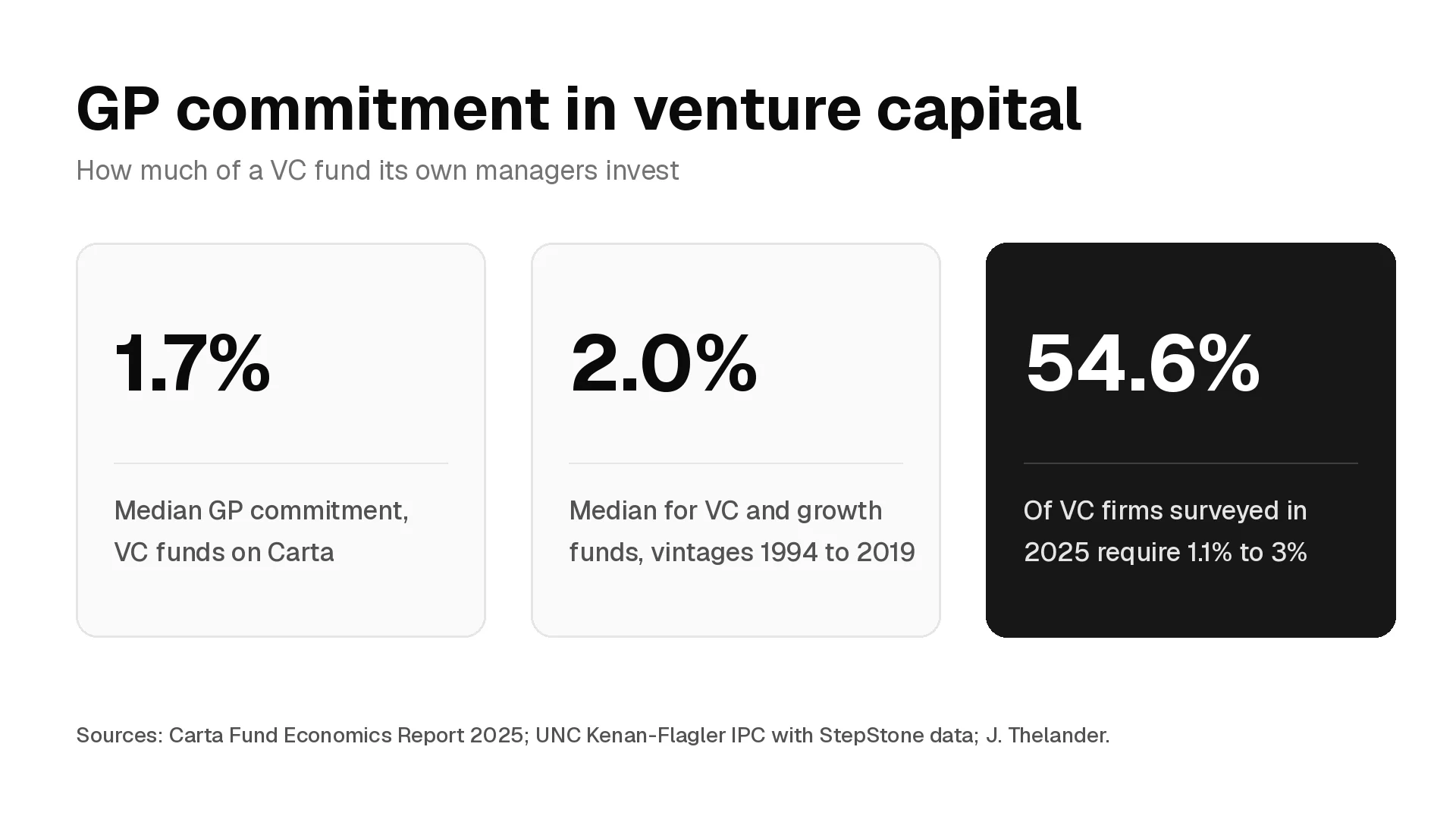
What a GP commitment is, how large it is in venture capital, how GPs fund it, where it sits in the LPA, what the returns evidence says, how firms split it across partners and principals, and what to ask before you accept a role with carry.
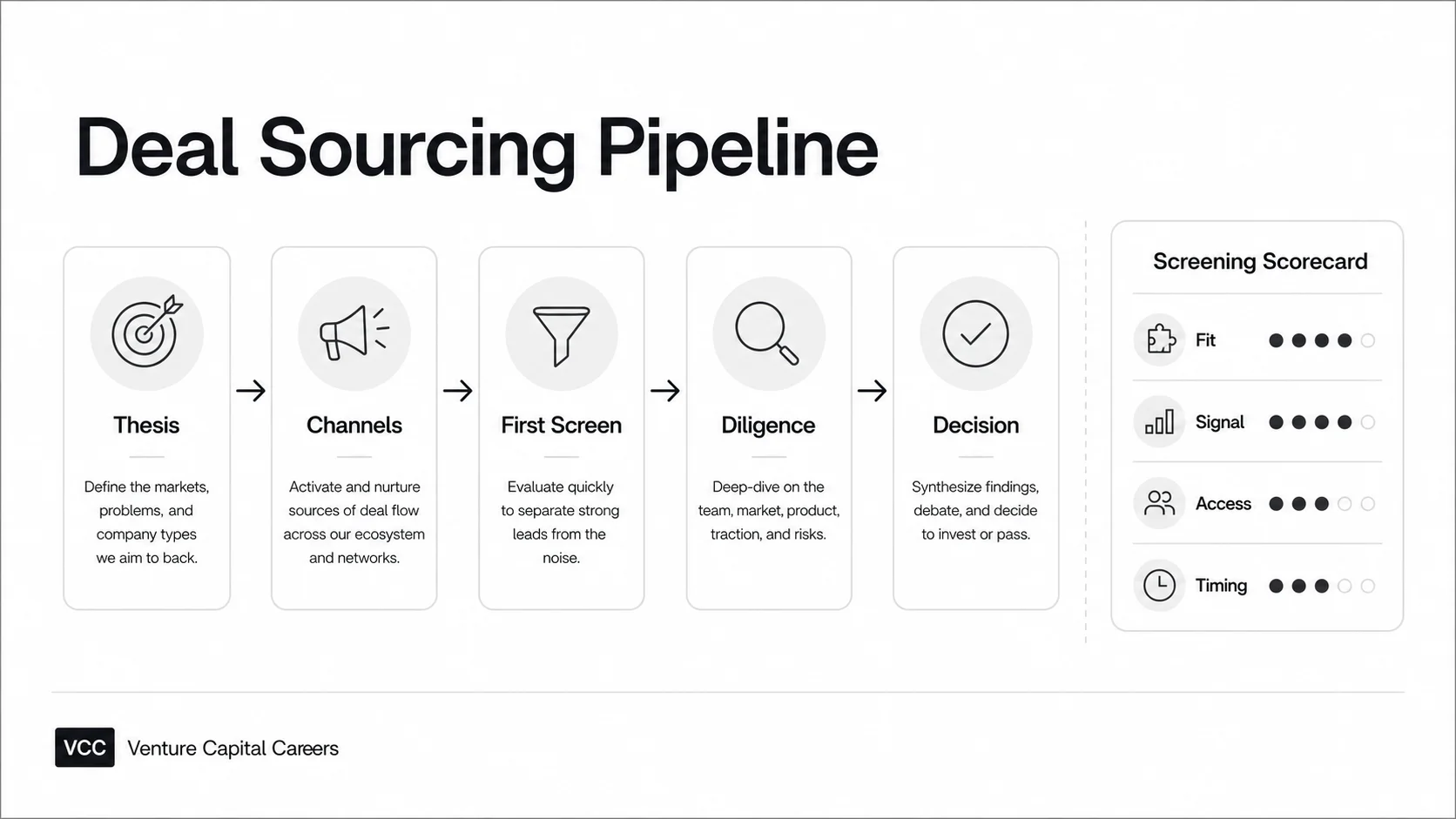
Most closed VC deals start with a relationship. See where deals come from by stage, how to work each sourcing channel, which signals show up early, and how analysts run a weekly sourcing process.
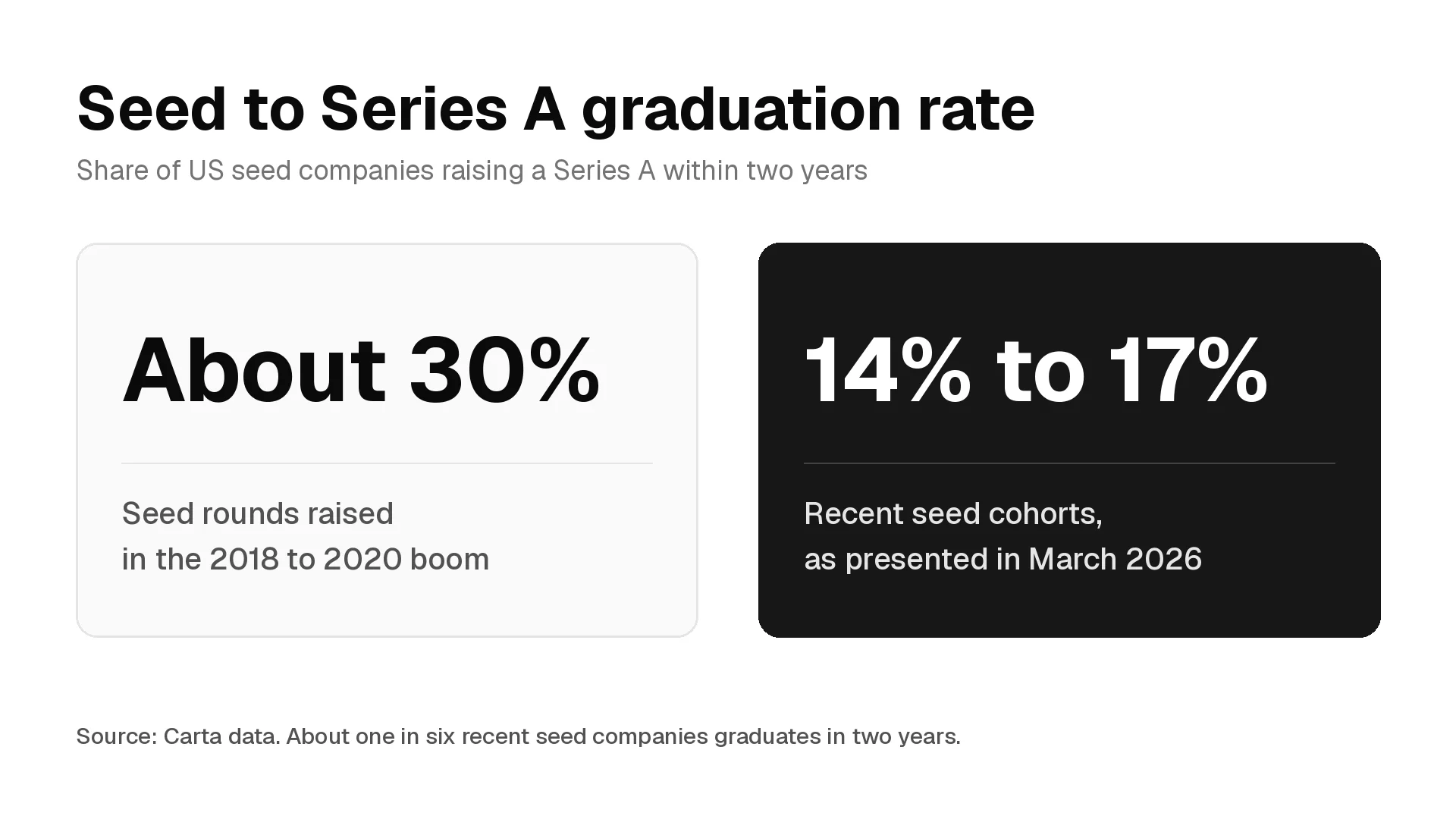
Seed to Series A graduation rates by cohort from Carta and Crunchbase, how long the jump takes, why rates fell after 2021, why published figures disagree, and how seed and Series A firms use the rate for reserves, LP reporting, portfolio reviews and interviews.